How Does the U.S. CPI Report Affect the Nasdaq? Inflation, Interest Rates, and Tech Stocks Explained


Hello, this is MasterMind.
Why can a single inflation report send the Nasdaq sharply higher or lower within minutes?
Every month, investors around the world watch the U.S. Consumer Price Index, or CPI, because even a small surprise relative to Wall Street expectations can move Treasury yields, the U.S. dollar, technology stocks, and other risk assets.
At first glance, consumer prices and the valuation of companies such as Apple, Microsoft, Nvidia, or other high-growth technology businesses may seem only loosely connected.
But financial markets are not simply trading the CPI number itself.
They are constantly asking a more important question
What does this inflation report imply for Federal Reserve policy, interest rates, and the price of money?
That is the key to understanding why CPI matters so much for the Nasdaq.
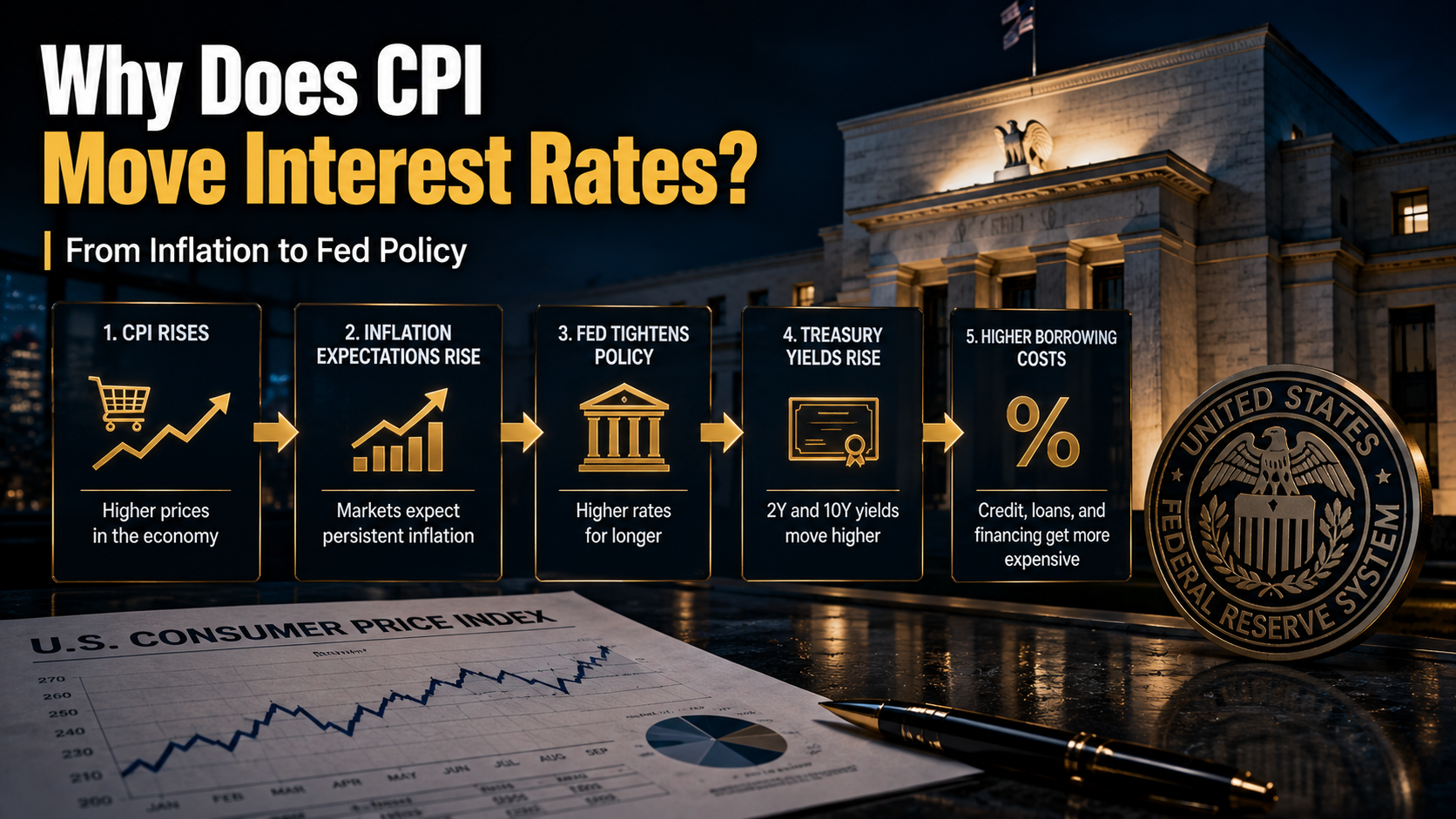
The transmission mechanism can be summarized as
CPI → Fed expectations → Treasury yields → discount rates → tech valuations → Nasdaq
Understanding this chain is far more useful for long-term investors than trying to predict the market's reaction to every monthly inflation report.

Key Takeaway
CPI is an inflation indicator, but for Nasdaq investors it is also an interest-rate and liquidity signal. Inflation data can change expectations for Federal Reserve policy, which can move Treasury yields and ultimately affect the valuations investors are willing to pay for technology and growth stocks.
What Is the U.S. Consumer Price Index?
The Consumer Price Index measures changes in the prices U.S. consumers pay for a broad basket of goods and services.
It includes categories such as housing, food, transportation, medical care, apparel, and other everyday expenses.
In simple terms, CPI attempts to answer
How quickly is the cost of living changing for U.S. consumers?
For households, CPI is primarily an inflation measure.
For financial markets, however, it serves another purpose.
Investors use inflation data to assess whether price pressures are cooling enough for the Federal Reserve to ease monetary policy—or whether inflation remains persistent enough to justify restrictive policy for longer.
That is where CPI begins to affect the Nasdaq.
How Are CPI and Federal Reserve Policy Connected?
The Federal Reserve conducts monetary policy with a dual mandate that includes price stability and maximum employment.
When inflation is too high and persistent, restrictive monetary policy may be needed to slow demand and bring inflation back toward a sustainable level.
Higher interest rates can make mortgages, business loans, credit, and investment more expensive.
That can reduce demand across the economy and eventually ease inflationary pressure.
When inflation becomes more contained, the Fed may have greater flexibility to reduce interest rates.
This means a hotter-than-expected CPI report can lead investors to think
"Rates may stay higher for longer."
A cooler-than-expected report can lead to a different conclusion
"The Fed may have more room to cut rates."
There is an important distinction, however.
The Federal Reserve does not set monetary policy based on one CPI report alone. Policymakers evaluate employment, wages, consumer spending, financial conditions, economic growth, and multiple measures of inflation.
The Personal Consumption Expenditures Price Index, or PCE inflation measure, also plays an especially important role in the Fed's inflation framework.
CPI should therefore be viewed not as a button that automatically changes interest rates, but as one of the most important pieces of information markets use to update the expected path of monetary policy.
Why Are Nasdaq and Technology Stocks So Sensitive to Interest Rates?
The Nasdaq is heavily exposed to technology and growth-oriented companies.
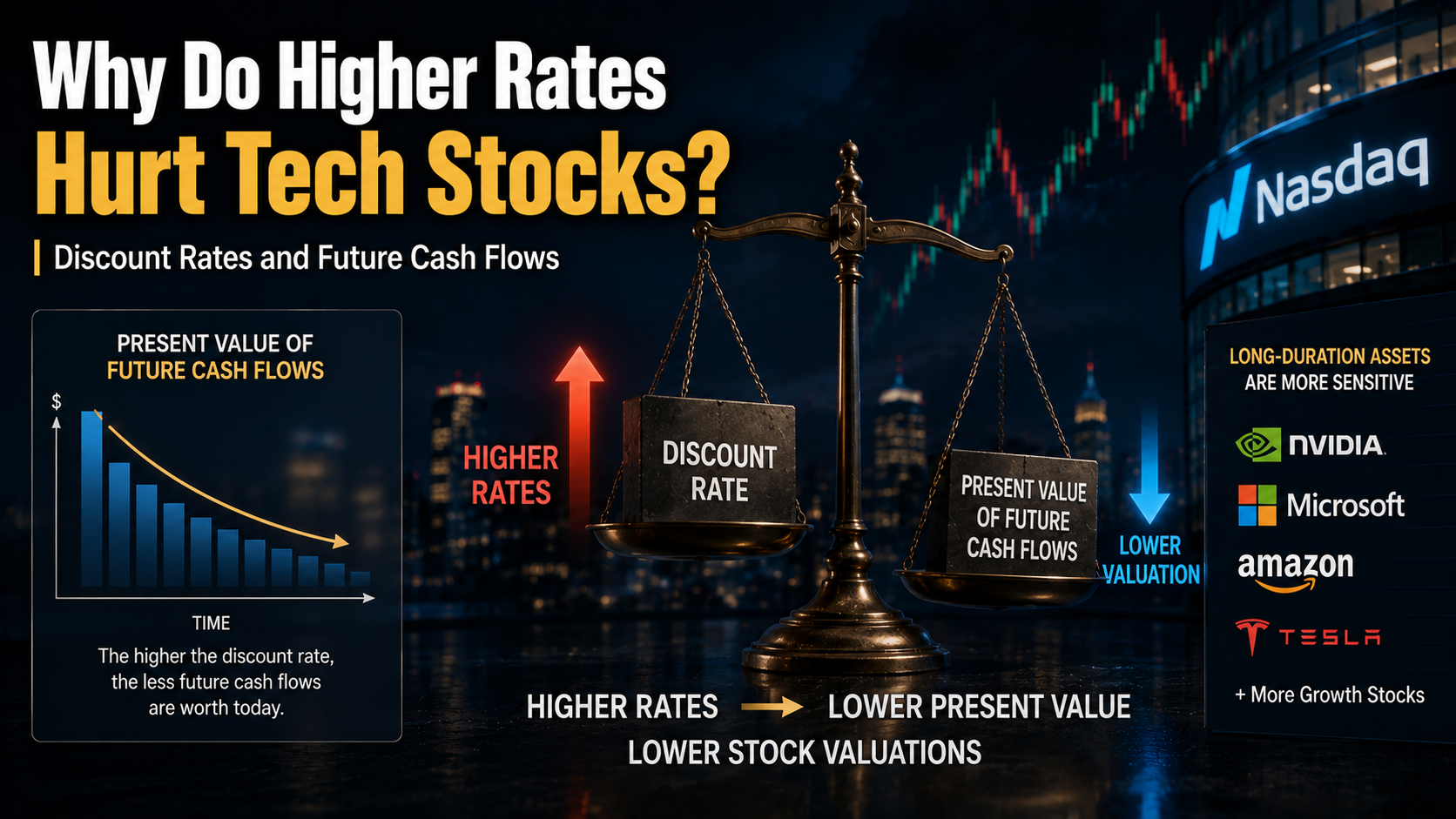
These businesses can be especially sensitive to interest rates because a significant portion of their valuation may depend on profits and cash flows expected far into the future.
This introduces one of the most important concepts in investing
the discount rate.
The value of a business can be thought of as the present value of the cash it may generate in the future.
The higher the discount rate, the less those distant future cash flows are worth today.
Consider a simple example.
If interest rates are extremely low, receiving $1 million ten years from now can look relatively attractive because safe alternatives offer limited returns.
But if investors can earn meaningful yields from relatively low-risk assets such as U.S. Treasuries, waiting ten years for uncertain corporate cash flows becomes less attractive.
Investors may therefore demand a lower price—or a higher expected return—to own the stock.
This is why companies whose valuations depend heavily on distant future growth are often described as long-duration equities.
In general
Higher rates → higher discount rates → lower present value of future cash flows
while
Lower rates → lower discount rates → greater support for growth-stock valuations
This does not mean every technology stock automatically falls when yields rise. Earnings growth, competitive advantages, margins, balance sheets, and market expectations still matter.
But it explains why interest-rate changes can have an unusually large influence on growth-stock valuations.
How CPI Moves the Nasdaq: The Transmission Mechanism
The basic relationship can be visualized as follows
CPI Report
   ↓
Inflation Expectations Change
   ↓
Expected Federal Reserve Policy Changes
   ↓
Treasury Yields Move
   ↓
Discount Rates and Financing Costs Change
   ↓
Growth-Stock Valuations Are Repriced
   ↓
Nasdaq Moves
When CPI Is Hotter Than Expected
A typical market reaction might look like this
Hot CPI → fewer or later rate cuts expected → Treasury yields rise → discount rates rise → growth-stock valuations face pressure → Nasdaq weakens
Higher interest rates can also increase financing costs.
That matters particularly for companies that depend on debt issuance or external capital to fund expansion.
When CPI Is Cooler Than Expected
The opposite mechanism can occur
Cool CPI → rate-cut expectations increase → Treasury yields fall → discount-rate pressure eases → growth valuations receive support → Nasdaq strengthens
But there is one major complication.
Markets rarely react to economic data in isolation.
To understand the actual response, investors must first understand the role of expectations.
Why CPI Expectations Matter More Than the Headline Number
One of the biggest mistakes investors make is asking only whether CPI was "high" or "low."
Financial markets are forward-looking.
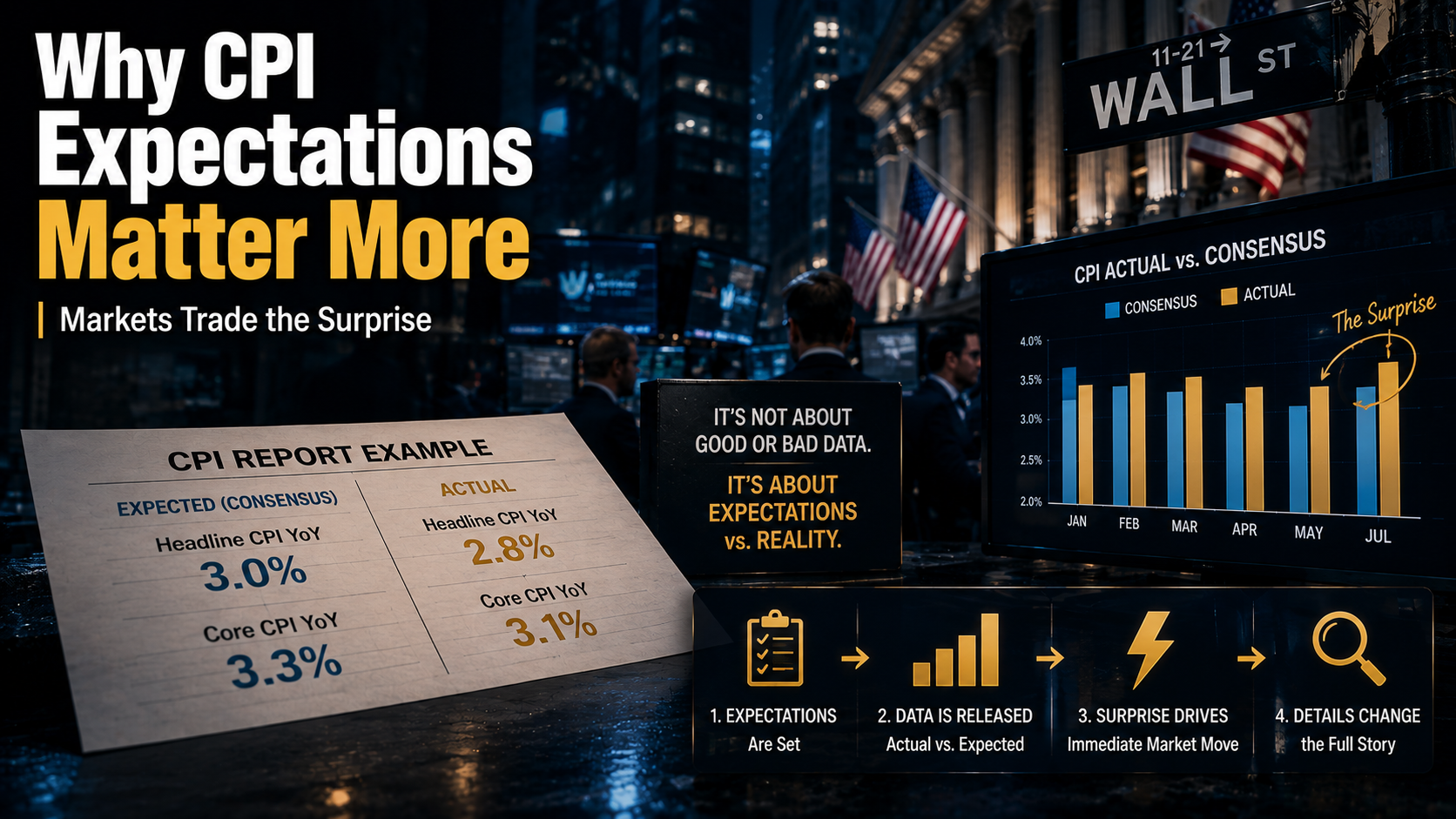
Before the CPI report is released, economists and Wall Street strategists have already formed a consensus forecast.
Asset prices may therefore reflect much of that expectation before the actual number appears.
Suppose the market expects annual CPI inflation of 3.0%.
If CPI comes in at 2.8%, prices are still rising compared with the previous year.
But markets may interpret the report positively because inflation is cooling faster than expected.
Now imagine the market expects 2.8%, but CPI comes in at 3.1%.
Inflation might still be lower than it was several months earlier, yet markets could react negatively because the report exceeded expectations.
The key distinction is
Markets do not simply trade good or bad economic numbers. They trade the difference between expectations and reality.
This concept applies far beyond CPI.
The same mechanism influences reactions to employment reports, GDP releases, earnings results, revenue guidance, and other major financial events.
Why Investors Should Watch Treasury Yields After CPI
One of the best ways to understand the market's interpretation of a CPI report is to watch the U.S. Treasury market.
Two yields are particularly useful.
The 2-Year Treasury Yield
The 2-year Treasury yield tends to be highly sensitive to expectations about near-term Federal Reserve policy.
If CPI comes in hotter than expected and the 2-year yield jumps, the bond market may be signaling that investors expect tighter monetary policy—or fewer rate cuts—than they did before the report.
The 10-Year Treasury Yield
The 10-year Treasury yield reflects a broader combination of expected future short-term rates, inflation, economic growth, and term premium.
It also serves as an important reference point for the valuation of long-duration financial assets.
That makes it especially relevant for growth stocks.
For Nasdaq investors, a useful framework is therefore
CPI surprise → 2-year and 10-year Treasury yields → Nasdaq reaction
If CPI looks favorable but the Nasdaq fails to rally, the Treasury market may help explain why.
Headline CPI vs. Core CPI
Investors should not evaluate CPI using only one headline number.
Two major measures are commonly discussed.
Headline CPI
Headline CPI includes the entire basket, including food and energy.
It provides a broad picture of consumer inflation but can be heavily influenced by volatile categories such as gasoline and food.
Core CPI
Core CPI excludes food and energy.
Because those categories can fluctuate sharply, core CPI can help investors evaluate whether underlying inflation pressures are becoming more persistent or are beginning to ease.
For example, falling oil prices might cause headline CPI to decline rapidly.
But if housing and service-sector inflation remain elevated, underlying inflation pressure may still be persistent.
That is why markets frequently look beyond headline CPI and examine the composition of the report.
Month-over-Month vs. Year-over-Year CPI
CPI is commonly reported in two ways
- Month over month, or MoM
- Year over year, or YoY
Year-over-year inflation receives significant media attention because it provides an intuitive picture of how prices have changed over the previous 12 months.
But it can also be influenced by base effects.
If inflation was unusually high one year earlier, the annual inflation rate can fall significantly even if recent monthly inflation remains uncomfortable.
Month-over-month data can provide a more immediate view of whether inflation momentum is accelerating or cooling.
For that reason, investors should generally look at four numbers
- Headline CPI MoM
- Headline CPI YoY
- Core CPI MoM
- Core CPI YoY
Then compare each figure with consensus expectations.
This gives a much more complete picture than simply reading the headline annual inflation rate.
Does Lower CPI Always Mean a Higher Nasdaq?
No.
This is one of the most important nuances in understanding inflation and the stock market.
Lower inflation can support lower interest rates, which is generally favorable for growth-stock valuations.
But investors must ask
Why is inflation falling?
There are two very different possibilities.
Scenario 1: Disinflation With a Soft Landing
Suppose supply conditions normalize, inflation gradually declines, employment remains relatively healthy, and the economy continues to expand.
This is close to the classic soft landing scenario.
The combination could look like
Lower inflation + lower rate pressure + resilient earnings
That can create a favorable environment for equities.
Scenario 2: Inflation Falls Because Demand Is Collapsing
Now consider a different situation.
Unemployment rises rapidly, consumer spending weakens, businesses reduce investment, and economic activity contracts.
Inflation may fall quickly because demand is deteriorating.
Interest rates may eventually decline, but corporate revenue and earnings expectations may fall as well.
In that environment, the market can care more about recession risk than rate cuts.
This is why the better question is not
"Is CPI falling?"
It is
"Why is CPI falling?"
The answer can determine whether falling inflation is bullish or bearish for equities.
How CPI Can Affect Major Asset Classes
CPI can influence nearly every major financial market because inflation affects interest rates, liquidity, and required returns.
| Asset | Hotter-Than-Expected CPI | Cooler-Than-Expected CPI |
| U.S. Treasury yields | Upward pressure | Downward pressure |
| U.S. dollar | Often supportive | Often negative |
| Nasdaq / growth stocks | Valuation pressure | Valuation support |
| Gold | Higher real yields can be a headwind | Lower real yields can be supportive |
| Bitcoin / high-beta assets | Risk appetite may weaken | Risk appetite may improve |
These are tendencies, not mechanical rules.
Financial markets simultaneously price economic growth, earnings, fiscal policy, geopolitical risk, positioning, liquidity, and many other variables.
U.S. Treasuries
Hot inflation can increase expectations that rates will remain restrictive for longer, putting upward pressure on yields.
Because bond prices and yields generally move in opposite directions, existing Treasury prices can come under pressure when yields rise.
U.S. Dollar
Higher expected U.S. interest rates can increase the relative attractiveness of dollar-denominated assets and support the dollar.
But currencies are always relative.
The dollar's performance also depends on monetary policy and economic conditions in Europe, Japan, the United Kingdom, and other major economies.
Nasdaq and Growth Stocks
Higher Treasury yields can raise the discount rate applied to future corporate earnings.
That can pressure growth-stock valuations, particularly when valuations are already elevated.
Lower yields can have the opposite effect.
Gold
Gold does not generate interest income.
As a result, rising real yields can increase the opportunity cost of holding gold, while falling real yields may improve its relative attractiveness.
The dollar, central-bank demand, and safe-haven flows also matter.
Bitcoin
Bitcoin does not fit neatly into traditional equity valuation models, but it has often been sensitive to changes in liquidity and risk appetite.
When markets anticipate easier financial conditions, high-volatility assets can benefit from improving risk sentiment.
When liquidity expectations tighten, the opposite can occur.
Why the Nasdaq Can Rally After CPI and Then Reverse
Investors occasionally see the Nasdaq surge immediately after a CPI release only to give back the entire move later in the trading session.
The reverse can happen as well.
This does not necessarily mean the market is behaving irrationally.
Different participants process information at different speeds.
Immediately after the report, algorithms and short-term traders can react to the difference between the actual CPI reading and consensus expectations.
Minutes and hours later, investors begin examining the details.
Perhaps headline CPI was soft but core services remained sticky.
Perhaps Treasury yields initially fell but then reversed higher.
Perhaps the inflation report was favorable, but growth concerns began to dominate the market narrative.
The initial move is therefore not always the market's final judgment.
The first reaction tells you how traders read the headline. The later reaction can tell you how the broader market interpreted the entire report.
For long-term investors, that distinction matters.
What Investors Should Check on CPI Day
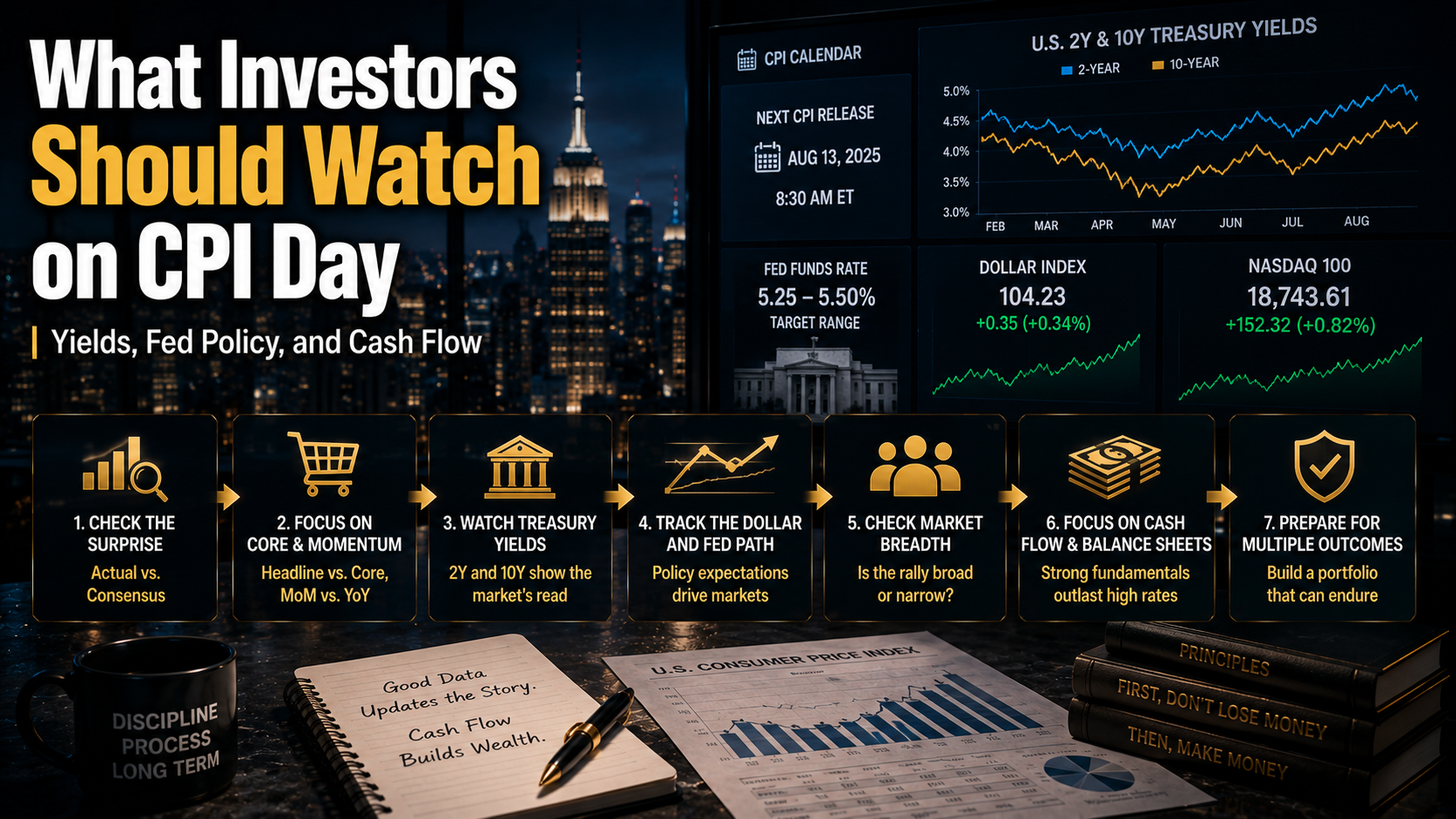
Instead of focusing on a single headline number, investors can use a broader framework.
1. Compare Actual CPI With Consensus
Was the report hotter, cooler, or roughly in line with expectations?
The size and direction of the surprise can matter more than the absolute inflation rate.
2. Compare Headline and Core CPI
Was the improvement caused mainly by energy prices, or did underlying inflation also cool?
3. Look at Monthly Inflation Momentum
Month-over-month readings can provide clues about whether recent inflation pressure is accelerating or decelerating.
4. Watch the 2-Year and 10-Year Treasury Yields
The bond market often provides one of the clearest real-time signals of how investors are updating their interest-rate expectations.
5. Watch the Dollar and the Expected Fed Path
If Treasury yields, the dollar, and rate expectations all move together, the CPI report may be causing a meaningful repricing of monetary policy expectations.
6. Look Beneath the Nasdaq Index
Is the rally broad?
Are semiconductors, software stocks, and smaller growth companies participating, or is the index being carried by a handful of mega-cap names?
Market breadth can provide useful information about whether capital is moving broadly into growth assets.
7. Evaluate Corporate Balance Sheets and Cash Flow
Not all technology companies have the same sensitivity to higher rates.
A highly profitable company with significant cash and strong free cash flow is fundamentally different from an unprofitable business that must repeatedly raise outside capital.
Interest rates expose that difference.
Do Higher Interest Rates Hurt Every Tech Stock Equally?
No.
Treating "technology stocks" as a single category can hide major differences in financial quality.
A mega-cap technology company generating billions of dollars in free cash flow may be able to withstand a restrictive interest-rate environment far better than an early-stage company dependent on debt or equity issuance.
Higher rates can increase financing costs for companies that need external capital.
They can also reduce the valuation investors are willing to assign to distant future earnings.
Companies with strong margins, pricing power, recurring revenue, large cash balances, and durable free cash flow may have greater resilience.
The deeper question is therefore not simply
"Are higher rates bad for tech?"
It is
"Which companies can survive a higher cost of capital?"
That is a much more useful question for long-term investors.
What Do Long-Term Investors and Wealthy Asset Owners Watch?
Experienced investors are usually less interested in predicting the Nasdaq's first five-minute reaction to CPI than in understanding how inflation changes the broader flow of capital.
Follow the Money
When short-term Treasury bills and other relatively low-risk assets offer attractive yields, investors do not need to take as much risk to generate returns.
Capital may remain in cash, money-market instruments, and government bonds.
As inflation cools and interest rates decline, the relative appeal of cash can weaken, creating conditions in which capital may gradually move toward equities and other risk assets.
The important question is not simply whether CPI rose or fell.
It is
Where is capital moving next?
Focus on Cash Flow
Higher interest rates tend to expose weak business models.
Companies that require continuous financing can become vulnerable when capital becomes expensive.
Companies that generate durable free cash flow have more flexibility.
They can invest, repurchase shares, acquire competitors, reduce debt, or simply wait for better opportunities.
Measure Asset Resilience
Economic regimes change.
Low rates do not last forever, and neither do high rates.
A business that works only when capital is nearly free may have less long-term resilience than one that can generate attractive returns across multiple economic environments.
Think Beyond the Next CPI Print
Investors can ask themselves
- How much monetary easing is already priced into the market?
- Which assets would be most vulnerable if inflation surprises to the upside?
- Can the companies I own generate cash flow if rates stay high for longer?
- Is inflation falling because of healthy disinflation or weakening demand?
- Are stock prices rising because earnings are improving, or because discount rates are falling?
- Can my portfolio survive an economic outcome that the consensus does not expect?
These questions are often more valuable than attempting to forecast the next CPI number.
Final Thoughts
The reason CPI matters to the Nasdaq is not simply that inflation is rising or falling.
The deeper transmission mechanism is
CPI → inflation expectations → Fed policy expectations → Treasury yields → discount rates and financing costs → technology valuations → Nasdaq
A hotter-than-expected CPI report can reduce expectations for monetary easing and put upward pressure on Treasury yields, potentially creating a headwind for growth-stock valuations.
A cooler inflation report can ease rate pressure and create a more supportive environment for growth assets.
But investors should always ask one additional question
Why is inflation changing?
Disinflation accompanied by resilient growth is fundamentally different from falling inflation caused by a recession.
That is why CPI should be evaluated alongside core inflation, monthly inflation momentum, Treasury yields, labor-market conditions, economic growth, and corporate earnings.
The most important lesson is simple
Markets are not really trading the CPI number. They are trading what that number implies about the future price of money.
Long-term investing is not about perfectly predicting every CPI report.
It is about understanding which assets and businesses can survive when the economic environment turns out differently than expected.
This was MasterMind.
Related Articles
- What Is CPI? How Inflation Data Moves Stocks, Interest Rates, and the Dollar
- What Is Core CPI? Why the Federal Reserve Watches It Closely
- What Is Breakeven Inflation (BEI)? Why It Matters for Investors and Financial Markets
- Are Interest Rate Cuts Always Good for Stocks? How Fed Rate Cuts Affect the Stock Market and Asset Prices
- What Is a Recession? How It Works and Affects Stocks, Bonds, and the Economy
'[Global] Success Blueprints' 카테고리의 다른 글