What Is a Recession? How It Works and Affects Stocks, Bonds, and the Economy


Hello, this is MasterMind.
When recession warnings begin appearing across Wall Street, investors often assume the next step is obvious: stocks fall, unemployment rises, the Federal Reserve cuts interest rates, and investors rush into safe-haven assets.
The real relationship is much more complicated.
Why can the stock market begin falling while the U.S. economy still appears healthy?
Why can stocks rally when unemployment is rising and economic data looks terrible?
And why do Treasury yields, the U.S. dollar, gold, and Bitcoin sometimes react very differently to the same recession fears?
Understanding a recession requires looking beyond GDP.
A recession is ultimately a process in which weaker demand, tighter credit, declining corporate profits, deteriorating employment, and changing liquidity conditions begin reinforcing one another.
For investors, the key question is therefore not simply
“Is the U.S. entering a recession?”
A better question is
“Where are we in the economic cycle, and where is capital moving next?”
The Bottom Line
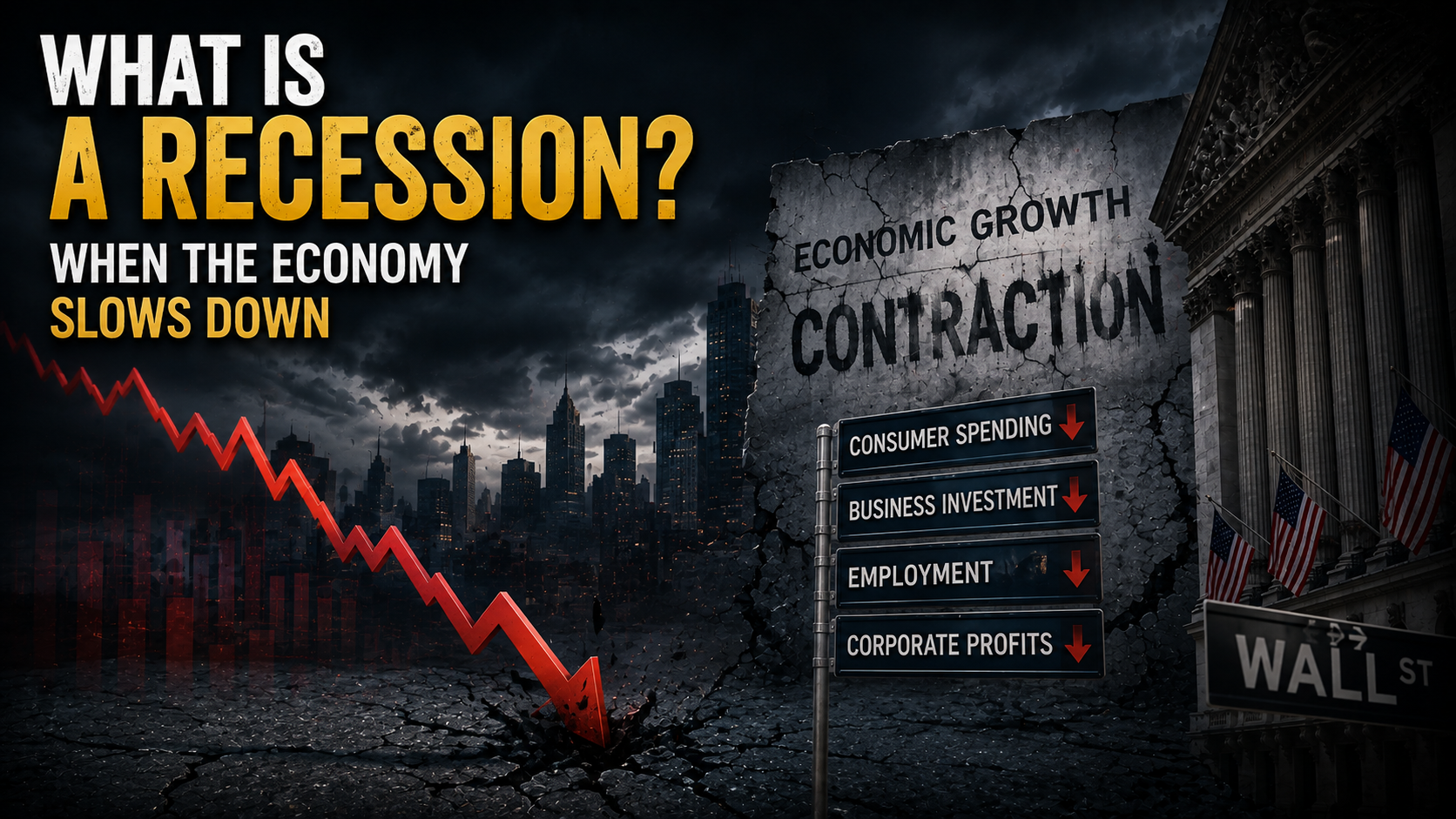
A recession is a broad contraction in economic activity. For financial markets, however, what matters most is not the recession label itself but the direction of growth, corporate earnings, interest rates, credit conditions, and liquidity.
What Is a Recession?
A recession is a significant and broad decline in economic activity that lasts for more than a brief period.
In simple terms, several engines of the economy begin slowing at the same time.
Consumers spend less.
Businesses reduce investment.
Corporate revenue and profits weaken.
Hiring slows.
Unemployment may begin rising.
Banks can become more cautious about lending.
As these forces interact, weakness in one part of the economy can spread into others.
This is why a recession should not be viewed simply as a falling GDP number. It is better understood as a deterioration in the economic system as a whole.
Do Two Consecutive Quarters of Negative GDP Mean a Recession?
One of the most common definitions of recession is two consecutive quarters of negative real GDP growth.
This is a useful rule of thumb, but it is not the official U.S. recession definition.
In the United States, business-cycle peaks and troughs are identified by the National Bureau of Economic Research, or NBER.
The NBER examines a broader range of economic activity rather than relying on a single GDP rule.
Employment, real income, industrial production, consumption, and other indicators can all matter when assessing whether economic activity has declined significantly across the economy.
For investors, this distinction is important.
Waiting for an official recession declaration can mean looking backward at an economic change that financial markets began pricing months earlier.
Why Do Recessions Happen?
There is no single cause of every recession.
Economic downturns can emerge from monetary tightening, financial crises, asset bubbles, excessive debt, credit contractions, external shocks, or sudden declines in demand.
But one common business-cycle sequence looks like this
Economic expansion → Strong demand → Inflation pressure → Monetary tightening → Weaker consumption and investment → Slower earnings → Labor-market deterioration → Recession
The specific trigger changes from cycle to cycle.
The underlying mechanism often involves the same fundamental force
the cost and availability of money change.
How Does a Recession Develop?
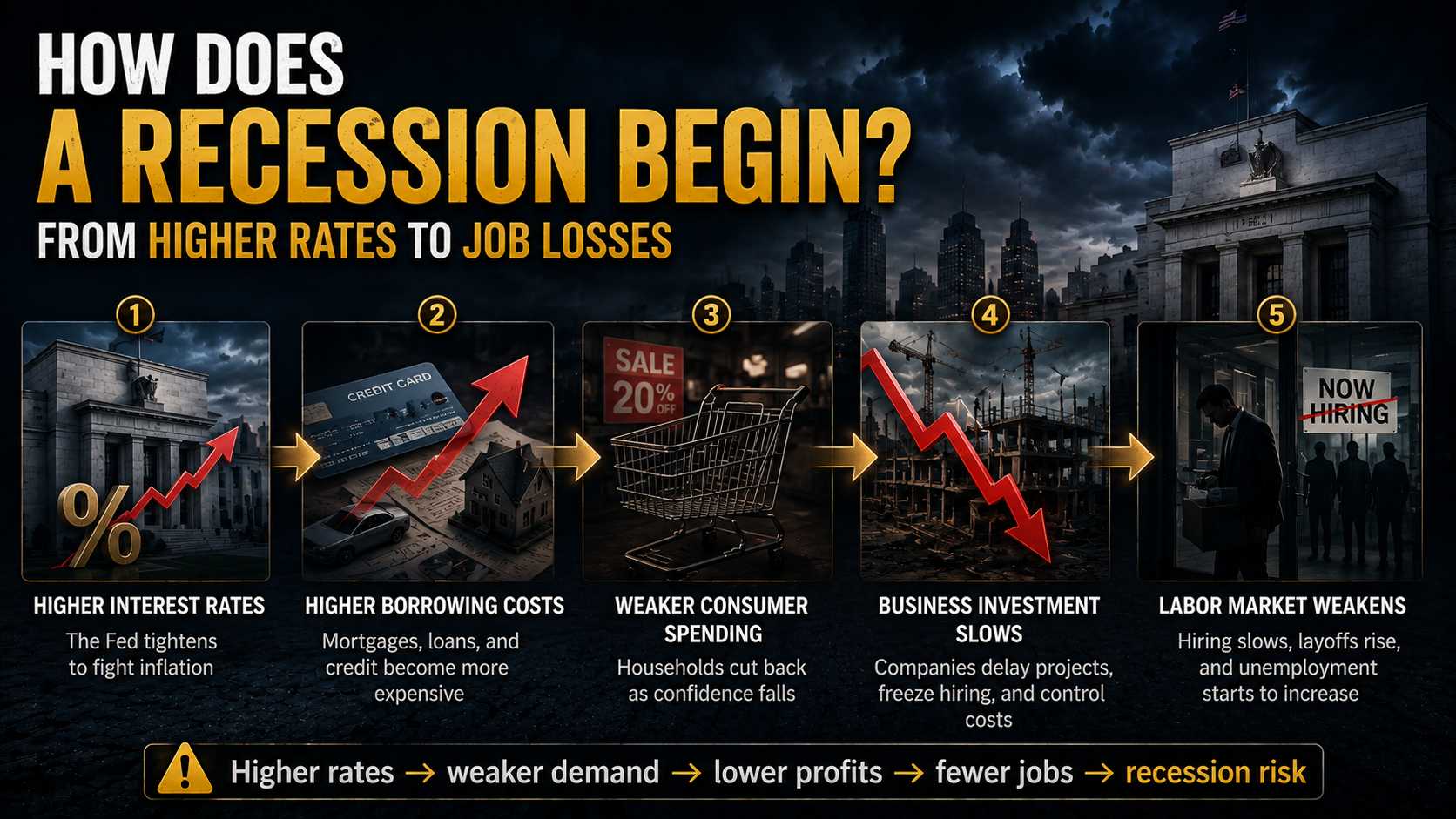
Recessions rarely appear overnight.
They tend to develop through a chain reaction across interest rates, credit, corporate earnings, employment, and consumer demand.
1. Higher Interest Rates Increase the Cost of Money
When inflation becomes too high, the Federal Reserve may raise interest rates and tighten monetary conditions.
Higher rates affect almost every part of the economy.
Mortgage rates rise.
Auto loans become more expensive.
Credit-card interest costs increase.
Corporate borrowing becomes more expensive.
The hurdle rate for new business investment rises.
Projects that made financial sense when capital was cheap may no longer generate attractive returns at higher financing costs.
This gradually slows economic activity.
2. Consumers Begin Cutting Spending
Higher borrowing costs are only part of the problem.
When households become worried about employment, income, inflation, or their financial position, they may increase savings and reduce discretionary spending.
One household's spending is another company's revenue.
When millions of households become more cautious simultaneously, corporate sales begin feeling the pressure.
3. Businesses Reduce Investment
When demand weakens, companies become less willing to expand.
New factories may be delayed.
Capital expenditures can be reduced.
Research projects may be reconsidered.
Hiring plans may be frozen.
Management teams shift from maximizing growth toward protecting margins and cash flow.
4. The Labor Market Weakens
Eventually, weaker revenue and tighter margins can reach the labor market.
Job openings decline.
Hiring slows.
Layoffs may increase.
Unemployment begins rising.
This matters because employment is one of the strongest foundations of U.S. consumer spending.
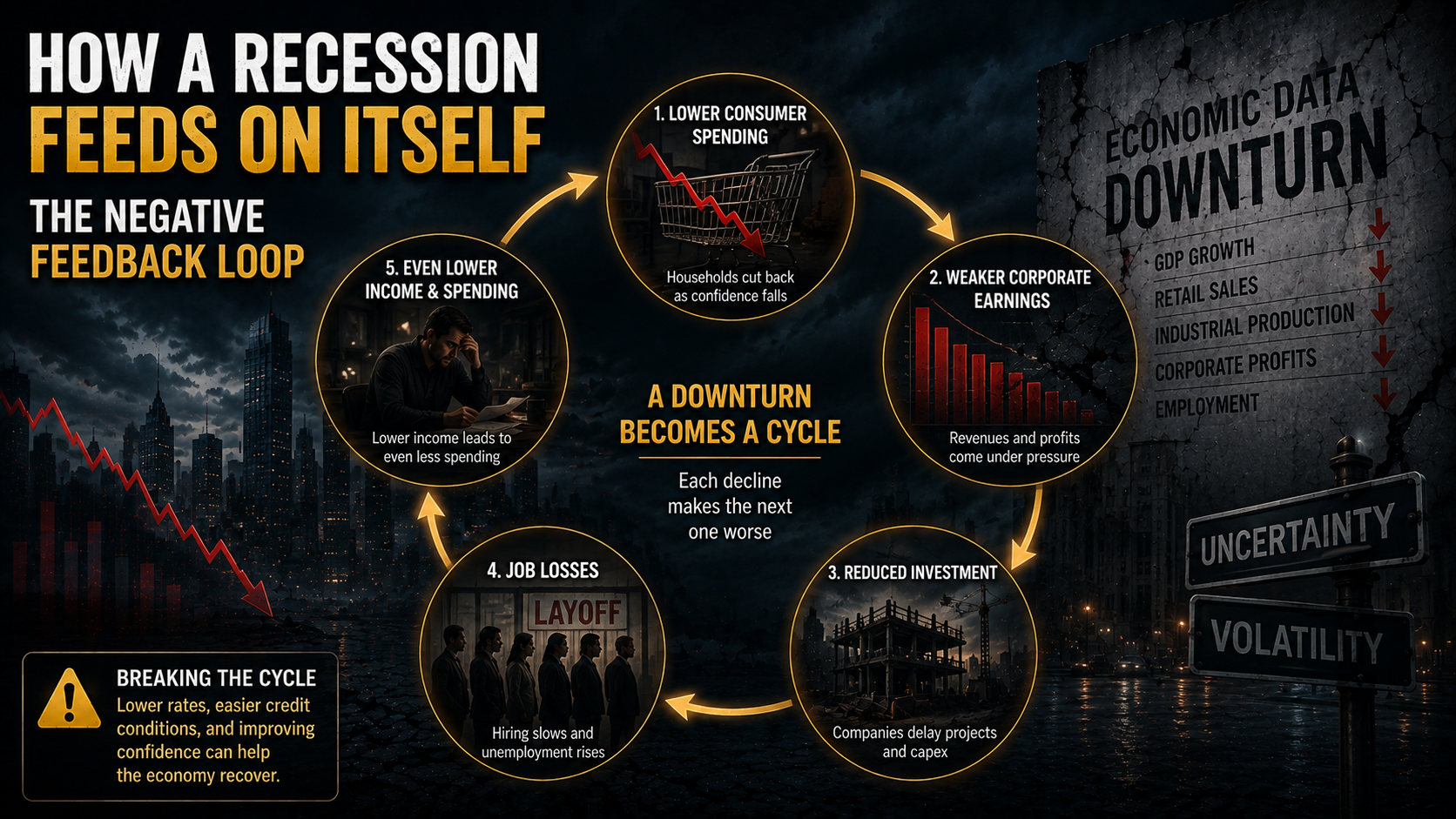
5. A Negative Feedback Loop Can Form
Once labor-market weakness affects household income and confidence, consumers may cut spending even further.
That creates a potentially self-reinforcing cycle
Lower consumption → Weaker corporate earnings → Lower investment → Weaker employment → Lower household income → Even lower consumption
This negative feedback loop is one of the central mechanisms behind a recession.
Why Are Recessions So Important for Investors?
A recession matters because the market's valuation framework can change.
During an economic expansion, investors may be willing to pay high valuations for future growth.
When recession risk increases, the questions change.
Instead of asking
“How fast can this company grow?”
Investors begin asking
“Can this company generate cash?”
“How much debt does it have?”
“When does that debt mature?”
“Can it refinance if credit conditions tighten?”
“Can it survive without raising additional capital?”
The market's attention can shift from growth potential to financial durability.
That change can dramatically alter which companies and assets attract capital.
From Risk-On to Risk-Off: Where Does the Money Go?
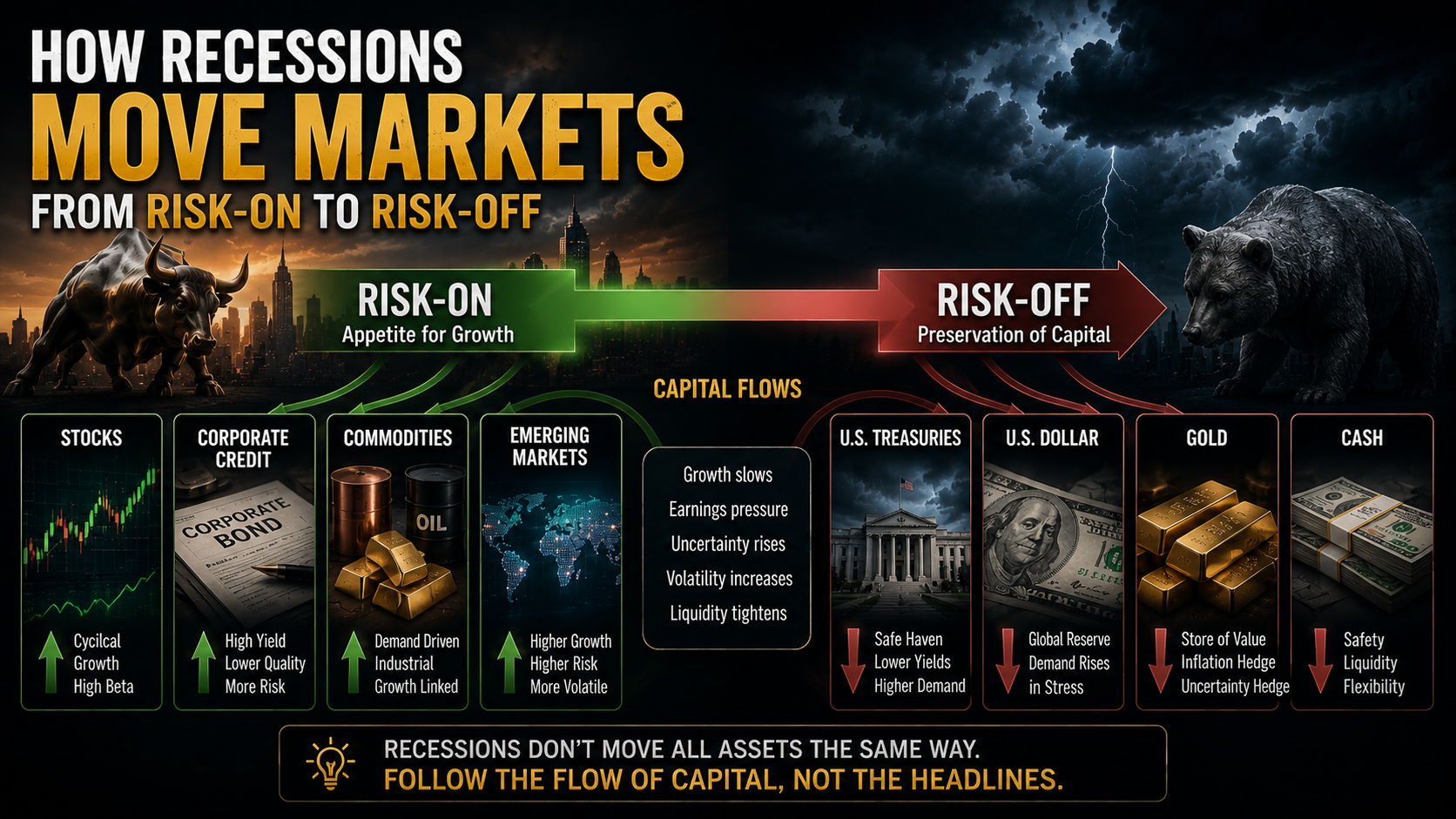
Financial markets are ultimately driven by capital flows.
When growth is strong, liquidity is abundant, and investors feel confident, capital tends to move toward assets offering higher expected returns.
This is commonly described as a risk-on environment.
Growth stocks, cyclical companies, high-yield credit, small-cap stocks, commodities, and speculative assets may attract more capital.
Recession fears can reverse that psychology.
Investors may become less concerned with maximizing returns and more concerned with preserving capital.
This creates a risk-off environment.
Money may move toward cash, high-quality government bonds, defensive assets, or other instruments perceived as more resilient.
But there is an important qualification.
Money does not move to the same place in every recession.
An inflation-driven downturn can behave very differently from a banking crisis.
A recession caused by monetary tightening can produce different asset-market outcomes from one caused by a deflationary shock.
Investors should therefore avoid memorizing a simple formula such as
“Recession equals bonds up, stocks down, gold up.”
The better question is
What caused the recession, and what policy response is likely to follow?
Why the Stock Market Can Rally During a Recession
One of the most confusing features of financial markets is that stocks can rise while the economy is still deteriorating.
The explanation is simple
markets are forward-looking.
Stock prices reflect expectations about future earnings, interest rates, liquidity, and economic growth rather than today's economic conditions alone.
Consider a simplified recession cycle.
Early Slowdown
Economic data begins weakening, but employment and corporate earnings may still look relatively strong.
Markets begin debating whether monetary policy is too restrictive.
Recession Fears Increase
Earnings estimates fall.
Credit conditions tighten.
Unemployment risks rise.
Investors reduce exposure to economically sensitive assets.
Recession Becomes Visible
GDP, employment, manufacturing, and corporate earnings may now look clearly weak.
But financial markets may already have priced in substantial economic damage.
At this stage, the market's central question can begin changing from
“How bad will things get?”
to
“When will things stop getting worse?”
Recovery Expectations Appear
The economy can still look terrible when investors begin anticipating lower interest rates, easier financial conditions, improving liquidity, and an eventual earnings recovery.
Stocks can therefore begin recovering before the recession officially ends.
This leads to one of the most important principles in macro investing
Markets do not simply trade good economies versus bad economies. They trade economies that are getting better or worse relative to expectations.
How Does a Recession Affect the Stock Market?
Recessions generally create pressure on corporate revenue and earnings.
Cyclical businesses can be particularly vulnerable because their revenue depends heavily on consumer demand, housing, manufacturing, capital expenditures, or business investment.
But a recession does not automatically mean stocks must continue falling.
Three variables matter enormously
earnings expectations, valuations, and liquidity.
If analysts still expect unrealistic earnings growth, recession risk can force estimates lower.
If valuations remain expensive, falling earnings expectations can create additional downside pressure.
But if valuations have already compressed and earnings expectations have been heavily reduced, even weak economic data may fail to push stocks materially lower.
The market trades the gap between reality and expectations.
How Does a Recession Affect Treasury Bonds?
U.S. Treasury bonds often receive significant attention during recession fears.
If economic growth slows and inflation pressures decline, investors may expect the Federal Reserve to lower interest rates.
Falling market yields can increase the value of existing fixed-rate bonds.
Demand for high-quality government securities can also rise during periods of risk aversion.
However, Treasuries are not guaranteed to rally in every downturn.
If inflation remains elevated, fiscal concerns increase, or term premiums rise, long-term Treasury yields may behave differently from what a simple recession framework would suggest.
This is why investors need to watch both growth and inflation.
How Does a Recession Affect the U.S. Dollar?
A slowing U.S. economy does not automatically mean a weaker dollar.
During global financial stress, investors and institutions may increase demand for dollars because the dollar remains central to global trade, funding, and financial markets.
This can produce a counterintuitive situation
The U.S. economy weakens, but the dollar strengthens.
The key is relative conditions.
Investors need to compare U.S. growth, interest rates, and financial stability with conditions in Europe, Japan, emerging markets, and the rest of the global economy.
For the dollar, the question is rarely just
“Is America slowing?”
It is also
“Is America slowing more or less than everyone else, and how strong is global demand for dollar liquidity?”
How Does a Recession Affect Gold?
Gold often attracts attention during periods of economic and financial uncertainty.
But recession alone does not determine the gold price.
Real interest rates and the U.S. dollar can be especially important.
If recession fears lead to falling nominal rates and lower real yields, the opportunity cost of holding gold can decline.
If the dollar simultaneously weakens, gold may receive another tailwind.
However, a strong dollar or persistently high real yields can create a much more difficult environment.
For gold investors, the policy response to recession can therefore matter as much as the recession itself.
How Does a Recession Affect Bitcoin?
Bitcoin creates an even more complicated relationship.
It is sometimes described as a hedge against monetary debasement, but in periods of severe financial stress it can trade like a high-volatility risk asset.
During the initial phase of a liquidity shock, investors may sell Bitcoin alongside equities and other risky assets to raise cash.
Later, however, expectations of easier monetary policy and expanding global liquidity can create a very different environment.
This is why the relationship between Bitcoin and recession is better understood through liquidity conditions than through the recession label alone.
Recession vs. Soft Landing: What Is the Difference?
One of the most important debates during a Federal Reserve tightening cycle is whether the U.S. economy can achieve a soft landing.
A soft landing occurs when inflation declines without the economy experiencing a severe contraction or major deterioration in employment.
A hard landing generally describes a much sharper slowdown in which restrictive monetary policy contributes to significant economic weakness.
| Factor | Soft Landing | Recession / Hard Landing |
| Economic Growth | Slows but remains resilient | Broad contraction |
| Labor Market | Gradual cooling | Rising unemployment risk |
| Corporate Earnings | Slower growth | Greater downside risk |
| Inflation | Gradually normalizes | Demand weakness may accelerate disinflation |
| Fed Policy | Gradual normalization possible | Faster easing may become necessary |
| Markets | Risk appetite may remain healthier | Volatility and risk aversion may increase |
This distinction leads to another important principle
A Fed rate cut is not automatically bullish.
Why the Federal Reserve is cutting rates matters.
Rate cuts because inflation has normalized while growth remains resilient can be very different from emergency rate cuts triggered by rapidly deteriorating employment, credit stress, or financial instability.
Investors should focus on the reason for the cut, not simply the direction of rates.
What Indicators Can Signal a U.S. Recession?
No single indicator can reliably predict every recession.
A stronger framework is to look for confirmation across several parts of the economy.
Real GDP
Real GDP provides a broad measure of economic output.
Investors should monitor both outright contraction and the direction of growth.
A slowing economy is not necessarily in recession, but persistent deterioration can increase recession risk.
Unemployment and Payroll Growth
The labor market is one of the most important indicators for the U.S. economy.
Investors should monitor unemployment, payroll growth, job openings, layoffs, and other measures of labor demand.
The direction and speed of deterioration can matter more than the absolute unemployment rate.
Consumer Spending
Consumption represents a major share of U.S. economic activity.
Retail sales, real consumer spending, and household financial conditions can therefore provide important information about economic resilience.
If employment remains healthy and consumers continue spending, the economy can withstand restrictive monetary policy longer than expected.
Corporate Earnings and Guidance
Economic statistics often describe what has already happened.
Corporate guidance can provide clues about what executives expect to happen next.
Revenue expectations, margins, order books, inventories, hiring plans, and capital expenditures can reveal changes in business confidence and demand.
Credit Spreads
Credit markets deserve particular attention.
When investors become more concerned about corporate defaults, the yield spread between risky corporate debt and safer government debt can widen.
A significant deterioration in credit spreads can indicate that financial stress is spreading beyond the stock market.
Bank Lending Standards
Recessions are often closely connected to credit availability.
If banks become more cautious about extending loans, households and businesses may find financing more difficult or expensive.
This can amplify the effect of higher interest rates.
The Yield Curve
An inverted yield curve has historically received considerable attention as a recession signal.
An inversion occurs when shorter-term Treasury yields exceed longer-term yields.
But investors should avoid treating inversion as a countdown clock.
The yield curve reflects expectations about monetary policy, inflation, growth, and term premiums.
The more useful approach is to examine the yield curve together with employment, credit, consumer spending, and corporate earnings.
Why Debt and Liquidity Matter So Much in a Recession
Recessions expose financial fragility.
During an expansion, debt can appear manageable because revenue is growing and financing is easily available.
During a downturn, the equation changes.
Revenue may decline while interest payments remain.
Debt still needs to be refinanced.
Banks may tighten lending standards.
Bond investors may demand higher credit spreads.
Equity markets may become less willing to fund unprofitable businesses.
Two companies with similar revenue growth can therefore experience completely different outcomes during a recession.
One may have a strong balance sheet, substantial cash reserves, positive free cash flow, and manageable debt maturities.
The other may depend on continuous external financing.
When liquidity becomes scarce, that difference becomes critical.
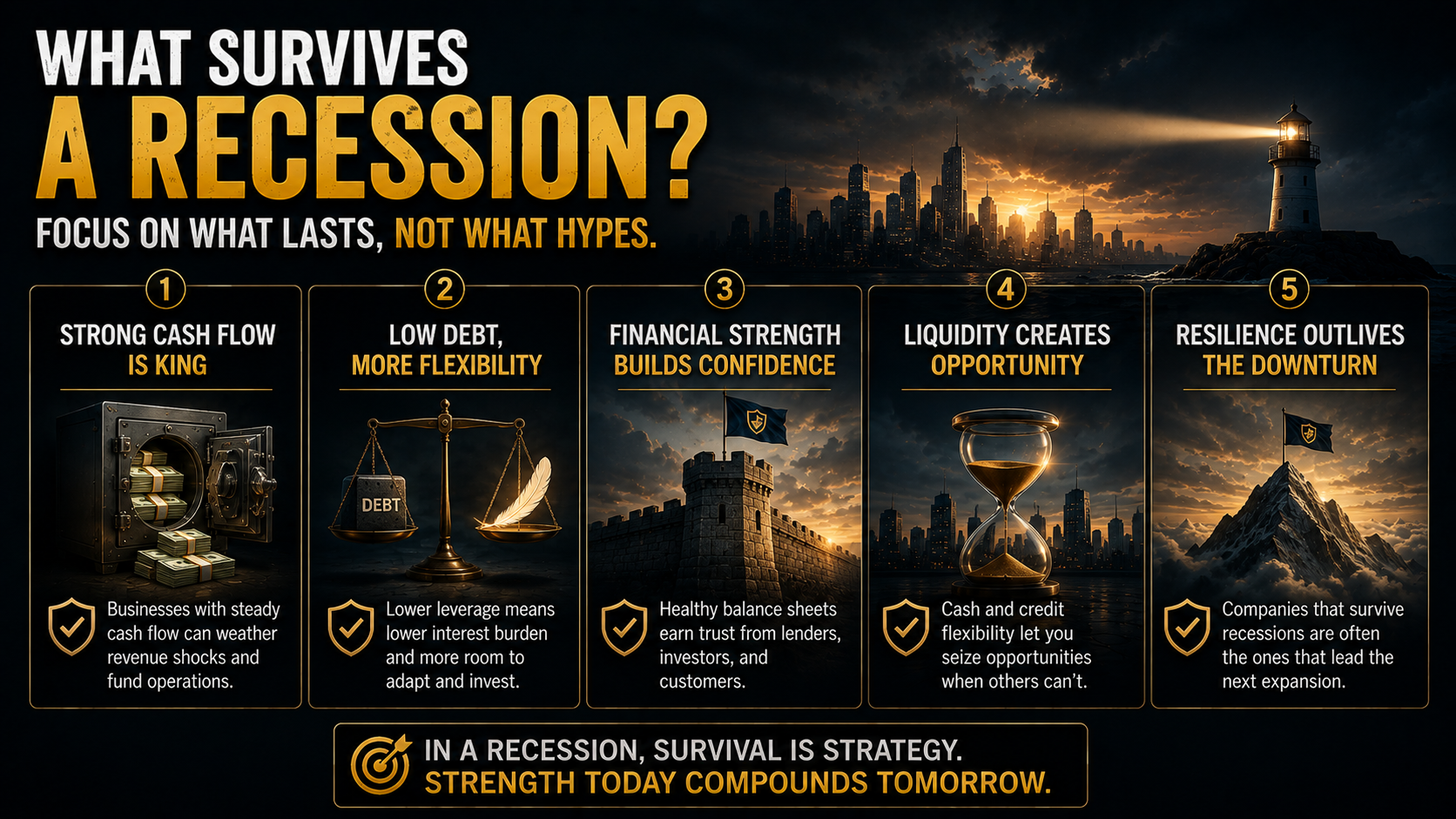
During expansions, growth often separates companies. During recessions, balance sheets can determine survival.
Are Recessions Bad for Every Company?
Not necessarily.
A recession can weaken entire industries while simultaneously changing competitive positions within those industries.
Companies with weak balance sheets may cut investment, sell assets, lose market share, or disappear entirely.
Financially stronger competitors may continue investing.
They may acquire assets at lower prices.
They may maintain research and development.
They may gain customers when weaker competitors retreat.
For long-term investors, this creates a more useful question than simply asking whether a stock will fall during a recession
Can this business emerge from the recession stronger than it entered?
What Should Investors Watch During a Recession?
The first principle is that recession investing is less about perfect prediction and more about resilience.
Watch the Direction, Not Just the Level
A weak economy that is beginning to improve can create a different market environment from a strong economy that is beginning to deteriorate.
Direction matters.
Understand the Gap Between Markets and the Economy
Markets can peak before a recession begins and bottom before the recession ends.
Current headlines and future asset prices are not the same thing.
Ask Why the Fed Is Cutting Rates
Rate cuts can signal successful disinflation.
They can also signal economic distress.
The policy action may look identical while the economic message is completely different.
Examine Cash Flow and Debt
Free cash flow, cash reserves, interest coverage, debt maturities, and refinancing needs can become increasingly important when economic growth slows.
Watch Credit Markets
Equities receive most of the headlines, but credit markets can reveal stress underneath the surface.
Credit spreads and lending standards can provide valuable information about the availability and price of capital.
What Do Wealthy Investors Look for During a Recession?
Experienced long-term investors may approach recessions differently from investors focused primarily on short-term price movements.
They often focus on four broader questions.
Where Is the Money Moving?
Is capital leaving growth stocks?
Is it moving into Treasuries or cash?
Are defensive sectors attracting capital?
Or are investors beginning to rotate back into economically sensitive assets in anticipation of recovery?
Capital flows reveal what the market fears and what it expects.
Who Can Generate Cash?
Revenue growth receives enormous attention during bull markets.
During difficult economic periods, the quality of cash flow can become much more important.
A company that can fund its own operations has greater flexibility than one that depends continuously on outside capital.
Which Assets Can Survive?
Upside potential means little if an asset cannot survive the downturn.
The same principle applies to an investor's portfolio.
Excessive leverage and insufficient liquidity can force investors to sell at precisely the wrong moment.
Who Could Become Stronger After the Recession?
Recessions can reshape competitive landscapes.
Companies with strong balance sheets may emerge with larger market shares, stronger pricing power, better assets, and fewer competitors.
For long-term investors, the objective is not merely to find what has fallen the most.
It is to identify what has the financial strength to survive and potentially become more valuable when the cycle turns.
Investors can ask themselves
- Can the businesses I own continue generating cash during a downturn?
- Could they survive if interest rates remain higher for longer?
- Are their debt maturities and interest expenses manageable?
- Could my portfolio withstand a deeper recession than markets currently expect?
- Am I dependent on selling assets during a period of market stress?
- Could these businesses emerge from the recession with stronger competitive positions?
The most important principle is simple
A durable investment strategy should not require a perfect economic forecast to survive.
The Most Important Way to Think About Recessions
Investors naturally want a binary answer
“Will there be a recession or not?”
But financial markets rarely work in binary terms.
Growth can weaken while employment remains strong.
Corporate earnings can decline while expectations for Fed easing increase.
GDP can remain positive while credit conditions deteriorate.
The economic cycle is a chain of interconnected variables
Growth → Inflation → Interest Rates → Credit → Corporate Earnings → Employment → Consumption → Liquidity
The key is identifying where the chain is beginning to weaken—and where it eventually begins to improve.
That is why understanding recessions is ultimately not about memorizing a definition.
It is about understanding turning points.
When does inflation stop being the dominant problem?
When does the labor market begin weakening?
When does the Fed gain room to ease?
When does credit stress peak?
When do earnings expectations stop falling?
And most importantly
When does capital begin moving before the economic headlines improve?
Final Thoughts
A recession is more than two quarters of negative GDP growth.
It is a broad process in which consumption, investment, corporate profits, employment, credit, and liquidity can weaken together.
For investors, however, the official beginning and end of a recession may be less important than the turning points inside that process.
Financial markets attempt to price the future.
That means the stock market can decline while the economy still looks healthy—and begin recovering while economic headlines remain deeply negative.
Instead of focusing exclusively on whether a recession is coming, investors should monitor the direction of growth, employment, corporate earnings, credit conditions, Federal Reserve policy, and global liquidity.
The central lesson is this
Predicting the exact timing of a recession is less important than understanding the economic cycle, following the flow of capital, and owning assets capable of surviving when the forecast is wrong.
In investing, survival comes before prediction.
This was MasterMind.
'[Global] Success Blueprints' 카테고리의 다른 글