What Happens If You Put $1 Million in the Bank? Interest, Taxes, and How Much You Really Keep


Hello, this is MasterMind.
If you had $1 million in cash and wanted to protect it, putting the money in a bank might seem like the safest possible choice.
Your account balance does not swing 20% in a bear market. You can earn predictable interest from a high-yield savings account, money market deposit account, or certificate of deposit. And unlike stocks or real estate, you do not have to worry about daily market prices.
But does keeping $1 million in the bank actually preserve your wealth?
That depends on what we mean by “preserve.”
There is a major difference between protecting the nominal value of your money and protecting its real purchasing power.
Once $1 million sits in a bank account, several forces begin working at the same time: interest rates, federal and potentially state income taxes, FDIC insurance limits, inflation, reinvestment risk, and opportunity cost.
So the real question is not simply
“How much interest can $1 million earn?”
The more important question is
“How much purchasing power will that $1 million still have 10 or 20 years from now?”
That distinction changes the way investors should think about cash.
Key Takeaway
Putting $1 million in the bank can generate meaningful interest income and reduce short-term volatility, but preserving wealth over the long run depends on what remains after taxes and inflation—not simply on keeping the account balance intact.
How Much Interest Does $1 Million Earn?
Let’s begin with the question most people want answered.
How much money can $1 million actually generate in a bank account?
The basic calculation is straightforward
Annual interest = Principal × Interest rate
Assuming the rate remains constant for one year
| Annual Rate | Annual Interest Before Tax | Monthly Average Before Tax |
| 2.0% | $20,000 | $1,667 |
| 3.0% | $30,000 | $2,500 |
| 4.0% | $40,000 | $3,333 |
| 4.5% | $45,000 | $3,750 |
| 5.0% | $50,000 | $4,167 |
At a 4% annual rate, $1 million produces $40,000 of interest before taxes.
At 5%, that rises to $50,000.
That sounds like substantial passive income.
But there is one important phrase in those calculations
Before taxes.
The amount you actually keep can be significantly lower.
How Much Do You Actually Keep After Taxes?
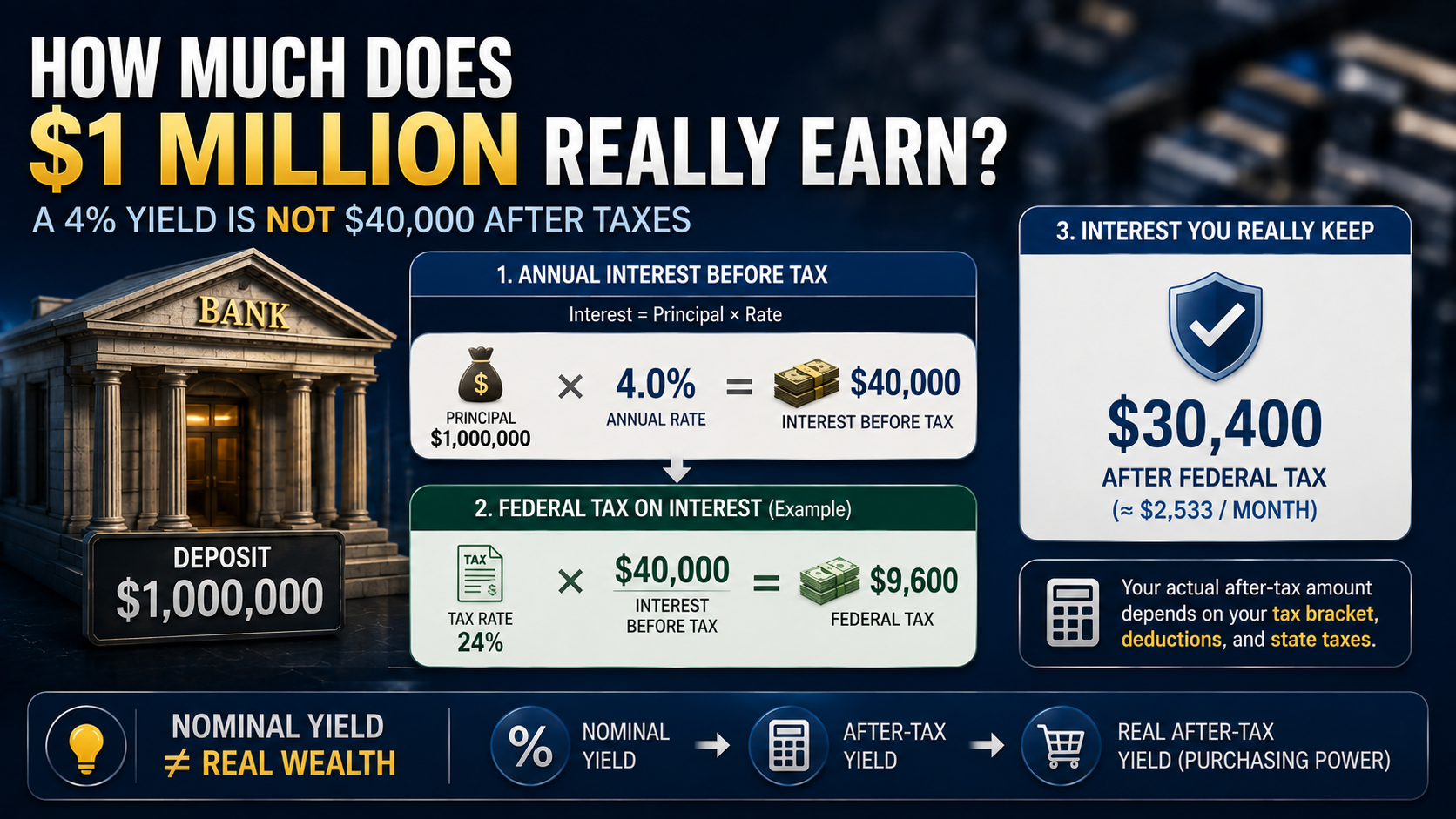
In the United States, interest earned from ordinary bank accounts and CDs is generally treated as taxable interest income for federal income tax purposes.
Unlike qualified long-term capital gains, ordinary bank interest generally does not receive a special lower federal tax rate.
Instead, the tax impact depends largely on your taxable income and marginal tax bracket.
Consider a simplified example using a hypothetical 24% federal marginal tax rate and ignoring state and local taxes.
| Rate | Interest Before Tax | Federal Tax at 24% | Interest After Federal Tax | Monthly Average |
| 2.0% | $20,000 | $4,800 | $15,200 | $1,267 |
| 3.0% | $30,000 | $7,200 | $22,800 | $1,900 |
| 4.0% | $40,000 | $9,600 | $30,400 | $2,533 |
| 4.5% | $45,000 | $10,800 | $34,200 | $2,850 |
| 5.0% | $50,000 | $12,000 | $38,000 | $3,167 |
These numbers are only illustrations.
Your actual after-tax income depends on your federal tax bracket, filing status, other income, deductions, and potentially state and local taxes.
But the principle matters.
Someone might say
“If I put $1 million in a 5% account, I can live on $50,000 a year.”
Not necessarily.
At a hypothetical 24% federal marginal rate, that $50,000 becomes about $38,000 before considering state and local income taxes.
At higher marginal tax rates, even less remains.
That means investors should not compare investments using headline yields alone.
The more useful sequence is
Nominal yield → After-tax yield → Real after-tax yield
The last number is what matters most for long-term purchasing power.
Nominal Wealth vs. Real Wealth
To understand what happens when $1 million stays in the bank for many years, we need to distinguish between nominal value and real value.
Nominal Value
Nominal value is simply the number of dollars shown on your statement.
If your account says $1,000,000, your nominal principal is $1 million.
Real Value
Real value measures what those dollars can actually buy.
This is your purchasing power.
A bank account can be excellent at reducing short-term price volatility.
But it cannot guarantee how much a dollar will buy in the future.
This leads to one of the most important principles in long-term wealth management
Avoiding market volatility does not mean avoiding risk. It often means exchanging market risk for purchasing-power risk.
How Inflation Changes the Value of $1 Million
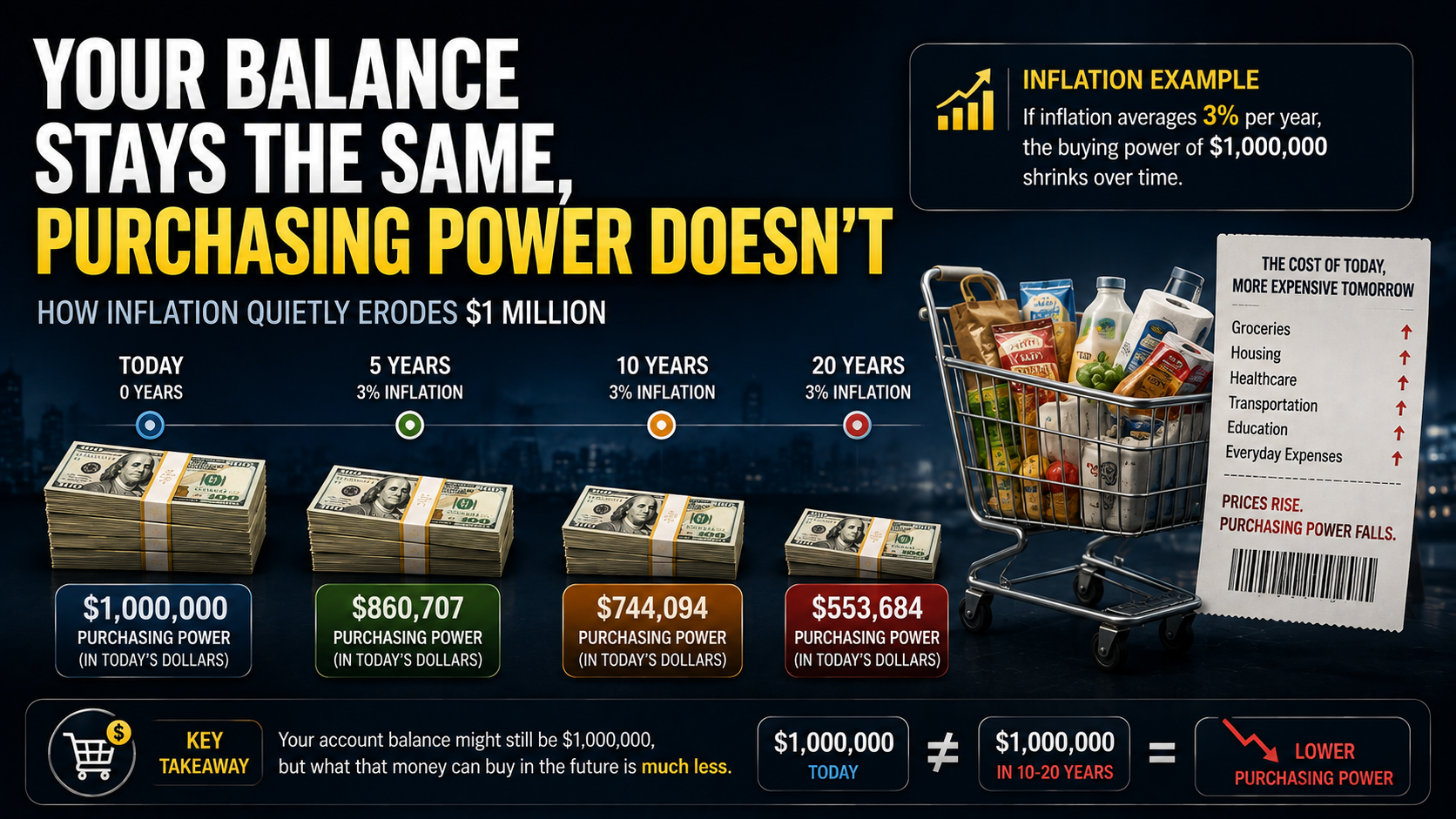
Imagine that you simply held $1 million in cash without earning any return.
If inflation averaged 3% annually for the next decade, the prices of goods and services would rise substantially.
Something costing $1 million today would cost roughly $1.34 million after 10 years if its price increased by 3% every year.
Viewed another way, $1 million received 10 years from now would have purchasing power equivalent to only about $744,000 in today’s dollars under the same assumption.
The number on the account still says $1,000,000.
But economically, it is no longer the same $1 million.
That is what makes inflation so different from a stock-market crash.
A bear market is visible.
Your portfolio might fall 20% in a matter of months.
Inflation is quieter.
The dollar amount may remain intact while purchasing power erodes gradually in the background.
Even a 4% Savings Rate May Not Make You Much Richer
Suppose your $1 million earns 4% annually.
That produces $40,000 before tax.
Using our hypothetical 24% federal marginal tax rate, you would keep approximately $30,400 before state and local taxes.
That is an after-federal-tax return of roughly 3.04%.
Now assume inflation is running at 3%.
Suddenly, the situation looks very different.
Your account produced $40,000 of nominal interest, but your after-federal-tax return barely exceeded the assumed inflation rate.
Your real purchasing power barely increased.
If you also owe state income taxes, your real after-tax return could potentially become negative.
A useful approximation is
Real return ≈ After-tax nominal return − Inflation
A more precise formula is
Real return = (1 + after-tax return) ÷ (1 + inflation rate) − 1
This is why a high savings-account balance can create an illusion of financial progress.
Your account balance may rise every year while your ability to buy goods, services, housing, healthcare, or other assets barely improves.
Is $1 Million Fully Protected by FDIC Insurance?
Another common misconception is that money held in a bank is automatically protected regardless of the amount.
That is not how FDIC insurance works.
For deposit accounts at an FDIC-insured bank, the standard insurance amount is generally $250,000 per depositor, per insured bank, for each account ownership category.
This distinction becomes important when someone holds $1 million or more in cash.
Putting $1 million into a single account at one bank does not automatically mean the entire $1 million is covered under the standard FDIC insurance limit.
Coverage can depend on how deposits are structured, the number of insured institutions involved, and ownership categories.
It is also important to distinguish deposits from investments.
Checking accounts, savings accounts, money market deposit accounts, and CDs at insured banks can qualify for FDIC insurance.
Stocks, bonds, mutual funds, crypto assets, and other investment products are not FDIC-insured merely because they were purchased through a financial institution.
For investors managing large cash balances, the question should therefore not only be
“Which bank pays the highest rate?”
It should also be
“How much of my cash is actually insured, and where is that cash concentrated?”
$1 Million in the Bank Still Has Reinvestment Risk
Bank deposits do not experience the same daily price swings as stocks.
But they carry another type of risk
Reinvestment risk.
Suppose you lock $1 million into a one-year CD yielding 5%.
You earn $50,000 before taxes.
A year later, the CD matures.
But imagine that interest rates have fallen and comparable CDs now yield only 2.5%.
Your same $1 million now generates only $25,000 annually before taxes.
Your principal did not decline.
Your income was cut in half.
This matters particularly for retirees or anyone planning to live primarily from interest income.
Statements such as,
“$1 million earns $50,000 a year at 5%.”
are mathematically correct today if that rate is available, but they can be dangerously misleading as a long-term financial assumption.
Interest rates change.
A high-yield environment does not last forever.
What Happens to Money When Interest Rates Fall?

This is where an individual bank account connects to the broader financial markets.
When savings accounts, CDs, Treasury bills, and money market instruments offer attractive yields, investors have less incentive to take additional risk.
Why accept major stock-market volatility if relatively low-risk assets already offer competitive returns?
But when interest rates fall, the equation changes.
Cash yields decline.
CDs mature and must be rolled over at lower rates.
Money market yields eventually follow short-term interest rates downward.
Some investors then begin searching for higher expected returns elsewhere.
Capital may move toward
- Longer-duration bonds
- Dividend-paying stocks
- Growth stocks
- Real estate
- Credit
- Other risk assets
The opposite can occur when interest rates rise sharply.
If investors can suddenly earn attractive yields on cash or short-term government debt, some capital may leave riskier assets.
This is one of the fundamental mechanisms through which monetary policy affects asset prices.
Money does not simply chase the highest return. It moves toward the most attractive return relative to risk.
That is why interest rates influence far more than savings accounts.
They affect stock valuations, bond prices, mortgage rates, real estate, the U.S. dollar, and global capital flows.
How Does Cash Compare With Other Major Assets?
Keeping $1 million in the bank serves a different purpose from owning stocks, bonds, real estate, or gold.
| Asset | Primary Cash Flow | Price Volatility | Liquidity | Inflation Protection | Major Risk |
| Bank Deposits | Interest | Very Low | High | Limited | Inflation, falling rates |
| Bonds | Interest | Low to Moderate | Generally High | Depends on bond type | Rates, credit |
| Stocks | Dividends / Earnings Growth | High | High | Potential long-term protection | Earnings, valuation |
| Real Estate | Rent | Moderate to High | Low | Potential protection | Rates, prices, liquidity |
| Gold | None | Moderate to High | High | Potential store of value | Price volatility |
The point is not that one asset is always superior.
Each asset performs a different function.
Cash provides liquidity and stability.
Bonds can provide income and diversification.
Stocks provide ownership in businesses and participation in long-term earnings growth.
Real estate can provide both income and exposure to real assets.
Gold can serve as a portfolio diversifier and potential store of value under certain economic conditions.
The key question in portfolio construction is therefore not
“Which asset is best?”
A better question is
“What job is each asset supposed to perform?”
The Opportunity Cost of Keeping $1 Million in Cash
Bank deposits feel safe partly because their opportunity cost does not appear on an account statement.
Suppose your bank account earns 3% while another asset earns 8%.
The difference is 5 percentage points.
On $1 million, that represents $50,000 in potential return over one year.
That difference is an opportunity cost.
But this concept works both ways.
Imagine instead that stocks decline 30%.
The investor holding substantial cash avoids that drawdown and, more importantly, retains the ability to buy assets at lower prices.
This is why cash should not automatically be dismissed as an unproductive asset.
Cash is both an asset and an option on future opportunities.
When markets become euphoric, that option can look useless.
When markets collapse and high-quality assets become cheaper, liquidity suddenly becomes extremely valuable.
An investor without cash may recognize an opportunity but be unable to act.
An investor with liquidity has choices.
Why Wealthy Investors Rarely Keep Everything in the Bank
If bank deposits are stable and pay interest, why don't wealthy investors simply keep all their money in savings accounts and CDs?
The answer is time.
Over short periods, capital preservation may be the dominant objective.
Over 10, 20, or 30 years, the challenge changes.
Long-term wealth must do more than preserve a nominal number.
It may need to
- Maintain purchasing power
- Generate sustainable cash flow
- Survive recessions and market shocks
- Participate in economic growth
- Remain liquid enough to handle emergencies
- Provide capital when opportunities appear
That is why sophisticated wealth management often begins by assigning different jobs to different pools of capital.
Money needed for living expenses has a different purpose from money intended to compound for 20 years.
Emergency liquidity has a different purpose from long-term equity capital.
Capital waiting for an attractive opportunity has a different purpose from money earmarked for a near-term purchase.
Cash is not inherently bad.
Stocks are not inherently good.
The bigger mistake is matching the wrong asset with the wrong time horizon.
What Investors Should Pay Attention To
1. Focus on Real After-Tax Returns
A 5% savings yield is not necessarily a 5% increase in wealth.
Taxes reduce the return.
Inflation reduces its purchasing power.
The number that matters most over long periods is what remains after both.
2. Understand FDIC Insurance Limits
A bank can be financially strong while a depositor still holds cash above standard insurance limits.
Investors with large cash balances should understand how deposit insurance applies to their specific account structure rather than assuming every dollar is automatically insured.
3. Do Not Assume Today's Interest Rate Will Last Forever
A 5% savings or CD rate can create attractive income today.
But if rates eventually fall to 2% or 3%, that income can decline substantially.
Long-term plans should therefore avoid treating a temporary rate environment as permanent.
4. Recognize the Opportunity Cost of Cash
Too much cash can sacrifice long-term compounding.
Too little cash can force investors to sell assets during a downturn or prevent them from taking advantage of attractive prices.
The appropriate amount of liquidity therefore depends on its purpose and time horizon.
5. Think About Survival Before Maximum Returns
Investors naturally focus on maximizing returns.
But the highest expected return is not always the most important objective.
A portfolio that cannot survive a recession, liquidity shock, job loss, or major bear market may force its owner to sell at exactly the wrong time.
Long-term investing is not about winning every year.
It is about staying financially strong enough to remain in the game.
What Do Wealthy Investors Look for in This Environment?
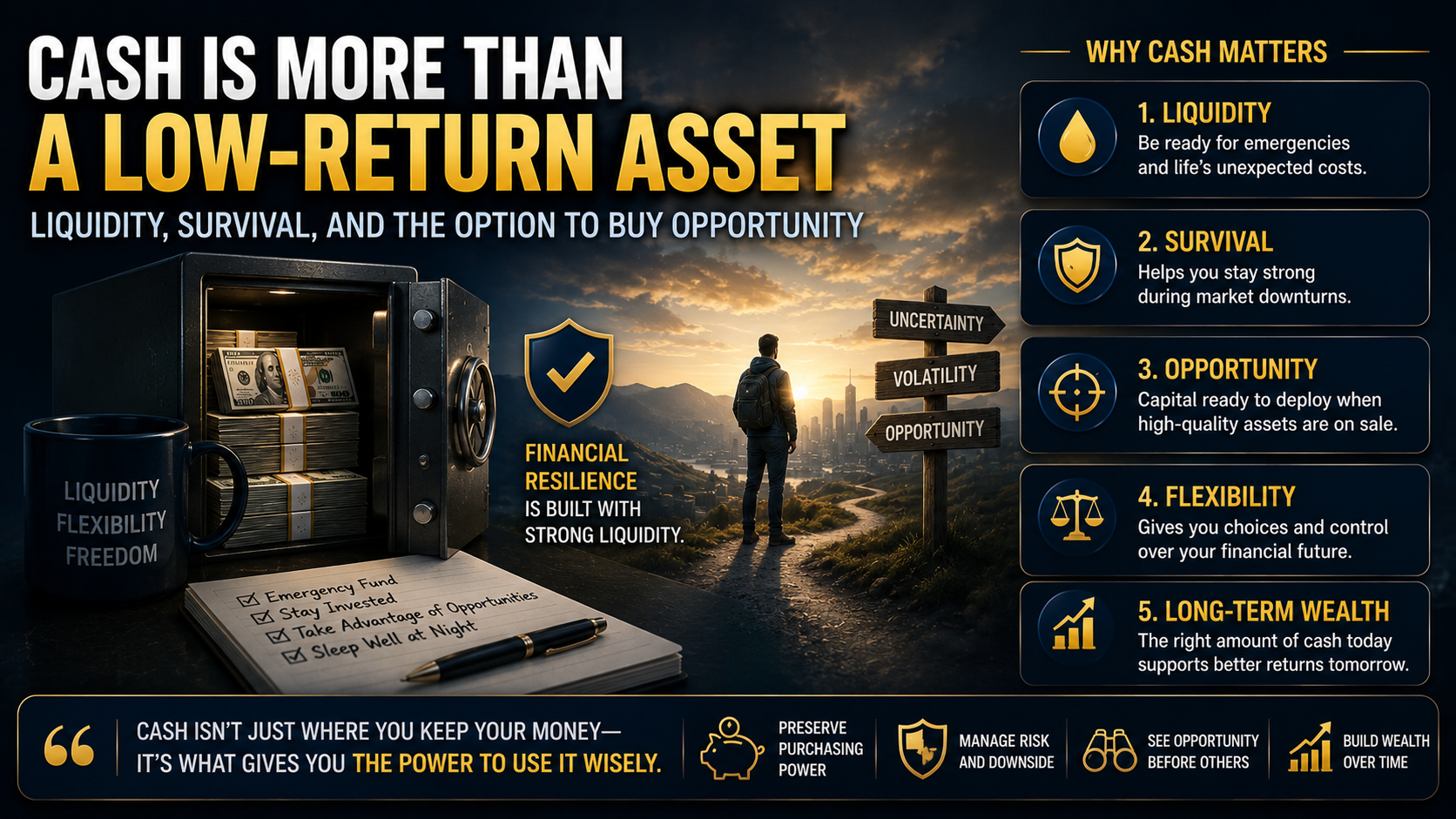
For sophisticated investors, $1 million in cash is not simply a number sitting in an account.
They ask what that capital can do.
Can it generate sustainable cash flow?
Can it preserve purchasing power?
Can it survive a crisis?
Can it be deployed when better opportunities appear?
Those questions lead to a different way of thinking about cash.
1. Follow the Flow of Money
When short-term interest rates rise, cash, CDs, Treasury bills, and money market instruments become more competitive.
Capital can move away from riskier assets.
When rates fall, the relative attractiveness of cash decreases.
Some of that capital may begin searching for returns in bonds, equities, real estate, and other assets.
Experienced investors therefore do not only ask
“Will stocks rise?”
They also ask
“Where is capital sitting today, and where is it likely to move next?”
Asset prices are ultimately influenced by flows of money.
2. Focus on Sustainable Cash Flow
A bank's interest rate changes with the monetary environment.
A 5% yield today may become 3% or 2% later.
Other assets have different cash-flow structures.
Some companies can grow earnings and dividends over time.
Some real estate can generate rental income that changes with economic conditions.
Bonds can lock in specific cash flows for defined periods.
The goal is not simply to find the asset offering the highest yield today.
The more important question is
“How durable is this cash flow over the next decade?”
3. Protect Asset Survivability
Holding everything in cash exposes wealth to purchasing-power risk.
Holding everything in risky assets exposes wealth to severe market drawdowns.
Neither extreme solves every problem.
Liquidity matters because it buys time.
During financial stress, time can be one of the most valuable assets an investor has.
Cash can prevent forced selling.
It can cover unexpected expenses.
And when high-quality assets fall sharply in price, it can provide the ability to act.
4. Measure Wealth in Purchasing Power, Not Just Dollars
Imagine keeping $1 million intact for 20 years.
The statement still shows seven figures.
It feels like the principal has been perfectly preserved.
But if the cost of housing, healthcare, food, transportation, and services has risen dramatically, the economic value of that $1 million may be substantially lower.
That is why long-term investors should ask themselves
- What role does cash play in my portfolio?
- Is my purchasing power increasing after taxes and inflation?
- What happens to my income if interest rates fall sharply?
- Do I have enough liquidity to survive a major bear market?
- Would I have cash available if high-quality assets became significantly cheaper?
- Am I taking risks that I cannot financially or psychologically withstand?
The goal is not to predict every recession, interest-rate move, or market crash correctly.
The goal is to build a financial structure that can survive when those predictions are wrong.
In investing, survival matters more than prediction.
Conclusion
Putting $1 million in the bank can generate meaningful income.
At a 3% rate, it produces $30,000 per year before taxes.
At 4%, it produces $40,000.
At 5%, it produces $50,000.
But those headline numbers tell only part of the story.
Taxes reduce the amount you keep.
Inflation reduces what those dollars can buy.
FDIC insurance has limits.
And when interest rates fall, the income generated by cash can decline substantially.
None of this means cash is a bad asset.
Cash can be one of the most valuable components of a portfolio.
It provides stability during market stress, liquidity for unexpected expenses, and the ability to act when attractive investments become available at lower prices.
The real question is therefore not whether $1 million should be held entirely in cash or entirely invested in stocks.
It is whether each dollar has the right job for the investor's time horizon, liquidity needs, and ability to tolerate risk.
The most important lesson is simple
The true value of $1 million is not the number displayed on a bank statement. It is the purchasing power that remains after taxes and inflation.
And long-term wealth management is not about maximizing returns at every moment.
It is about building a financial structure strong enough to survive different market environments and remain ready for the next opportunity.
This was MasterMind.
'[Global] Success Blueprints' 카테고리의 다른 글