What Is Survivorship Bias? Why Success Stories Mislead Investors


Hello, this is MasterMind.
When you hear about an investor who turned a small position into millions of dollars, what is your first reaction?
Maybe you think about the investor who bought Apple, Amazon, or Nvidia years before they became market giants. Maybe you think about someone who bought Bitcoin early and held through multiple crashes. Or perhaps you have seen stories about entrepreneurs who concentrated everything they had into one business and eventually became wealthy.
These stories are compelling because they suggest a simple conclusion
“If I can identify the same pattern and follow the same strategy, maybe I can achieve a similar result.”
But there is a problem.
Where are all the investors who made similar decisions and failed?
Successful investors write books, appear on financial television, post their returns online, and become the subjects of case studies. Failed investors often disappear quietly. Companies that survive for decades remain in our databases and stock screens, while bankrupt and delisted companies gradually disappear from the average investor’s field of view.
This creates one of the most important psychological traps in investing: survivorship bias.
Survivorship bias is not merely an academic concept from psychology or statistics. It can distort how investors think about stock picking, fund performance, backtests, entrepreneurship, real estate, cryptocurrencies, and even long-term investing itself.
Understanding it forces us to ask a question that financial markets often encourage us to ignore
What happened to everyone who did the same thing and did not survive?

The Key Takeaway
Survivorship bias occurs when we focus on visible winners while ignoring the failures that disappeared from the sample, causing us to overestimate the probability of success and underestimate the true level of risk.
What Is Survivorship Bias?
Survivorship bias is a cognitive and statistical error that occurs when we analyze only the people, companies, investments, or strategies that survived a selection process while ignoring those that failed along the way.
The basic problem is simple
The sample we can see today may not represent the population that existed at the beginning.
Imagine analyzing the 20-year performance of companies that are still publicly traded today.
Suppose the results look excellent.
It might be tempting to conclude
“Buying quality stocks and holding them for 20 years is almost guaranteed to produce strong returns.”
But something important may be missing.
What about companies that went bankrupt?
What about businesses that were delisted?
What about former market leaders that were disrupted by technological change?
What about firms that suffered permanent declines in their businesses and never recovered?
If those companies are missing from the dataset, the surviving companies will naturally make the past look better than it actually was for an investor making decisions in real time.
The data has already passed through a survival filter.
That is the essence of survivorship bias.
The Famous World War II Example of Survivorship Bias
One of the most famous illustrations of survivorship bias comes from World War II.
Researchers examined Allied aircraft returning from combat missions and mapped where they had been hit by enemy fire.
Many returning aircraft showed extensive bullet damage across their wings and fuselage.
The intuitive solution seemed obvious
Add more armor to the areas with the most bullet holes.
Statistician Abraham Wald recognized the flaw.
The military was studying only the aircraft that had successfully returned.
If an airplane could take multiple hits to its wings and still make it home, those areas were not necessarily the most critical weaknesses.
The more important question was
Where were the returning aircraft not being hit?
Damage to certain critical areas could have prevented aircraft from returning at all. Those aircraft were therefore absent from the dataset being analyzed.
The missing aircraft contained some of the most valuable information.
Financial markets work in a remarkably similar way.
Investors constantly study the airplanes that made it home.
We study companies that became trillion-dollar businesses.
We study hedge fund managers who produced extraordinary returns.
We study entrepreneurs who became billionaires.
We study cryptocurrencies that survived several market cycles.
But the companies, funds, traders, projects, and strategies that disappeared receive far less attention.
Sometimes the most important investment information is hidden inside the failures we no longer see.

How Survivorship Bias Distorts Investment Decisions
The mechanism can be summarized as follows
Large initial population
↓
Winners and losers emerge
↓
Many losers disappear
↓
Survivors remain visible
↓
Media and investors focus on survivors
↓
Success appears more common than it actually was
↓
Risk is underestimated
Three mechanisms make this particularly dangerous for investors.
1. The Filtering Effect
Markets constantly eliminate weak companies, poorly capitalized investors, unsuccessful funds, and fragile strategies.
Over time, the population investors can easily observe becomes increasingly dominated by survivors.
Consider an aggressive investment strategy using leverage.
Some investors may achieve spectacular returns during a bull market.
Others using essentially the same strategy may experience margin calls, forced liquidation, or permanent capital loss.
Years later, who is more likely to be interviewed?
The investor who became wealthy.
The investors who blew up their portfolios rarely become bestselling case studies.
This creates an illusion that the strategy itself caused the success.
But the existence of a winner does not tell us the probability of winning.
To understand that, we need the denominator.
2. Missing Data Can Make Investment Performance Look Better
Survivorship bias is not limited to storytelling. It can enter financial datasets.
Consider mutual fund performance.
If investors examine only funds that still exist today, poorly performing funds that were liquidated or merged into other funds may be missing from the comparison.
The remaining group can therefore appear stronger than the original universe of funds actually was.
The same issue can occur in stock-market backtests.
Imagine developing an investment strategy and testing it on companies that are currently listed on U.S. exchanges.
If you take today's stock universe and run the strategy backward through history, you already know something investors at the time did not know
Those companies survived.
Companies that later went bankrupt or were delisted may be missing.
A backtest can look mathematically sophisticated while still being built on a biased dataset.
3. Success Stories Become Explanations After the Fact
After someone becomes successful, humans naturally try to construct a coherent explanation for why it happened.
A successful investor might emphasize discipline, conviction, research, patience, or concentration.
Those qualities may genuinely have contributed to the result.
But other factors may have mattered too
- Falling interest rates
- Expanding liquidity
- A powerful bull market
- Favorable industry cycles
- Technological breakthroughs
- Valuation expansion
- Timing
- Randomness
Once the outcome is known, however, these factors can receive less attention than the personal story.
The result is a clean narrative
“This person succeeded because of this strategy.”
Reality is usually more complicated.
Why Are Investors So Attracted to Success Stories?
Human beings understand stories more easily than probability distributions.
Consider these two statements
“Thousands of investors pursued highly concentrated strategies, producing a wide range of outcomes.”
And
“This investor put almost everything into one stock and became a millionaire.”
Which one are you more likely to remember?
The second.
Success has a face.
Success has a portfolio screenshot.
Success has an interview.
Success has a dramatic story.
Failure often has none of these things.
An investor who loses most of a portfolio may simply stop participating in the market. A failed startup disappears. A speculative token becomes irrelevant. A weak fund closes.
This creates an information imbalance.
Success is repeatedly documented. Failure quietly disappears.
Over time, investors can begin to mistake what is highly visible for what is statistically common.

Why Survivorship Bias Matters for Investors
The greatest danger of survivorship bias is not that it makes us misunderstand history.
It can make us underestimate future risk.
It Can Make Risk Look Smaller Than It Is
Suppose you repeatedly hear stories about investors who used leverage to accelerate wealth creation.
If you focus only on the successful examples, leverage can appear to be an efficient shortcut.
But the relevant dataset must also include investors who were forced to sell during crashes, experienced margin calls, or permanently destroyed their capital.
In investing, the probability of survival matters as much as the potential return.
A strategy that can produce extraordinary returns but also carries a meaningful probability of ruin has a very different risk profile from what its most successful survivor suggests.
The Problem With Studying Only Long-Term Winners
American investors frequently use companies such as Apple, Microsoft, Amazon, and Nvidia as examples of the power of long-term investing.
These companies certainly demonstrate what compounding can accomplish when extraordinary businesses continue growing for decades.
But there is a dangerous leap in logic
“Great stocks eventually recover, so just hold forever.”
History does not support that conclusion for every company.
Past markets were also filled with businesses that once appeared dominant but later suffered technological disruption, financial distress, competitive decline, or permanent destruction of shareholder value.
The lesson from long-term winners should therefore not be
Hold every investment forever.
A better lesson is
Look for assets capable of surviving long enough for compounding to matter.
Long-term investing is not simply about time.
It is about durability.
Survivorship Bias and the S&P 500
The S&P 500 is often used to demonstrate the long-term wealth-creation power of U.S. equities.
That lesson is broadly valuable, but investors should understand an important distinction between an index and an individual company.
The composition of a major index changes over time.
Companies that decline can eventually leave, while stronger or more representative companies enter.
An investor buying the broad index therefore owns an evolving portfolio rather than permanently holding exactly the same set of corporations for decades.
This is fundamentally different from selecting a handful of individual stocks and assuming today's winners will remain winners forever.
The long-term success of the U.S. stock market does not mean every U.S. company survives.

Survivorship Bias Across Asset Classes
Survivorship bias appears in many forms throughout financial markets.
| Asset Class | How Survivorship Bias Appears | What Investors May Miss |
| Individual stocks | Investors study long-term multibaggers | Bankruptcies, delistings, permanent declines |
| Mutual funds and ETFs | Existing funds dominate performance comparisons | Closed or merged funds |
| High-yield bonds | Successful high-yield investments receive attention | Defaults, recovery rates, credit losses |
| Cryptocurrency | Bitcoin and major surviving tokens dominate the narrative | Thousands of failed or abandoned projects |
| Real estate | Successful neighborhoods and developments become case studies | Vacancies, financing stress, failed developments |
| Trading strategies | Successful traders become visible | Traders who used similar strategies and disappeared |
The point is not that these assets or strategies should be avoided.
The point is that visible winners may not represent the full distribution of outcomes.
Survivorship Bias and Market Cycles
Survivorship bias can become particularly powerful during long bull markets.
Imagine an environment with falling interest rates, abundant liquidity, rising valuations, and strong risk appetite.
Aggressive strategies begin producing spectacular returns.
Those investors receive attention.
Other investors copy them.
More capital flows toward the same assets.
Prices rise further.
This creates a reinforcing cycle
Success → Attention → Capital Inflows → Higher Prices → More Success Stories
Eventually, the strategy can appear almost obvious.
But there is an important question investors should ask
Was the strategy exceptional, or was the environment exceptionally favorable to the strategy?
When market conditions change, the distinction becomes critical.
A strategy that flourishes when capital is cheap may struggle when interest rates remain elevated.
A company that can easily raise money during a liquidity boom may face serious problems when financing becomes expensive.
A speculative asset supported by momentum can behave very differently when capital begins leaving the market.
Market regimes create heroes.
They can also expose which strategies were dependent on the regime.
Survivorship Bias and the Flow of Money
Survivorship bias is closely connected to capital flows.
Assets that recently generated spectacular returns naturally attract attention.
Attention attracts investors.
Investors bring capital.
Capital inflows push prices higher.
Higher prices create additional success stories.
The cycle can become self-reinforcing
Strong Returns → Attention → Capital Inflows → Higher Prices → More Strong Returns
This does not mean every popular investment is a bubble.
It means investors should ask why money is entering the asset.
Is capital flowing in because corporate earnings and free cash flow are improving?
Because interest rates are falling?
Because the industry's long-term economics have changed?
Because institutional demand is growing?
Or simply because the price has already gone up?
This distinction matters because capital flows can reverse.
Past success cannot protect an asset when the conditions supporting that success disappear.
How Investors Can Reduce Survivorship Bias
Survivorship bias cannot be completely eliminated, but investors can build better habits for recognizing it.
1. Always Look for the Denominator
If ten investors became wealthy using a strategy, ask
How many people attempted the strategy?
Ten winners among 100 participants tells a very different story from ten winners among one million participants.
The number of winners alone tells us very little about probability.
2. Study Failures Deliberately
Do not study only successful companies.
Study competitors that started from similar positions and failed.
Ask
Why did one company survive while another disappeared?
Was the difference debt?
Free cash flow?
Capital allocation?
Competitive advantage?
Management?
Technology?
Timing?
By comparing winners with losers, investors can learn more about the actual determinants of survival.
3. Check Backtests for Survivorship Bias
When evaluating quantitative strategies, investors should determine whether the historical universe includes companies that later disappeared.
A backtest using today's surviving stocks to represent yesterday's investment opportunities can overstate historical performance.
A sophisticated model cannot compensate for a biased dataset.
4. Separate Good Decisions From Good Outcomes
A profitable investment was not necessarily a good decision.
A losing investment was not necessarily an irrational decision.
Investors can take enormous risks and get lucky.
They can also make well-reasoned decisions and experience unfavorable short-term outcomes.
A useful evaluation therefore asks
Given the information available at the time, was the risk reasonable?
This helps separate decision quality from outcome quality.
5. Separate Skill From Luck
Short-term financial performance can contain a large element of randomness.
When thousands of people make different predictions, some will inevitably produce extraordinary records for a period of time.
Instead of focusing only on maximum returns, investors can examine
- Performance across multiple market cycles
- Drawdown management
- Use of leverage
- Consistency
- Risk-adjusted returns
- Behavior during unfavorable environments
Survival across different market regimes can reveal more than one spectacular year.
6. Think About Ruin Before Return
One of the most useful questions in investing is
What happens if I am wrong?
Investors naturally focus on upside.
Could the stock double?
Could this industry become the next major growth market?
Could this asset increase tenfold?
But long-term compounding requires one condition before everything else
Capital must survive.
A strategy with enormous upside but a meaningful probability of catastrophic loss may prevent an investor from participating in future opportunities.
Compounding does not work if the capital base disappears.
What Do Wealthy Investors Look for in This Environment?
Long-term capital allocators generally have a different problem from someone chasing a single winning trade.
They must preserve the ability to invest tomorrow.
That shifts attention from spectacular outcomes toward durability.
Follow the Money
Rather than asking only which asset has produced the biggest winners, investors can ask where capital is coming from and where it is going.
Are higher prices being supported by improving earnings?
Falling interest rates?
Credit expansion?
Institutional flows?
Leverage?
Speculative momentum?
The source of capital can tell investors something about how durable the trend may be.
Focus on Cash Flow
Market narratives change.
Cash generation matters long after the story becomes less fashionable.
For companies, factors such as free cash flow, debt service capacity, margins, and access to capital can determine whether the business survives a difficult economic environment.
When liquidity is abundant, distant growth expectations can receive high valuations.
When liquidity becomes scarce, the market often rediscoveries the importance of actual cash generation.
Evaluate Asset Durability
Instead of asking only
“How much can this asset rise?”
Consider asking
Can this asset survive if the environment becomes much worse than expected?
Can the company survive a recession?
Can it handle higher-for-longer interest rates?
Can it fund operations if capital markets become less accommodating?
Can it survive if its growth thesis takes several years longer than expected?
These questions are less exciting than predicting the next 10x stock.
But they are central to long-term capital preservation.
Think in Decades, Not Headlines
Long-term investing is not the same as refusing to sell.
It means continuously evaluating whether the fundamental conditions that justified ownership remain intact.
Competitive advantages change.
Industries change.
Management changes.
Debt changes.
Valuations change.
Technology changes.
A long investment horizon is valuable only when the underlying asset remains capable of surviving that horizon.
Investors can therefore ask themselves
- Am I studying only the winners?
- What happened to investors who used the same strategy and failed?
- Are failed companies missing from the data I am using?
- How much of this success came from skill versus market conditions?
- Where is the money supporting this asset coming from?
- Can the company survive if liquidity becomes tighter?
- What happens to my portfolio if my thesis is wrong?
- Will I still have enough capital to participate in the next opportunity?
These questions are not designed to predict the future perfectly.
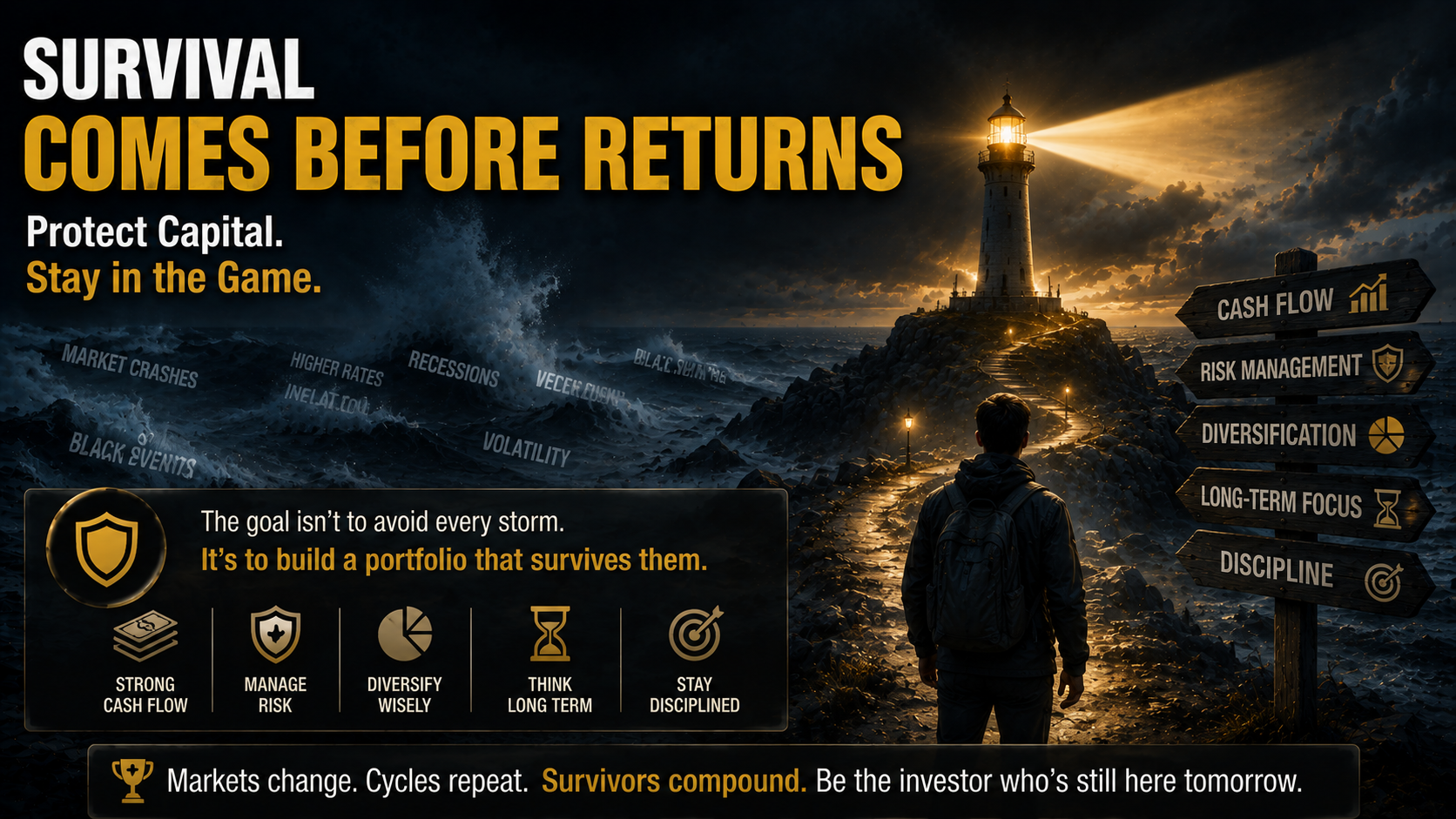
They are designed to improve the probability of surviving an unpredictable future.
The Most Important Investing Lesson From Survivorship Bias
Investors always analyze history after the outcome is already known.
That makes the past look much more obvious than it really was.
Today's dominant technology companies were once merely competitors among many other businesses.
Today's legendary investors once operated without knowing how their decisions would eventually turn out.
Today's successful assets survived countless periods when failure was possible.
The market we see today is therefore not a complete picture of the past.
It is the result left behind after countless failures were removed.
That means studying winners alone is not enough.
To understand what creates durable success, investors must also study the competitors, strategies, and portfolios that disappeared.
Sometimes failure contains more useful information than success.
Final Thoughts
Investors naturally study successful people, successful companies, and successful strategies.
There is nothing wrong with learning from winners.
The mistake is assuming their stories represent the full distribution of possible outcomes.
Abraham Wald's aircraft problem offers a powerful lesson for investors.
Do not look only at the bullet holes on the airplanes that returned.
Ask what happened to the airplanes that never came home.
In financial markets, the same questions apply
Who succeeded?
Who disappeared?
What separated them?
What is missing from the dataset?
And most importantly
If my forecast is wrong, can I remain in the game?
The key lesson to remember is simple
The winners we see are only part of the story. Investing is not merely about identifying yesterday's winners—it is about understanding why others failed and building a portfolio capable of surviving long enough to reach the next opportunity.
This was MasterMind.
'[Global] Success Blueprints' 카테고리의 다른 글