Are Interest Rate Cuts Always Good for Stocks? How Fed Rate Cuts Affect the Stock Market and Asset Prices


Hello, this is MasterMind.
When the Federal Reserve begins cutting interest rates, investors often assume the message is straightforward: lower rates mean easier financial conditions, more liquidity, and higher stock prices.
That logic is not entirely wrong.
Lower interest rates can reduce borrowing costs, increase the present value of future corporate cash flows, and make stocks more attractive relative to cash and newly issued bonds. Growth stocks, in particular, can benefit when discount rates fall.
But there is a major problem with the simple formula
Fed rate cut = stocks go up.
History has repeatedly shown that stocks can fall sharply even after the Federal Reserve begins cutting rates.
So the real question is not simply whether the Fed is cutting rates.
It is
Why is the Fed cutting rates in the first place?
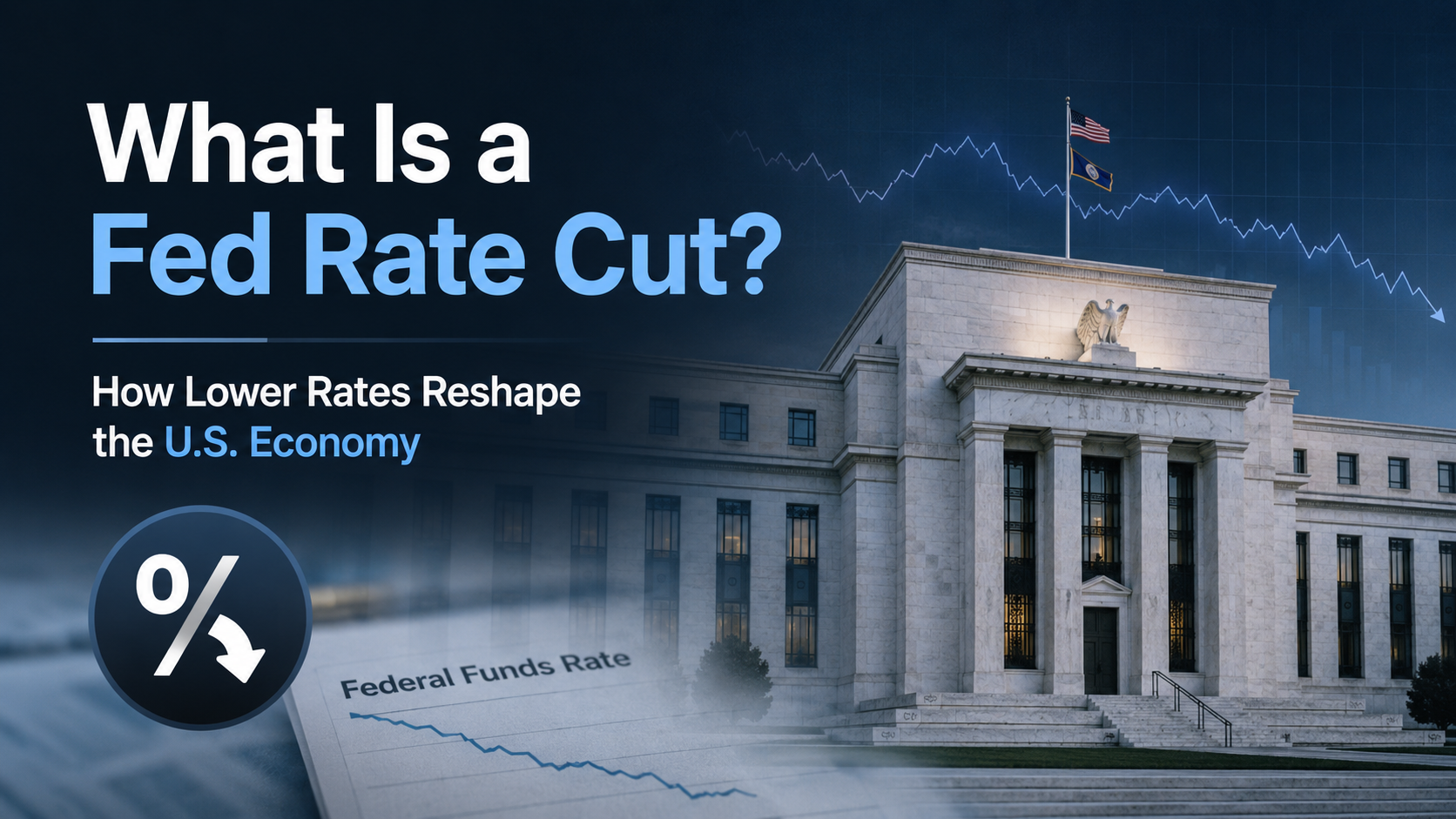
Key Takeaway
Interest rate cuts can create a favorable environment for stocks, but their market impact depends heavily on why the Federal Reserve is cutting. Rate cuts during a soft landing can support equities, while aggressive cuts triggered by recession or financial stress may not be enough to offset falling corporate earnings and rising credit risk.
1. What Is an Interest Rate Cut?
An interest rate cut occurs when a central bank lowers its benchmark policy rate.
In the United States, monetary policy is set by the Federal Reserve, with the federal funds rate serving as the primary policy-rate target.
The federal funds rate does not directly determine every interest rate in the economy, but it influences financial conditions across the system.
Changes in Fed policy can affect
- Treasury yields
- Bank lending rates
- Corporate borrowing costs
- Mortgage rates
- Consumer credit
- Asset valuations
- The U.S. dollar
- Investor risk appetite
This is why Federal Reserve policy matters far beyond Wall Street.
Interest rates are essentially the price of money.
When that price falls, borrowing can become cheaper and financial conditions may become more supportive of economic activity.
However, one important distinction is often overlooked.
Rate Cuts Are Not the Same as Money Printing
A Fed rate cut does not automatically mean that the central bank is injecting an equivalent amount of new money into the financial system.
Rate cuts primarily change the cost of money.
Actual liquidity conditions also depend on factors such as bank lending, private-sector credit demand, the Federal Reserve's balance sheet, Treasury operations, and broader financial conditions.
This distinction becomes especially important during recessions.
Even when the Fed cuts rates aggressively, banks may tighten lending standards while businesses and households become reluctant to borrow.
Cheaper money does not necessarily mean that credit will flow freely.
2. How Do Fed Rate Cuts Affect the Economy?
Monetary policy works through several transmission channels.
A simplified sequence looks like this
Fed cuts rates
↓
Borrowing costs face downward pressure
↓
Household and corporate financial conditions improve
↓
Consumption and investment may strengthen
↓
Asset valuations adjust
↓
Economic activity responds over time
The key phrase is over time.
Monetary policy does not immediately transform the real economy. Its effects often operate with a lag.
Lower Borrowing Costs
Companies regularly borrow money to build factories, invest in technology, fund acquisitions, refinance debt, and expand operations.
When borrowing costs fall, companies may be able to refinance debt at lower rates or fund new projects more cheaply.
All else being equal, lower interest expenses can improve net income and free cash flow.
Households may also benefit if borrowing costs on mortgages, auto loans, and other forms of credit decline.
That can eventually support consumer spending.
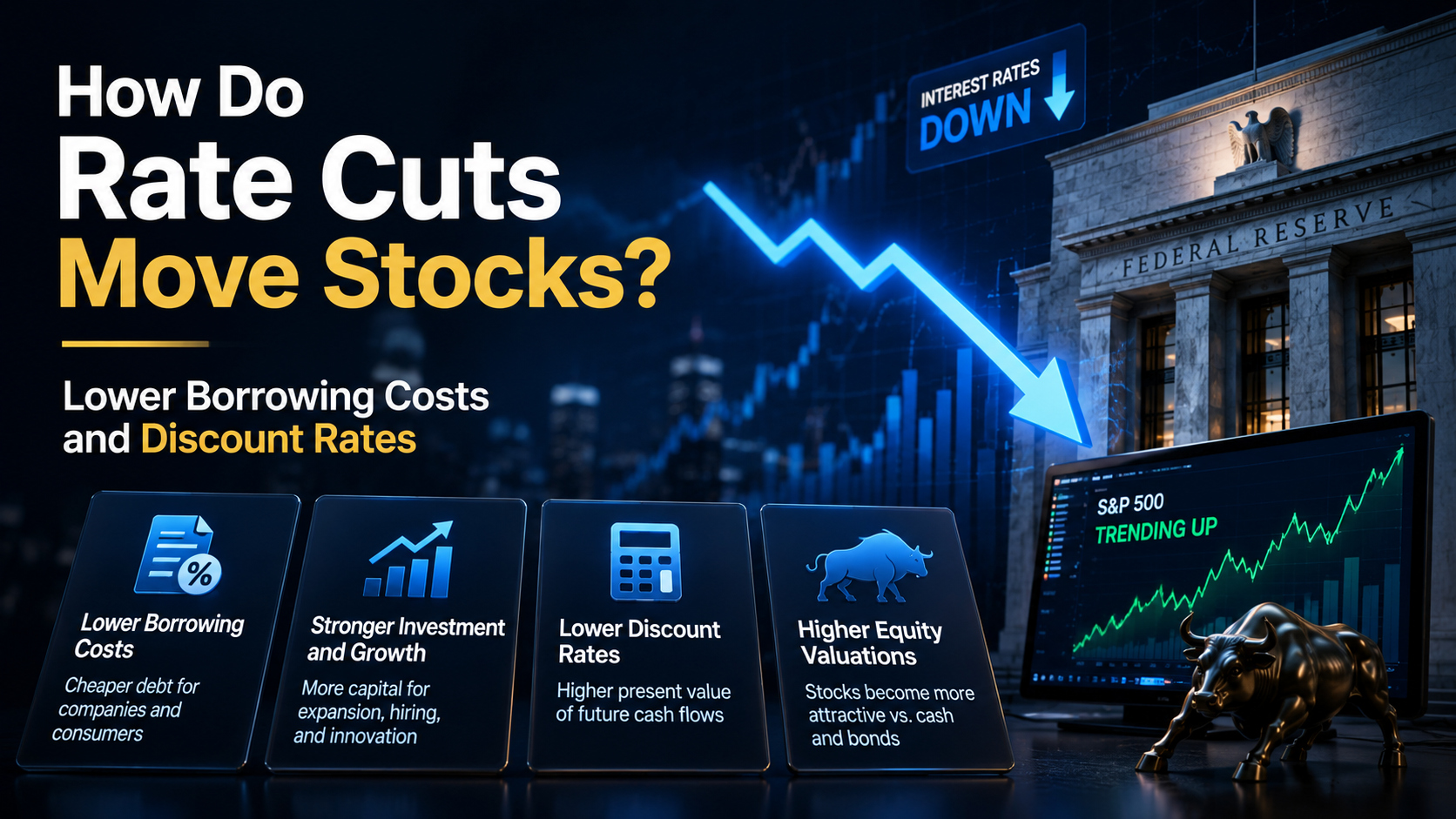
Lower Discount Rates
This is one of the most important links between interest rates and stock valuations.
A stock represents a claim on a company's future cash flows.
But a dollar earned ten years from now is not worth the same as a dollar received today.
Investors therefore discount future cash flows back to their present value.
When interest rates and required returns decline, the discount rate used in valuation models may also decline.
That increases the present value of future cash flows, all else being equal.
This helps explain why long-duration growth stocks—companies whose valuations depend heavily on profits expected far into the future—can be particularly sensitive to changes in interest rates.
Changes in Relative Asset Attractiveness
When short-term interest rates are high, investors can earn relatively attractive yields from Treasury bills, money market funds, and other lower-risk instruments.
That raises the opportunity cost of owning riskier assets.
When rates decline, yields on newly issued short-term instruments eventually become less attractive.
Some investors may then move further out on the risk spectrum toward longer-duration bonds, equities, real estate, or alternative assets.
This is one reason rate cuts can change capital flows across financial markets.
3. Why Do Investors Care So Much About Rate Cuts?
Interest rates can be thought of as a form of financial gravity.
When rates are high, that gravity becomes stronger.
Companies face higher financing costs, future earnings are discounted more heavily, and investors have more attractive alternatives to stocks.
When rates fall, some of that gravitational pressure weakens.
But stock prices are not determined by discount rates alone.
They also depend on the amount of cash companies are expected to generate.
That creates two competing forces.
Lower interest rates → lower discount rates → potentially higher valuations
But at the same time
Economic weakness → lower revenue and earnings → potentially lower valuations
The stock market ultimately reflects the balance between these forces.
The real market question is not simply whether rates are rising or falling. It is whether interest rates, economic growth, corporate earnings, liquidity, and expectations are moving in a combination that supports asset prices.
4. Why Aren't Rate Cuts Always Bullish for Stocks?
Not all rate-cutting cycles are created equal.
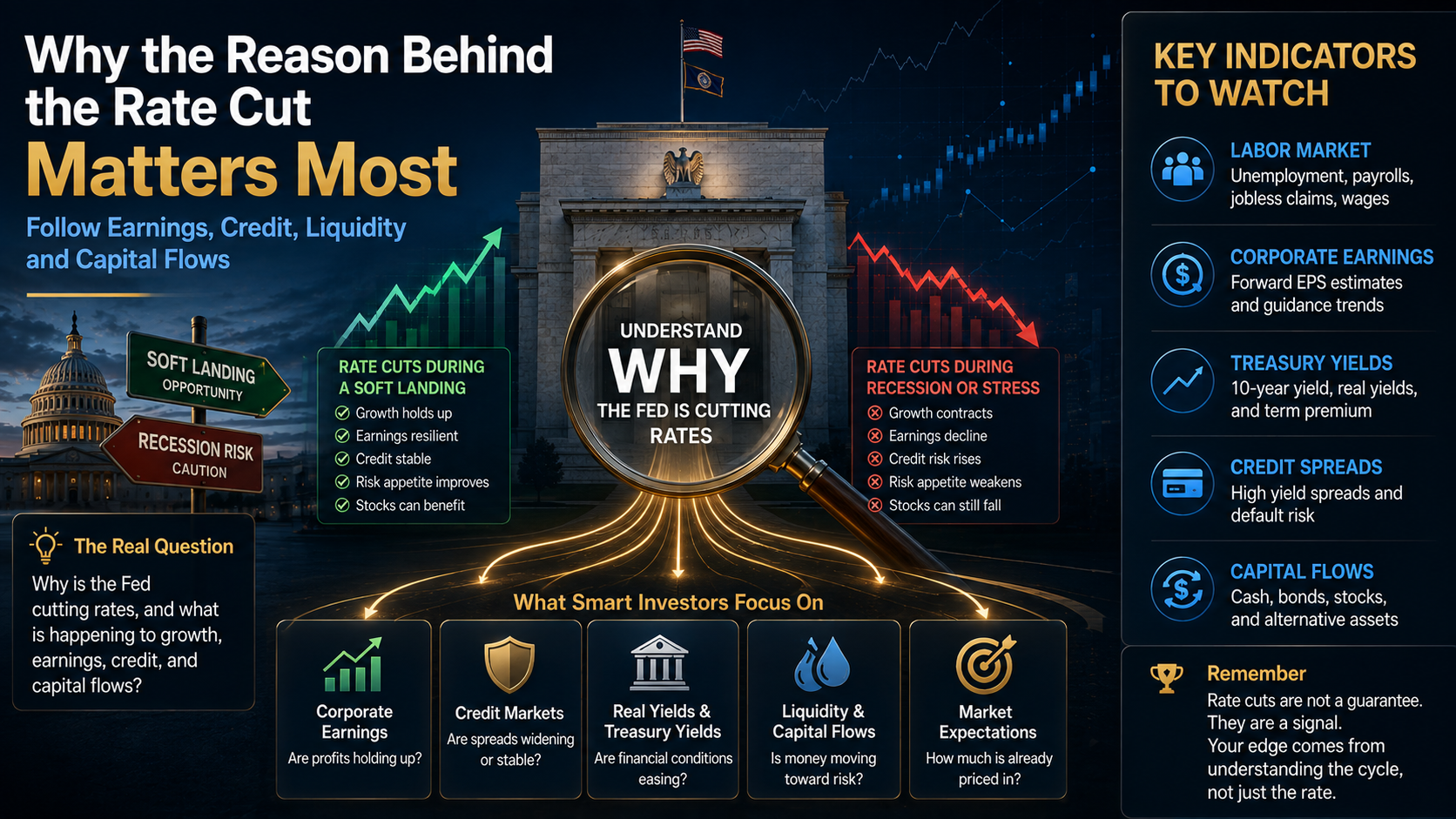
For investors, one of the most useful distinctions is between insurance cuts and recessionary cuts.
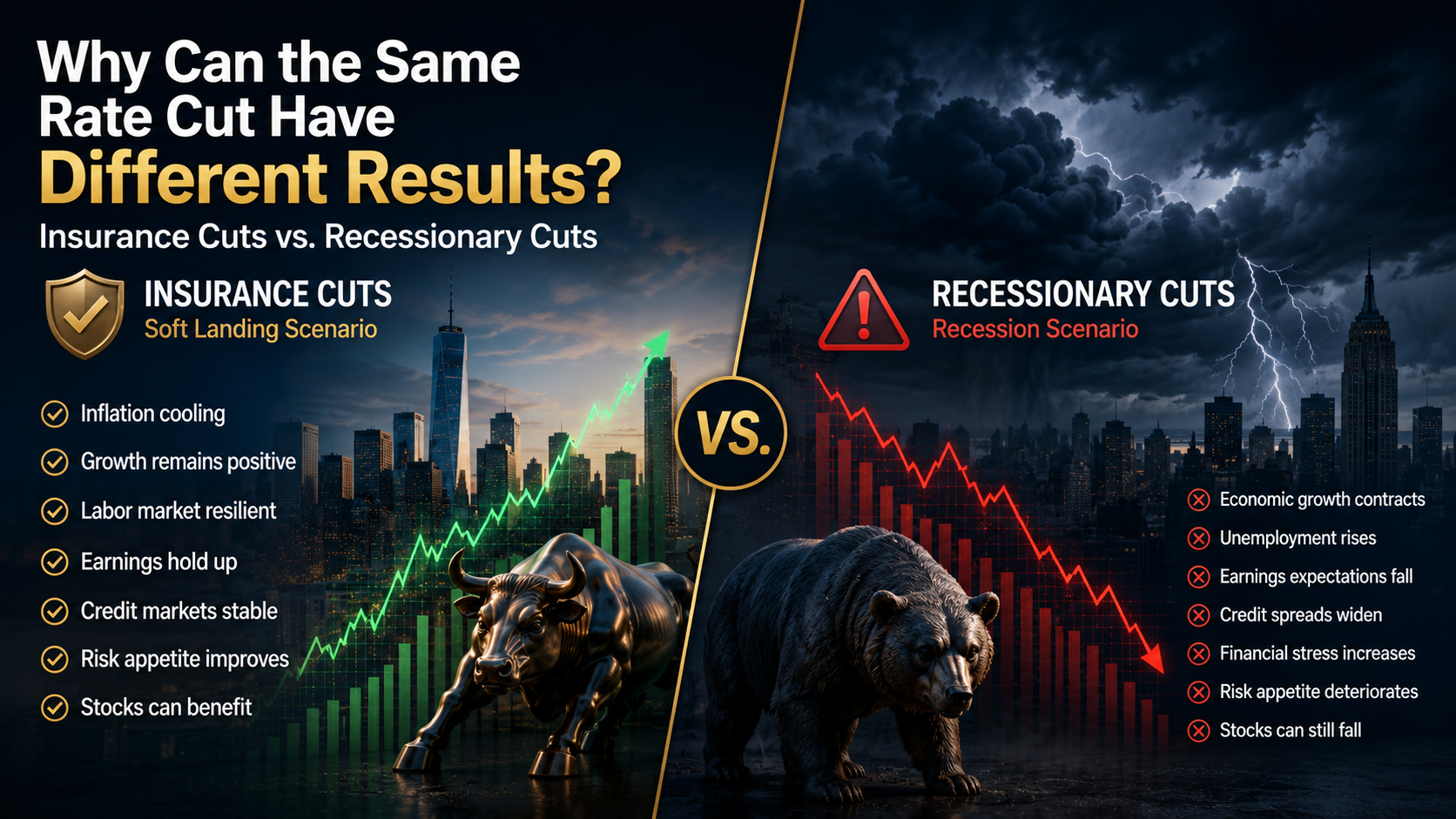
Insurance Cuts
An insurance cut occurs when the Federal Reserve lowers rates while the economy remains relatively healthy.
Inflation may be cooling, labor-market conditions may be normalizing, and growth may be slowing without collapsing.
The Fed can then reduce some of its monetary restraint before serious economic damage occurs.
This can create an attractive combination for equities
Cooling inflation + continued economic growth + resilient earnings + lower interest rates
This environment is closely associated with the market's preferred scenario: a soft landing.
In a soft landing, inflation returns toward a more sustainable level without the economy falling into a severe recession.
If corporate profits remain resilient while interest rates decline, stocks can benefit from both lower discount rates and continued earnings growth.
Recessionary Cuts
The situation is very different when the Fed is cutting because the economy is already deteriorating rapidly.
Unemployment may be rising.
Consumer spending may be weakening.
Corporate earnings estimates may be falling.
Credit defaults may be increasing.
Banks may also become more cautious about lending.
Under these conditions, the Fed can cut rates aggressively and stocks can still decline.
Why?
Because deteriorating earnings and rising credit risk can overwhelm the positive valuation effect of lower rates.
The battle becomes
Lower rates and easier policy
versus
Falling earnings and worsening economic conditions
If earnings deteriorate faster than financial conditions improve, stocks may continue falling even while the Fed is cutting.
| Factor | Soft-Landing / Insurance Cuts | Recessionary Cuts |
| Economic growth | Slows but remains positive | Deteriorates sharply |
| Labor market | Gradual cooling | Rising unemployment |
| Corporate earnings | Relatively resilient | Earnings decline risk |
| Credit markets | Generally stable | Spreads may widen |
| Fed policy | Gradual normalization | Aggressive easing |
| Risk appetite | Can improve | Can deteriorate |
| Equity environment | Potentially favorable | Higher downside and volatility risk |
That is why investors should not simply ask
“Is the Fed cutting rates?”
The better question is
“What economic problem is forcing the Fed to cut rates?”
5. How Rate Cuts Affect Stocks, Bonds, the Dollar, Gold, and Bitcoin
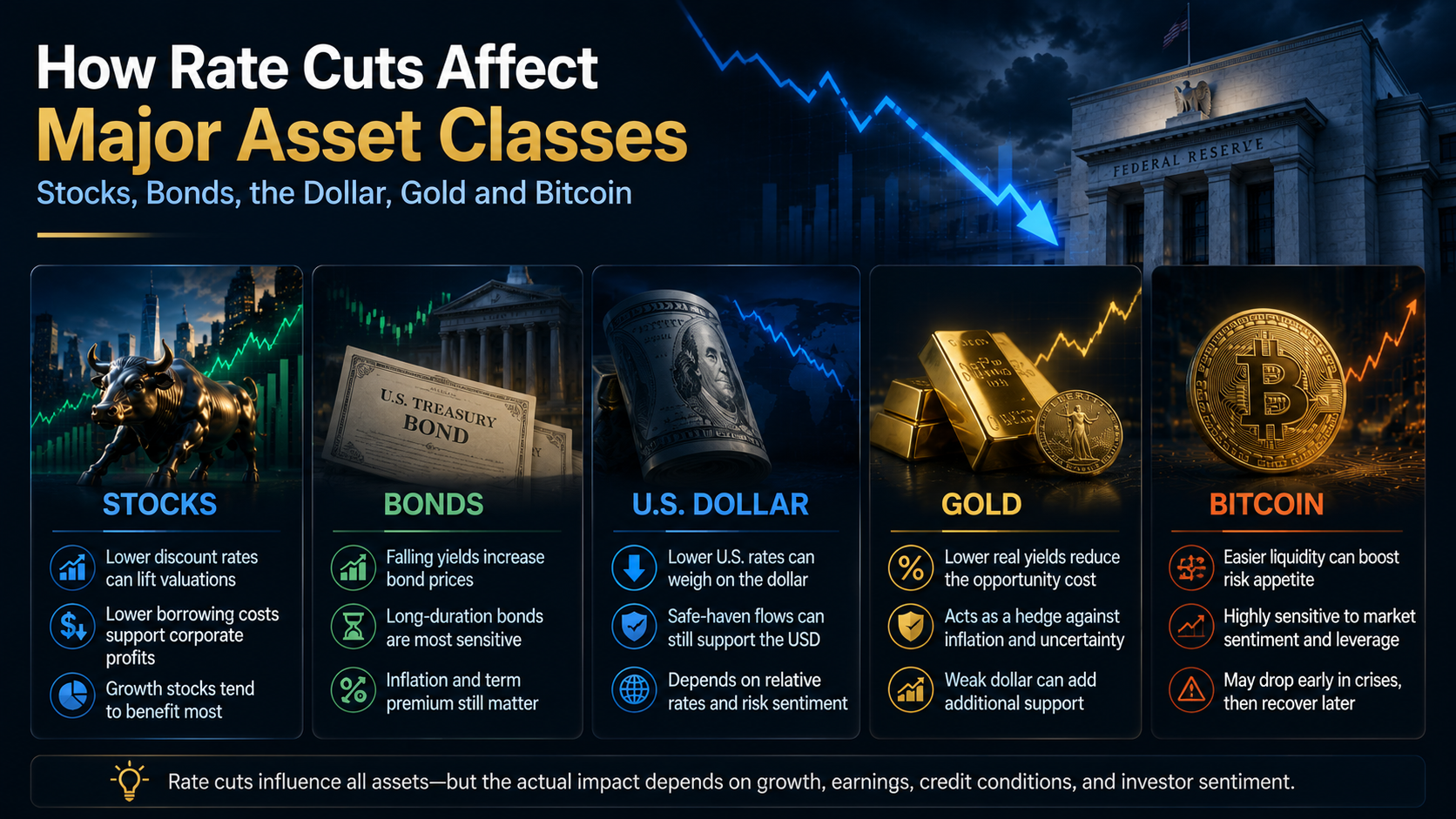
A Federal Reserve easing cycle can affect nearly every major asset class.
But none of these relationships should be treated as mechanical rules.
| Asset | Typical Effect of Lower Rates | Key Variables to Watch |
| U.S. stocks | Potentially positive | Earnings and economic growth |
| Bonds | Existing bond prices may benefit | Inflation and term premium |
| U.S. dollar | Potential downside pressure | Relative global rates and risk aversion |
| Gold | Can become more attractive | Real yields and the dollar |
| Bitcoin | May benefit from easier liquidity | Risk appetite and financial conditions |
U.S. Stocks
If the U.S. economy remains resilient while rates decline, equities can benefit from lower discount rates, reduced financing costs, and improved risk appetite.
Growth stocks can be especially sensitive because a larger portion of their expected value comes from cash flows far in the future.
But falling rates cannot indefinitely compensate for collapsing earnings.
If analysts continue cutting EPS estimates because the economy is entering recession, equity valuations may remain under pressure despite easier Fed policy.
U.S. Treasuries and Bonds
Falling market yields generally increase the value of existing fixed-rate bonds.
Long-duration bonds tend to be more sensitive to changes in interest rates.
However, investors should not assume that Fed rate cuts automatically force the 10-year Treasury yield lower by the same amount.
Long-term Treasury yields also reflect
- Inflation expectations
- Real growth expectations
- Treasury supply
- Fiscal conditions
- Term premium
- Investor demand for duration
The Fed controls the short end of the policy framework much more directly than the entire Treasury yield curve.
U.S. Dollar
Lower U.S. interest rates can reduce the yield advantage of dollar-denominated assets relative to assets in other countries.
That can put downward pressure on the U.S. dollar.
But this relationship can reverse during periods of severe global stress.
When investors urgently seek liquidity and safety, demand for dollars and U.S. assets can increase even while the Fed is cutting rates.
Therefore
Fed cuts do not automatically equal a weaker dollar.
Gold
Gold does not generate interest income.
As a result, the opportunity cost of holding gold tends to decline when real interest rates fall.
For gold investors, the more important variable is often not the nominal federal funds rate itself but the direction of real yields.
A combination of falling real yields and a weaker dollar can create a supportive environment for gold.
Bitcoin
Bitcoin does not have traditional corporate cash flows, so conventional discounted cash flow models are difficult to apply.
Its price can instead be highly sensitive to global liquidity, investor risk appetite, leverage, and market sentiment.
An easing cycle that improves liquidity and encourages risk-taking can create a more favorable backdrop for Bitcoin.
However, during the early stages of a financial crisis, investors may sell volatile assets to raise cash.
That means Bitcoin can initially fall even while central banks are easing policy.
Once again, context matters more than the rate cut itself.
6. What Should Investors Watch During a Fed Rate-Cutting Cycle?
The Fed announcement is only one part of the story.
Several indicators can help investors determine what kind of rate-cutting cycle is developing.
1. The Labor Market
Watch the unemployment rate, payroll growth, jobless claims, hiring activity, and wage growth.
A gradual cooling in employment can be consistent with a soft landing.
A rapid deterioration in labor conditions may indicate that the Fed is responding to a deeper economic slowdown.
2. Corporate Earnings
For equity investors, this may be even more important than the rate cut itself.
Stocks ultimately represent claims on corporate cash flows.
If interest rates are falling while forward EPS estimates remain stable or rise, the environment can be supportive.
If rates are falling while earnings expectations collapse, the market faces a very different situation.
3. Long-Term Treasury Yields and Real Yields
The federal funds rate does not tell investors everything about financial conditions.
Watch the 10-year Treasury yield and real yields.
If the Fed is cutting but long-term yields remain elevated, markets may be concerned about persistent inflation, fiscal deficits, Treasury issuance, or a rising term premium.
4. Credit Spreads
Credit markets can reveal stress before it becomes obvious in headline economic data.
When investors become worried about corporate defaults, the yield spread between corporate bonds and comparable Treasuries can widen.
If the Fed is cutting rates while credit spreads are rapidly widening, financial conditions may not actually be improving as much as the policy rate suggests.
5. What the Market Has Already Priced In
Financial markets are forward-looking.
By the time the Federal Reserve officially announces a rate cut, investors may have been anticipating it for months.
The important question is therefore not simply whether the Fed cuts.
It is whether the actual path of monetary policy is more or less dovish than markets already expected.
This is one of the most important principles in investing
Markets do not simply trade good news and bad news. They trade the difference between expectations and reality.
7. Where Does Money Move When Rates Fall?
To understand a rate-cutting cycle, investors should follow capital flows rather than focusing only on stock indexes.
When short-term rates are high, cash-like instruments can become unusually attractive.
Investors may hold substantial amounts of capital in
- Treasury bills
- Money market funds
- Short-duration fixed income
- High-yield savings products
As policy rates decline, the yields available on newly issued short-term instruments may gradually fall as well.
Investors then face a new allocation decision.
Some capital may move into longer-duration Treasuries.
Some may move into equities.
Some may move into gold, real estate, or alternative assets.
But there is no rule saying that money leaving cash must immediately enter the stock market.
During a recession or financial crisis, investors may value liquidity and capital preservation more than potential returns.
The key question is therefore not simply
“Is there more liquidity?”
It is
“Is that liquidity willing to take risk?”
8. Three Common Misconceptions About Rate Cuts
“The Fed Is Cutting, So Stocks Must Rise”
Not necessarily.
Lower discount rates can support valuations, but declining corporate earnings can overwhelm that effect.
“Rate Cuts Automatically Create More Liquidity”
Rate cuts make money cheaper, but they do not guarantee stronger credit creation.
Banks may tighten lending standards during recessions, while households and businesses may become reluctant to borrow.
The price of credit can fall while the availability or demand for credit remains weak.
“Investors Can Wait Until the First Rate Cut”
Markets often move before policy changes become official.
Bond yields, equity valuations, and rate expectations can adjust months before the Federal Reserve acts.
By the time the first cut arrives, a substantial portion of the expected easing cycle may already be reflected in asset prices.
9. What Do Long-Term Investors Look for During Rate Cuts?
Large, long-term pools of capital tend to view a rate cut less as an automatic buy signal and more as evidence that the macroeconomic environment is changing.
Follow the Money
Where is capital actually moving?
Is money leaving short-term cash instruments for longer-duration bonds?
Are investors increasing exposure to equities?
Or is demand for defensive assets still rising?
Capital flows can provide clues about how investors are interpreting the Fed's actions.
Focus on Cash Flow
Lower rates can reduce financing costs, but not every company deserves a higher valuation simply because money becomes cheaper.
A stronger question is whether the business can generate durable free cash flow even if economic conditions deteriorate.
Companies that depend continuously on cheap external financing may remain vulnerable even during an easing cycle.
Test Balance-Sheet Resilience
Recessionary rate cuts can expose weak balance sheets.
Investors should consider debt maturities, interest coverage, liquidity, free cash flow, competitive positioning, and the durability of demand.
Some companies may do more than simply survive a downturn.
Financially strong businesses can sometimes gain market share when weaker competitors are forced to retreat.
Think in Cycles, Not Fed Meetings
The daily market reaction to an FOMC announcement can attract enormous attention.
Long-term investors should focus on the larger transition
Is inflation falling?
Is growth stabilizing?
Are earnings holding up?
Are credit markets healthy?
Are real yields declining?
Is liquidity moving toward or away from risk?
These questions matter more than whether the S&P 500 rises or falls immediately after a Fed decision.
Investors can ask themselves
- Is the Fed cutting because inflation is normalizing or because growth is collapsing?
- Are corporate earnings estimates holding up as rates fall?
- Are Treasury yields and real yields confirming easier financial conditions?
- Are credit spreads stable or widening?
- Is capital moving toward risk assets or toward safety?
- Can the companies I own generate cash through a downturn?
- How much Fed easing is already priced into markets?
- Would these assets survive if the downturn lasts longer than expected?
Investing is not about perfectly predicting every Fed decision.
It is about owning assets and building a portfolio that can survive when the forecast is wrong.
10. Final Thoughts
Federal Reserve rate cuts can create powerful tailwinds for financial markets.
Lower rates can reduce financing costs, lower discount rates, improve financial conditions, and change the relative attractiveness of stocks, bonds, cash, gold, and other assets.
But a Fed rate cut does not guarantee a bull market.
A gradual easing cycle driven by cooling inflation and resilient growth is fundamentally different from emergency rate cuts triggered by recession, financial stress, and collapsing corporate earnings.
That is why investors should look beyond the federal funds rate itself.
Labor conditions, earnings expectations, Treasury yields, real yields, credit spreads, liquidity, and market expectations all help reveal what kind of easing cycle is actually taking place.
The most important question is therefore not
“How much will the Fed cut?”
It is
“Why is the Fed cutting, and what is happening to growth, earnings, credit, and capital flows while rates are falling?”
Interest rates are one of the most powerful forces in financial markets, but they never operate in isolation.
The deeper market story is always the interaction between rates, growth, earnings, liquidity, credit, and expectations.
And for long-term investors, the goal is not to predict every turn in the interest-rate cycle.
It is to understand which assets can survive—and potentially emerge stronger—when the economic environment does not unfold as expected.
This was MasterMind.
'[Global] Success Blueprints' 카테고리의 다른 글