Investor Psychology: How Great Investors Overcome Psychological Biases


Hello, this is MasterMind.
Why do investors often feel safest buying after prices have already surged—and most desperate to sell after markets have already collapsed?
It happens even to people who understand financial statements, valuation models, interest rates, and economic indicators.
The problem is not always a lack of knowledge.
Investors are human. We naturally hate losses, become more confident after recent gains, look for information that confirms what we already believe, and feel uncomfortable watching everyone else make money while we sit on the sidelines.
When the S&P 500 or Nasdaq keeps setting new highs, fear can disappear precisely when valuations and expectations are becoming more demanding. When markets fall sharply, the same investors may suddenly perceive stocks as dangerous precisely because prices have already declined.
This is why investor psychology matters.
The difference between an experienced investor and an inexperienced one is not the absence of emotion.
It is whether the investor has built a decision-making process that prevents fear, greed, and cognitive bias from controlling the portfolio.
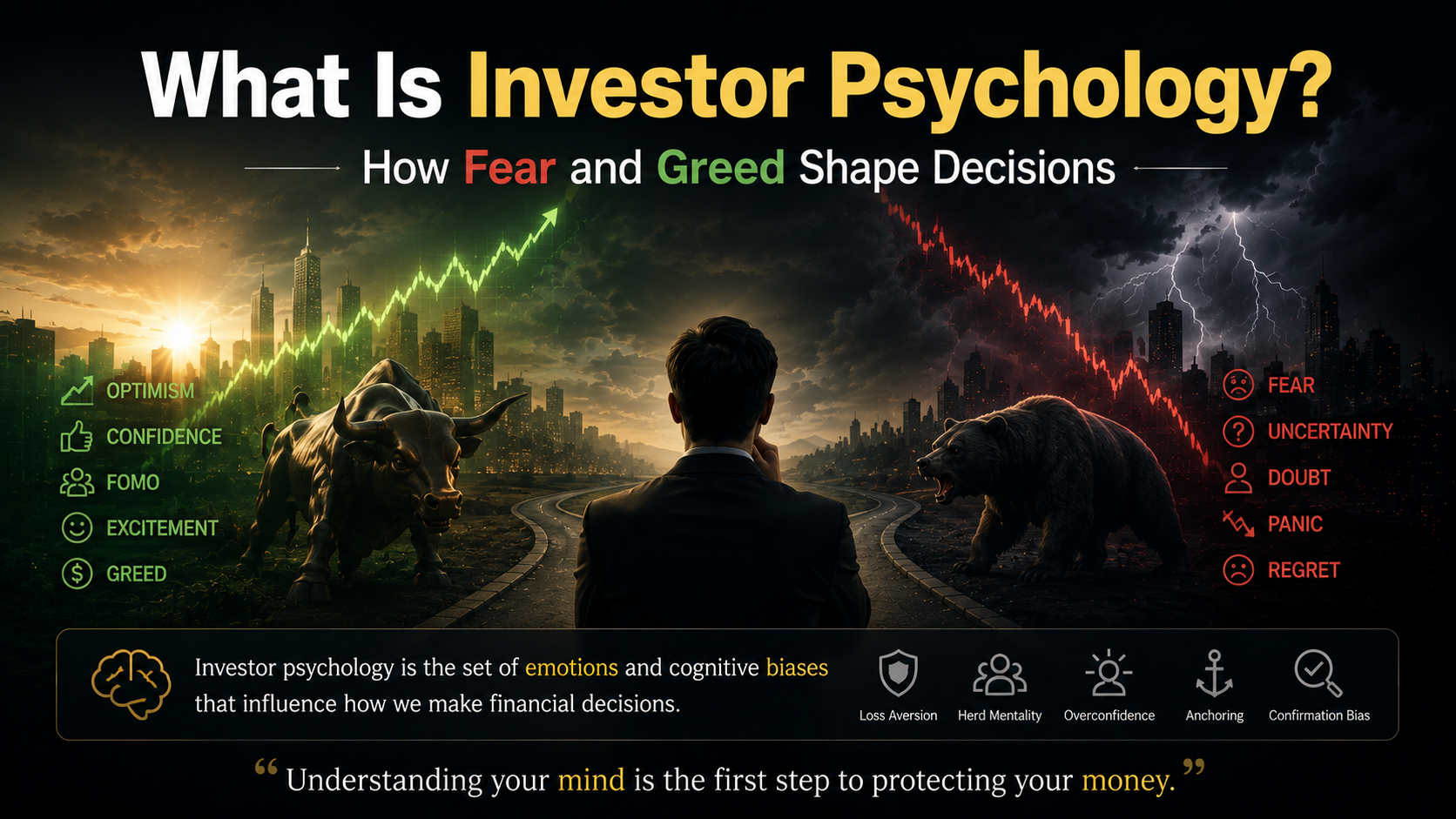
The Key Takeaway
Successful investing is less about predicting every market move and more about controlling behavioral biases, managing risk, and surviving when your forecast is wrong.
What Is Investor Psychology?
Investor psychology refers to the emotions, cognitive biases, and behavioral tendencies that influence financial decisions.
Traditional finance often assumes that investors process information rationally.
Real markets are messier.
People react to gains and losses differently. They anchor to previous prices. They follow crowds. They extrapolate recent performance into the future. And once they own an investment, they may evaluate it differently simply because it belongs to them.
Our brains were not designed to maximize risk-adjusted returns in modern financial markets.
They evolved to respond quickly to danger, remember recent threats, protect what we already possess, and pay attention to what the group around us is doing.
Those instincts can be useful in everyday life.
In markets, however, they can create expensive mistakes.
The Most Common Psychological Traps in Investing
| Psychological Bias | Typical Investor Behavior | Potential Risk |
| Loss Aversion | Avoiding the realization of a loss | Holding deteriorating investments too long |
| FOMO | Chasing rapidly rising assets | Buying after expectations are already elevated |
| Herd Mentality | Following what other investors are doing | Joining bubbles or panic selling |
| Confirmation Bias | Seeking information that supports an existing thesis | Ignoring evidence that the thesis is weakening |
| Anchoring | Fixating on a purchase price or previous high | Distorting current valuation decisions |
| Endowment Effect | Valuing an asset more because you own it | Becoming emotionally attached to holdings |
| Recency Bias | Assuming recent trends will continue | Excessive optimism near peaks and pessimism near bottoms |
| Halo Effect | Assuming a great company must be a great stock | Ignoring valuation |
| Survivorship Bias | Studying winners while overlooking failures | Underestimating the true risk of a strategy |
| Overconfidence | Overestimating forecasting or stock-picking ability | Excessive trading, concentration, or leverage |
The important point is that these biases rarely operate independently.
Imagine a hot technology sector rising rapidly.
Recency bias tells investors the rally will probably continue.
FOMO makes them uncomfortable staying on the sidelines.
Herd behavior becomes stronger as friends, financial media, and social networks focus on the same winners.
After buying, the endowment effect can make investors emotionally attached to their positions.
If prices then fall, confirmation bias encourages them to search for bullish information while loss aversion makes it psychologically difficult to reconsider the investment.
One behavioral mistake can therefore reinforce another.
How Investor Psychology Moves Markets
Financial assets are not priced solely on what businesses earn today.
Prices also reflect expectations about tomorrow.
That means market prices can be thought of as a combination of fundamentals, expectations, liquidity, and investor behavior.
A typical bullish psychological cycle might look like this
Positive narrative
→ Capital inflows
→ Rising prices
→ Strong recent returns
→ Increasing confidence
→ More capital inflows
→ Valuation expansion
The process can become self-reinforcing.
Rising prices create evidence that the bullish thesis is correct. Investors become more comfortable taking risk, and money moves from cash and defensive assets toward stocks, speculative growth companies, cryptocurrencies, and other risk-sensitive assets.
But the higher expectations rise, the harder they become to exceed.
The cycle can eventually reverse
Elevated expectations
→ Earnings disappointment or macro shock
→ Falling prices
→ Rising fear
→ Capital outflows
→ Forced selling or panic
→ Valuation compression
The underlying business may not have changed by 20% overnight, yet its stock price can move by that amount.
Why?
Because markets price not only current reality but also expectations about future reality.
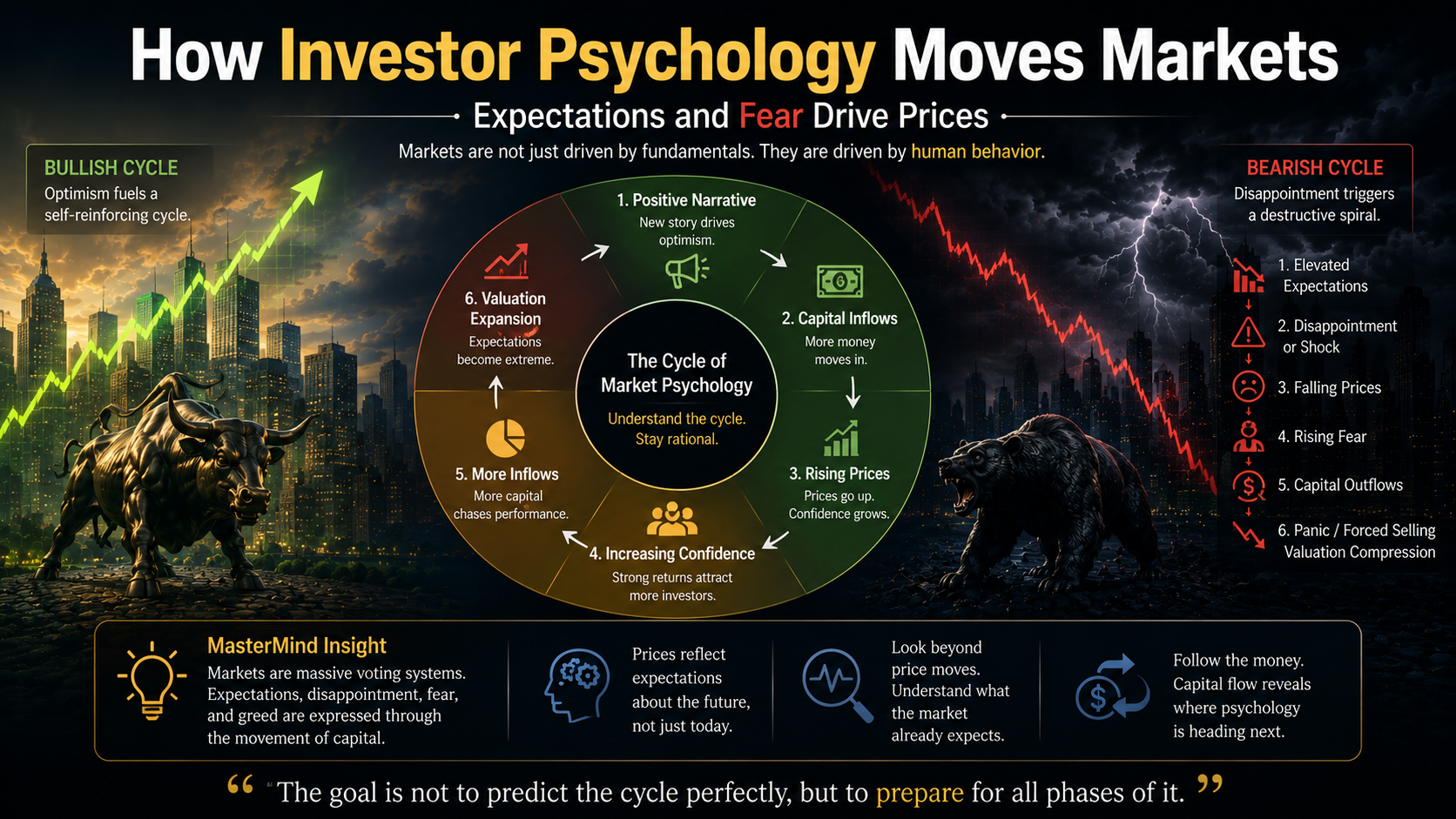
MasterMind Insight
Markets are not cold calculators. They are massive voting systems in which expectations, disappointment, fear, and greed are expressed through the movement of capital.
That is why understanding markets requires more than reading economic data.
Investors also need to ask what the market already expects, how much optimism or pessimism is embedded in prices, and where money is actually moving.
Why Great Investors Think in Probabilities, Not Certainties
Financial commentary often sounds certain.
“The economy is heading into recession.”
“The Fed will cut rates, so stocks will rally.”
“AI stocks are in a bubble.”
“The next bull market has begun.”
Real markets rarely offer that level of certainty.
The U.S. economy could experience a soft landing. Growth could reaccelerate. Inflation could return. Corporate earnings could surprise to the upside or deteriorate faster than expected.
Experienced investors therefore tend to ask a different question
What happens to my portfolio if my base case is wrong?
A useful framework is to think in scenarios.
Base Case
Economic growth and corporate earnings evolve roughly as expected.
Bull Case
Growth, productivity, margins, or financial conditions turn out better than the market currently expects.
Bear Case
Economic growth weakens, inflation returns, interest rates remain restrictive, or corporate earnings disappoint.
This changes the objective of investing.
Instead of building a portfolio that works only if one forecast is correct, the goal becomes building one that can survive multiple possible futures.
That is the essence of probabilistic thinking.

Great Investors Try to Disprove Their Own Ideas
Confirmation bias is especially dangerous because it often feels like research.
Suppose you become bullish on a company.
You begin reading its earnings reports, watching interviews with management, following analysts who like the stock, and consuming information about the industry's growth potential.
Eventually, nearly everything you see appears to support the investment.
But that may not mean the thesis is getting stronger.
It may mean your information environment is becoming narrower.
A more disciplined question is
If I am wrong, what is the most likely reason?
For a high-growth U.S. company, that could mean asking
- Is the total addressable market smaller than investors assume?
- Am I underestimating competitors?
- Is revenue growing while free cash flow deteriorates?
- Are stock-based compensation or capital expenditures masking weak economics?
- Am I paying too much simply because this is an exceptional company?
- Has the market already priced several years of strong growth into today's valuation?
This is not pessimism.
It is a stress test.
A strong investment thesis should be able to survive serious attempts to disprove it.
Separate Your Purchase Price From the Investment's Value
One of the most powerful anchors in investing is the price you paid.
Suppose an investor buys a stock at $100 and it falls to $70.
A common reaction is
“I'll sell when it gets back to $100.”
But the market does not know or care that you paid $100.
If new information suggests the company is worth substantially less, your original purchase price has little economic relevance.
Likewise, if the long-term value of the business has increased significantly, reaching your original purchase price does not automatically mean the investment should be sold.
A useful question is
If I owned no shares today and had the equivalent amount in cash, would I buy this stock at its current price?
That question helps expose both anchoring and the endowment effect.
Your cost basis is part of your personal history.
The relationship between price and future value is what matters to the investment decision.
Losing Money and Taking Risk Are Not the Same Thing
Loss aversion makes declining prices feel dangerous.
But a falling price and rising fundamental risk are not necessarily the same thing.
Suppose the S&P 500 falls because investors suddenly demand higher risk premiums, while the long-term earnings power of many businesses remains intact.
Prices are lower, but that does not automatically mean those businesses have become worse.
In some cases, expected future returns may actually improve because valuations have declined.
The opposite can also happen.
A stock that rises 100% may feel safer because everyone is making money.
But if its price rises much faster than its earnings and free cash flow, valuation risk may be increasing rather than decreasing.
This is why investors should ask
Did the price change because the underlying value changed—or because market psychology changed?
The answer will not always be obvious, but asking the question itself improves the decision-making process.
Great Investors Judge the Process, Not Just the Outcome
A profitable investment is not automatically a good decision.
Imagine buying a speculative stock without analyzing the business, simply because it has been rising.
The stock gains another 50%.
The outcome was excellent.
The process was not.
The reverse can also happen.
An investor can perform careful research, manage position size responsibly, identify the major risks, and still lose money because an unpredictable event occurs.
Why does this distinction matter?
Because good outcomes can reinforce bad habits.
If highly speculative bets succeed several times in a row, an investor may conclude that the gains came entirely from skill.
Position sizes increase.
Leverage rises.
Risk controls disappear.
Eventually, one sufficiently large mistake can erase years of previous gains.
Long-term investing therefore requires a process that can be repeated across different market environments.
Luck can produce a winning trade.
It cannot reliably produce a durable investment system.
A Great Company Is Not Automatically a Great Stock
This is where the halo effect becomes particularly important.
A company can have outstanding products, visionary leadership, a powerful brand, strong margins, and enormous long-term growth potential.
None of that automatically tells you whether its stock is attractive at today's price.
U.S. markets repeatedly demonstrate this distinction.
The best businesses often command premium valuations precisely because millions of investors already recognize their quality.
The question is therefore not simply
Is this a great company?
It is also
How much am I paying for that greatness?
A brilliant business can become a disappointing investment if the purchase price assumes an unrealistically perfect future.
Conversely, an ordinary business purchased at an unusually pessimistic valuation may produce a very different risk-return profile.
Quality matters.
Price matters too.
How Fear and Greed Affect Major Asset Classes
Investor psychology influences the movement of capital across the entire financial system.
| Asset Class | Risk-On / Greed Environment | Risk-Off / Fear Environment |
| U.S. Growth Stocks | Valuation expansion and stronger speculative demand | Multiple compression and potential capital outflows |
| U.S. Treasuries | Can lose relative appeal when growth and risk appetite rise | May attract safe-haven demand during growth scares |
| U.S. Dollar | Can face pressure during strong global risk appetite | Often benefits from demand for liquidity and safety |
| Gold | Influenced by real yields, inflation expectations, and the dollar | Can benefit from uncertainty and safe-haven demand |
| Bitcoin / Crypto | Can benefit strongly from abundant liquidity and risk appetite | Often vulnerable to liquidity contraction and deleveraging |
These relationships are not mechanical.
For example, during the early phase of an extreme liquidity crisis, investors may sell almost anything—including assets normally considered defensive—simply to raise cash.
That is why investors should not stop at labels such as “risk-on” or “risk-off.”
The more important question is
Where is the money actually going?
Why Experienced Investors Think Differently About Cash
During a powerful bull market, cash can feel useless.
If the Nasdaq is climbing and speculative assets are surging, every dollar sitting in cash appears to represent a missed opportunity.
But cash has another characteristic
optionality.
When markets fall sharply and attractive assets become cheaper, investors with available liquidity have choices.
Investors who are highly leveraged or fully committed may have none.
In extreme situations, they may even be forced to sell assets at the worst possible time.
That does not mean investors should always hold large cash balances.
Cash has an inflation cost and an opportunity cost.
The point is that liquidity should have a defined role within a portfolio.
Cash is not merely an asset that earns less than stocks.
It can also be the resource that allows an investor to act when everyone else needs liquidity.
Why Survival Matters More Than Prediction
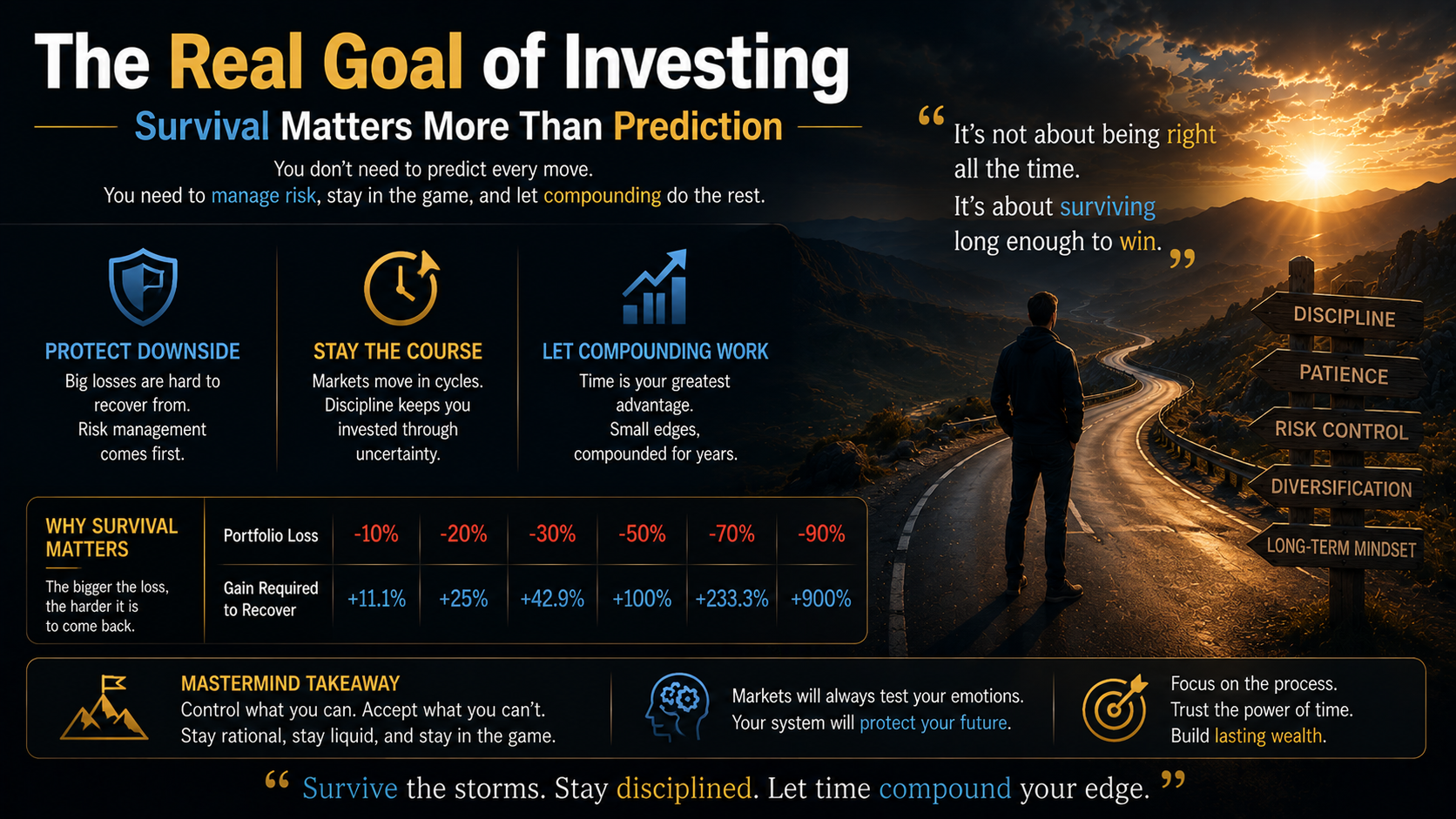
Investors naturally focus on returns.
But before compounding can work, one condition must be satisfied
You have to remain in the game.
Large losses are mathematically difficult to recover from.
| Portfolio Loss | Gain Required to Recover |
| -10% | +11.1% |
| -20% | +25% |
| -30% | +42.9% |
| -50% | +100% |
| -70% | +233.3% |
| -90% | +900% |
A 50% decline does not require a 50% gain to recover.
It requires a 100% gain on the remaining capital.
This asymmetry explains why risk management matters so much.
The relevant question is not only
“How much can I make if I'm right?”
It is also
“How much can I lose if I'm wrong?”
Compounding is not created by high returns alone.
It also requires avoiding catastrophic losses and remaining invested long enough for time to work.
How Investors Can Overcome Psychological Biases
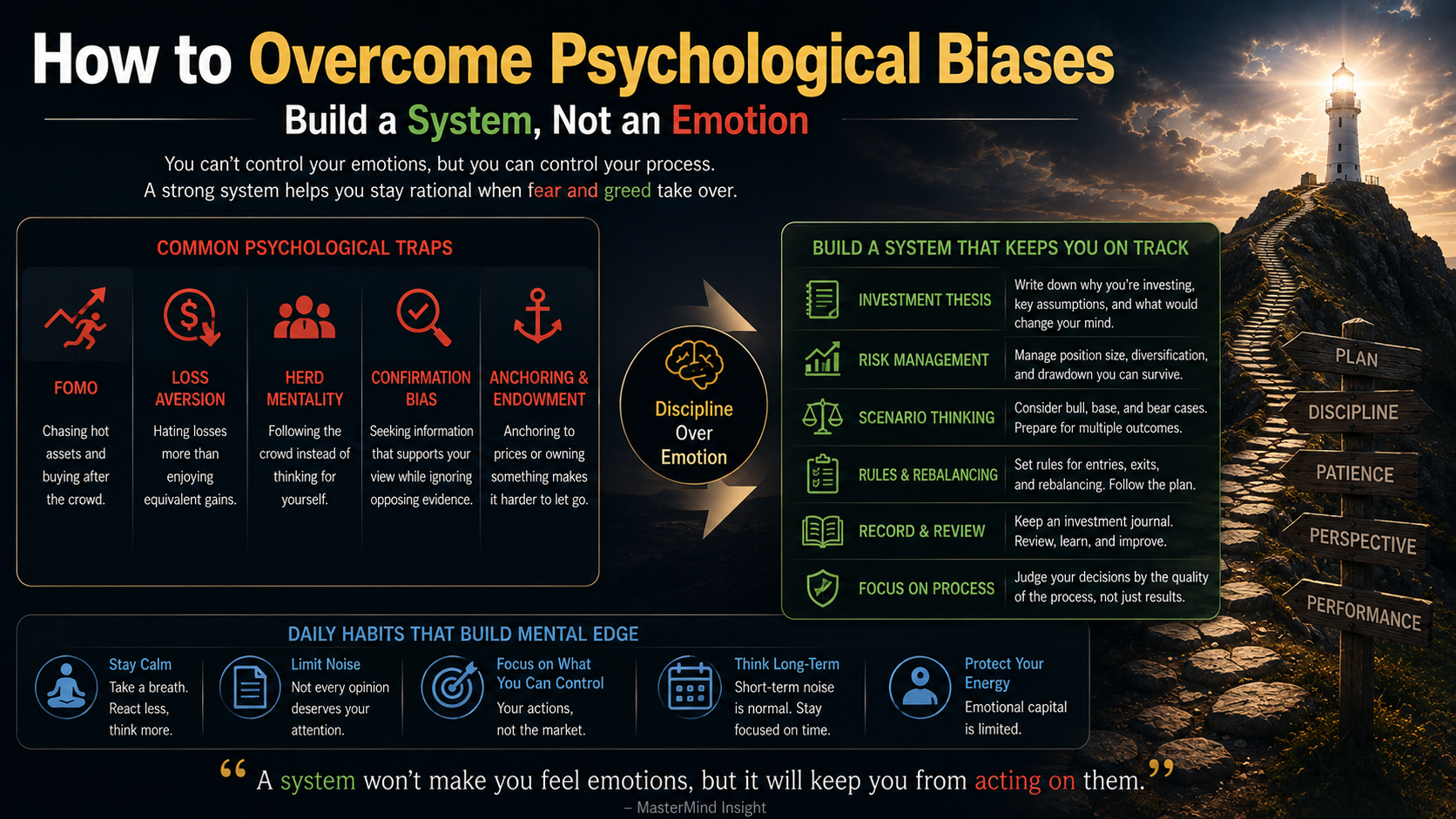
The realistic goal is not to eliminate emotion.
It is to create a system that makes it harder for emotion to take control.
1. Write Down the Investment Thesis
Before buying, document why you are investing.
Write down the fundamental thesis, major assumptions, risks, and conditions that would invalidate the thesis.
This makes it harder to rewrite history after the price moves.
2. Build the Bear Case Before You Buy
Actively search for evidence that could prove you wrong.
If you cannot explain the bear case for an investment, you probably do not understand the risk well enough.
3. Use Scenario-Based Thinking
Consider base, bull, and bear cases instead of assuming one future is inevitable.
Then ask how your portfolio would behave under each scenario.
4. Manage Position Size
Even outstanding research cannot eliminate uncertainty.
Position sizing helps prevent one incorrect thesis from threatening the entire portfolio.
5. Keep an Investment Journal
Record not only what you bought but why you bought it and how you felt at the time.
Over time, patterns may emerge.
Perhaps you repeatedly chase breakouts after strong rallies.
Perhaps you become too pessimistic during corrections.
Perhaps your largest mistakes occur after a series of successful trades.
An investment journal turns vague memories into evidence.
6. Create Rebalancing Rules
Instead of changing portfolio weights whenever fear or excitement rises, establish a framework for reviewing allocations.
That could involve periodic reviews, target ranges, valuation changes, or fundamental developments.
Rebalancing should not mean blindly buying everything that falls.
The underlying thesis still matters.
7. Remember That Doing Nothing Is Also a Decision
The stock market is open almost every business day.
That does not mean investors need to act every day.
When expected returns are unattractive or uncertainty is difficult to price, patience can be a legitimate portfolio decision.
Activity and productivity are not the same thing.
What Do Wealthy and Long-Term Investors Watch?
Experienced investors do not simply try to do the opposite of the crowd.
Buying everything when investors are fearful can be just as simplistic as chasing everything when investors are greedy.
The deeper question is whether psychology has pushed price meaningfully away from underlying fundamentals.
1. Money Flow
When markets fall, ask where the capital is going.
Is money leaving equities for Treasuries?
Is capital moving from speculative growth stocks toward profitable large-cap companies?
Is money leaving risk assets entirely and moving into cash?
Is the move a broad liquidity event or merely sector rotation?
Price tells you what happened.
Money flow can help explain why.
2. Cash Flow
Stock prices fluctuate constantly.
Long-term business value ultimately depends heavily on the cash economics of the underlying company.
For U.S. equities, investors should look beyond revenue growth and consider operating cash flow, free cash flow, debt obligations, capital intensity, and the sustainability of margins.
Narratives attract capital.
Cash flows ultimately have to justify the narrative.
3. Asset Survivability
Almost everything looks strong when financial conditions are easy.
The real test comes when capital becomes expensive.
Businesses with excessive debt, persistent cash burn, weak balance sheets, or dependence on continuous external financing can become vulnerable when liquidity tightens.
That is why downside analysis should ask not only whether an asset can rebound.
It should ask whether the underlying business can survive long enough to rebound.
4. Long-Term Perspective
Long-term investing does not mean refusing to sell.
It means allowing time to work when the underlying investment thesis remains intact.
A falling price alone does not invalidate a thesis.
But “I'm a long-term investor” should never become an excuse for ignoring deteriorating fundamentals.
Time can be a powerful ally for a productive asset.
It cannot automatically repair a broken business model.
Questions Every Investor Should Ask
Before making a major portfolio decision, consider asking yourself
- Am I analyzing fundamental value or simply reacting to recent price action?
- If I did not already own this investment, would I buy it today?
- Have I actively looked for evidence that contradicts my thesis?
- What is the most likely reason this investment could fail?
- Could I survive a major market decline without being forced to sell?
- Is one position large enough to threaten the entire portfolio?
- Is the business producing the cash flow I originally expected?
- Am I following a predetermined process—or reacting to fear and FOMO?
If those questions are difficult to answer, predicting the next market move may not be the most important task.
Reexamining the investment process may be more valuable.
What Really Separates Great Investors From Everyone Else?
Great investors feel fear.
They experience uncertainty.
They can become excited about transformative technologies, worry during bear markets, and regret opportunities they missed.
They are human.
The difference is what happens next.
Disciplined investors assume they can be wrong.
They think in probabilities rather than certainties.
They separate price from value.
They challenge their own assumptions.
They manage position sizes and liquidity so that a single mistake does not destroy years of progress.
The objective is not to predict every rally and every correction.
It is to remain financially and psychologically capable of making the next decision.
Final Thoughts
One of the hardest variables to manage in investing is not interest rates, inflation, the Federal Reserve, or corporate earnings.
It is the investor's own psychology.
Loss aversion makes it difficult to admit mistakes.
FOMO makes rising prices increasingly attractive.
Recency bias encourages investors to extrapolate today's market into tomorrow.
Confirmation bias filters information.
Anchoring and the endowment effect can tie current capital to outdated decisions.
These tendencies cannot be completely eliminated.
But they can be managed.
Investors can document their reasoning, study opposing arguments, think in scenarios, separate price from value, control position size, preserve liquidity, and judge the quality of their process rather than a single outcome.
No investor can consistently predict every market move.
That is precisely why survival matters.
The real skill in investing is not eliminating emotion. It is building a system that prevents emotion from controlling your decisions—and remaining in the game long enough to benefit from the opportunities that uncertainty eventually creates.
This was MasterMind.
'[Global] Success Blueprints' 카테고리의 다른 글