What Is CPI? How Inflation Data Moves Stocks, Interest Rates, and the Dollar


Hello, this is MasterMind.
Every month, one economic report captures the attention of investors around the world the U.S. Consumer Price Index (CPI).
When CPI data is released, markets often react immediately. The Nasdaq can surge or plunge, Treasury yields move sharply, the U.S. dollar strengthens or weakens, and even assets like gold and Bitcoin respond.
But why does a single inflation report carry so much power?
The answer is simple - CPI doesn't just measure prices. It influences monetary policy, liquidity, and ultimately the flow of money across global markets.
Today, we'll break down what CPI is, why investors pay so much attention to it, and how CPI affects stocks, bonds, currencies, and other major asset classes.
What Is CPI?
CPI stands for Consumer Price Index.
It measures the average change in prices paid by consumers for goods and services over time.
The index includes categories such as
- Food
- Housing
- Transportation
- Healthcare
- Education
- Energy
- Consumer goods
In simple terms, CPI is one of the most widely used indicators of inflation in the United States.
If CPI rises, it suggests that prices are increasing and the purchasing power of money is declining.
If CPI falls or stabilizes, inflation pressures are easing.
The Real Importance of CPI - It Guides Liquidity
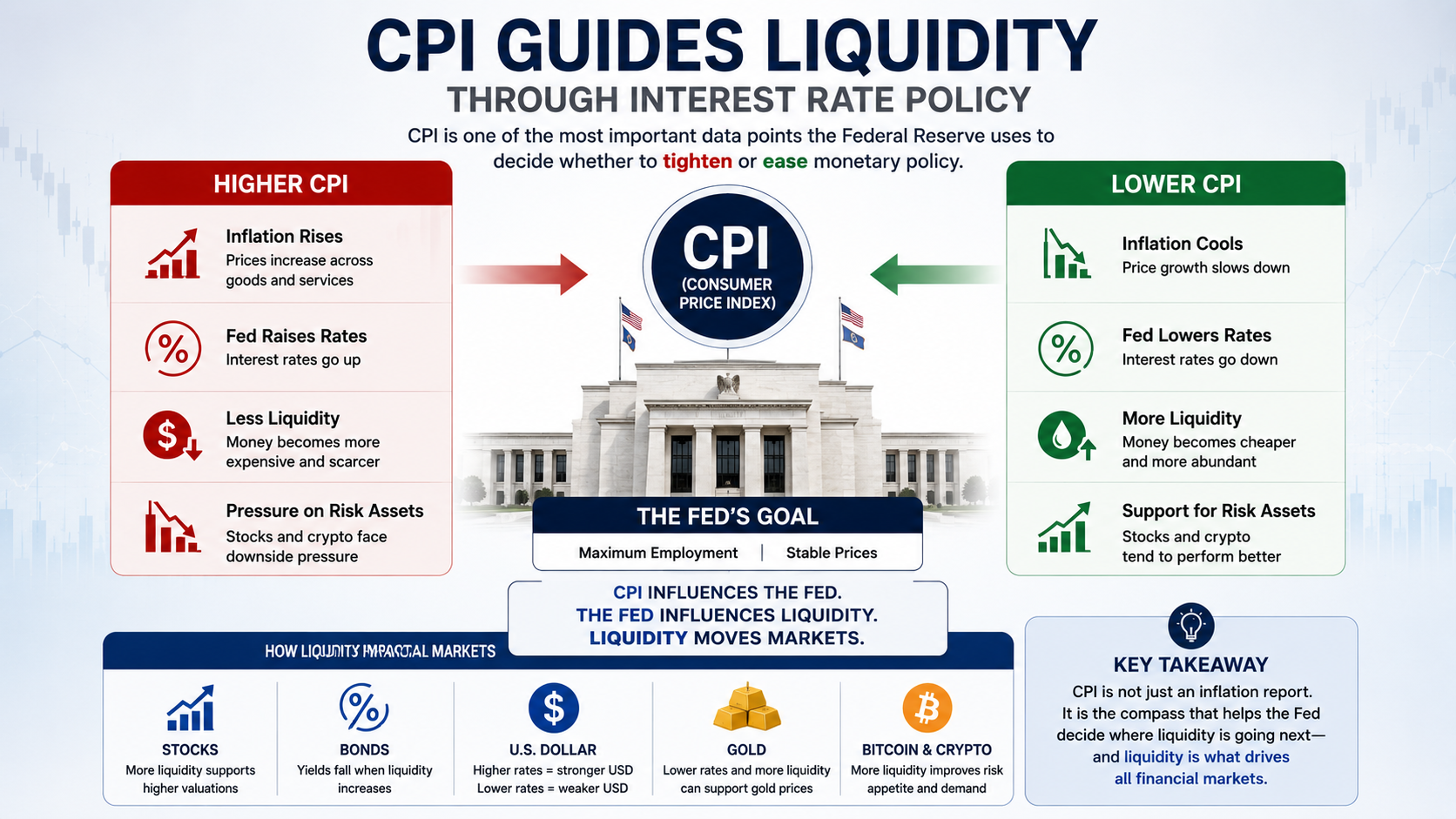
Many people think CPI is simply an inflation report.
Investors see something much bigger.
CPI is one of the most important indicators used by the Federal Reserve when making interest rate decisions.
And interest rates determine liquidity.
The relationship is straightforward
Higher Inflation → Higher Interest Rates → Less Liquidity → Pressure on Risk Assets
Lower Inflation → Lower Interest Rates → More Liquidity → Support for Risk Assets
This is why CPI matters.
The market is not reacting to inflation itself. The market is reacting to what inflation means for future Federal Reserve policy.
In other words, CPI helps determine whether the Fed will tighten or loosen the financial system's liquidity faucet.
The Two CPI Numbers Investors Must Understand

Headline CPI
Headline CPI includes all categories of consumer spending, including food and energy.
This is the number most commonly reported in financial news.
Because it includes energy and food prices, it reflects what consumers experience in everyday life.
However, it can also be highly volatile due to factors such as oil prices, weather events, or geopolitical tensions.
Core CPI
Core CPI excludes food and energy prices.
Why?
Because these categories can fluctuate significantly in the short term and may distort the underlying inflation trend.
For this reason, the Federal Reserve often pays closer attention to Core CPI when evaluating long-term inflation pressures.
Many professional investors consider Core CPI the more important number.
What Happens When CPI Comes In Higher Than Expected?
When CPI exceeds market expectations, investors often assume inflation remains persistent.
As a result, the Federal Reserve may need to keep interest rates elevated for longer.
This typically leads to
- Rising Treasury yields
- A stronger U.S. dollar
- Reduced market liquidity
- Pressure on growth stocks
- Increased volatility in risk assets
Technology companies and AI-related stocks are especially sensitive because their valuations depend heavily on future earnings.
Higher interest rates reduce the present value of those future cash flows.
This is one reason why the Nasdaq often reacts strongly to CPI surprises.
What Happens When CPI Comes In Lower Than Expected?
A lower-than-expected CPI reading suggests inflation is cooling.
Markets may interpret this as a signal that the Federal Reserve could begin cutting rates sooner than expected.
This often results in
- Falling Treasury yields
- A weaker U.S. dollar
- Increased liquidity expectations
- Stronger equity markets
- Outperformance from technology and growth stocks
This explains why investors frequently celebrate lower inflation data.
Lower inflation can create a more favorable environment for risk assets.
How CPI Affects Major Asset Classes

Nasdaq and Growth Stocks
- Higher CPI → Higher rates → Valuation pressure
- Lower CPI → Lower rates → Growth stock support
U.S. Treasury Bonds
- Higher CPI → Higher yields → Lower bond prices
- Lower CPI → Lower yields → Higher bond prices
U.S. Dollar
- Higher CPI → Dollar strength
- Lower CPI → Dollar weakness
Gold
- Higher rates often create headwinds for gold
- Lower rates can support gold prices
Bitcoin and Crypto Assets
- Higher CPI may reduce risk appetite
- Lower CPI often improves liquidity expectations and investor sentiment
Because modern financial markets are heavily influenced by liquidity conditions, Bitcoin frequently reacts to inflation data as well.
Risks Investors Should Watch
One of the biggest mistakes investors make is focusing only on the CPI number itself.
Markets care more about expectations than absolute numbers.
For example
A 3.0% inflation reading may actually be bullish if investors expected 3.3%.
Likewise, a 2.5% reading may be bearish if markets expected 2.2%.
The difference between expectations and reality often matters more than the headline figure.
Investors should also pay attention to sticky inflation.
Sticky inflation occurs when prices stop falling and remain elevated for an extended period.
This can force markets to reassess future rate-cut expectations and create significant volatility.
Remember
Markets price the future, not the present.
What Do Wealthy Investors Focus On?

While most traders obsess over monthly CPI releases, experienced investors focus on something deeper.
They watch liquidity.
They understand that inflation influences interest rates, interest rates influence liquidity, and liquidity influences asset prices.
Rather than trying to predict every CPI report, they build portfolios that can survive different economic environments.
Ask yourself
- Can my portfolio withstand a prolonged high-rate environment?
- Do the companies I own generate real cash flow?
- Am I investing based on fundamentals or market excitement?
- Would I still own these assets during a major market correction?
Successful investing is not about predicting every economic report.
It is about owning resilient assets and managing risk effectively.
Final Thoughts
The U.S. Consumer Price Index is far more than a measure of inflation.
It is one of the most important indicators for understanding interest rates, liquidity conditions, and the future direction of financial markets.
Every month, investors study CPI not because they care about a single data point, but because they want insight into where money is likely to flow next.
Market conditions change.
Economic cycles come and go.
But one principle remains constant
Capital flows toward opportunity, and liquidity drives markets.
Understanding CPI is one of the first steps toward understanding how money moves in the global financial system.
This was MasterMind.
'[Global] Success Blueprints' 카테고리의 다른 글