What Is Core CPI? Why the Federal Reserve Watches It Closely


Hello, this is MasterMind.
Every month, the release of the U.S. Consumer Price Index (CPI) becomes one of the most closely watched economic events in global financial markets.
Stocks, bonds, the U.S. dollar, gold, and even Bitcoin can experience significant volatility based on a single inflation report.
However, experienced investors and policymakers are not simply focused on the headline number.
Instead, they pay much closer attention to Core CPI, a measure that often provides a clearer picture of underlying inflation trends and future monetary policy decisions.
So why does Core CPI matter so much, and why is the market often more concerned with the direction of inflation than the actual number itself?
Let's take a closer look.
What Is Core CPI?

Core CPI, or Core Consumer Price Index, measures inflation while excluding food and energy prices.
At first glance, this may seem strange.
Food and energy are essential expenses for households, so why remove them from an inflation calculation?
The answer lies in volatility.
Energy prices can surge due to geopolitical conflicts, oil supply disruptions, or natural disasters. Food prices can fluctuate because of weather conditions, supply shortages, or global trade disruptions.
These short-term shocks can distort the broader inflation picture.
Core CPI removes these highly volatile components and focuses on areas such as:
- Housing costs
- Healthcare expenses
- Education
- Insurance
- Service-related spending
Because these categories reflect longer-term economic conditions, Core CPI is often viewed as a better measure of persistent inflation pressure within the economy.
This is one reason why the Federal Reserve pays close attention to Core CPI when making interest rate decisions.
Why Does the Market Focus on the Trend Rather Than the Number?
One of the most common mistakes among new investors is focusing only on the reported inflation figure.
Financial markets do not simply react to where inflation is today.
They react to where inflation is likely to be tomorrow.
For example, imagine Core CPI stands at 3.0%.
The number itself is not the most important factor.
Investors want to know:
- Was it higher or lower last month?
- Has inflation been declining for six months?
- Did the result beat or miss expectations?
- Is inflation moving closer to the Federal Reserve's 2% target?
Consider these two scenarios:
3.8% → 3.5% → 3.3% → 3.0%
In this case, inflation is clearly moving lower.
Now consider:
2.8% → 2.9% → 3.0% → 3.1%
Although inflation is still relatively low, the trend suggests inflation is accelerating again.
Markets are often more concerned about a change in direction than the absolute level itself.
This is why inflation trends frequently matter more than a single monthly reading.
Key Forces Driving Core CPI

1. The Limits of Goods Disinflation
After the pandemic, supply chains gradually normalized.
Prices for goods such as furniture, used cars, and electronics began to stabilize, helping reduce inflation pressures.
However, that disinflationary trend may be losing momentum.
Rising labor costs, trade fragmentation, and the restructuring of global supply chains are making it more difficult for goods prices to continue falling.
As a result, inflation may become more persistent than many investors expect.
2. Sticky Service Inflation
One of the Federal Reserve's biggest concerns today is service inflation.
Unlike physical goods, services depend heavily on labor costs.
When wages rise, businesses often pass those higher costs on to consumers.
As long as the labor market remains strong, service inflation can remain elevated.
This makes it more difficult for Core CPI to decline rapidly.
3. Housing Costs Remain Critical
Housing costs represent one of the largest components of Core CPI.
The challenge is that housing inflation tends to move slowly.
Rental markets may cool in real time, but official inflation data often reflects those changes with a significant delay.
Because of this lag effect, investors often focus on future housing trends rather than current housing inflation readings.
4. Inflation Expectations Matter
Markets are driven not only by data but also by expectations.
If businesses expect inflation to remain high, they may raise prices proactively.
Workers may demand higher wages in anticipation of future cost increases.
These behaviors can create a self-reinforcing inflation cycle.
This is one reason why the Federal Reserve closely monitors inflation expectations alongside actual inflation data.
Risks Investors Should Watch

Persistent Core CPI inflation can create several challenges for financial markets.
First, interest rate cuts may be delayed.
Second, Treasury yields may remain elevated, putting pressure on growth-oriented assets.
Third, liquidity conditions may remain tighter than investors expect.
Perhaps the greatest risk is stagflation.
Stagflation occurs when economic growth slows while inflation remains stubbornly high.
In such an environment, central banks face difficult choices.
Cutting rates may worsen inflation, while maintaining high rates may further weaken economic activity.
For investors, this is often one of the most challenging market environments to navigate.
What Do Wealthy Investors Focus On?
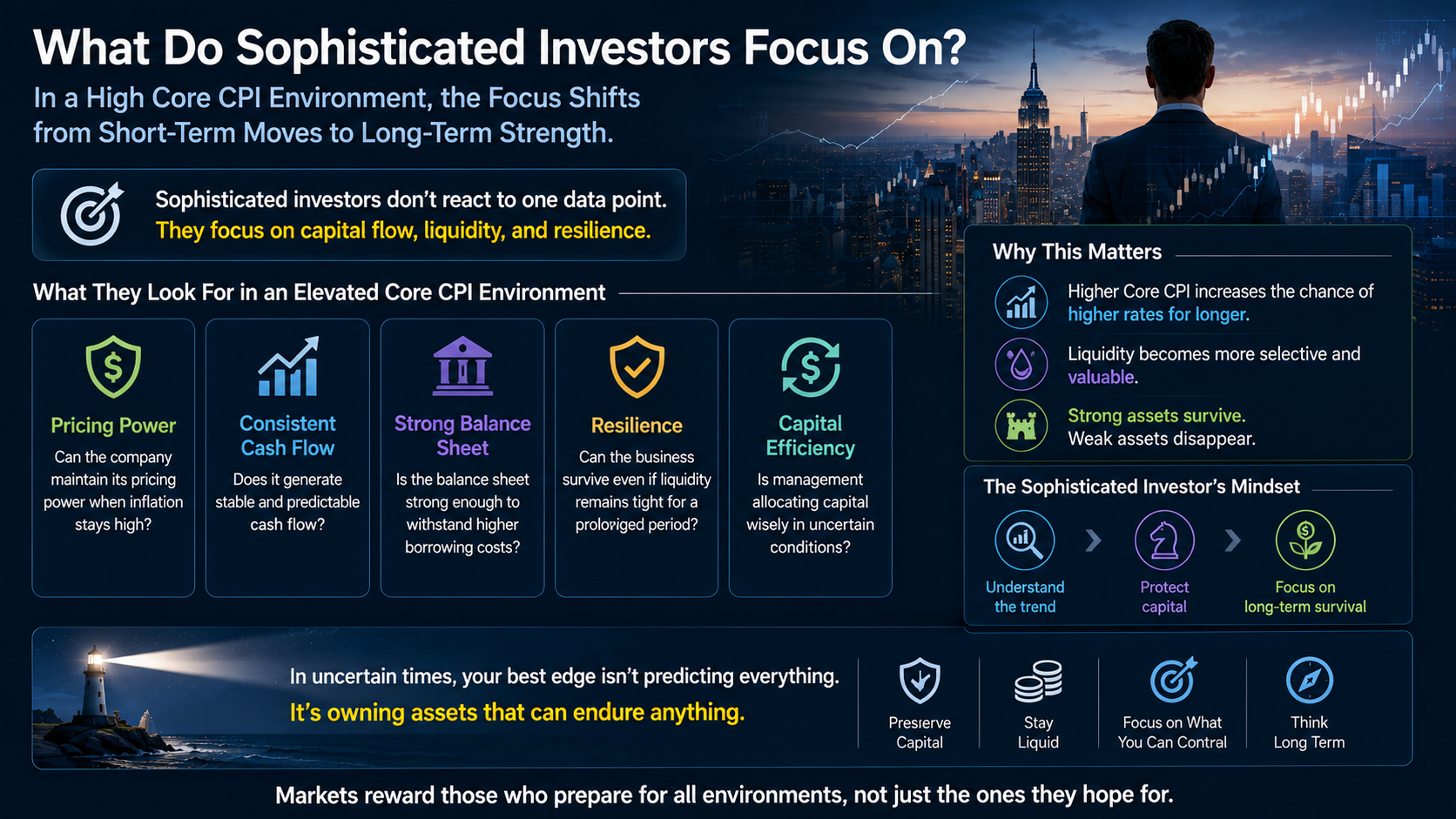
Large institutional investors and wealthy asset managers rarely make decisions based on a single inflation report.
Instead, they focus on long-term capital flows and asset resilience.
When Core CPI remains elevated, the likelihood of prolonged higher interest rates increases.
As liquidity becomes more limited, capital tends to flow toward assets with strong fundamentals and reliable cash flows.
These investors often ask questions such as:
- Can this company maintain pricing power during inflationary periods?
- Does it generate consistent cash flow?
- Is its balance sheet strong enough to withstand higher borrowing costs?
- Can it survive even if liquidity remains constrained?
These questions become increasingly important during periods of economic uncertainty.
Strong assets tend to survive difficult environments, while weaker assets often struggle when liquidity conditions tighten.
Final Thoughts
Core CPI is far more than just another inflation report.
It serves as a critical indicator of monetary policy, liquidity conditions, and the future direction of financial markets.
The key is not to become overly focused on a single monthly number.
Markets appear to react to inflation data, but in reality they are attempting to estimate how inflation will influence future interest rates, liquidity, and economic growth.
Ultimately, Core CPI is not simply an inflation gauge.
It is a compass that helps investors understand where money may flow next.
Successful investors are not the ones who memorize economic data.
They are the ones who understand the broader trends shaping the market.
Markets always look forward.
And in investing, survival is often more important than prediction.
The goal is not to perfectly forecast every move, but to build a portfolio capable of enduring a wide range of economic environments.
That is how long-term wealth is created.
This was MasterMind.
'[Global] Success Blueprints' 카테고리의 다른 글