What Is the Financial Conditions Index (FCI)? Why It Matters for Interest Rates, Stocks, the Dollar, and Credit Markets


Hello, this is MasterMind.
If the Federal Reserve cuts interest rates, does that automatically mean financial conditions are becoming easier?
Not necessarily.
The Fed can lower its policy rate while Treasury yields rise, mortgage rates remain elevated, credit spreads widen, and stock prices fall. In that environment, households and businesses may actually experience tighter financing conditions despite an official rate cut.
The opposite can happen as well.
The Fed may keep interest rates high, but if Treasury yields fall, stocks rally, credit spreads tighten, and the U.S. dollar weakens, financial conditions can become easier without a single rate cut.
This distinction is one of the most important concepts for understanding monetary policy and financial markets.
The Financial Conditions Index, or FCI, attempts to capture that broader reality.
Rather than looking at the federal funds rate alone, an FCI combines several market variables to estimate whether the financial system is supporting or restraining economic activity.
For investors, this provides a much broader view of liquidity, risk appetite, borrowing costs, and the transmission of Federal Reserve policy into the real economy.

The Bottom Line
The Financial Conditions Index (FCI) combines variables such as interest rates, equity prices, credit spreads, and exchange rates to measure whether financial conditions are becoming easier or tighter for the economy.
Think of the federal funds rate as the Fed's policy setting.
Think of financial conditions as what households, corporations, borrowers, and investors actually experience.
That difference matters.
What Is the Financial Conditions Index?
The Financial Conditions Index is not one universally standardized indicator.
Instead, it is a category of indexes designed to combine multiple financial-market variables into a single measure of how supportive or restrictive the financial environment is.
Different institutions construct their indexes differently.
Examples include the Chicago Fed's National Financial Conditions Index, commonly known as the NFCI, as well as financial conditions indexes developed by major financial institutions and data providers.
Depending on the methodology, an FCI may incorporate variables related to
- Treasury yields
- Corporate borrowing costs
- Credit spreads
- Equity prices
- Exchange rates
- Market volatility
- Lending conditions
- Other measures of financial stress or availability of credit
This means investors should never assume that every FCI is calculated or displayed in exactly the same way.
The absolute number matters less without understanding the methodology behind it.
The larger purpose, however, is similar
How easy or difficult is it for money and credit to move through the financial system?
The Federal Funds Rate and Financial Conditions Are Not the Same Thing
This is the foundation of the entire concept.
The Federal Reserve controls a short-term policy rate.
But American households do not finance a home at the federal funds rate, and corporations do not generally issue long-term debt at the federal funds rate.
They face market prices.
For households, that can include
- Mortgage rates
- Auto loan rates
- Credit card rates
- Consumer lending standards
For corporations, it can include
- Treasury yields
- Investment-grade bond yields
- High-yield bond yields
- Bank lending rates
- Equity financing conditions
That creates an important distinction.
Suppose the Fed keeps its policy rate unchanged.
At the same time
- The 10-year Treasury yield falls
- Mortgage rates decline
- The S&P 500 rallies
- Corporate credit spreads tighten
- Market volatility falls
The financial system may have become meaningfully easier even though the Fed did nothing.
Now consider the opposite situation.
The Fed cuts rates, but
- Long-term Treasury yields rise
- Mortgage rates remain high
- Stocks fall
- Credit spreads widen
- Banks tighten lending standards
The economy may not receive nearly as much stimulus as the rate cut suggests.
In other words
The policy rate is an input. Financial conditions are closer to the economic output of monetary policy plus the market's reaction to it.
What Are the Main Components of an FCI?
The exact formula varies, but several variables repeatedly appear in financial conditions analysis.
| Component | Easier Conditions | Tighter Conditions |
| Market interest rates | Falling | Rising |
| Credit spreads | Narrowing | Widening |
| Equity prices | Rising | Falling |
| U.S. dollar | Weaker or stable | Sharp appreciation |
| Credit availability | Improving | Deteriorating |
| Market volatility | Falling | Rising |
Each component tells investors something different about the price and availability of money.
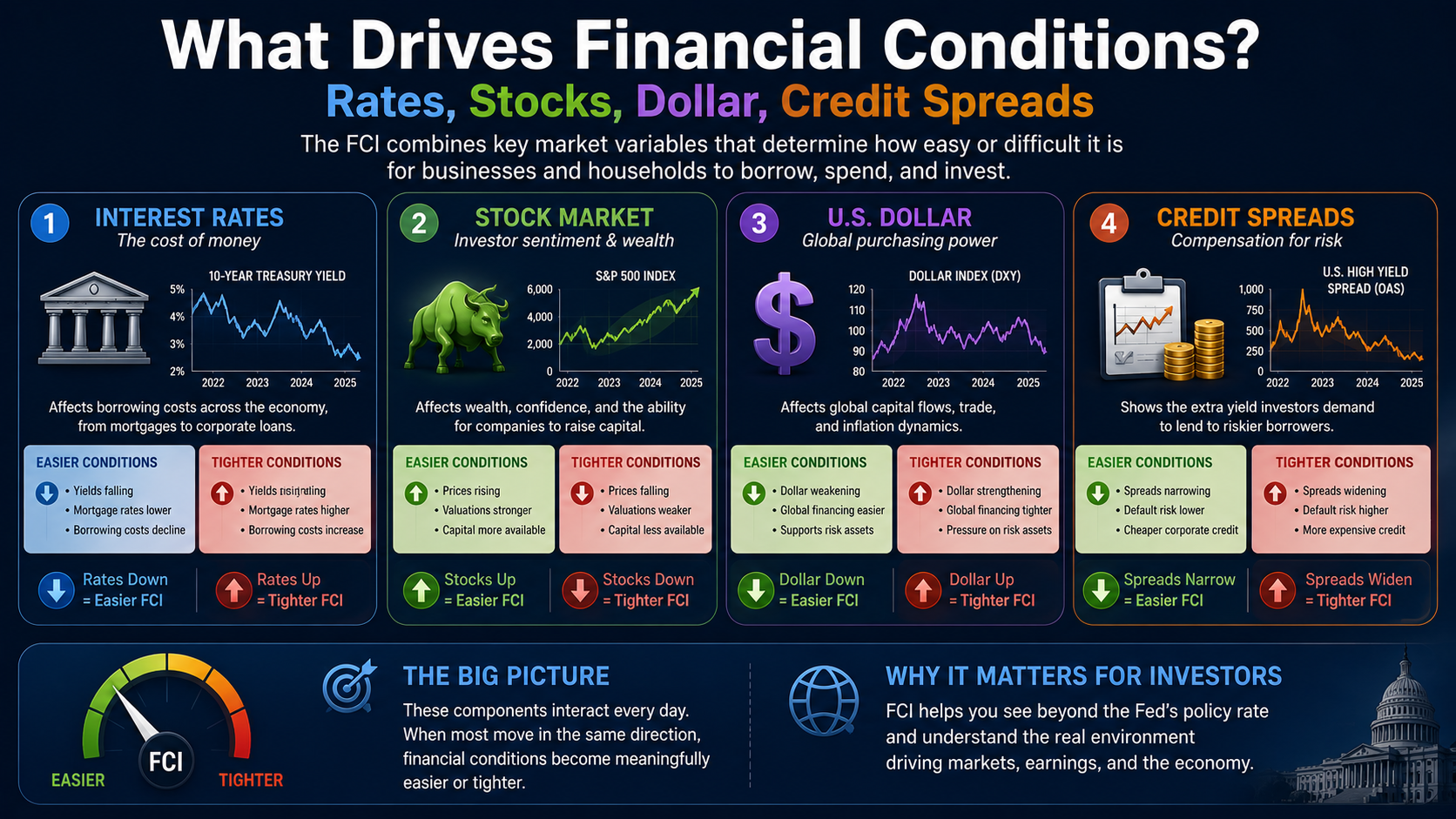
1. Interest Rates
Interest rates are among the most direct channels through which financial conditions affect the U.S. economy.
Lower Treasury yields can influence borrowing costs across the financial system.
Mortgage rates may fall.
Corporate bond yields may decline.
The hurdle rate for new business investment may become lower.
Higher rates work in the opposite direction.
A company considering a new factory, data center, acquisition, or capital expenditure project must compare its expected return against its financing cost.
As financing becomes more expensive, fewer projects make economic sense.
For households, higher borrowing costs can reduce housing affordability and discourage purchases financed with credit.
This is why market interest rates matter even when the federal funds rate itself has not changed.
But investors should always ask one additional question
Why are yields falling?
Falling yields caused by improving inflation and a soft landing can mean something very different from falling yields caused by a severe recession.
2. The Stock Market
Equity prices are not simply a scoreboard for investors.
They can influence financial conditions themselves.
When stock prices rise, corporations may find it easier to raise equity capital.
Strong equity valuations can support mergers, acquisitions, investment, and corporate confidence.
Households with significant financial assets may also experience a wealth effect that influences spending.
Falling equity prices can work in reverse.
This creates a feedback mechanism between Wall Street and the real economy.
The economy influences stock prices, but stock prices can also influence the economy.
That is why equities can be part of the financial conditions transmission mechanism rather than merely a consequence of it.
3. The U.S. Dollar
The U.S. dollar occupies a unique position because of its role in global trade and finance.
A sharply stronger dollar can tighten global financial conditions, particularly for borrowers with dollar-denominated liabilities.
For U.S. multinational companies, a stronger dollar can also reduce the dollar value of earnings generated overseas.
A weaker dollar, meanwhile, can ease some global financing pressures and improve the translated value of foreign earnings for U.S. corporations.
But the relationship is not mechanical.
Exchange rates are influenced by relative interest rates, growth expectations, risk sentiment, capital flows, and monetary policy across multiple economies.
Therefore, investors should not interpret a stronger dollar as automatically bearish or a weaker dollar as automatically bullish.
The dollar is one piece of a much larger financial system.
4. Credit Spreads
Credit spreads are one of the most valuable parts of financial conditions analysis.
A credit spread represents the additional yield investors demand to own corporate debt instead of a safer benchmark such as U.S. Treasury securities.
When investors are confident about economic growth and corporate balance sheets, they may accept a smaller risk premium.
Credit spreads tighten.
Companies can finance themselves relatively cheaply.
When recession fears, defaults, or financial stress increase, investors demand greater compensation for risk.
Credit spreads widen.
This can create a particularly difficult environment for highly leveraged businesses.
A company does not care only about the Treasury yield.
Its real financing cost is closer to
risk-free rate + credit risk premium
That is why falling Treasury yields do not always mean financing conditions are improving.
If Treasury yields fall by 50 basis points while a company's credit spread widens by 200 basis points, that company may actually face much more expensive financing.
For investors, this is an essential distinction.
How Does the Financial Conditions Index Work?
The easiest way to understand FCI is through the monetary-policy transmission mechanism.
The basic chain looks like this
Federal Reserve policy → financial markets → financial conditions → consumption and investment → employment and economic growth → inflation
Suppose inflation is too high and the Fed raises interest rates.
Higher policy rates can push borrowing costs higher across the economy.
Treasury yields may rise.
Mortgage rates may increase.
Equity valuations may decline.
Credit spreads may widen.
The dollar may strengthen.
If these changes occur together, financial conditions tighten.
Businesses become more cautious about investment.
Households become more cautious about borrowing and spending.
Economic activity can slow.
Eventually, weaker demand may reduce inflationary pressure.
But markets are forward-looking.
If investors become convinced that inflation is falling and future Fed cuts are approaching, markets may begin easing financial conditions before the Fed actually cuts rates.
Treasury yields can decline.
Stocks can rise.
Credit spreads can tighten.
The dollar can weaken.
In effect, financial markets can partially loosen the brakes before the Fed officially does.
Why Does the Financial Conditions Index Matter?
It Shows More Than the Fed's Policy Rate
Investors often reduce monetary policy to one question
"Is the Fed raising or cutting rates?"
That is useful, but incomplete.
A rate cut that fails to lower borrowing costs may deliver less stimulus than expected.
A rate hike accompanied by falling long-term yields and surging stock prices may deliver less tightening than policymakers intended.
FCI helps bridge that gap.
Markets Move Before the Federal Reserve
Financial markets price expectations.
If investors expect lower inflation, weaker growth, or future rate cuts, Treasury yields can move months before the Fed changes policy.
The stock market can reprice.
The dollar can move.
Credit spreads can change.
Therefore, the financial environment can shift before the official policy rate does.
Markets do not simply price today's policy. They continuously price expectations about tomorrow's policy, growth, inflation, and risk.
It Helps Measure the Real Strength of Monetary Tightening
Imagine that the Fed wants to slow demand.
If stocks surge, credit spreads collapse, long-term yields fall, and borrowing becomes easier, financial markets may partially offset the Fed's restraint.
The reverse is also possible.
Financial stress can become so severe that market forces create tighter conditions than the Fed intended.
Understanding this gap is crucial for interpreting the real economic impact of monetary policy.
The Feedback Loop Between the Fed and Financial Markets
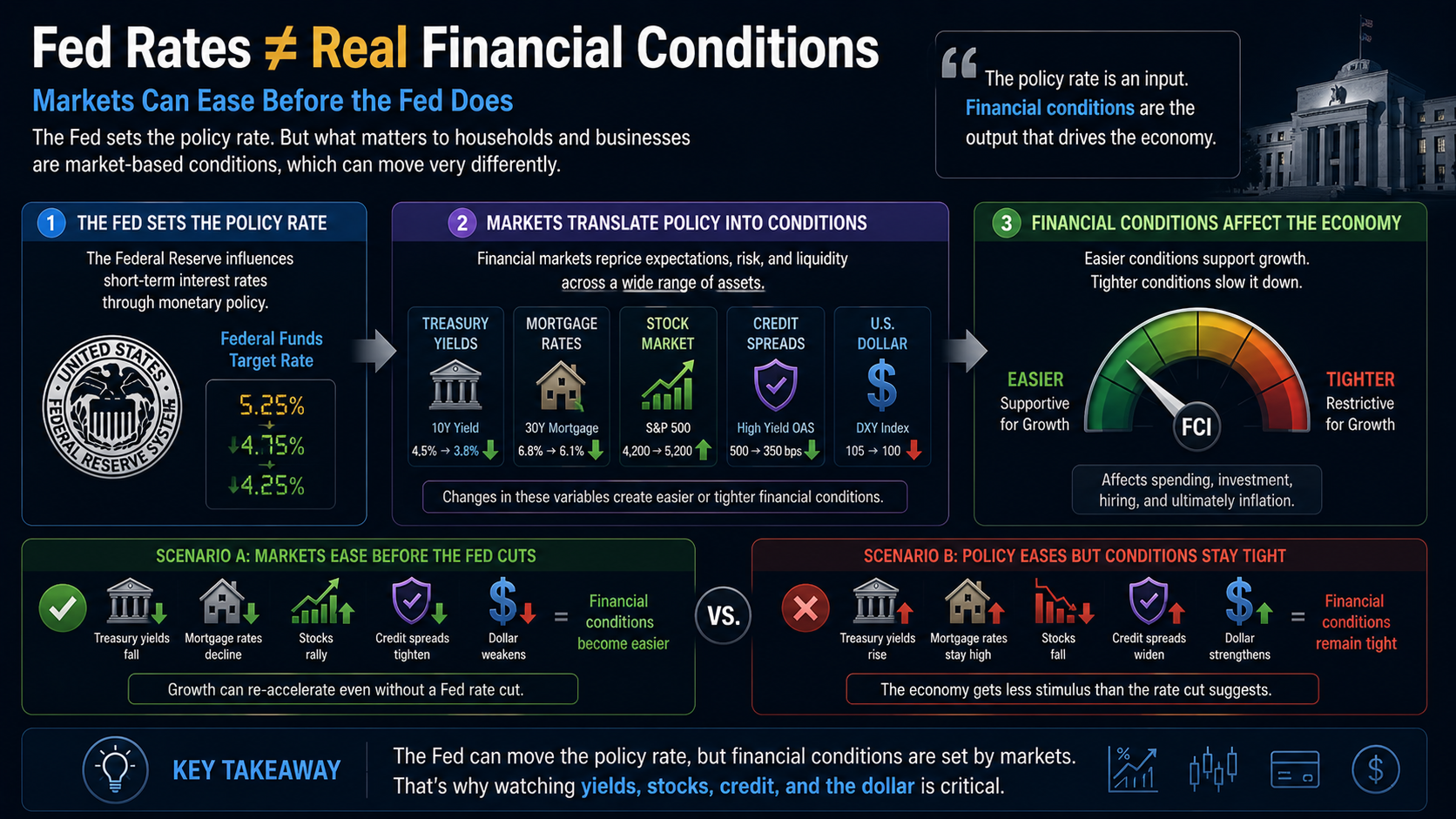
The Fed affects financial markets.
Financial markets affect financial conditions.
Financial conditions affect the economy.
And the economy eventually influences the Fed again.
This creates a feedback loop.
Consider a situation in which inflation remains above target while investors aggressively price future rate cuts.
Treasury yields fall.
Stocks rally.
Credit spreads narrow.
Financial conditions ease.
If easier conditions stimulate demand enough to slow the disinflation process, policymakers may have less reason to cut rates quickly.
Markets can therefore influence the policy outlook they are trying to anticipate.
The reverse can happen during financial stress.
A sharp increase in credit spreads, falling equity prices, and tighter lending standards can reduce economic activity even without another Fed rate hike.
This is why monetary policy cannot be understood by watching the federal funds rate alone.
What Do Easier Financial Conditions Do to the Economy?
Easier financial conditions generally reduce the cost of capital and improve access to financing.
Businesses may find it easier to
- Refinance debt
- Issue bonds
- Raise equity
- Invest in new projects
- Expand hiring
Households may benefit from lower borrowing costs and stronger asset prices.
The broad transmission mechanism can look like this
Easier financial conditions → lower financing costs → stronger consumption and investment → stronger economic activity → potentially greater inflation pressure
However, easier financial conditions are not always positive.
If the economy is already running above capacity, excessive financial easing can support asset-price inflation, leverage, and renewed consumer demand.
That can complicate the Fed's inflation fight.
What Do Tighter Financial Conditions Do to the Economy?
Tighter conditions raise the cost and reduce the availability of capital.
Highly leveraged companies may find refinancing more difficult.
Banks may become more selective.
Consumers may delay homes, cars, or other purchases that require financing.
The broad chain can become
Tighter financial conditions → higher financing costs → weaker consumption and investment → slower growth → potentially lower inflation pressure
But tighter conditions do not automatically mean recession.
If economic growth and corporate earnings remain strong, the economy may absorb relatively restrictive financial conditions for some time.
Again, the cause matters.
How Financial Conditions Affect U.S. Stocks
Easier financial conditions are generally supportive of equities.
Lower interest rates can reduce the discount rate applied to future corporate cash flows.
Lower financing costs can support earnings and investment.
Improving risk appetite can also increase valuation multiples.
Growth stocks can be especially sensitive because a larger portion of their expected value may come from cash flows far in the future.
But investors should avoid a simple rule such as
Rates down = stocks up.
The reason rates are falling matters.
If Treasury yields decline because inflation is cooling while growth remains resilient, equities may benefit.
If yields collapse because investors expect a severe recession, falling earnings can overwhelm the benefit of lower discount rates.
How Financial Conditions Affect Bonds
Bonds sit at the center of the financial conditions mechanism.
Falling Treasury yields can reduce borrowing costs throughout the economy.
But corporate credit conditions depend on both the risk-free rate and the credit spread.
This means investors should examine both.
Consider two environments
Environment A
Treasury yields fall and credit spreads tighten.
Corporate financing conditions are improving.
Environment B
Treasury yields fall but credit spreads surge.
The risk-free rate is falling because investors fear recession, while corporate financing conditions may actually be deteriorating.
That distinction can reveal much more than Treasury yields alone.
How Financial Conditions Affect the U.S. Dollar
Tighter U.S. financial conditions can sometimes coincide with a stronger dollar, particularly when U.S. yields rise or investors seek safe, liquid assets.
A stronger dollar can tighten financial conditions outside the United States and affect U.S. multinational earnings.
Easier U.S. conditions may reduce some of that pressure.
However, the dollar reflects relative conditions between the United States and the rest of the world.
Investors therefore need to consider foreign central banks, global growth, geopolitical risk, and relative interest-rate expectations as well.
How Financial Conditions Affect Gold
Gold is particularly sensitive to real interest rates, the dollar, and demand for safe-haven assets.
A combination of falling real yields and a weaker dollar can create a favorable environment for gold.
Rising real yields and a stronger dollar can create a headwind.
But during severe financial stress, safe-haven demand can sometimes support gold even as broader financial conditions tighten.
This is another reason why FCI should be used as a framework rather than a mechanical trading signal.
How Financial Conditions Affect Bitcoin and Crypto
Bitcoin and other crypto assets can be highly sensitive to liquidity and risk appetite.
When yields decline, financial liquidity improves, and investors become more willing to hold volatile assets, crypto markets can benefit.
When real yields rise, the dollar strengthens, and liquidity contracts, speculative assets can face greater pressure.
However, crypto also responds to factors that have little to do with traditional FCI measures, including regulatory developments, institutional adoption, market structure, leverage, and crypto-specific capital flows.
Financial conditions are important, but they are not the entire story.
Financial Conditions and Major Asset Classes
| Asset Class | Easier Financial Conditions | Tighter Financial Conditions |
| U.S. Stocks | Lower discount rates and stronger risk appetite can help | Higher financing costs and lower valuations can hurt |
| Treasuries | Falling yields can support prices | Rising yields can pressure prices |
| Corporate Bonds | Narrower spreads can support returns | Wider spreads increase credit risk |
| U.S. Dollar | Weakening pressure can emerge | Strengthening pressure can emerge |
| Gold | Lower real yields and weaker dollar can help | Higher real yields can become a headwind |
| Bitcoin | Greater liquidity and risk appetite can help | Liquidity contraction can increase downside volatility |
These relationships are tendencies, not laws.
The economic reason behind the change in financial conditions remains critical.

Soft-Landing Easing vs. Recessionary Easing
This may be the most important distinction for investors.
Two periods can both show falling interest rates and easier financial conditions while producing very different investment outcomes.
Soft-Landing Easing
Imagine inflation continues to decline while unemployment remains relatively low and corporate earnings remain resilient.
The Fed gains room to become less restrictive.
Treasury yields stabilize or decline.
Credit spreads remain contained.
Stocks remain supported.
This is the type of easing environment that can be relatively favorable for risk assets.
Recessionary Easing
Now imagine unemployment rises rapidly, consumer spending weakens, and corporate earnings deteriorate.
Markets begin pricing aggressive Fed cuts.
Treasury yields fall sharply.
But credit spreads widen because default risk is rising.
Stocks may fall because earnings expectations collapse.
Rates are declining in both scenarios.
The investment implications are completely different.
That leads to one of the most important questions in macro investing
Are financial conditions easing because inflation is improving, or because the economy is breaking?
Common Mistakes When Reading an FCI
Assuming Every FCI Uses the Same Scale
Different indexes use different methodologies.
In some indexes, higher values may indicate tighter conditions. Other indexes can use different conventions.
Always check the methodology before interpreting the direction.
Looking Only at the Absolute Level
The direction and speed of change can matter as much as the level.
Financial conditions can remain historically easy while tightening rapidly.
That change can still pressure risk assets.
Similarly, conditions can remain restrictive while beginning to improve.
Markets may respond to that turning point before the absolute level becomes easy.
Financial markets frequently react to changes at the margin rather than waiting for the final economic outcome.
Treating FCI as a Perfect Leading Indicator
An FCI often contains market prices such as stocks and bond yields.
That means it partly reflects conditions already being priced by financial markets.
It should not be treated as a crystal ball that predicts recessions or market crashes with certainty.
Its best use is as a framework for understanding the pressure the financial system is placing on the economy.
What Should U.S. Investors Watch Alongside FCI?
An investor does not need to rely on one composite index.
Watching the underlying components can often provide a clearer picture.
2-Year Treasury Yield
The 2-year Treasury yield is highly sensitive to expectations about Federal Reserve policy.
It can help investors understand how markets are repricing the future path of short-term interest rates.
10-Year Treasury Yield
The 10-year yield reflects a combination of expected short-term rates, inflation expectations, economic growth, and term premium.
It also matters directly for mortgage rates and long-term corporate financing.
High-Yield Credit Spreads
High-yield spreads can reveal stress that may not yet be obvious in the stock market.
Rapid spread widening suggests investors are demanding more compensation for corporate default risk.
The U.S. Dollar
The dollar provides information about relative monetary conditions, global risk appetite, and cross-border capital flows.
Market Volatility
Sharp increases in volatility can force investors and financial institutions to reduce risk, potentially weakening market liquidity.
Bank Lending Standards
Market interest rates are only one part of credit availability.
If banks become unwilling to lend, households and companies can experience tightening even if benchmark rates are falling.
What Should Investors Actually Take Away From FCI?
Watch Financial Conditions, Not Just Fed Decisions
Fed meetings matter.
But the financial system continues repricing every day between FOMC meetings.
Treasury yields, credit spreads, stocks, the dollar, and lending standards can materially change the economic environment without a policy-rate adjustment.
Always Ask Why Conditions Are Changing
Easier conditions caused by falling inflation and resilient growth are different from easier rates caused by recession fears.
Tighter conditions caused by healthy economic growth are different from tightening caused by a credit crisis.
The cause determines the implications.
Do Not Ignore Credit Markets
Equities can remain optimistic while credit markets begin signaling stress.
Credit deserves special attention because companies ultimately need access to capital, not merely a high stock price.
When credit spreads begin widening rapidly, the market may be demanding a higher price for survival.
Understand the Feedback Loop
Markets anticipate the Fed, but the Fed also observes the effects of markets.
A powerful equity rally, falling yields, and tight credit spreads can ease conditions even when policymakers are trying to restrain demand.
Conversely, financial stress can tighten conditions without another rate hike.
Neither relationship guarantees a specific Fed response, but both matter for understanding the policy environment.
Focus on What Survives When Liquidity Disappears
Easy financial conditions can hide weak balance sheets.
When capital is cheap, companies with negative free cash flow may continue refinancing and raising capital.
When conditions tighten, the differences become clearer.
Companies with
- Strong free cash flow
- Manageable debt
- Long debt maturities
- High interest coverage
- Durable margins
- Limited dependence on external financing
may have greater financial resilience.
This leads to a broader investment principle
The best test of an asset is not how it performs when liquidity is abundant, but whether it can survive when liquidity becomes scarce.
What Do Wealthy and Long-Term Investors Look for in Financial Conditions?
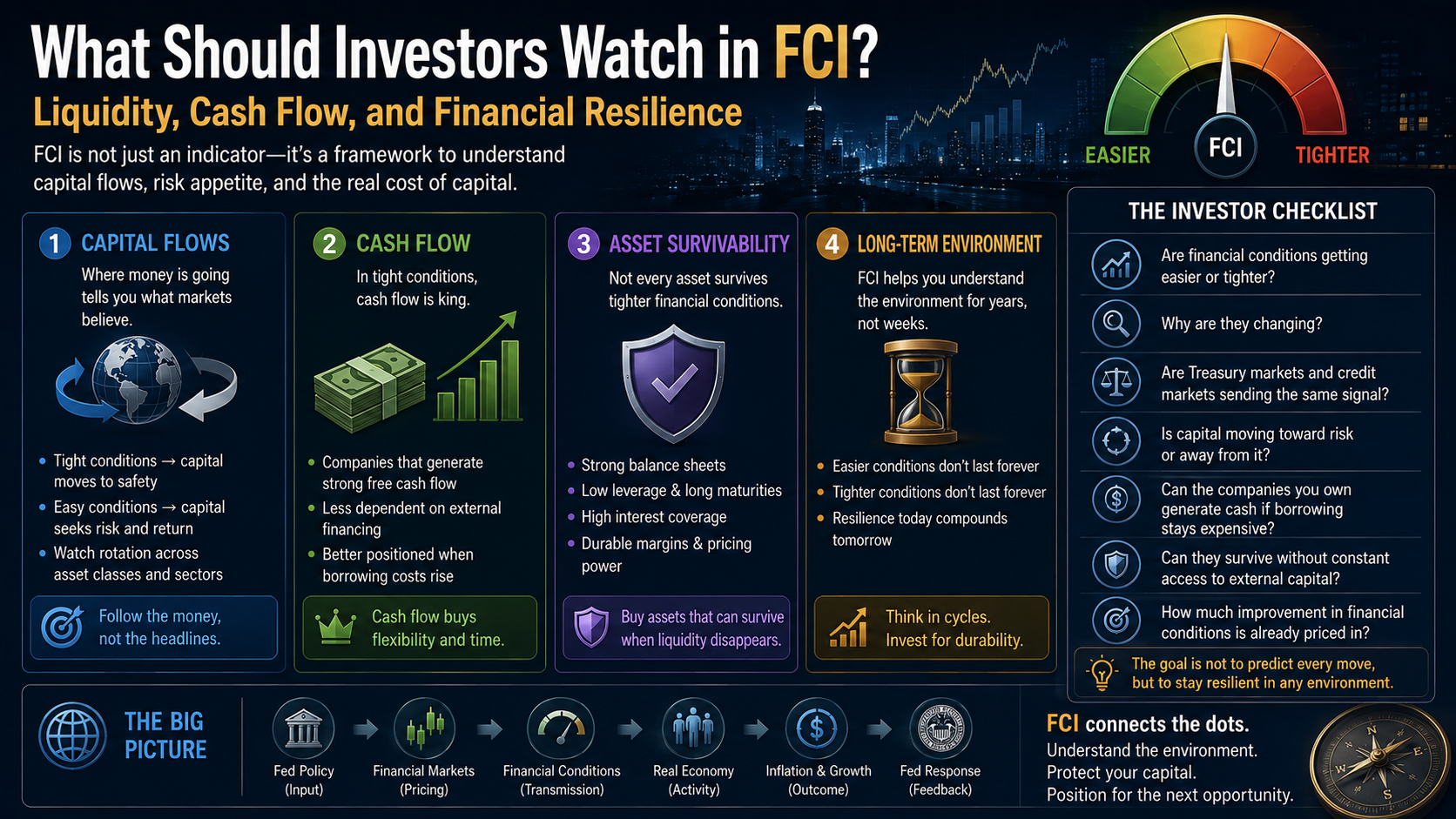
Sophisticated investors do not need to use FCI as a market-timing indicator.
Its greater value may come from helping them think about capital flows, cash generation, financial resilience, and portfolio survival.
Capital Flows
When financial conditions tighten, capital often becomes more selective.
Money may move away from highly leveraged, speculative, or illiquid assets toward cash, short-duration securities, high-quality bonds, and financially resilient companies.
When conditions stabilize and risk appetite returns, capital can gradually move back toward assets with greater risk and expected return.
The important question is not simply whether liquidity is rising or falling.
It is
Where is the money leaving, and where is it going?
Cash Flow
Companies that rely continuously on external financing are more vulnerable when financial conditions tighten.
During easy-money periods, investors may tolerate persistent losses because capital remains available.
That changes when refinancing becomes expensive.
Businesses capable of funding operations and investment through internally generated cash flow have greater flexibility.
This is why cash flow often becomes more important as money becomes more expensive.
Asset Survivability
Not every company experiences higher interest rates in the same way.
A company with large amounts of short-term floating-rate debt may feel the impact quickly.
Another company with long-term fixed-rate debt and significant cash reserves may have years before refinancing becomes a serious problem.
The relevant question for long-term investors is therefore not merely
"How fast can this company grow?"
It is also
"Can this business survive if financial conditions stay restrictive much longer than expected?"
The Long-Term Perspective
The greatest value of FCI is not predicting the exact top or bottom of the stock market.
It is understanding the environment in which assets must survive.
Investors can ask themselves
- Are financial conditions becoming easier or tighter?
- Why are they changing?
- Are Treasury markets and credit markets sending the same message?
- Is capital moving toward risk or away from it?
- Can the companies I own generate cash if borrowing remains expensive?
- Can they survive without constantly accessing external capital?
- How much improvement in financial conditions is already reflected in current valuations?
Investing is not about perfectly predicting every Fed meeting, Treasury move, or recession.
Survival matters because only capital that survives the difficult regimes can participate in the next opportunity.
The Deeper Lesson Behind the Financial Conditions Index
Financial markets are difficult to understand because everything is connected.
Interest rates influence stocks.
Stocks influence wealth and confidence.
The dollar influences global capital flows.
Credit spreads influence corporate financing.
Corporate financing influences investment and employment.
Those economic outcomes eventually feed back into inflation and Federal Reserve policy.
This is why focusing on one number can create a misleading picture.
The real financial environment is determined by several forces operating together
the price of money, the availability of credit, investors' willingness to take risk, and the direction in which capital is moving.
The Financial Conditions Index provides a framework for connecting those forces.
An investor watching only the federal funds rate and an investor watching the broader financial environment may look at the same economy and see two very different pictures.
Final Thoughts
The Financial Conditions Index is best understood as a bridge between Federal Reserve policy, financial markets, and the real economy.
It combines signals from interest rates, equity prices, credit spreads, exchange rates, and other financial variables to estimate whether the overall environment is becoming easier or tighter.
There are three ideas worth remembering.
First, the federal funds rate and actual financial conditions are not the same thing.
Second, why financial conditions are easing or tightening can matter more than the direction itself.
Third, long-term investors can use financial conditions not as a perfect market-timing tool, but as a framework for evaluating capital flows, cash generation, balance-sheet strength, and asset survivability.
Once you stop looking at Fed decisions in isolation and begin connecting Treasury yields, credit spreads, equities, the dollar, and lending conditions, the structure of the financial system becomes much easier to understand.
The goal is not to predict every move.
It is to understand the environment well enough to remain financially resilient when the market does something you did not expect.
This was MasterMind.
'[Global] Success Blueprints' 카테고리의 다른 글