What Is Convexity? Understanding Bond Prices, Interest Rates, and Duration


Hello, this is MasterMind.
If you've been learning about bonds, you've probably come across the term duration. It explains how sensitive a bond's price is to changes in interest rates.
But once you dive deeper into fixed-income investing, another term quickly appears: convexity.
Why isn't duration enough? Why do professional portfolio managers, hedge funds, and institutional investors pay close attention to convexity, especially during periods of volatile interest rates?
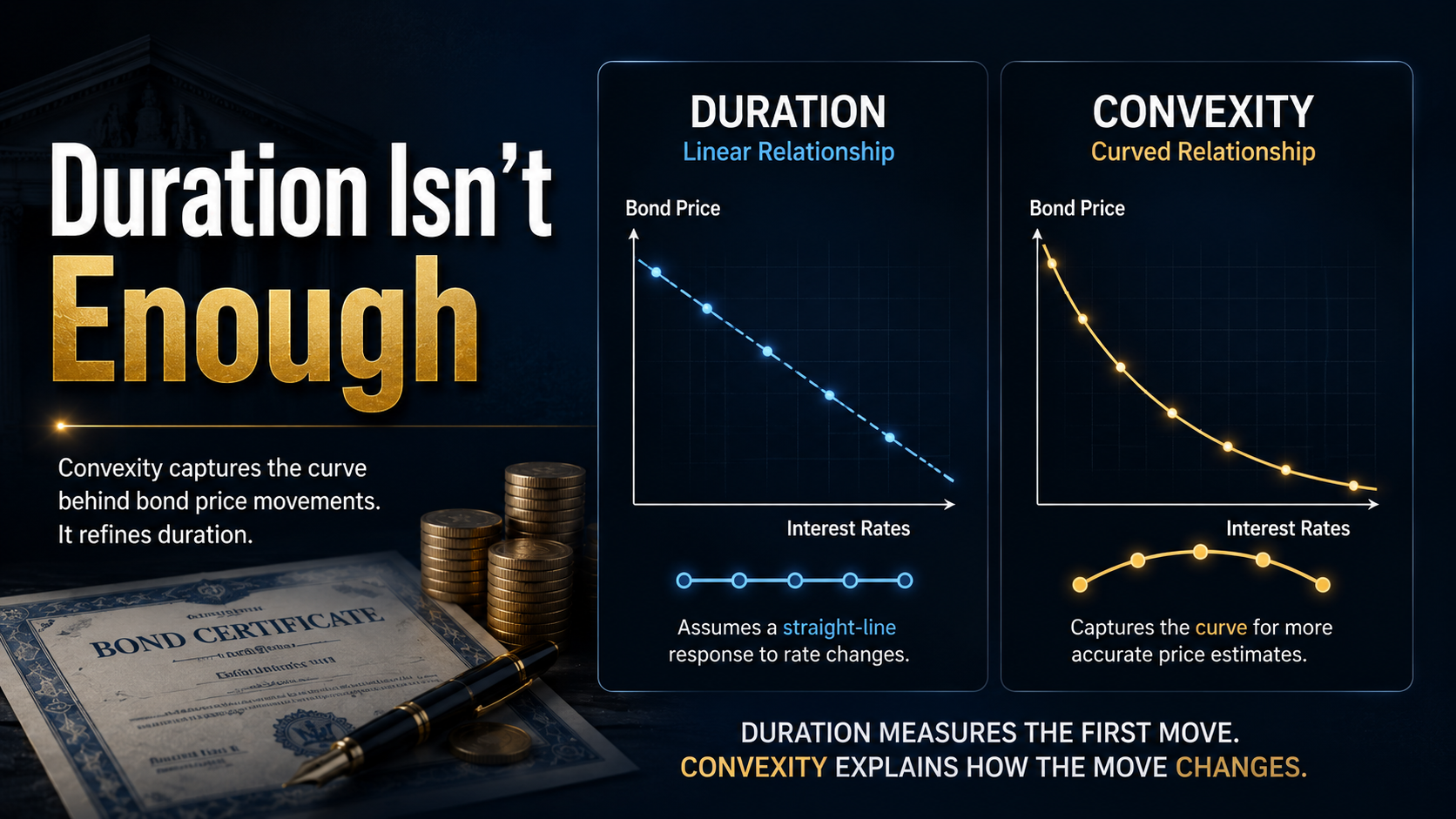
The answer is simple. Duration assumes that bond prices move in a straight line as interest rates change. Real markets don't work that way.
Understanding convexity helps investors estimate bond prices more accurately, manage downside risk, and build portfolios that perform better when interest rates become unpredictable.

Key Takeaway
Convexity measures how a bond's price changes in a curved, rather than linear, relationship with interest rates. It complements duration by providing a more accurate estimate of price movements when rates change significantly.
What Is Convexity?
Convexity is a measure of the curvature in the relationship between bond prices and interest rates.
To understand it, let's first revisit duration.
Duration estimates how much a bond's price will change for a 1% move in interest rates.
For example, if a bond has a modified duration of 7, its price is expected to rise about 7% when yields fall by 1%, or decline about 7% when yields rise by 1%.
However, this calculation assumes a straight-line relationship.
In reality, bond prices follow a curve.
As interest rates move further away from their starting point, the gap between the duration estimate and the actual bond price becomes larger.
Convexity measures that difference.
Think of it this way
- Duration answers: "How much will the price change?"
- Convexity answers: "How will that rate of change evolve?"
Together, these two measures provide a much more complete picture of interest rate risk.
How Does Convexity Work?
Every bond represents a stream of future cash flows.
Those future coupon payments and principal repayments are discounted back to today's value using current market interest rates.
Because discounting is nonlinear, bond prices do not move in straight lines.
Instead, they follow a curved path.
For most traditional Treasury bonds and high-quality corporate bonds, this curve is positively convex.
That means
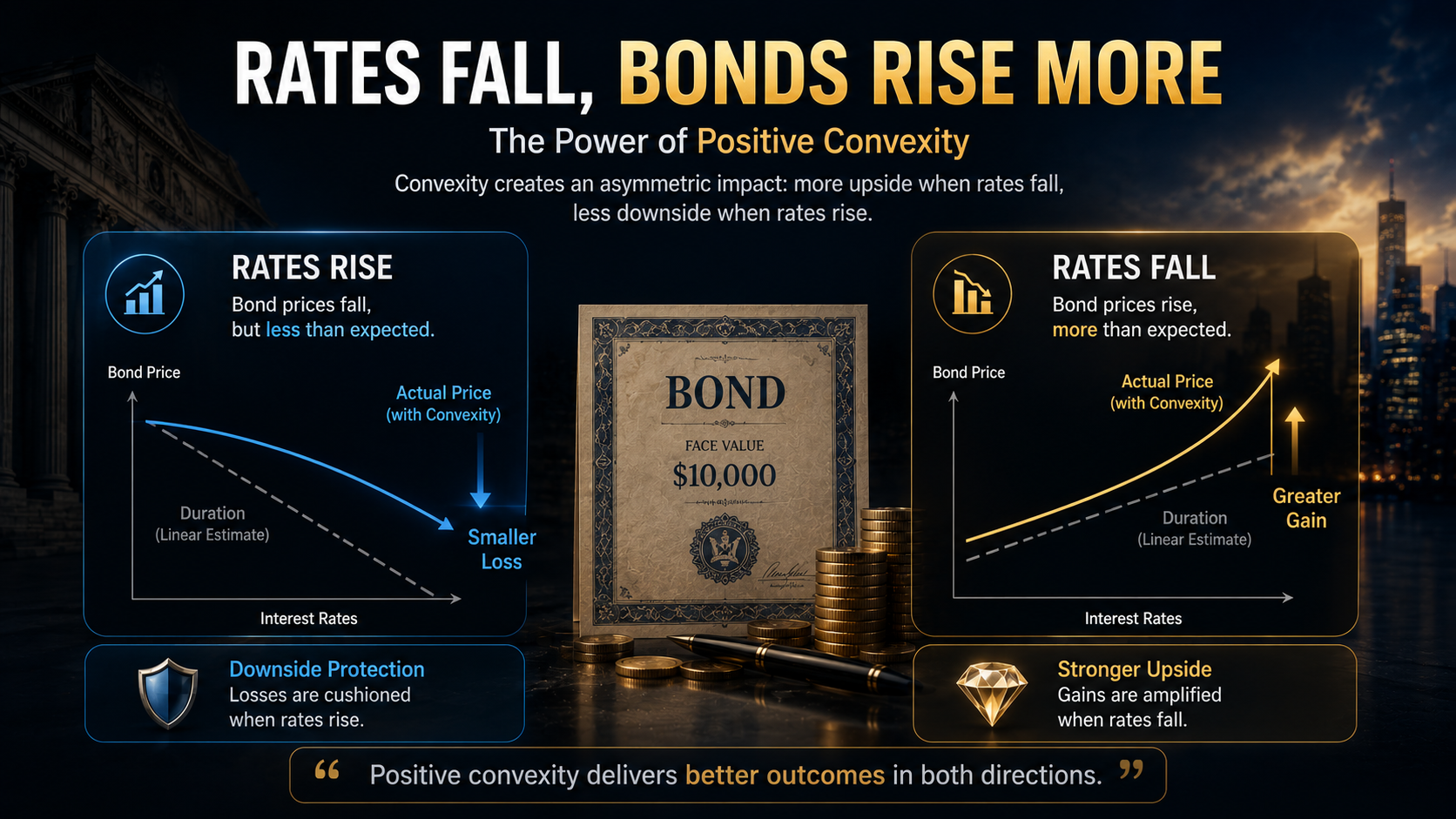
- When interest rates fall, bond prices rise more than duration alone predicts.
- When interest rates rise, bond prices decline less than duration alone predicts.
This characteristic creates an asymmetric payoff profile that many investors value during uncertain market conditions.
Imagine driving through rolling hills.
Going downhill, gravity naturally adds momentum.
Going uphill, gravity slows your speed.
Positive convexity works in a similar way by amplifying gains when rates fall while cushioning losses when rates rise.
Why Does Convexity Matter?
1. It Improves Price Estimates
Duration works well when interest rate changes are relatively small.
However, during periods of aggressive Federal Reserve tightening or easing, interest rates can move much more than expected.
Convexity helps explain the difference between estimated prices and actual market prices.
2. It Creates Better Risk Asymmetry
One of the primary goals of investing is not simply maximizing returns, but managing downside risk.
Positive convexity offers a favorable risk profile
- Smaller-than-expected losses when yields rise.
- Larger-than-expected gains when yields fall.
This asymmetry is one reason long-term Treasury securities often attract investors during periods of economic uncertainty.
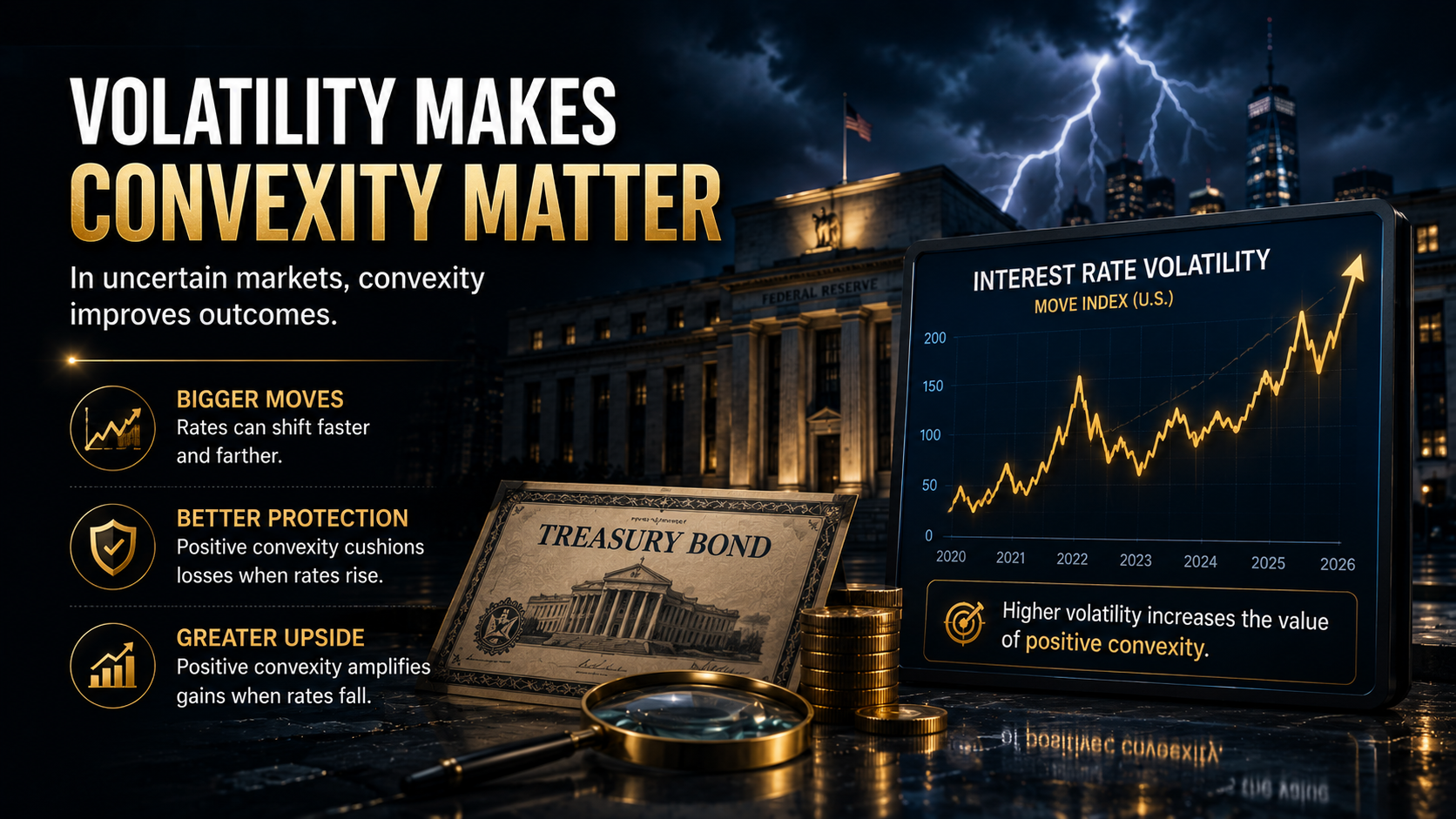
3. It Becomes More Valuable During Volatile Markets
Interest rate volatility has become a defining feature of modern financial markets.
As inflation expectations shift and Federal Reserve policy evolves, bond investors increasingly rely on convexity—not just duration—to evaluate portfolio risk.
The larger the move in yields, the more important convexity becomes.
4. Long-Term Bonds Usually Have Higher Convexity
In general, the longer a bond's maturity, the greater its convexity.
This is why long-duration Treasury ETFs often experience much larger price swings than short-term bond funds during periods of changing interest rates.
Understanding this relationship helps investors choose bond allocations that match their risk tolerance and market outlook.
How Convexity Affects Financial Markets
Convexity matters most directly in the bond market, but its implications extend far beyond individual Treasury securities.
Interest rates influence the discount rate applied to nearly every financial asset. When the discount rate changes, investors reassess the present value of future cash flows across bonds, stocks, real estate, gold, and other assets.
That is why convexity should not be viewed as an isolated bond-market formula. It is part of a broader framework for understanding how financial markets respond to changes in interest rates and volatility.
| Asset or Security | Convexity Profile | Typical Market Impact |
| U.S. Treasury bonds | Generally positive convexity | Prices may rise more than expected when yields fall and decline less than expected when yields rise |
| Investment-grade corporate bonds | Positive convexity with credit risk | Performance depends on both Treasury yields and credit spreads |
| Mortgage-backed securities | Often negative convexity | Refinancing can limit gains when rates fall, while extension risk can increase losses when rates rise |
| Long-duration bond ETFs | Higher sensitivity and convexity | Larger price swings during major changes in Treasury yields |
| Growth stocks | Highly sensitive to discount rates | Lower rates may support valuations, while higher rates can pressure long-duration cash flows |
| Gold | Sensitive to real interest rates | Falling real yields may improve the relative appeal of non-yielding assets |
| Bitcoin and other risk assets | Sensitive to liquidity and risk appetite | Easier financial conditions may support demand, while tighter liquidity can increase volatility |
Positive Convexity vs. Negative Convexity
Most traditional, option-free bonds have positive convexity.
This is generally favorable because the investor receives more upside when yields decline than the downside experienced from an equivalent increase in yields.
However, not every fixed-income asset behaves this way.
What Is Negative Convexity?
Negative convexity occurs when an asset's price rises less than expected as interest rates fall and declines more sharply as rates rise.
Mortgage-backed securities are the most common example in the U.S. market.
When mortgage rates fall, homeowners often refinance their loans. That causes mortgage principal to be repaid earlier than expected.
For investors in mortgage-backed securities, this creates reinvestment risk. The investor receives principal back at precisely the time when new bonds offer lower yields.
When rates rise, the opposite can happen. Homeowners are less likely to refinance, so the expected life of the mortgage pool becomes longer.
This creates extension risk and can make the security behave like a longer-duration asset just as yields are rising.
In simple terms
- Falling rates may limit the upside.
- Rising rates may increase the downside.
That is the opposite of the favorable asymmetry associated with positive convexity.
Why Mortgage-Backed Securities Matter to the U.S. Market
The U.S. mortgage market is large enough that changes in mortgage duration and convexity can influence the broader Treasury market.
When interest rates move sharply, mortgage investors and dealers may need to adjust their hedges.
For example, when rates rise and mortgage duration extends, investors may sell Treasury securities or use interest-rate derivatives to reduce their added duration exposure.
When rates fall and mortgage duration shortens, the opposite adjustment may occur.
These hedging flows can reinforce market movements and contribute to additional volatility in Treasury yields.
This is one reason professional investors monitor not only Federal Reserve policy and inflation data, but also the positioning and hedging behavior of large mortgage-market participants.
Money does not move only because investors change their economic forecasts. It also moves because financial institutions must rebalance risk.
What Investors Should Know About Convexity
1. Duration and Convexity Should Be Used Together
Duration provides the first estimate of interest-rate sensitivity.
Convexity refines that estimate, especially when yields move significantly.
Looking at duration alone may be sufficient for small rate changes, but it can become misleading during major Federal Reserve tightening cycles, recessions, inflation shocks, or rapid changes in Treasury yields.
2. Longer Maturities Usually Increase Convexity
Long-term Treasury bonds generally have more convexity than short-term securities.
That can be beneficial when yields fall, but investors should not confuse higher convexity with low risk.
Long-duration bonds can still experience substantial losses when rates rise.
Convexity improves the shape of the payoff, but duration still determines much of the initial price sensitivity.
3. Interest-Rate Volatility Changes the Value of Convexity
Convexity becomes more valuable when the bond market expects larger interest-rate movements.
The ICE BofA MOVE Index is often used as a broad measure of implied volatility in the U.S. Treasury market.
When rate volatility is elevated, securities with favorable convexity characteristics may command a higher premium because their asymmetric price behavior becomes more valuable.
However, that benefit is rarely free.
4. Higher Convexity Can Mean a Lower Yield
Investors typically prefer securities with greater positive convexity, all else being equal.
As a result, the market may price those bonds more highly, which can reduce their yield relative to less convex alternatives.
This is similar to paying an insurance premium.
The investor accepts slightly less income in exchange for a more favorable payoff profile during large interest-rate moves.
5. Bond ETFs Inherit the Characteristics of Their Holdings
A bond ETF does not eliminate duration or convexity risk.
Its behavior depends on the maturity, coupon structure, credit quality, and embedded options of the securities it owns.
A long-term Treasury ETF may have substantial positive convexity, but it can also experience large short-term losses if Treasury yields rise sharply.
A mortgage-backed securities ETF may display negative-convexity characteristics because of refinancing and extension risk.
Investors should therefore look beyond the ETF's distribution yield and examine its effective duration, average maturity, credit exposure, and portfolio composition.
How Convexity Connects to Stocks and the Economy
Convexity is a formal bond-market measure, so it should not be applied mechanically to stocks.
However, the underlying idea of nonlinear sensitivity is useful across financial markets.
Growth companies, for example, derive a large share of their estimated value from earnings expected far in the future.
Because those distant cash flows are highly sensitive to discount rates, growth-stock valuations may rise sharply when rates fall and compress significantly when rates rise.
That does not make growth stocks "convex bonds," but it explains why discount-rate changes can create disproportionate market reactions.
The same principle appears in real estate, private equity, infrastructure, and other long-duration assets.
The further into the future an asset's cash flows extend, the more sensitive its present value may be to changes in the discount rate.
The market's deeper structure is therefore not only about earnings, coupons, or economic growth.
It is also about how investors value time.
What Does Smart Money Look for in Convexity?
Large asset managers do not focus only on predicting whether the Federal Reserve will raise or cut interest rates.
They also ask how much they stand to gain if they are right and how much they could lose if they are wrong.
That is the practical value of convexity.
The Direction of Capital Flows
When volatility rises, capital may move away from assets with unfavorable optionality and toward securities with stronger liquidity, predictable cash flows, and more favorable convexity.
This does not mean institutions always sell mortgage-backed securities or callable bonds.
Many investors hold those assets because the additional yield may compensate them for the risk.
The real question is whether the compensation is sufficient.
Cash-Flow Reliability
Sophisticated investors examine whether expected cash flows are truly stable.
A bond may appear attractive because of its yield, but embedded call or prepayment features can alter the timing of those cash flows when market conditions change.
The timing of cash flows matters almost as much as the amount.
Asset Survivability
During periods of market stress, the most important asset is not always the one with the highest expected return.
It may be the one that preserves liquidity, limits forced selling, and gives the investor the ability to act when better opportunities emerge.
Convexity can contribute to that resilience by improving the balance between upside and downside.
The Long-Term Perspective
The strongest portfolios are not built around a single interest-rate forecast.
They are built to survive several possible paths.
Rates may remain high longer than expected, inflation may fall rapidly, growth may weaken, or fiscal pressure may keep long-term Treasury yields elevated.
A durable portfolio considers how each asset behaves across these different scenarios.
Questions Investors Should Ask
Before adding a bond or bond ETF to a portfolio, investors may want to ask
- How much duration risk am I taking?
- Does the security have positive or negative convexity?
- Are there call, prepayment, or extension risks?
- How would the investment behave if Treasury yields moved sharply in either direction?
- Am I being adequately compensated for the embedded risks?
- Does this asset improve the portfolio's ability to survive an unexpected market environment?
- Am I focusing only on yield while ignoring price sensitivity?
These questions do not predict the future.
They improve the structure of the decision.

Final Thoughts
Convexity is not simply an advanced formula used by bond traders.
It explains why bond prices respond unevenly to changes in interest rates and why duration alone may not fully capture the risks of a large market move.
For U.S. investors, the concept is especially relevant when evaluating long-term Treasury bonds, corporate bonds, mortgage-backed securities, and bond ETFs.
Positive convexity may provide a more favorable balance between upside and downside, while negative convexity can limit gains and increase losses under certain interest-rate scenarios.
The broader lesson extends beyond fixed income.
Financial markets constantly reprice future cash flows as discount rates change. Capital then moves toward assets offering the most attractive combination of income, liquidity, resilience, and risk-adjusted return.
The key message to remember is this
Duration estimates the first move in a bond's price, while convexity explains how that price response changes as interest rates move further.
Successful investing is not about predicting every Federal Reserve decision correctly. It is about building a portfolio that can survive when the forecast is wrong and still participate when the environment turns favorable.
This was MasterMind.
Related Articles
- What Is Modified Duration? How Interest Rates Affect Bond Prices
Learn how investors estimate the percentage change in a bond's price when market yields move. - What Is Duration? How Interest Rates Affect Bond Prices
Understand the relationship between cash-flow timing, maturity, and interest-rate sensitivity. - What Is Yield to Maturity (YTM)? How Bond Prices, Interest Rates, and Returns Are Connected
See how a bond's market price, coupon payments, and principal repayment combine into an estimated annualized return. - What Is Current Yield? Current Yield vs. Yield to Maturity
Learn why current yield measures income but does not capture the full return of holding a bond to maturity. - What Is a Bond Coupon Rate? Coupon Rate vs. Yield to Maturity
Understand how a bond's stated interest payment differs from its market yield. - What Are Discount and Premium Bonds? Why Bond Prices Move Above or Below Face Value
Learn why bonds trade above or below face value as market interest rates change. - What Is a Treasury Auction? How U.S. Government Bond Auctions Affect Interest Rates and Markets
Explore how Treasury demand influences yields, liquidity, and broader financial conditions.
'[Global] Success Blueprints' 카테고리의 다른 글