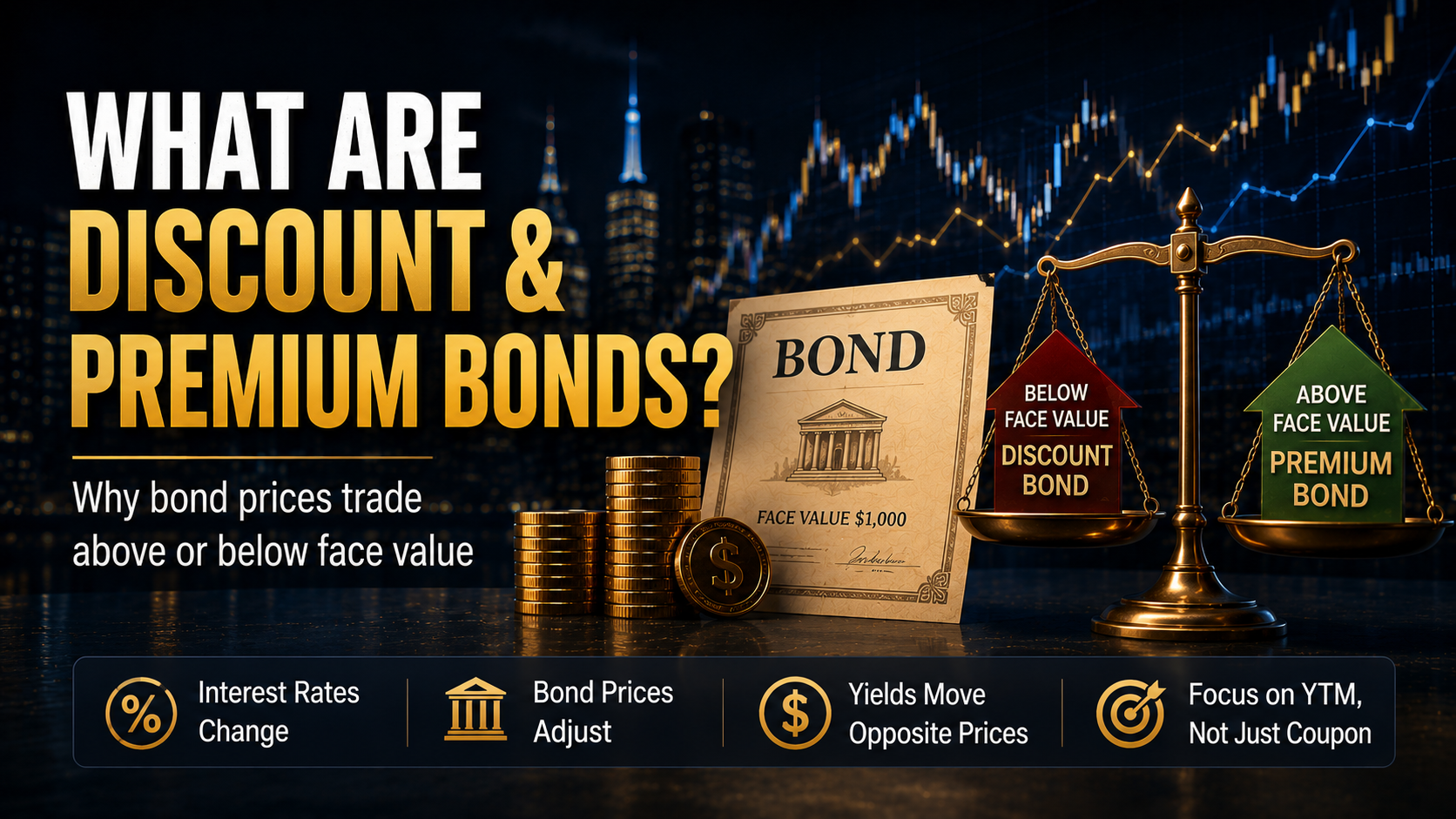
What Are Discount and Premium Bonds? Why Bond Prices Move Above or Below Face Value


Hello, this is MasterMind.
If a bond is designed to return its full face value at maturity, why would investors ever pay more than face value to buy it? And why do other bonds trade at a discount instead?
The answer lies in one of the most important principles of fixed-income investing: bond prices constantly adjust to changes in market interest rates.
Understanding discount and premium bonds isn't just about learning bond terminology. It's about understanding how capital flows, interest rates, and investor expectations shape every major financial market—from U.S. Treasuries to corporate bonds and even stocks.
Key Takeaway
A bond's price reflects current market interest rates, not its original face value. Successful investors focus on total return and Yield to Maturity (YTM), not simply the coupon rate.
What Are Discount Bonds and Premium Bonds?
A bond is essentially a loan.
When investors purchase a bond, they are lending money to a government, municipality, or corporation in exchange for periodic interest payments and the return of principal at maturity.
Every bond includes three basic components
- Face Value (Par Value): The amount repaid at maturity.
- Coupon Rate: The fixed annual interest rate paid on the face value.
- Maturity Date: The date when the issuer repays the principal.
Once issued, however, bonds trade freely in the secondary market.
That means the market—not the issuer—determines the bond's price.
Depending on market conditions, bonds typically fall into one of three categories
- Discount Bond: Trades below face value.
- Premium Bond: Trades above face value.
- Par Bond: Trades at face value.
These are not different types of bonds. They simply describe how the market currently values the same bond.

Why Do Discount and Premium Bonds Exist?
The answer is simple
Interest rates change, but coupon payments do not.
When new bonds offer higher yields than older bonds, existing bonds become less attractive.
When new bonds offer lower yields, older higher-coupon bonds become more valuable.
Money naturally flows toward better returns, and bond prices adjust until yields become competitive again.
How a Discount Bond Is Created
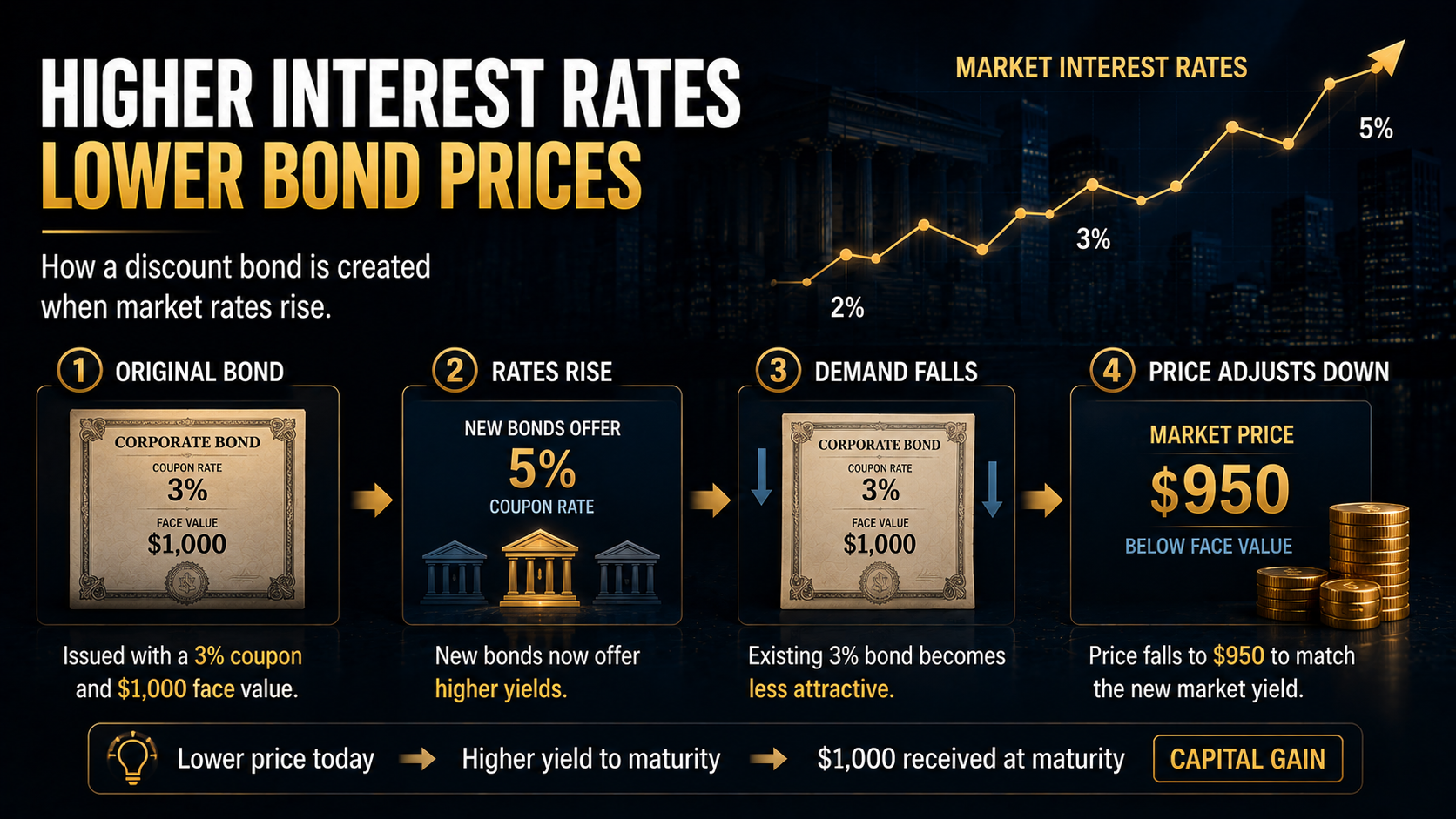
Imagine you own a corporate bond paying a 3% coupon.
A year later, newly issued bonds with similar credit quality begin offering 5%.
Why would another investor buy your 3% bond at full price?
They probably wouldn't.
To attract buyers, your bond's market price must fall.
For example
- Face Value: $1,000
- Market Price: $950
Although the coupon remains unchanged, the buyer now earns
- Annual coupon income
- A $50 capital gain when the bond matures at $1,000
The lower purchase price increases the bond's overall return until it becomes competitive with newly issued bonds.
This is how a discount bond is created.
How a Premium Bond Is Created
Now imagine the opposite scenario.
Suppose interest rates decline sharply.
New bonds now pay only 2%, but an existing bond continues paying a 5% coupon.
That bond suddenly becomes much more attractive.
Investors compete to buy it, pushing its market price above face value.
For example
- Face Value: $1,000
- Market Price: $1,070
Although the investor pays more upfront, the higher coupon payments compensate for the premium over time.
This creates a premium bond.

How Bond Pricing Actually Works
The most important concept in bond investing is this
Future cash flows are fixed. The market price is not.
Every bond promises
- Scheduled coupon payments
- Repayment of face value at maturity
The only variable is today's purchase price.
That is why bond prices constantly adjust to reflect current interest rates.
A lower purchase price increases future returns.
A higher purchase price reduces future returns.
This leads to one of the most fundamental rules in finance
Bond prices and bond yields always move in opposite directions.
Understanding this relationship is the foundation of every fixed-income investment strategy.
Why This Matters to Investors
Many beginners compare bonds using only the coupon rate.
Professional investors rarely do.
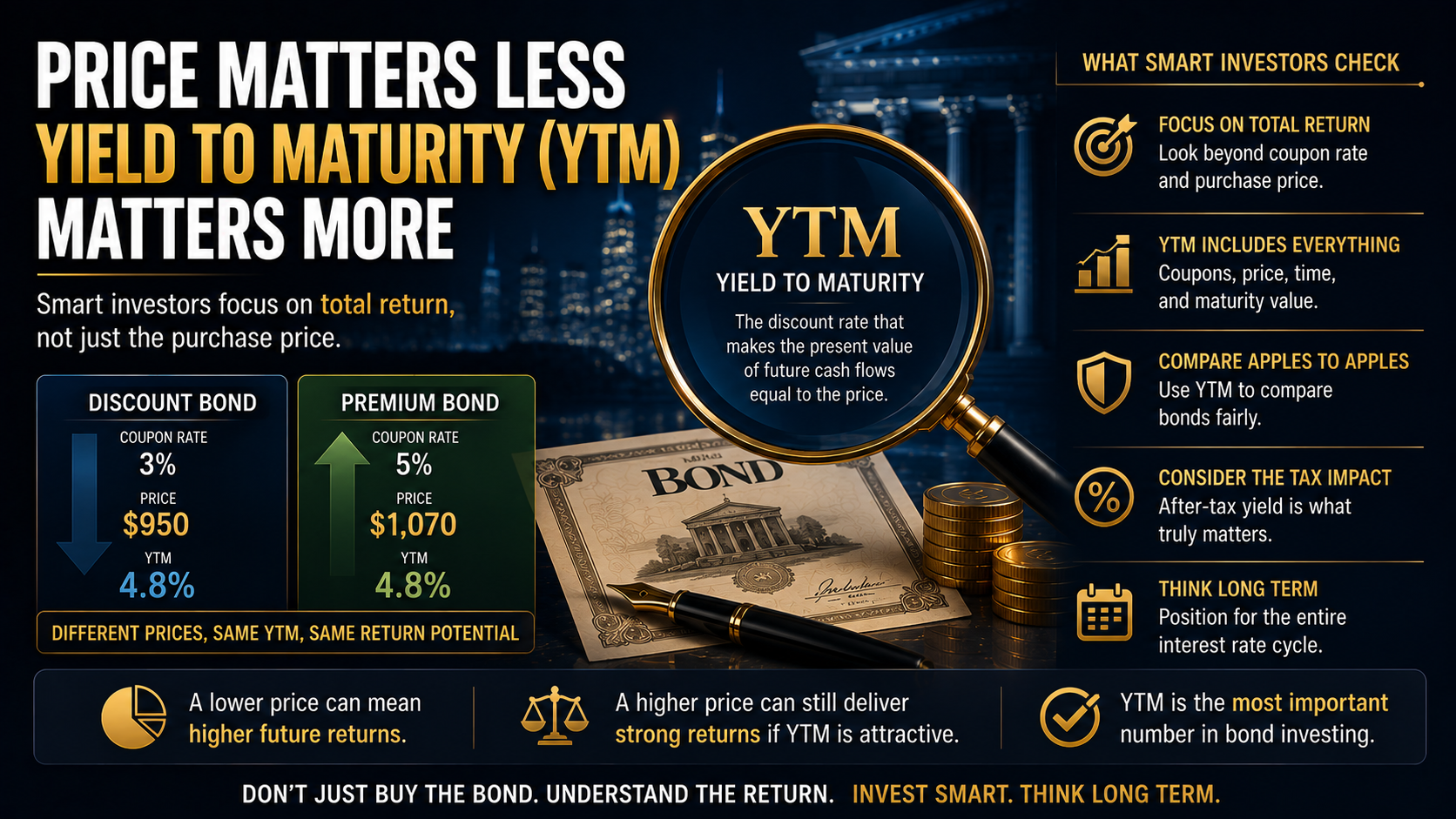
Instead, they evaluate Yield to Maturity (YTM) because it reflects the bond's complete return, including
- Coupon payments
- Purchase price
- Capital gain or loss at maturity
- Remaining time until maturity
This is why institutional investors, pension funds, and bond portfolio managers pay much more attention to YTM than coupon rates alone.
As a result, two bonds with identical coupon rates can produce very different investment outcomes depending on the purchase price.
The bond market doesn't value yesterday's interest rate. It values tomorrow's cash flows.
How Discount and Premium Bonds Affect Financial Markets
Interest rate movements influence far more than bond prices.
They shape capital allocation across nearly every major asset class.
| Market Condition | Discount Bonds | Premium Bonds | Typical Market Impact |
| Rising Interest Rates | Increase | Decrease | Bond prices decline, growth stocks face valuation pressure |
| Falling Interest Rates | Decrease | Increase | Bond prices rise, liquidity conditions improve |
| Economic Slowdown | High-quality government bonds often trade at premiums | Safe-haven demand strengthens | Investors shift toward defensive assets |
| Economic Expansion | More newly issued higher-yield bonds | Fewer premium bonds | Risk assets generally attract more capital |
Impact on Major Asset Classes
| Asset | Typical Effect |
| U.S. Stocks | Higher discount rates can reduce equity valuations |
| Bonds | Existing bond prices move opposite to interest rates |
| U.S. Dollar | Higher rates often attract global capital inflows |
| Gold | Rising real yields can reduce gold's relative appeal |
| Bitcoin | Tighter liquidity may increase volatility |
Markets never move because of a single factor, but interest rates remain one of the strongest drivers of long-term asset prices.
What Investors Should Remember
1. Never Judge a Bond by Its Coupon Rate Alone
The coupon tells you what the issuer promised years ago.
Yield to Maturity tells you what you'll likely earn today.
2. A Discount Bond Isn't Automatically a Bargain
Sometimes prices fall because interest rates rise.
Other times they fall because investors worry about the issuer's credit quality.
Knowing the difference is critical.
3. A Premium Bond Isn't Necessarily Overpriced
Higher coupon payments can justify paying more than face value.
The key question is whether the total return matches your investment objectives.
4. Consider After-Tax Returns
Tax treatment differs depending on the bond type, issuer, and jurisdiction.
For U.S. investors, Treasury securities, municipal bonds, and corporate bonds may all have different tax implications.
Looking only at pre-tax yield can produce misleading comparisons.
5. Always Think About the Interest Rate Cycle
Bond prices don't move randomly.
They respond to expectations about future Federal Reserve policy, inflation, and economic growth.
Understanding where rates may be headed is often more important than focusing on today's coupon.
What Wealthy Investors See That Others Often Miss
Experienced investors rarely focus on whether a bond is trading at a discount or a premium.
Instead, they ask
Where is capital moving next?
When interest rates rise, high-quality bonds often become cheaper.
That creates opportunities for investors who believe rates may eventually stabilize or decline.
When rates fall, existing higher-coupon bonds appreciate in value, rewarding investors who purchased them earlier.
Professional investors think in terms of
Capital Flows
Which assets are attracting institutional money, and which are losing it?
Cash Flow
How reliable are the bond's future income streams?
Asset Resilience
Can the issuer continue meeting its obligations during economic stress?
Long-Term Positioning
Will this investment remain attractive throughout an entire interest-rate cycle?
Before buying any bond, consider asking yourself
- Am I chasing a high coupon, or evaluating total return?
- Why is this bond trading below or above par?
- Is the price reflecting interest rates or credit risk?
- How would my investment perform if the Federal Reserve changes policy again?
In investing, survival doesn't come from predicting every market move.
It comes from understanding how capital flows through changing economic environments.
Final Thoughts
Discount bonds and premium bonds are not separate investment products.
They are simply the market's way of adjusting bond prices to today's interest rate environment.
When interest rates rise, existing bonds tend to trade at discounts.
When rates fall, existing higher-coupon bonds often trade at premiums.
The real lesson isn't whether a bond looks cheap or expensive.
It's understanding why the market assigned that price—and how it affects your total return.
The investors who consistently outperform over time aren't those who chase yields.
They're the ones who understand how interest rates, cash flows, and valuation work together.
MasterMind.
'[Global] Success Blueprints' 카테고리의 다른 글