What Is Modified Duration? How Interest Rates Affect Bond Prices


Hello, this is MasterMind.
When the Federal Reserve signals a rate cut or hike, one question immediately comes to mind for many investors
"How much will my bond portfolio actually move?"
Most investors understand the basic rule that bond prices and interest rates move in opposite directions. But knowing that relationship is very different from knowing how much a bond's price is likely to rise or fall.
That is where Modified Duration becomes one of the most valuable concepts in fixed-income investing.
Professional portfolio managers, pension funds, insurance companies, and institutional investors rarely evaluate a bond based solely on its coupon rate or maturity. Instead, one of the first numbers they examine is modified duration because it measures how sensitive a bond's price is to changes in interest rates.
Understanding this metric helps investors move beyond guessing the direction of rates and toward managing portfolio risk with greater precision.
Key Takeaway
Modified Duration estimates how much a bond's price is expected to change when interest rates move by one percentage point, making it one of the most important measures of interest rate risk.
What Is Modified Duration?
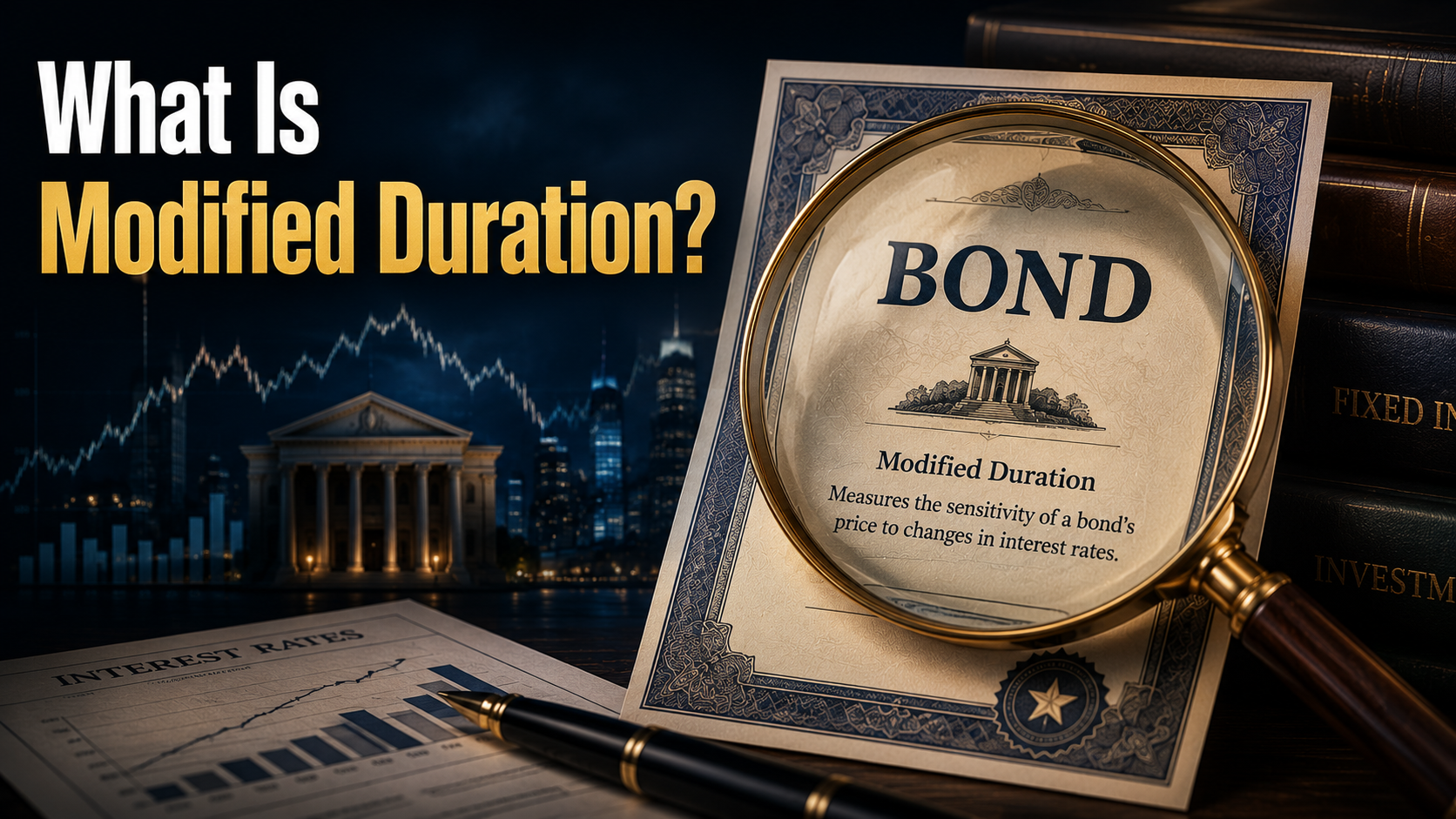
Modified Duration measures the price sensitivity of a bond to changes in market interest rates.
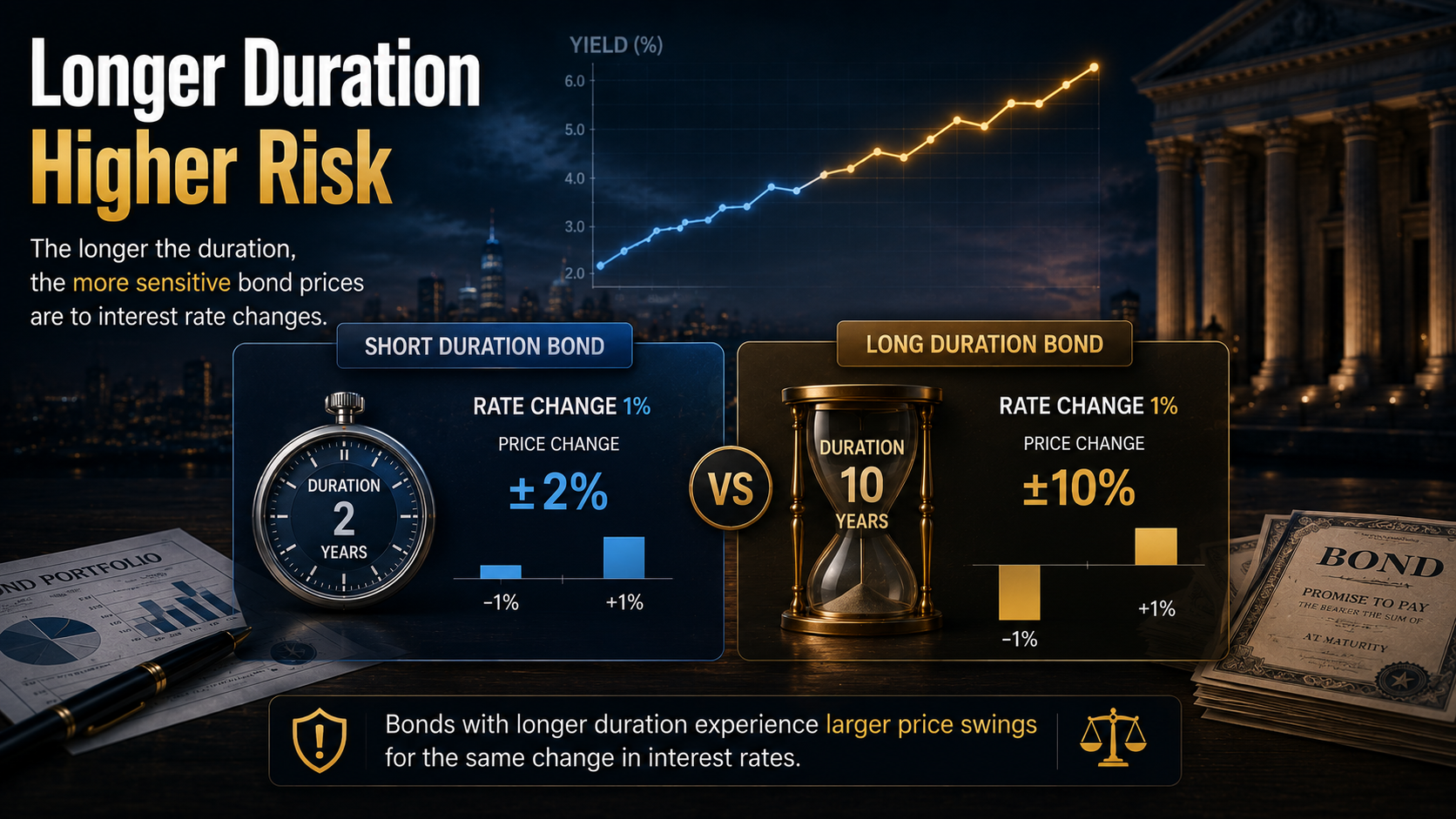
In simple terms, it estimates the percentage change in a bond's price for every 1% change in yield.
For example, if a bond has a modified duration of 6, then
- If yields fall by 1%, the bond's price is expected to rise by roughly 6%.
- If yields rise by 1%, the bond's price is expected to fall by roughly 6%.
While the estimate is not exact, it provides investors with a practical way to evaluate potential price movements before interest rates actually change.
Modified Duration vs. Macaulay Duration
Many investors first encounter Macaulay Duration, which measures the weighted average time required to recover a bond's cash flows.
Modified Duration takes that concept one step further.
Instead of measuring time, it converts duration into a measure of price sensitivity.
Think of it this way
- Macaulay Duration answers: "How long does it take to recover my investment?"
- Modified Duration answers "How much could my investment gain or lose if interest rates move?"
The relationship is calculated as
Modified Duration = Macaulay Duration ÷ (1 + Yield to Maturity / Number of Coupon Payments)
The formula itself matters less than understanding what the result represents.
How Modified Duration Works
Bond prices and interest rates have an inverse relationship.
When newly issued bonds offer higher yields, older bonds with lower coupons become less attractive, causing their prices to decline.
Conversely, when market yields fall, existing bonds paying higher coupons become more valuable.
Modified Duration measures how strongly that price adjustment occurs.
For example
| Modified Duration | If Rates Fall 1% | If Rates Rise 1% |
| 2 | Approximately +2% | Approximately -2% |
| 5 | Approximately +5% | Approximately -5% |
| 8 | Approximately +8% | Approximately -8% |
| 12 | Approximately +12% | Approximately -12% |
Generally speaking, modified duration becomes larger when
- Bond maturities are longer
- Coupon rates are lower
- Market yields are lower
The longer investors must wait to receive their cash flows, the more exposed they become to changing interest rates.

Why Modified Duration Matters
Many investors spend enormous amounts of time trying to predict where the Federal Reserve will move next.
Institutional investors often focus on something different.
Instead of asking "Will rates rise?", they ask
"How exposed is my portfolio if rates move unexpectedly?"
That distinction is critical.
Markets constantly price future expectations long before the Fed actually changes policy.
When investors begin anticipating lower interest rates, money often flows into long-duration bonds because they offer greater price appreciation potential.
When higher rates become more likely, investors frequently shorten portfolio duration to reduce downside risk.
The market rarely waits for official announcements.
Capital moves ahead of them.
Modified duration helps explain why.
How Modified Duration Affects Financial Markets
Although modified duration is a bond metric, its influence extends far beyond the bond market.
Interest rates affect valuation models across virtually every major asset class.
| Asset Class | Lower Rates | Higher Rates |
| Treasury Bonds | Strong price gains | Larger price declines |
| Investment-Grade Bonds | Moderate appreciation | Moderate declines |
| Long-Term Bond ETFs | Highest sensitivity | Highest downside risk |
| Growth Stocks | Higher valuations | Multiple compression |
| Value Stocks | Limited impact | Often relatively resilient |
| Gold | Can benefit from lower real yields | May weaken if real yields rise |
| Bitcoin | May benefit from increased liquidity | Higher volatility during tightening cycles |
Understanding modified duration provides investors with a broader perspective on why capital rotates between asset classes during different monetary policy environments.

What Investors Should Know
Modified Duration Is an Estimate
Modified duration assumes a linear relationship between yields and prices.
In reality, bond prices follow a curved relationship.
For small interest-rate changes, modified duration provides an excellent approximation.
For larger rate movements, investors should also consider Convexity, which improves pricing accuracy by accounting for that curvature.
This is why professional bond managers typically evaluate duration and convexity together.
Bond ETFs Behave Differently From Individual Bonds
Individual bonds naturally see their duration decline as they approach maturity.
Bond ETFs operate differently.
Because portfolio managers continuously replace maturing securities with newly issued bonds, the fund's average duration often remains relatively stable over time.
This means investors should always review a bond ETF's average modified duration before investing rather than assuming risk automatically declines with time.
Higher Duration Means Both Higher Opportunity and Higher Risk
A longer-duration portfolio can generate substantial capital gains during falling-rate environments.
However, it can also suffer significantly larger losses when yields rise.
Higher modified duration does not guarantee higher returns.
It simply means the investment is more sensitive to changes in interest rates.
What Wealthy Investors Pay Attention To
Sophisticated investors rarely view modified duration as merely a bond statistic.
Instead, they see it as a tool for understanding where capital is likely to flow next.
When monetary policy shifts toward easing, capital often rotates from cash, money market funds, and short-duration bonds into longer-duration Treasuries and high-quality bonds.
The objective is not simply earning coupon income.
It is capturing capital appreciation as yields decline.
During tightening cycles, however, institutional investors frequently shorten portfolio duration to preserve capital and reduce interest-rate exposure.
Notice the pattern.
Professional investors are less concerned with predicting every Federal Reserve decision than with ensuring their portfolios remain resilient regardless of the outcome.
Markets reward disciplined risk management more consistently than perfect forecasts.
Ask yourself
- What is the average duration of my fixed-income portfolio?
- How would my investments perform if Treasury yields unexpectedly moved by one percentage point?
- Am I chasing yield, or am I managing risk?
Long-term investing is not about accurately predicting every interest-rate cycle.
It is about building a portfolio capable of surviving many different market environments.

Final Thoughts
Modified Duration is one of the most important concepts in fixed-income investing because it translates interest-rate movements into expected price changes.
Whether you invest in Treasury securities, corporate bonds, bond ETFs, or maintain a diversified portfolio, understanding duration provides valuable insight into how monetary policy affects your investments.
The market does not simply react to interest rates.
It reacts to how interest-rate expectations reshape capital flows, valuations, and risk.
The better investors understand modified duration, the better prepared they become for changing market conditions.
The most important lesson is simple
Successful investing is rarely about predicting the next move in interest rates. It is about understanding your exposure to risk before the market forces you to.
This was MasterMind.
'[Global] Success Blueprints' 카테고리의 다른 글