What Is Yield to Maturity (YTM)? How Bond Prices, Interest Rates, and Returns Are Connected


Hello, this is MasterMind.
When most investors look at a bond, the first thing they notice is the coupon rate. A bond paying 5% interest naturally seems more attractive than one paying 3%.
However, experienced investors know that the coupon rate rarely tells the whole story.
A bond purchased at a discount can generate a higher overall return than one with a larger coupon, while an expensive premium bond may deliver a lower return despite offering higher interest payments.
This is why professional investors focus on Yield to Maturity (YTM) rather than the coupon rate alone.
YTM measures the total annualized return an investor can reasonably expect if a bond is purchased today and held until maturity. More importantly, Treasury yields influence far more than the bond market—they affect stock valuations, mortgage rates, corporate borrowing costs, the U.S. dollar, gold, Bitcoin, and global capital flows.
Understanding YTM is not simply about becoming a better bond investor. It is about understanding how money moves through the financial system.
Key Takeaway
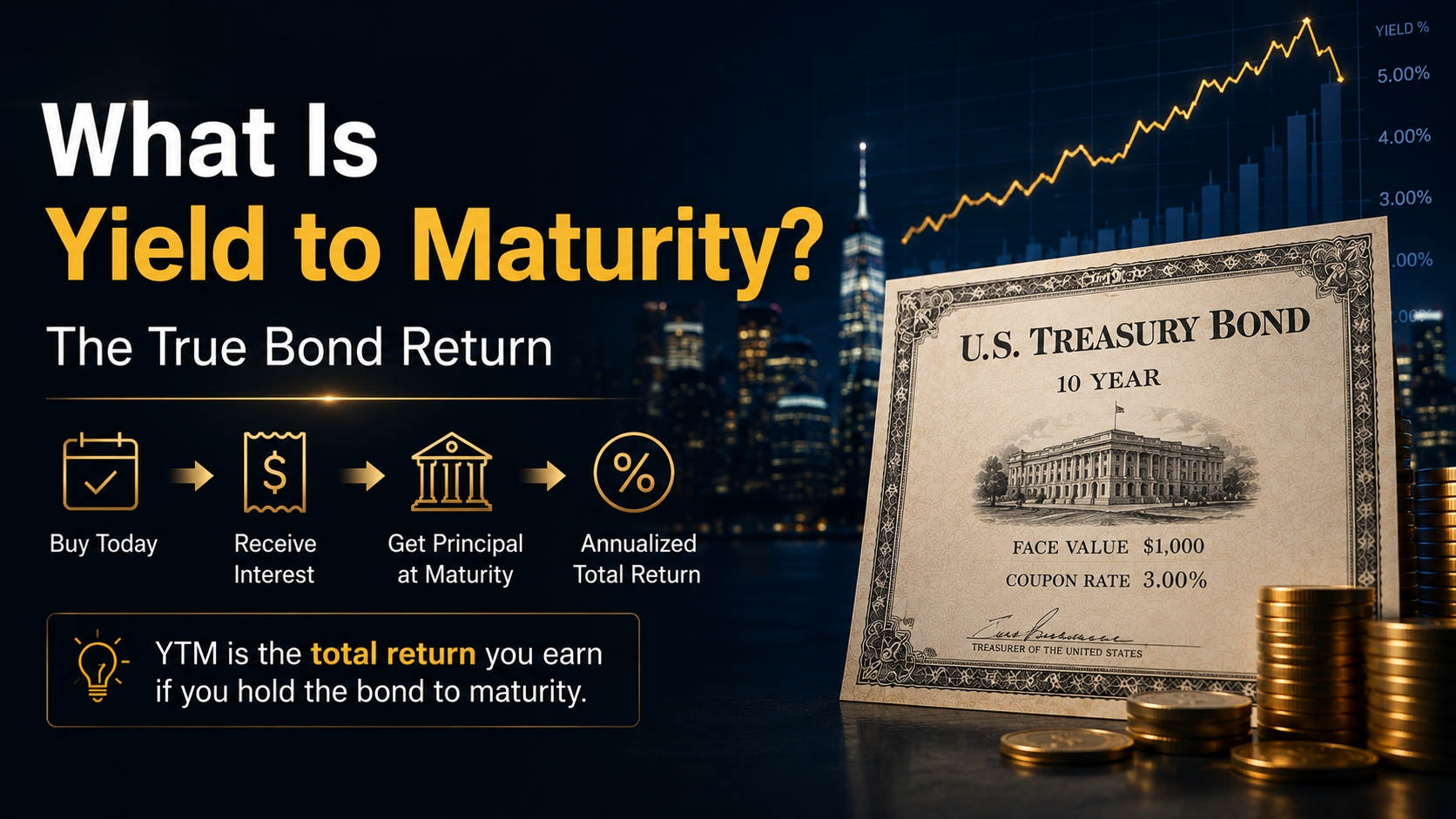
Yield to Maturity (YTM) represents the annualized total return an investor expects to earn by purchasing a bond at its current market price and holding it until maturity.
What Is Yield to Maturity (YTM)?
Yield to Maturity (YTM) is the comprehensive return of a bond.
Unlike the coupon rate, which measures only the annual interest payment relative to the bond's face value, YTM considers every component of an investment's return.
It includes
- The bond's current market price
- Annual coupon payments
- Face value repaid at maturity
- Remaining time until maturity
- The assumption that coupon payments are reinvested at the same yield
In finance, YTM is essentially the bond's Internal Rate of Return (IRR).
A simple way to think about it is
If I buy this bond today and hold it until it matures, what annual return should I expect over the life of the investment?
That single figure allows investors to compare bonds with completely different coupon rates, maturities, and market prices.
How Does Yield to Maturity Work?
The most important relationship in the bond market is surprisingly simple
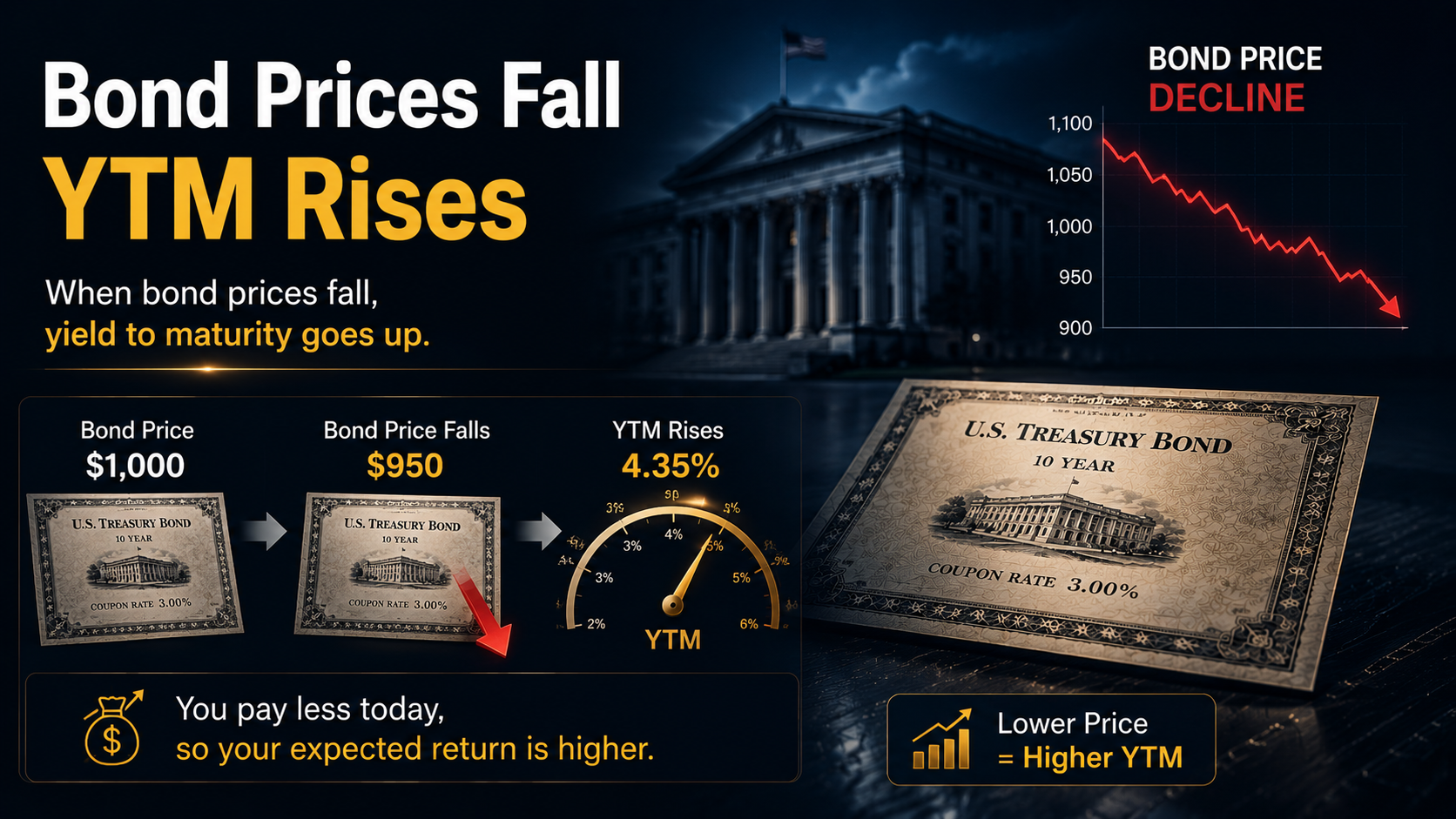
Bond prices and yields move in opposite directions.
Imagine a U.S. Treasury bond with
- Face value: $1,000
- Coupon rate: 3%
- Annual interest payment: $30
When Bond Prices Fall
Suppose rising interest rates push the bond's market price down to $950.
The bond still pays the same $30 every year and still returns $1,000 at maturity.
Since investors pay less while receiving the same future cash flows, the expected return increases.
Lower price = Higher YTM
When Bond Prices Rise
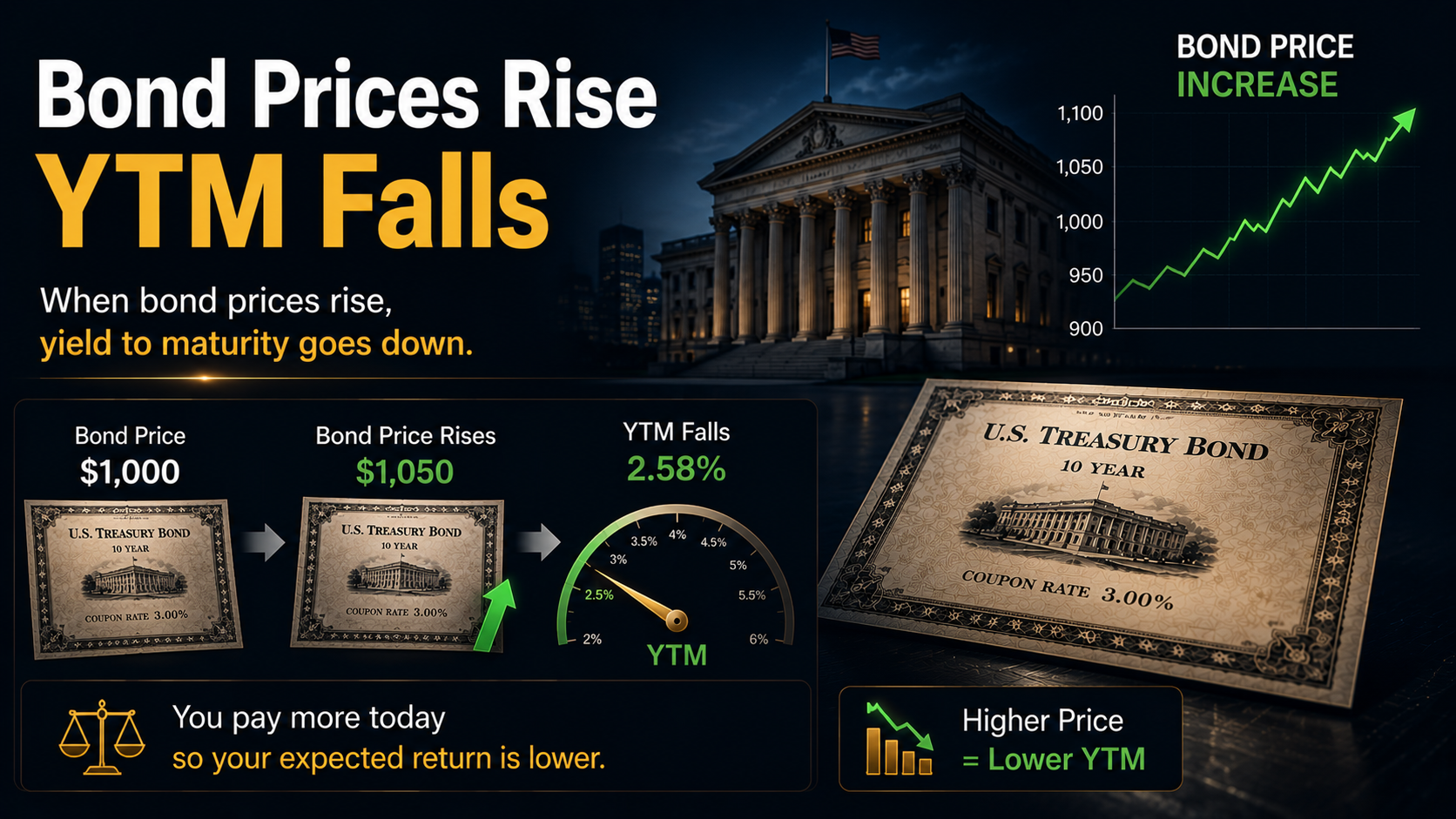
Now imagine investors bid the bond price up to $1,050.
Although coupon payments remain unchanged, buyers pay more for the same future cash flows.
Because part of the purchase price will effectively be lost when the bond matures at $1,000, the expected return declines.
Higher price = Lower YTM
This inverse relationship explains why bond prices often fall when interest rates rise—and vice versa.
Why Is Yield to Maturity So Important?
The bond market contains thousands of securities with different
- Maturity dates
- Coupon rates
- Credit quality
- Market prices
Comparing bonds using coupon rates alone would be misleading.
For example, a bond paying a 5% coupon may actually produce a lower investment return than a discounted bond paying only 3%.
YTM creates a common benchmark that allows investors to compare bonds on an equal footing.
This is why portfolio managers, pension funds, insurance companies, and institutional investors almost always evaluate bonds using YTM rather than coupon rates.
Why Treasury Yields Matter Beyond the Bond Market
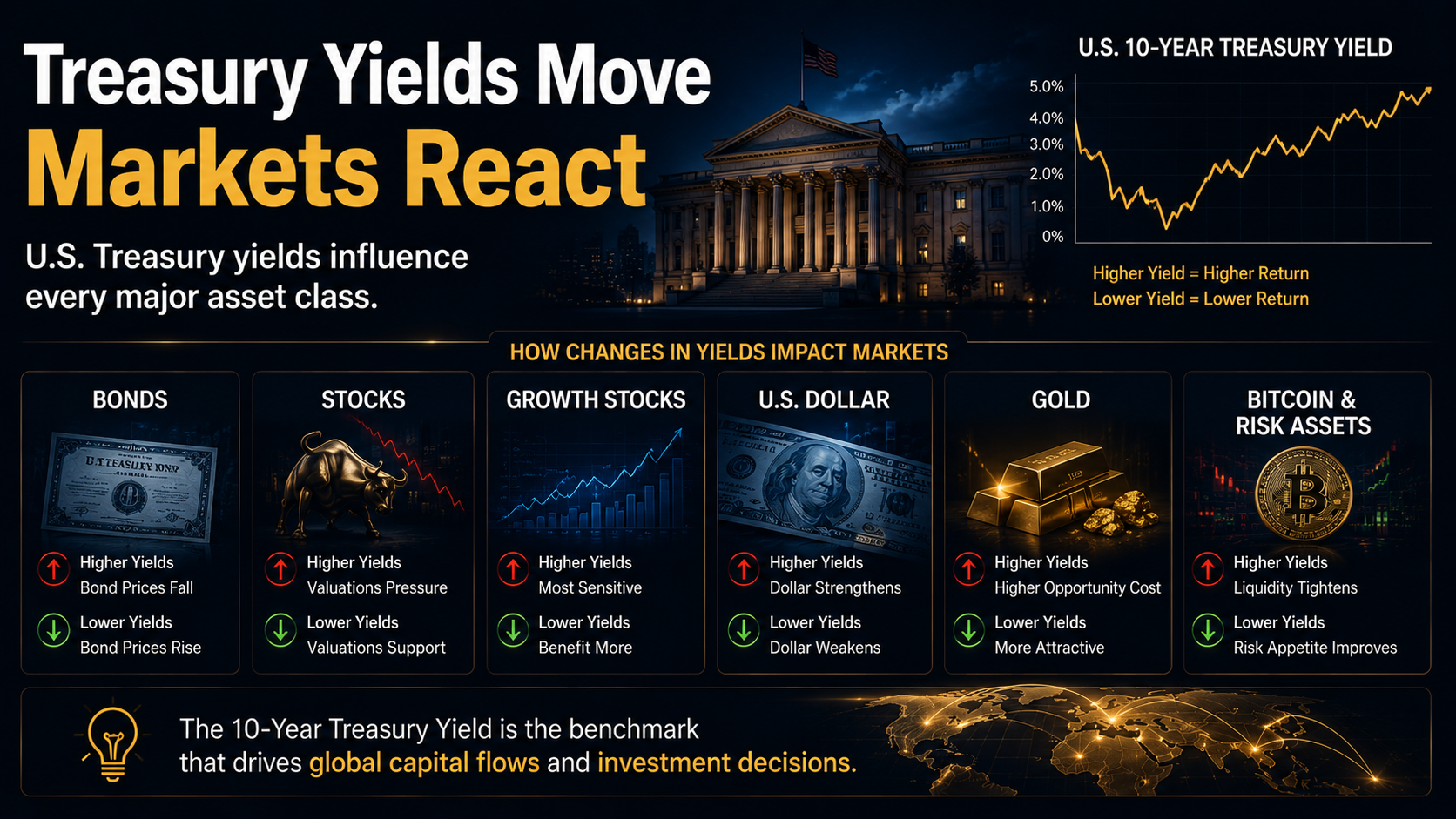
In the United States, Treasury yields serve as the financial world's benchmark risk-free rate.
Nearly every major asset class is priced relative to Treasury yields.
| Asset Class | Higher Treasury Yields | Lower Treasury Yields |
| Bonds | Existing bond prices decline | Existing bond prices rise |
| Stocks | Higher discount rates reduce valuations | Lower discount rates support higher valuations |
| Growth Stocks | Most sensitive because future earnings are discounted more heavily | Benefit from lower discount rates |
| U.S. Dollar | Often strengthens as investors seek higher yields | May weaken as interest rate expectations decline |
| Gold | Faces higher opportunity cost | Becomes relatively more attractive |
| Bitcoin & Risk Assets | Liquidity may tighten as capital shifts toward safer assets | Risk appetite often improves |
This is why investors closely watch the U.S. 10-Year Treasury yield every day.
It is not merely a bond market statistic—it represents the baseline return against which virtually every investment opportunity is evaluated.
Yield to Maturity vs. The Federal Funds Rate
Many new investors confuse Treasury yields with the Federal Reserve's policy rate.
Although they are related, they are not the same.
| Federal Funds Rate | Yield to Maturity |
| Set by the Federal Reserve | Determined by market participants |
| Monetary policy tool | Market expectation of future returns |
| Influenced by Fed decisions | Influenced by inflation, growth expectations, Treasury supply, and investor demand |
The Federal Reserve may leave interest rates unchanged while Treasury yields continue rising if investors expect stronger inflation or larger government borrowing in the future.
That makes YTM one of the market's most forward-looking indicators.
What Investors Should Know
1. Focus on YTM, Not Just Coupon Rates
Coupon payments determine cash income.
YTM determines total investment performance.
2. Remember the Reinvestment Assumption
YTM assumes coupon payments can be reinvested at the same yield.
If interest rates fall significantly, actual realized returns may be lower than the original YTM.
3. YTM Applies Only If You Hold the Bond to Maturity
Selling before maturity exposes investors to market price fluctuations.
Actual returns may differ substantially from the original YTM.
4. Treasury Yields Influence Every Portfolio
Whether you invest in stocks, ETFs, real estate, or cryptocurrencies, Treasury yields affect asset valuations through changes in discount rates and capital allocation.
Professional investors rarely analyze one market in isolation.
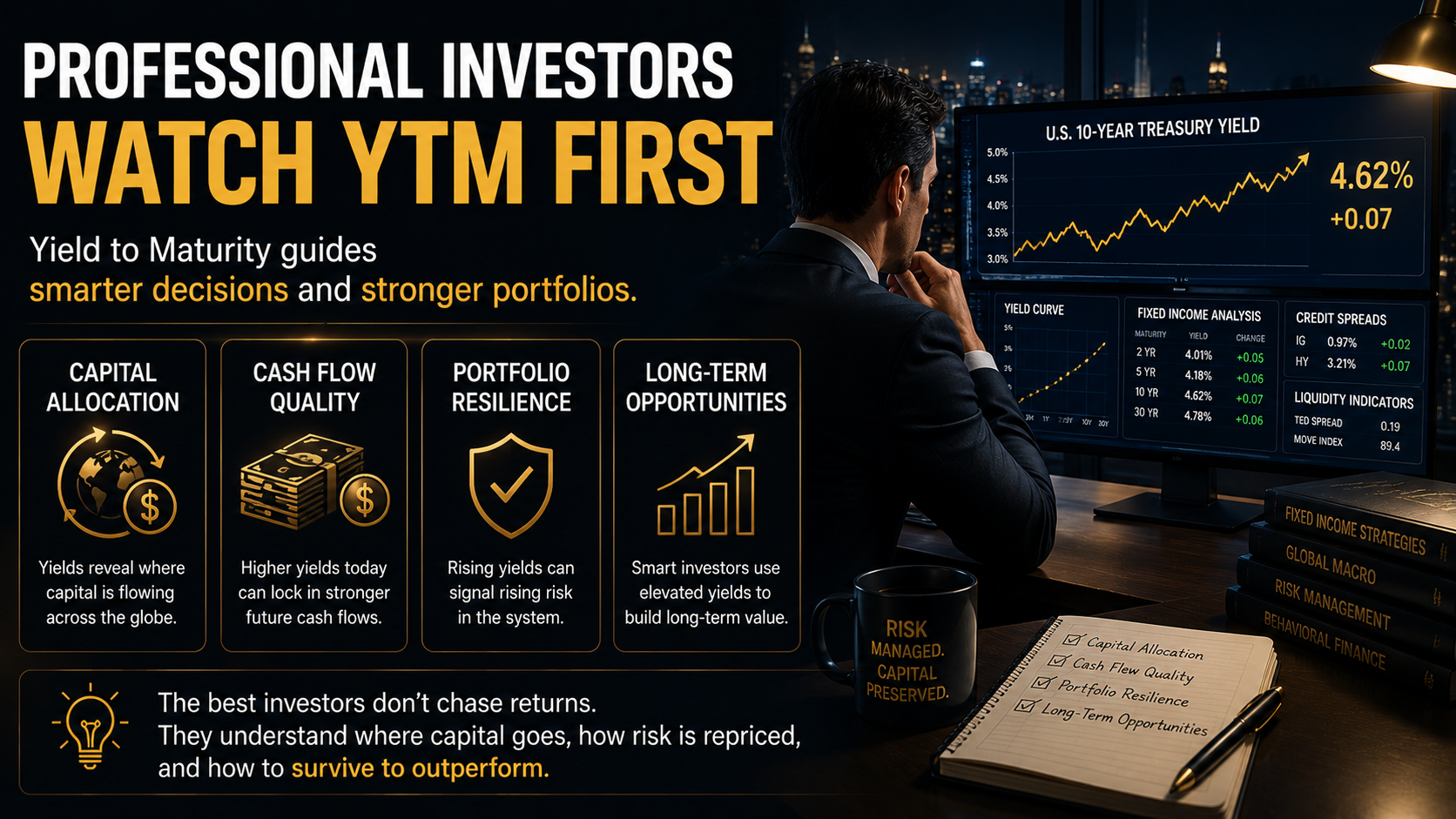
What Do Professional Investors See in YTM?
Institutional investors do not simply monitor Treasury yields.
They use them to interpret the direction of capital flows throughout the global financial system.
Capital Allocation
When Treasury yields become increasingly attractive, capital often rotates away from speculative assets toward safer fixed-income investments.
When yields decline, investors typically become more willing to take risk.
Cash Flow Quality
Professional investors evaluate whether current yields provide durable income rather than chasing the highest short-term returns.
Periods of elevated Treasury yields can create opportunities to lock in attractive long-term cash flows.
Financial Resilience
Sharp increases in corporate bond yields often signal growing concerns about credit risk.
Because the bond market tends to react earlier than the stock market, many institutional investors treat rising yields as an early warning system.
Before making any investment decision, consider asking yourself
Is this investment offering enough additional return to justify taking more risk than a U.S. Treasury bond?
That single question can dramatically improve long-term investment discipline.
Final Thoughts
Yield to Maturity is far more than a bond calculation.
It reflects how markets price risk, evaluate future economic conditions, and allocate capital across the financial system.
Understanding YTM helps investors explain why bond prices move opposite to yields, why Treasury markets influence equity valuations, and why shifts in interest rates ripple through currencies, commodities, and digital assets.
The most successful investors rarely focus on predicting tomorrow's market move.
Instead, they focus on understanding where capital is flowing, how risk is being repriced, and whether their portfolios can remain resilient under changing financial conditions.
Because in investing, survival comes before outperformance.
This was MasterMind.
'[Global] Success Blueprints' 카테고리의 다른 글