Why the U.S. Stock Market Isn't Crashing Despite the Semiconductor Sell-Off


Hello, this is MasterMind.
When semiconductor stocks experience a sharp sell-off, many investors instinctively expect the broader U.S. stock market to follow.
After all, companies like NVIDIA, AMD, Broadcom, and TSMC have become some of the largest contributors to the S&P 500 and Nasdaq over the past several years.
So when chip stocks suddenly decline, one question naturally follows
Why isn't the entire market collapsing?
The answer lies in something far more important than daily price movements.
Professional investors rarely focus on where prices fall first. Instead, they ask a different question
Where is the money going next?
Understanding capital flows, sector rotation, and market breadth provides a much clearer picture of what is actually happening beneath the surface of the market.

Key Takeaway
A semiconductor correction does not automatically signal a market-wide collapse. In many cases, capital simply rotates from one sector to another, allowing the broader market to remain resilient even while former leaders cool off.
What Is Sector Rotation?
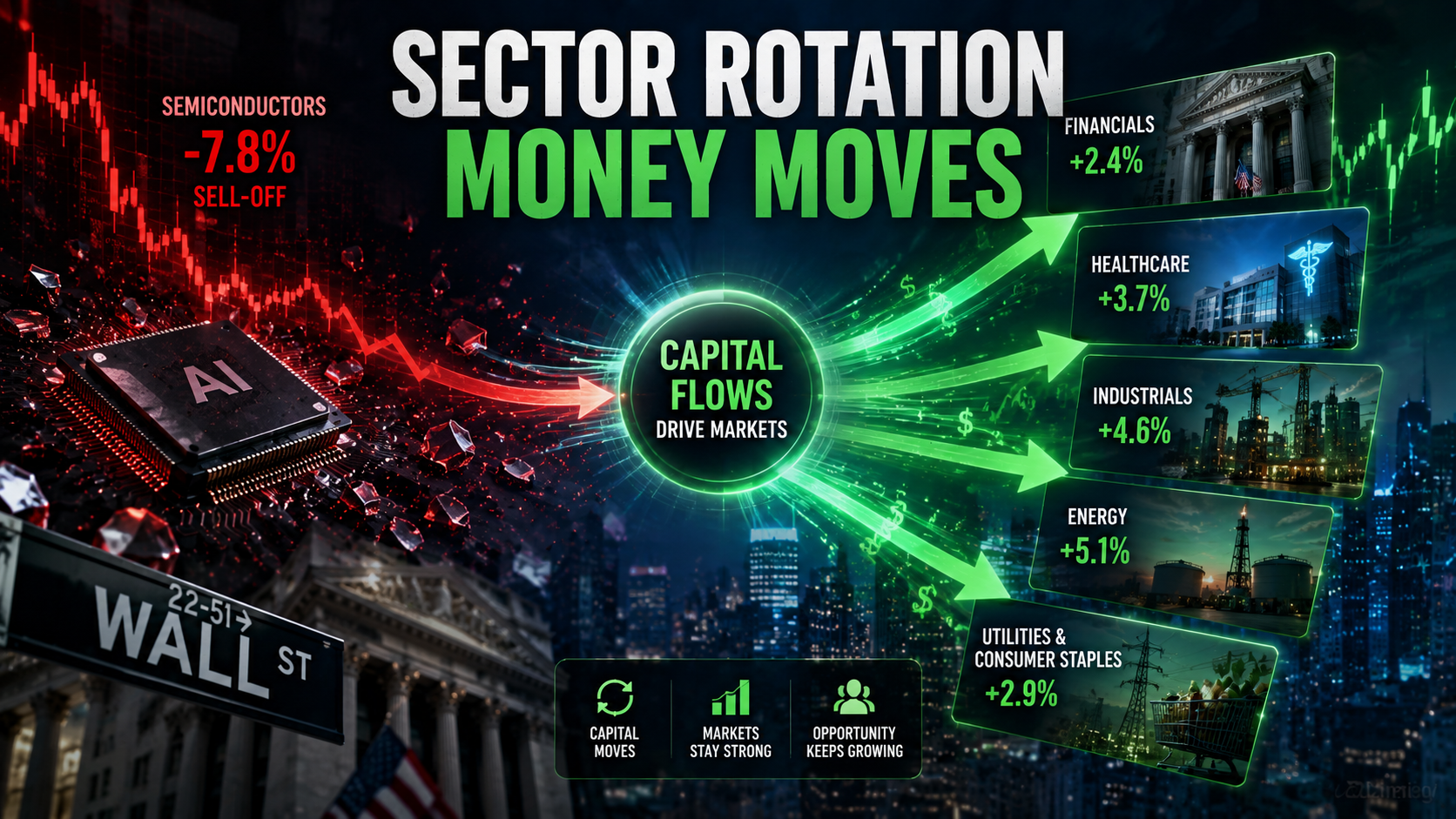
Sector rotation is the process of institutional investors reallocating capital from one part of the market to another.
Money rarely disappears overnight.
Instead, it moves.
After a prolonged rally in semiconductor stocks, portfolio managers often reduce exposure to lock in profits and rebalance risk.
That capital may then flow into sectors such as
- Financials
- Healthcare
- Industrials
- Utilities
- Consumer Staples
- Energy
- Software and Enterprise AI
This movement explains why the S&P 500 can remain relatively stable even when one of its largest sectors experiences significant selling pressure.
The market is not necessarily losing liquidity.
It is simply redistributing it.
Market Breadth Matters More Than Headlines
One of the biggest mistakes individual investors make is judging the market solely by index performance.
Professional investors pay close attention to Market Breadth—the number of stocks participating in a move.
For example
Imagine NVIDIA drops 8% in a single session.
At first glance, that sounds extremely bearish.
However, if hundreds of companies across healthcare, financials, industrials, and utilities are advancing on the same day, the overall market may actually be healthier than the headlines suggest.
Conversely, a market driven by only a handful of mega-cap technology companies can appear strong while underlying participation continues to weaken.
This is why experienced investors monitor
- Advance/Decline Line
- Percentage of Stocks Above the 200-Day Moving Average
- Equal-Weight S&P 500 Performance
- Sector Performance Relative to the Index
These indicators often reveal what price indexes alone cannot.
Why the AI Era Changes Everything
Today's market is fundamentally different from previous technology cycles.
Artificial intelligence is no longer a single-industry story.
It is an entire economic ecosystem.
While semiconductors remain essential, AI investment now extends across multiple industries.
A modern AI infrastructure includes
- Advanced semiconductor manufacturers
- Cloud computing providers
- Hyperscale data centers
- Electric utilities and power infrastructure
- Cooling and thermal management companies
- Networking equipment manufacturers
- Enterprise AI software developers
Because these industries are deeply interconnected, capital can rotate within the AI ecosystem rather than leaving technology altogether.
For example, after a strong semiconductor rally, institutional investors may shift capital toward companies benefiting from data-center construction, electricity demand, networking equipment, or enterprise AI software.
That rotation can offset weakness in chip stocks and help stabilize the broader market.
In other words, AI investing has become much broader than simply buying semiconductor companies.

Looking Beyond Price
One of the most valuable lessons in investing is this
Prices tell you what happened. Capital flows tell you what is happening.
News headlines often focus on the biggest losers of the day.
Institutional investors focus on where liquidity is moving next.
Understanding that difference can dramatically improve how investors interpret market volatility and avoid emotional decision-making.
How Sector Rotation Affects the Broader U.S. Market
A semiconductor sell-off can feel like the beginning of a broader market breakdown, especially when chip stocks have been responsible for a large share of recent index gains.
However, the real market impact depends on what happens next.
If investors are selling semiconductors and moving into cash, the decline may signal genuine risk aversion.
If they are selling semiconductors and reallocating capital into other sectors, the market may simply be going through a leadership transition.
That distinction is critical.
A healthy rotation can reduce market concentration, broaden participation, and make the overall market less dependent on a small number of mega-cap stocks.
In that environment, weakness in former leaders may actually create a more balanced market structure.
However, sector rotation is not always bullish.
The market becomes more vulnerable when several warning signs appear at the same time
- Semiconductor stocks decline sharply
- Market breadth deteriorates
- Credit spreads widen
- Treasury yields rise rapidly
- Defensive sectors outperform because investors are seeking safety
- Major indexes fall alongside equal-weight indexes
When these signals occur together, the market may be experiencing more than a routine rotation.
It may be entering a broader risk-off phase.
What Smart Money Is Watching

Institutional investors do not evaluate a semiconductor correction in isolation.
They compare price action across multiple markets to determine whether capital is rotating or leaving risk assets altogether.
1. Equal-Weight Versus Market-Cap-Weighted Indexes
The standard S&P 500 gives larger companies more influence because it is weighted by market capitalization.
The equal-weight S&P 500 gives every company the same importance.
When the market-cap-weighted index weakens but the equal-weight index remains stable or rises, it suggests that weakness is concentrated among the largest companies.
That can be a sign of healthy rotation.
If both indexes decline together, selling pressure is likely becoming broader.
2. Relative Strength Across Sectors
Professional investors compare sector performance rather than analyzing each sector independently.
They ask questions such as
- Are financials outperforming technology?
- Are industrials gaining strength?
- Are utilities rising because of electricity demand or because investors are becoming defensive?
- Is software outperforming semiconductor hardware?
- Are small-cap stocks beginning to participate?
Relative strength helps identify where the next phase of market leadership may be developing.
3. Trading Volume
Price declines become more meaningful when they occur with unusually high volume.
Heavy selling volume may indicate that institutions are reducing exposure.
However, volume must be interpreted with context.
If semiconductor stocks fall on high volume while other sectors rise on equally strong buying volume, the market may still be experiencing rotation rather than broad liquidation.
The important question is not simply whether selling volume is high.
It is whether buying demand is appearing somewhere else.
4. Bond Yields and Financial Conditions
Semiconductor and AI stocks are especially sensitive to interest rates because much of their valuation depends on expectations for future growth.
When Treasury yields rise, the present value of future earnings declines.
This can pressure high-valuation technology stocks even when the underlying business outlook remains strong.
At the same time, rising yields can support some financial companies by improving lending margins.
This is another reason why a semiconductor correction does not always translate into a full-market decline.
Different sectors respond differently to the same macroeconomic environment.
5. Credit Spreads
Credit spreads measure the additional yield investors demand to hold corporate debt instead of safer government bonds.
When credit spreads remain stable, financial stress is usually contained.
When they widen sharply, investors are demanding more compensation for risk.
A semiconductor sell-off combined with stable credit spreads is often less concerning than a sell-off accompanied by rising credit risk.
The bond market can therefore help investors determine whether equity weakness is technical, sector-specific, or systemic.
What Long-Term Investors Should Focus On
Short-term market moves can create the illusion that every correction requires immediate action.
In reality, long-term investors benefit more from distinguishing between three different situations.
Situation 1: A Valuation Reset
A valuation reset occurs when a high-performing sector becomes too expensive and investors reduce exposure.
The business outlook may remain intact, but expectations were simply too high.
In this situation, the market is repricing the stock rather than rejecting the long-term growth story.
Situation 2: A Leadership Rotation
A leadership rotation occurs when capital moves from one winning sector to another.
Semiconductors may weaken while financials, industrials, energy, healthcare, or software strengthen.
The broader market can remain stable because liquidity is still invested in equities.
This is often a normal feature of a healthy bull market.
Situation 3: A Structural Breakdown
A structural breakdown is more serious.
It occurs when selling spreads across sectors, liquidity deteriorates, credit conditions weaken, and investors move aggressively toward cash or government bonds.
In this environment, the issue is no longer limited to semiconductor stocks.
The entire risk framework of the market is changing.
Recognizing the difference between these three situations can prevent investors from overreacting to sector-specific volatility.
The Biggest Mistake Investors Make
The biggest mistake is assuming that a falling market leader means the entire market is about to collapse.
Market leadership changes constantly.
The strongest stocks of one year are not always the strongest stocks of the next.
Capital tends to move toward areas with
- Better relative valuation
- Improving earnings momentum
- Stronger cash flow visibility
- Lower positioning risk
- More attractive macroeconomic sensitivity
When semiconductor stocks become crowded, expensive, or vulnerable to profit-taking, investors may search for opportunities elsewhere.
That process can look bearish on the surface while creating new opportunities underneath.
A Better Framework for Reading the Market
Instead of asking
“Why are semiconductor stocks falling?”
A better set of questions would be
Is money leaving the market or moving within it?
Is market participation improving or deteriorating?
Are other sectors gaining relative strength?
Are credit markets showing stress?
Are interest rates changing the valuation environment?
These questions provide a much more complete view of market conditions.
They also help investors separate emotional headlines from structural developments.

Final Takeaway
A semiconductor sell-off does not automatically mean the U.S. stock market is entering a major collapse.
In many cases, the market is simply rotating.
Capital moves out of crowded leaders and into sectors with better valuations, improving earnings prospects, or stronger macroeconomic support.
The broader market can remain resilient as long as liquidity stays within risk assets and participation expands beyond a narrow group of mega-cap technology stocks.
The key is not to watch one sector in isolation.
The key is to understand the direction of money.
Because markets rarely move in a straight line.
They rotate, rebalance, and continuously search for the next source of growth.
This was Success Blueprints, where we explain the forces shaping markets, technology, and long-term wealth.
'[Global] Success Blueprints' 카테고리의 다른 글