What Is the Output Gap? How It Affects Inflation, Interest Rates, and Financial Markets


Hello, this is MasterMind.
Why can the stock market rally even when economic growth slows? And why do investors sometimes become nervous even when GDP is growing at a healthy pace?
The answer often lies in a lesser-known but highly influential economic indicator: the Output Gap.
Professional investors, economists, and the Federal Reserve do not focus solely on how fast the economy is growing. Instead, they pay close attention to whether the economy is growing above or below its sustainable capacity.
The Output Gap acts like a thermometer for the economy. It helps policymakers judge whether economic activity is overheating or cooling, and it provides investors with valuable clues about future interest rates, liquidity, and asset prices.
Understanding the Output Gap allows investors to look beyond today's headlines and better anticipate tomorrow's market environment.

Key Takeaway
The Output Gap measures the difference between an economy's actual output and its sustainable productive capacity. It is one of the most important indicators for understanding inflation, Federal Reserve policy, and long-term market trends.
What Is the Output Gap?
To understand the Output Gap, you first need to understand two important concepts.
Real GDP
Real Gross Domestic Product (Real GDP) measures the total value of goods and services produced by an economy after adjusting for inflation. It reflects the economy's actual level of production.
Potential GDP
Potential GDP represents the maximum level of economic output that can be sustained without creating excessive inflation.
It assumes workers, factories, technology, and capital are being utilized efficiently under normal economic conditions.
Think of it this way
- Real GDP is your current performance.
- Potential GDP is your economy's sustainable maximum performance.
The Output Gap measures the difference between these two values.
Output Gap (%) = [(Real GDP − Potential GDP) ÷ Potential GDP] × 100
Imagine driving on a highway.
Potential GDP is the speed your car can comfortably maintain for hours without damaging the engine.
Real GDP is your current speed shown on the speedometer.
The Output Gap tells you whether the economy is cruising at a healthy pace, pushing beyond its limits, or running well below its full potential.

Why Does the Output Gap Exist?
Economic activity rarely moves at a perfectly steady pace.
Consumer spending, business investment, hiring, and manufacturing constantly fluctuate as economic conditions change.
Potential GDP, however, changes much more gradually because it depends on structural factors such as
- Labor force growth
- Productivity improvements
- Capital investment
- Technological innovation
- Demographic trends
Because actual economic activity moves faster than productive capacity, a gap naturally develops between the two.
That difference is known as the Output Gap.
How the Output Gap Works

Positive Output Gap
A positive Output Gap occurs when Real GDP exceeds Potential GDP.
Businesses are operating near full capacity, labor markets become tight, wages rise, and demand begins to outpace supply.
As inflationary pressures build, the Federal Reserve often responds by raising interest rates to slow economic activity.
Typical characteristics include
- Strong consumer spending
- Rising inflation
- Labor shortages
- Higher wages
- Tightening monetary policy
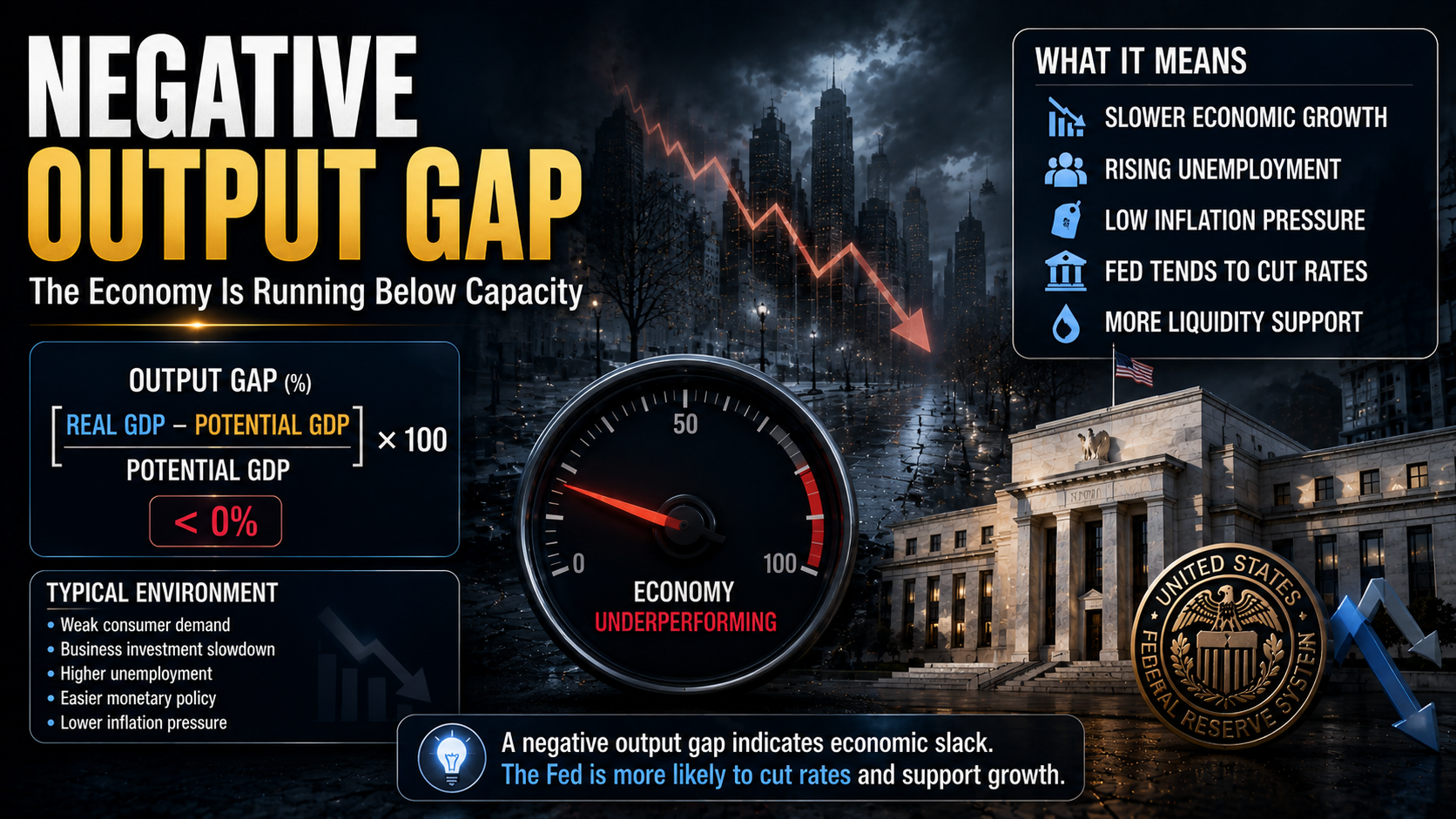
Negative Output Gap
A negative Output Gap occurs when Real GDP falls below Potential GDP.
Factories operate below capacity, unemployment rises, and businesses experience weaker demand.
Since inflationary pressure remains limited, the Federal Reserve may lower interest rates or provide additional liquidity to stimulate economic growth.
Typical characteristics include
- Slower economic growth
- Rising unemployment
- Weak consumer demand
- Easier monetary policy
- Lower inflation pressure
Why Investors Should Care
Many investors focus primarily on GDP growth.
Professional investors look one step further.
They focus on whether economic growth is sustainable.
The Output Gap provides valuable insight into what the Federal Reserve is likely to do next.
As the Output Gap widens, expectations surrounding inflation and interest rates begin to change.
Those expectations influence
- Stock valuations
- Treasury yields
- Corporate borrowing costs
- U.S. dollar strength
- Liquidity across financial markets
A Market Insight
Financial markets do not trade today's economy—they trade expectations about tomorrow.
The Output Gap helps investors estimate whether the next major policy move is more likely to be tightening or easing.
Understanding where the economy sits relative to its productive capacity often provides more valuable information than simply looking at GDP growth alone.
How the Output Gap Affects Financial Markets
The Output Gap does not move asset prices by itself. Its influence comes from the way it changes expectations about inflation, Federal Reserve policy, interest rates, and liquidity.
That is why the same economic data can produce very different market reactions depending on where the economy is in the cycle.
A strong economy may support corporate earnings early in a positive Output Gap, but later in the cycle, the same strength can trigger tighter monetary policy and lower valuations.
Likewise, a weak economy may initially hurt stocks, yet eventually create expectations for rate cuts and improved liquidity.
Output Gap and the Stock Market
The relationship between the Output Gap and stocks depends largely on timing.
During the Early Stage of a Positive Output Gap
A positive Output Gap often begins during a period of strong economic expansion.
Consumer spending is healthy, corporate revenue is rising, and cyclical sectors may benefit from stronger demand.
In this phase, investors may favor
- Financials
- Industrials
- Energy
- Consumer discretionary companies
- Economically sensitive small-cap stocks
The market may continue rising because earnings growth is still strong.
During the Late Stage of a Positive Output Gap
The environment becomes more difficult when inflation pressures intensify.
Rising wages, higher input costs, and tighter financial conditions can begin to weaken profit margins.
At the same time, higher Treasury yields increase the discount rate applied to future corporate earnings.
This can place particular pressure on long-duration growth stocks whose valuations depend heavily on profits expected many years into the future.
The key lesson is that a strong economy is not always automatically positive for stocks.
When economic strength begins to reduce liquidity, good economic news can become bad news for asset prices.
During a Negative Output Gap
A negative Output Gap usually reflects weaker demand, lower business activity, and pressure on corporate earnings.
Stocks may initially decline because investors expect slower growth and falling profits.
However, markets often begin to recover before the economy itself improves.
This happens because investors start pricing in
- Federal Reserve rate cuts
- Lower bond yields
- Fiscal support
- Improved financial conditions
- A future recovery in earnings
The stock market is forward-looking. It may rise while economic data remains weak if investors believe the negative Output Gap is approaching its widest point.
Output Gap and U.S. Treasuries
The bond market is highly sensitive to changes in the Output Gap because Treasury yields reflect expectations about inflation and Federal Reserve policy.
Positive Output Gap
When the economy operates above its sustainable capacity, inflation risk tends to rise.
Investors may expect the Fed to keep interest rates higher for longer or tighten policy further.
As a result
- Treasury yields may rise
- Existing bond prices may fall
- Short-term yields may react strongly to Fed expectations
- Long-term yields may rise if inflation expectations remain elevated
Negative Output Gap
When actual output falls below potential output, inflation pressure usually weakens.
Investors may anticipate lower policy rates and slower nominal growth.
In this environment
- Treasury yields may decline
- Existing bond prices may rise
- Longer-duration bonds may benefit more from falling rates
- Credit risk may become more important in corporate bonds
Investors should distinguish between Treasury bonds and lower-quality corporate debt.
Falling rates can support bond prices, but a severe negative Output Gap can also increase default risk among highly leveraged companies.
Output Gap and the U.S. Dollar
The U.S. dollar is influenced by interest-rate expectations, relative economic growth, and global demand for safe assets.
A widening positive Output Gap can support the dollar if investors expect the Federal Reserve to maintain higher rates than other central banks.
Higher U.S. yields can attract global capital into dollar-denominated assets.
However, the dollar does not always weaken during a negative Output Gap.
If the slowdown creates global fear, investors may still move toward the dollar because of its role as the world's primary reserve currency and a major source of global liquidity.
Therefore, the dollar's reaction depends on two competing forces
- Expectations for easier Federal Reserve policy
- Safe-haven demand during periods of market stress
The relative position of the U.S. economy matters more than the Output Gap in isolation.
Output Gap and Gold
Gold is affected by inflation expectations, real interest rates, the dollar, and demand for portfolio protection.
During a positive Output Gap, gold may benefit if investors fear persistent inflation.
However, aggressive Federal Reserve tightening can raise real yields and strengthen the dollar, both of which can pressure gold prices.
During a negative Output Gap, gold may benefit from
- Falling real yields
- Expectations for rate cuts
- Financial instability
- Safe-haven demand
- Concerns about aggressive monetary or fiscal support
Gold therefore does not respond mechanically to economic weakness or strength.
Its direction depends on whether inflation, real yields, and financial risk are rising or falling.
Output Gap and Bitcoin
Bitcoin and other crypto assets are often highly sensitive to global liquidity and investor risk appetite.
A widening positive Output Gap may initially support speculative assets when growth and liquidity remain strong.
However, once the Fed begins tightening aggressively, higher yields and shrinking liquidity can create significant pressure.
A negative Output Gap may also produce two separate phases.
In the early stage, recession fears and forced deleveraging can hurt Bitcoin along with other risk assets.
Later, expectations for easier monetary policy and improving liquidity may support a recovery.
For Bitcoin, the most important question is often not whether the economy is strong or weak, but whether financial conditions are becoming tighter or easier.
Summary of Market Effects
| Asset Class | Positive Output Gap | Negative Output Gap |
| U.S. Stocks | Early earnings strength, followed by valuation pressure as tightening increases | Initial earnings weakness, followed by potential recovery as easing expectations grow |
| U.S. Treasuries | Higher yields and lower bond prices are more likely | Lower yields and higher bond prices are more likely |
| U.S. Dollar | Can strengthen through higher relative interest rates | May weaken on easing expectations, but can strengthen during global risk aversion |
| Gold | Can benefit from inflation fears but face pressure from higher real yields | Can benefit from lower real yields and safe-haven demand |
| Bitcoin | Vulnerable when liquidity is withdrawn | May recover when liquidity expectations improve |
These relationships are not fixed rules. They describe the forces investors should examine rather than outcomes that must occur.
What Investors Need to Know About the Output Gap
1. Potential GDP Is an Estimate
Potential GDP cannot be directly observed.
Economists estimate it using data on productivity, labor supply, capital investment, demographics, and inflation.
That means Output Gap figures can be revised significantly as new information becomes available.
Investors should avoid treating a single estimate as an exact measurement.
The trend is usually more important than the precise number.
2. Productivity Can Change the Economy's Speed Limit
Potential GDP is not fixed.
Technological innovation, artificial intelligence, automation, infrastructure investment, and improvements in worker productivity can increase the economy's sustainable capacity.
This matters because rapid growth does not always create the same level of inflation.
If productivity rises quickly, the U.S. economy may grow faster without developing an equally large positive Output Gap.
On the other hand, weaker labor-force growth or declining productivity can reduce potential output and cause inflation pressure to appear sooner than expected.
3. Monetary Policy Works With a Delay
Federal Reserve policy does not affect the economy immediately.
Higher interest rates gradually influence
- Mortgage demand
- Business investment
- Credit conditions
- Hiring
- Consumer spending
- Corporate refinancing costs
Because these effects take time, the economy may continue expanding even after the Fed has tightened significantly.
It may also continue weakening after rate cuts begin.
This is why the Federal Reserve can appear late at turning points.
Markets, however, often move before official policy changes because investors continuously price in the expected path of interest rates.
4. The Direction of the Gap Matters More Than the Sign Alone
A positive Output Gap is not automatically bearish, and a negative Output Gap is not automatically bullish.
Investors should ask whether the gap is widening or narrowing.
For example
- A positive but narrowing Output Gap may signal cooling inflation and an approaching end to tightening.
- A negative but widening Output Gap may signal worsening recession risk.
- A negative but narrowing Output Gap may indicate that economic recovery is beginning.
- A positive and widening Output Gap may signal stronger growth but increasing inflation risk.
The direction of change often matters more than whether the latest estimate is simply above or below zero.
5. Use the Output Gap With Other Indicators
The Output Gap is most useful when considered alongside other macroeconomic indicators.
Important related data include
- Core inflation
- Wage growth
- Unemployment
- Labor-force participation
- Capacity utilization
- Purchasing Managers' Indexes
- Credit spreads
- Treasury yield curves
- Financial conditions
No single indicator can fully explain the economy.
The Output Gap provides a framework, but investors still need to confirm the signal through inflation, labor, credit, and liquidity data.
What Do Wealthy Investors Watch in This Cycle?
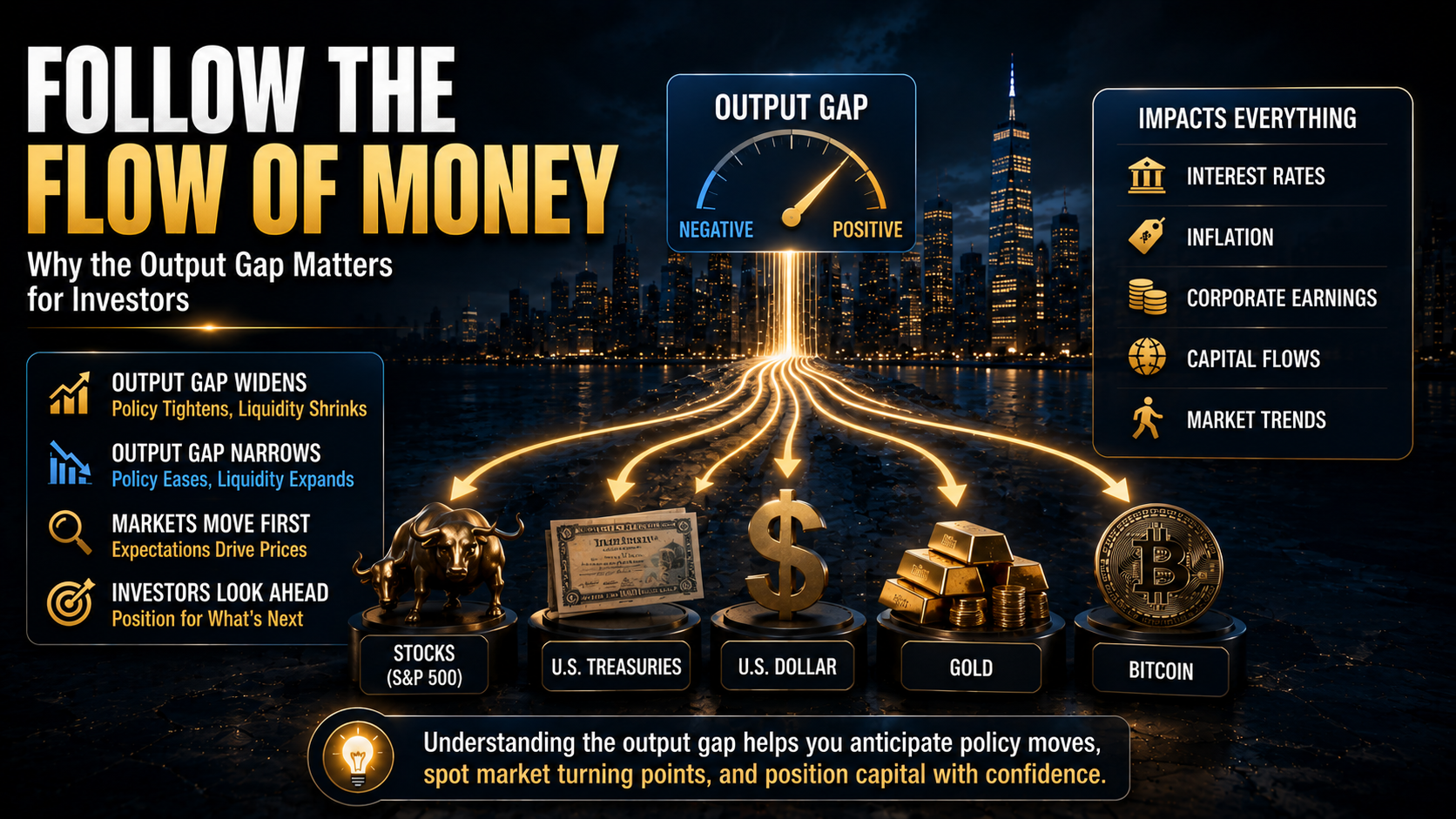
Large investors do not simply ask whether the Output Gap is positive or negative.
They focus on how the changing economic environment will affect capital flows, cash generation, asset durability, and long-term value.
The Movement of Capital
When a positive Output Gap leads to higher rates and tighter liquidity, capital may move away from speculative assets and heavily indebted companies.
Money may flow toward
- Short-term Treasuries
- Money market funds
- Profitable companies
- Businesses with pricing power
- Assets with dependable cash flows
When a negative Output Gap leads to expectations for rate cuts, capital may gradually return to longer-duration bonds, growth stocks, and other assets that benefit from falling discount rates.
The transition is rarely immediate.
Professional investors watch for changes in yields, credit spreads, bank lending, and market liquidity before assuming that a new cycle has begun.
Cash Flow
During periods of abundant liquidity, investors may overlook weak business models.
That changes when interest rates rise.
Companies with durable free cash flow, manageable debt, and consistent demand are more likely to survive tightening financial conditions.
This is why cash flow becomes more valuable when the Output Gap is positive and policy is restrictive.
The higher the cost of capital, the more important it becomes for a business to finance itself through real earnings rather than constant borrowing.
Asset Durability
A strong asset is not simply one that rises during favorable conditions.
It is one that can survive
- Higher borrowing costs
- Lower consumer demand
- Falling valuations
- Restricted access to capital
- Unexpected economic shocks
When the Output Gap changes direction, fragile assets are often exposed first.
Highly leveraged companies, weak balance sheets, and speculative projects tend to suffer when liquidity disappears.
In difficult markets, survival becomes a source of long-term competitive advantage.
A Long-Term Investment Perspective
Long-term investors are less concerned with predicting the exact month of the next recession or rate cut.
They focus instead on whether asset prices already reflect realistic assumptions.
During periods of extreme optimism, a positive Output Gap may encourage investors to assume strong growth will continue indefinitely.
During periods of deep pessimism, a negative Output Gap may cause investors to ignore the possibility of eventual recovery.
Both situations can create mispricing.
Wealth is often built not by reacting to every economic headline, but by maintaining liquidity, avoiding permanent losses, and recognizing when market expectations have become disconnected from long-term fundamentals.
Questions Investors Should Ask Themselves
- Is the U.S. economy operating above or below its sustainable capacity?
- Is the Output Gap widening or beginning to narrow?
- Are inflation pressures increasing or cooling?
- Is Federal Reserve policy becoming more restrictive or more supportive?
- Can the companies I own generate cash under higher interest rates?
- Are current asset prices assuming an unrealistically strong or weak economy?
- Do I have enough liquidity to survive volatility and act when valuations become attractive?
These questions do not provide perfect forecasts.
They help investors prepare for multiple possible outcomes.
Conclusion
The Output Gap is more than an academic economic concept.
It is a practical framework for understanding the relationship between growth, inflation, Federal Reserve policy, liquidity, and financial markets.
A positive Output Gap can support earnings and employment, but it can also create inflation pressure and tighter monetary policy.
A negative Output Gap can weaken corporate profits and increase unemployment, but it may eventually lead to lower rates and easier financial conditions.
The most important lesson is that markets do not respond only to whether the economy is strong or weak.
They respond to how economic conditions are changing relative to expectations—and to what those changes imply for the future supply and cost of money.
Investors cannot consistently predict every turning point.
They can, however, build portfolios around durable cash flows, manageable risk, sufficient liquidity, and assets capable of surviving multiple economic environments.
Remember this
The Output Gap helps explain not only where the economy stands today, but also where interest rates, liquidity, and capital may move next.
This was MasterMind.
'[Global] Success Blueprints' 카테고리의 다른 글