What Is the Federal Funds Rate? How It Works and Why It Matters to Investors


Hello, this is MasterMind.
Whenever the Federal Reserve announces an interest rate decision, financial markets react almost instantly. Stocks swing, Treasury yields move, the U.S. dollar strengthens or weakens, and even gold and Bitcoin often change direction within minutes.
Why does a single overnight interest rate have such a powerful influence over virtually every major asset class?
Many investors think of the Federal Funds Rate as simply the benchmark that affects mortgage or credit card rates. In reality, it is much more than that. The Federal Funds Rate represents the price of money, serving as the foundation upon which borrowing costs, asset valuations, and global capital flows are built.
Understanding this rate is one of the first steps toward understanding how financial markets truly work.

Key Takeaway
The Federal Funds Rate is the price of money. It influences borrowing costs, liquidity, asset valuations, and ultimately determines where capital flows throughout the global financial system.
What Is the Federal Funds Rate?
The Federal Funds Rate is the target interest rate established by the Federal Reserve for overnight lending between U.S. banks.
Banks are required to hold a certain amount of reserves. When one bank has excess reserves and another falls short, they lend funds to each other overnight. The interest rate charged in these transactions is known as the Federal Funds Rate.
Rather than setting a fixed rate, the Federal Reserve establishes a target range and uses monetary policy tools such as open market operations and reserve management to keep the effective rate within that range.
Although this market exists between banks, its impact extends far beyond Wall Street. It becomes the reference point for nearly every other interest rate in the economy, including mortgages, auto loans, business financing, Treasury yields, and corporate bond yields.
How the Federal Funds Rate Spreads Through the Economy
Changes in the Federal Funds Rate create a chain reaction across the financial system.
Federal Reserve Rate Decision
            ↓
Bank Funding Costs Change
            ↓
Consumer & Business Lending Rates Adjust
            ↓
Corporate Investment and Consumer Spending Shift
            ↓
Economic Growth and Corporate Earnings Change
            ↓
Stocks, Bonds, Real Estate, Gold, and Bitcoin React
For this reason, investors often describe the Federal Funds Rate as the heartbeat of the financial system.
How the Federal Funds Rate Works

Think of the Federal Funds Rate as the faucet controlling liquidity.
When the Fed Raises Rates
Higher interest rates increase the cost of borrowing.
Businesses become more cautious about expanding operations, consumers reduce discretionary spending, and speculative investments become less attractive.
Liquidity gradually leaves financial markets and moves toward safer income-producing assets.
When the Fed Cuts Rates
Lower interest rates reduce financing costs.
Consumers borrow more, businesses increase investment, and financial conditions become more supportive of economic growth.
More liquidity enters the financial system, often benefiting risk assets.
From an investor's perspective, interest rates determine the opportunity cost of taking risk.
If Treasury securities offer attractive yields with relatively low risk, investors may shift capital away from equities or cryptocurrencies. When rates decline, that opportunity cost falls, making growth assets relatively more attractive.
Financial markets frequently react to changes in the price of money before they react to changes in corporate earnings.
Why the Federal Funds Rate Matters
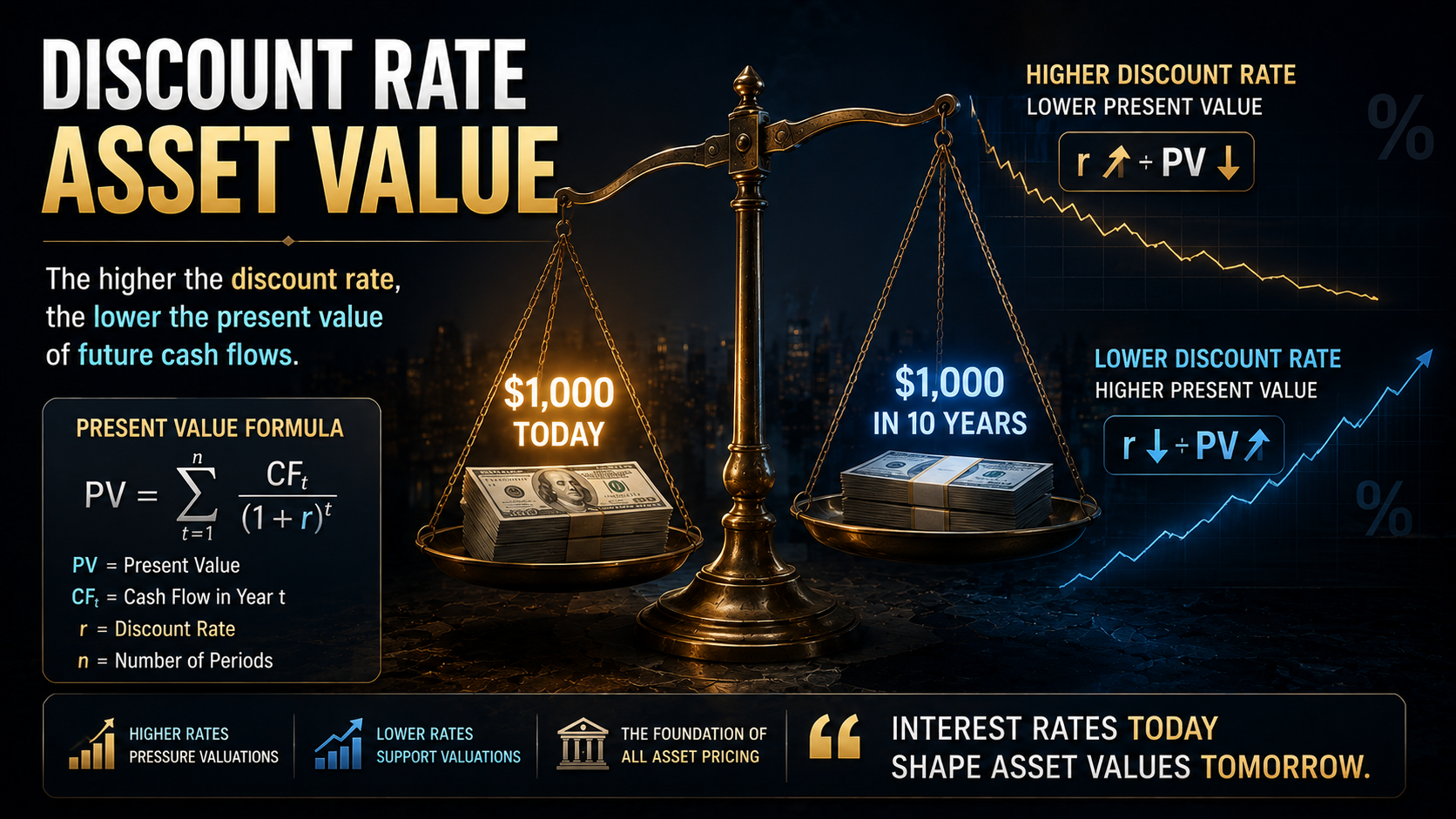
Every financial asset is ultimately valued based on the present value of its future cash flows.
The discount rate used in valuation models begins with the risk-free interest rate, making the Federal Funds Rate one of its most important foundations.
Simply put, $1,000 received today is worth more than $1,000 received ten years from now.
Future cash flows must be discounted to today's dollars.
A simplified valuation formula looks like this
Present Value = Σ [Future Cash Flow ÷ (1 + Discount Rate)ᵗ]
As discount rates rise, the present value of future earnings declines.
As discount rates fall, future cash flows become more valuable.
This explains why high-growth companies—particularly technology and AI businesses with earnings expected years into the future—are generally more sensitive to interest rate changes than mature companies generating strong cash flow today.
Ultimately, the Federal Funds Rate is not just a policy tool; it serves as one of the primary inputs used to value financial assets.
How the Federal Funds Rate Affects Major Asset Classes
Changes in U.S. interest rates influence markets worldwide because the U.S. dollar remains the global reserve currency.
| Asset Class | Higher Rates | Lower Rates | Primary Driver |
| Stocks | Often face valuation pressure, especially growth stocks | Typically benefit from easier financial conditions | Higher discount rates reduce future valuations |
| Treasuries & Bonds | Existing bond prices generally decline | Existing bond prices generally rise | Bond prices move inversely to yields |
| U.S. Dollar | Often strengthens | Often weakens | Global capital seeks higher yields |
| Gold | Can face headwinds | Often benefits | Opportunity cost changes as real yields move |
| Bitcoin & Crypto | Liquidity headwinds | Liquidity tailwinds | Highly sensitive to global liquidity conditions |
However, markets rarely react to the rate decision alone.
What matters most is whether the decision differs from expectations and what it signals about future monetary policy.

Why Investors Should Look Beyond the Rate Decision
Many new investors focus only on the headline rate announced after each FOMC meeting.
Professional investors look much deeper.
Markets are forward-looking.
A rate hike that everyone expected may have little market impact. Conversely, a rate cut could trigger selling if investors interpret it as evidence that the economy is weakening.
For that reason, experienced investors also monitor
- FOMC statements
- The Fed's Summary of Economic Projections (Dot Plot)
- Federal Reserve press conferences
- CPI and PCE inflation reports
- Nonfarm Payrolls and unemployment data
- Treasury yields
- Real interest rates
- Inflation expectations
The market constantly prices the future—not the present.
Key Takeaways for Investors
1. Expectations Matter More Than Headlines
Markets price expectations in advance.
The difference between expectations and reality often moves prices far more than the rate decision itself.
2. Follow the Fed's Dual Mandate
The Federal Reserve balances two primary objectives
- Price Stability
- Maximum Employment
Inflation and labor market data often provide the strongest clues about future policy.
3. Watch the Entire Yield Curve
The Federal Funds Rate tells only part of the story.
Professional investors also monitor long-term Treasury yields.
An inverted yield curve has historically been one of the most reliable warning signs of slowing economic growth.
What Wealthy Investors Watch
Long-term investors rarely ask only whether rates are going up or down.
Instead, they focus on where money is moving.
Capital Flows
Is capital rotating into Treasury securities, money market funds, defensive sectors, or back into growth stocks?
Following capital flows often provides more insight than following headlines.
Cash Flow Strength
Companies with durable cash flow tend to withstand higher interest rates far better than businesses relying heavily on debt financing.
Financial Resilience
High leverage becomes increasingly dangerous during tightening cycles.
Strong balance sheets often outperform when financing conditions become more restrictive.
Long-Term Perspective
Interest rate cycles are temporary.
Patient investors understand that periods of higher rates frequently create opportunities to acquire quality businesses at more attractive valuations.
Ask yourself
- Would my portfolio remain resilient if rates stayed elevated longer than expected?
- Am I investing based on headlines or based on long-term capital flows?
- Are the companies I own generating sustainable free cash flow?
Successful investors focus less on predicting every Federal Reserve decision and more on building portfolios capable of surviving multiple economic cycles.

Conclusion
The Federal Funds Rate is far more than an overnight lending rate.
It is the foundation of borrowing costs, asset valuation, and global capital allocation.
Understanding how interest rates influence liquidity, valuation, and investor behavior provides a significant advantage when interpreting market movements.
Rather than trying to predict every Federal Reserve decision, investors should focus on understanding how changes in the price of money reshape the flow of capital across financial markets.
Because in investing, long-term success is rarely about making perfect predictions.
It is about building a portfolio that can survive—and compound—through every interest rate cycle.
MasterMind.
'[Global] Success Blueprints' 카테고리의 다른 글