What Is a Treasury Auction? How U.S. Government Bond Auctions Affect Interest Rates and Markets


Hello, this is MasterMind.
When headlines say, "The latest U.S. Treasury auction was weak" or "Strong demand pushed Treasury yields lower," many investors assume it's just another bond market story.
In reality, Treasury auctions influence far more than government borrowing costs. They provide one of the clearest real-time signals of how Wall Street, institutional investors, and foreign governments view the future path of interest rates, inflation, and economic growth.
Whether you invest in stocks, bonds, ETFs, gold, or Bitcoin, understanding Treasury auctions helps you better interpret the flow of money across financial markets.
In this article, we'll explore how Treasury auctions work, why investors closely monitor them, and what auction results can reveal about the broader economy.
Key Takeaway
A Treasury auction is more than a government fundraising event—it is the market's real-time vote on interest rates, inflation expectations, and confidence in the U.S. economy.
What Is a Treasury Auction?
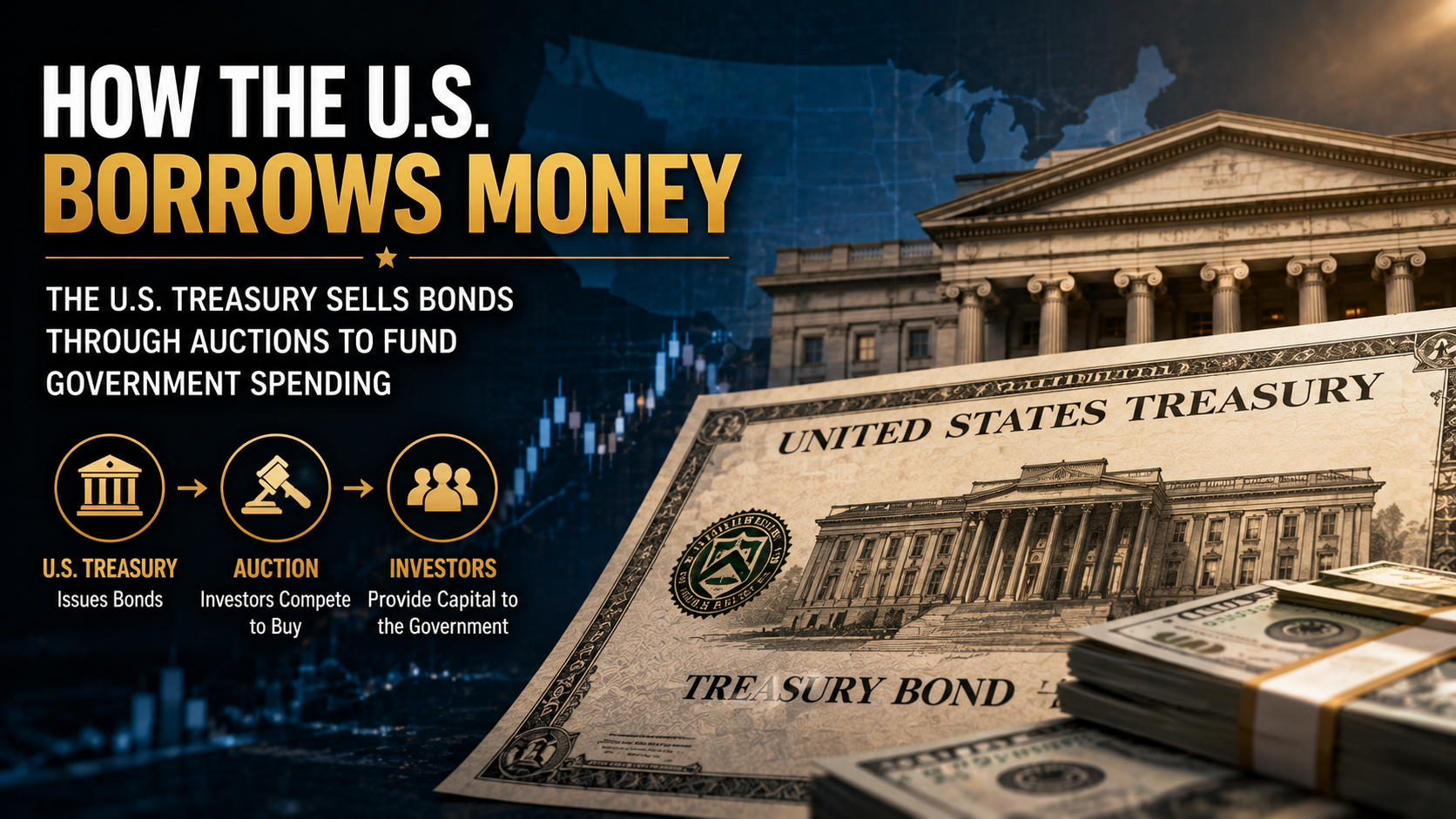
A Treasury auction is the process through which the U.S. Department of the Treasury sells government securities to investors in order to finance federal spending, refinance existing debt, and manage the nation's borrowing needs.
Instead of setting borrowing costs on its own, the Treasury allows the market to determine the interest rate through competitive bidding.
Think of it like a large-scale auction.
The U.S. government asks
"At what yield are investors willing to lend us money?"
Banks, pension funds, insurance companies, mutual funds, hedge funds, foreign central banks, and individual investors all participate by submitting bids.
The final auction result determines the yield that the U.S. government must pay on newly issued Treasuries.
Why Does the U.S. Treasury Use Auctions?
The government could simply announce an interest rate and issue bonds.
Instead, it relies on market-based auctions because they create transparent price discovery.
The more investors compete to buy Treasuries, the lower the yield the government has to offer.
Conversely, if investor demand weakens, the Treasury must offer higher yields to attract buyers.
This process allows the market—not policymakers—to determine the fair value of government debt.
It also makes Treasury auctions one of the purest indicators of investor sentiment.
How Treasury Auctions Work
The U.S. Treasury generally uses a single-price Dutch auction system.
Here's how the process unfolds.
Step 1: The Treasury Announces an Auction
The Treasury specifies
- Security type (Bills, Notes, or Bonds)
- Maturity (2-year, 5-year, 10-year, 30-year, etc.)
- Total amount to be issued
- Auction schedule
Step 2: Investors Submit Bids
Participants indicate
- How much they want to purchase
- The yield they are willing to accept
Investors willing to accept lower yields are more competitive because they allow the government to borrow at a lower cost.
Step 3: The Auction Is Allocated
The Treasury accepts bids starting with the lowest yields until the entire offering amount is sold.
The highest accepted yield becomes the High Yield, and every successful bidder receives securities at that same yield.
This standardized pricing helps ensure fairness and transparency across participants.
WI Yield vs. High Yield: The Numbers Markets Watch Closely
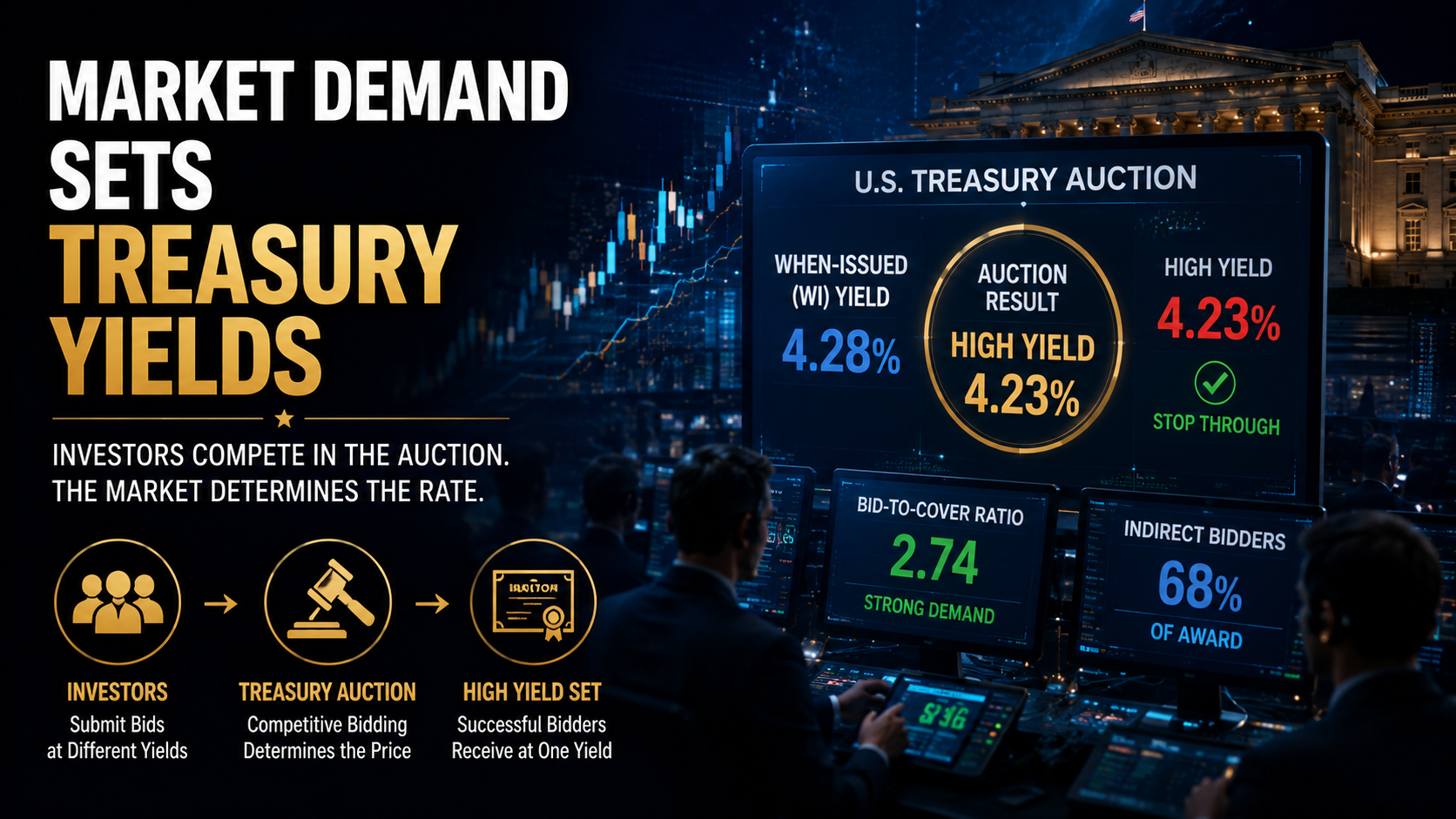
One of the most important concepts in Treasury auctions is the relationship between the When-Issued (WI) Yield and the High Yield.
When-Issued (WI) Yield
Before an auction takes place, Treasuries trade in the secondary market on a "when-issued" basis.
The resulting yield represents what investors expect the auction to clear at.
Think of it as the market's consensus estimate before the auction begins.
High Yield
The High Yield is the actual yield determined by the auction.
Comparing these two numbers reveals whether demand was stronger or weaker than expected.
- High Yield below the WI Yield → Strong demand. Investors accepted lower yields than anticipated.
- High Yield above the WI Yield → Weak demand. Investors required higher yields to purchase the new issue.
On Wall Street, these outcomes are often described as
- Stop Through → Strong auction
- Tail → Weak auction
Even a difference of just a few basis points can trigger significant moves across Treasury yields, stock indexes, and currency markets.
Why Treasury Auctions Matter
Treasury securities are often considered the foundation of the global financial system.
Their yields influence virtually every major asset class.
Mortgage rates, corporate bond yields, business financing costs, and stock valuations all use Treasury yields as a benchmark.
That means a single Treasury auction can affect far more than the bond market.
It can reshape expectations for Federal Reserve policy, alter borrowing costs across the economy, and shift capital between risk assets and safe havens.
MasterMind Insight
Financial markets don't simply react to headlines—they react to the price of money. Treasury auctions reveal that price in real time, making them one of the most important indicators of liquidity and investor confidence.
How Treasury Auctions Affect Financial Markets

Treasury auction results don't stay confined to the bond market. They ripple across nearly every major asset class because Treasury yields serve as the benchmark for the global cost of capital.
Understanding these relationships helps investors interpret market moves with greater confidence instead of reacting emotionally to short-term headlines.
How Treasury Auctions Impact Different Asset Classes
Stocks
Stock valuations are heavily influenced by interest rates.
A strong Treasury auction typically pushes yields lower, reducing borrowing costs and increasing the present value of future corporate earnings. This environment often supports growth stocks and technology companies.
A weak auction has the opposite effect. Higher Treasury yields raise financing costs, compress valuation multiples, and can pressure equity markets—especially high-growth sectors.
Bonds
Treasury securities set the baseline for the entire fixed-income market.
When Treasury yields rise after a weak auction, yields on corporate bonds, municipal bonds, and mortgage-backed securities often move higher as well.
When yields fall following a strong auction, bond prices generally increase, benefiting existing bondholders.
U.S. Dollar
Treasury yields and the U.S. dollar frequently move together.
Higher yields can attract global capital seeking better returns, strengthening the dollar.
Lower yields may reduce that advantage, leading to a softer dollar if other major economies offer relatively attractive returns.
Gold
Gold does not generate interest income.
When Treasury yields rise, investors earn more from interest-bearing assets, making gold relatively less attractive.
When yields decline, the opportunity cost of holding gold falls, which can provide support for precious metal prices.
Bitcoin and Other Risk Assets
Bitcoin often responds to changes in global liquidity.
Lower Treasury yields generally improve financial conditions and encourage investors to take more risk.
Higher yields can tighten liquidity, reducing demand for speculative assets such as cryptocurrencies and high-growth equities.
While the relationship is not perfect, Treasury auctions frequently influence the broader risk appetite of financial markets.
Key Treasury Auction Metrics Every Investor Should Watch
Professional investors rarely focus on just one number. Instead, they analyze several indicators together.
Bid-to-Cover Ratio
This measures total demand relative to the amount of securities offered.
- Higher ratio = Strong investor demand
- Lower ratio = Weak investor demand
High Yield vs. WI Yield
Comparing the auction's final yield with the When-Issued yield reveals whether demand exceeded or fell short of market expectations.
- Stop Through: High Yield below the WI Yield (Bullish for bonds)
- Tail: High Yield above the WI Yield (Bearish for bonds)
Bidder Composition
Investors also examine who is buying.
- Indirect Bidders often include foreign central banks and international institutions.
- Direct Bidders include domestic institutional investors.
- Primary Dealers purchase any remaining supply and facilitate market liquidity.
Healthy participation across multiple buyer groups generally reflects broad confidence in U.S. government debt.
What Institutional Investors Really Watch
Professional investors are rarely concerned with a single auction in isolation.
Instead, they ask bigger questions
- Is demand for Treasuries strengthening or weakening?
- Are investors expecting inflation to accelerate or cool?
- How might these results influence future Federal Reserve policy?
- Is liquidity flowing toward risk assets or defensive assets?
- Are global investors increasing or reducing their exposure to U.S. debt?
These questions provide a clearer picture of capital flows than any single market headline.
Long-Term Investment Insight

Many individual investors treat Treasury auctions as news events.
Institutional investors view them as signals.
A strong auction may indicate growing confidence in the bond market and expectations for stable or declining interest rates.
A weak auction can signal rising inflation concerns, tighter financial conditions, or reduced investor appetite for government debt.
Neither outcome automatically predicts the direction of the stock market.
Instead, Treasury auctions offer valuable context for understanding why money is moving between different asset classes.
Following these signals consistently can help investors make more disciplined, data-driven decisions over the long run.
Conclusion
Treasury auctions are one of the most important mechanisms in global finance.
They determine how much it costs the U.S. government to borrow, influence Treasury yields across the yield curve, and shape expectations for monetary policy, inflation, and economic growth.
More importantly, they reveal how investors around the world are pricing risk in real time.
Rather than viewing Treasury auctions as technical bond-market events, consider them a window into the broader flow of capital.
The investors who consistently succeed are not the ones who react fastest to headlines—they are the ones who understand where money is moving before the crowd does.
Thank you for reading.
This was MasterMind.
'[Global] Success Blueprints' 카테고리의 다른 글