What Is Current Yield? Current Yield vs. Yield to Maturity


Hello, this is MasterMind.
If you've ever researched U.S. Treasury bonds, corporate bonds, or bond ETFs, you've probably come across two different yield figures: Current Yield and Yield to Maturity (YTM).
At first glance, they seem to measure the same thing. After all, they're both called "yield." But why do they often display different percentages for the exact same bond? More importantly, which one represents the return you'll actually earn?
The answer lies in understanding what each metric measures.
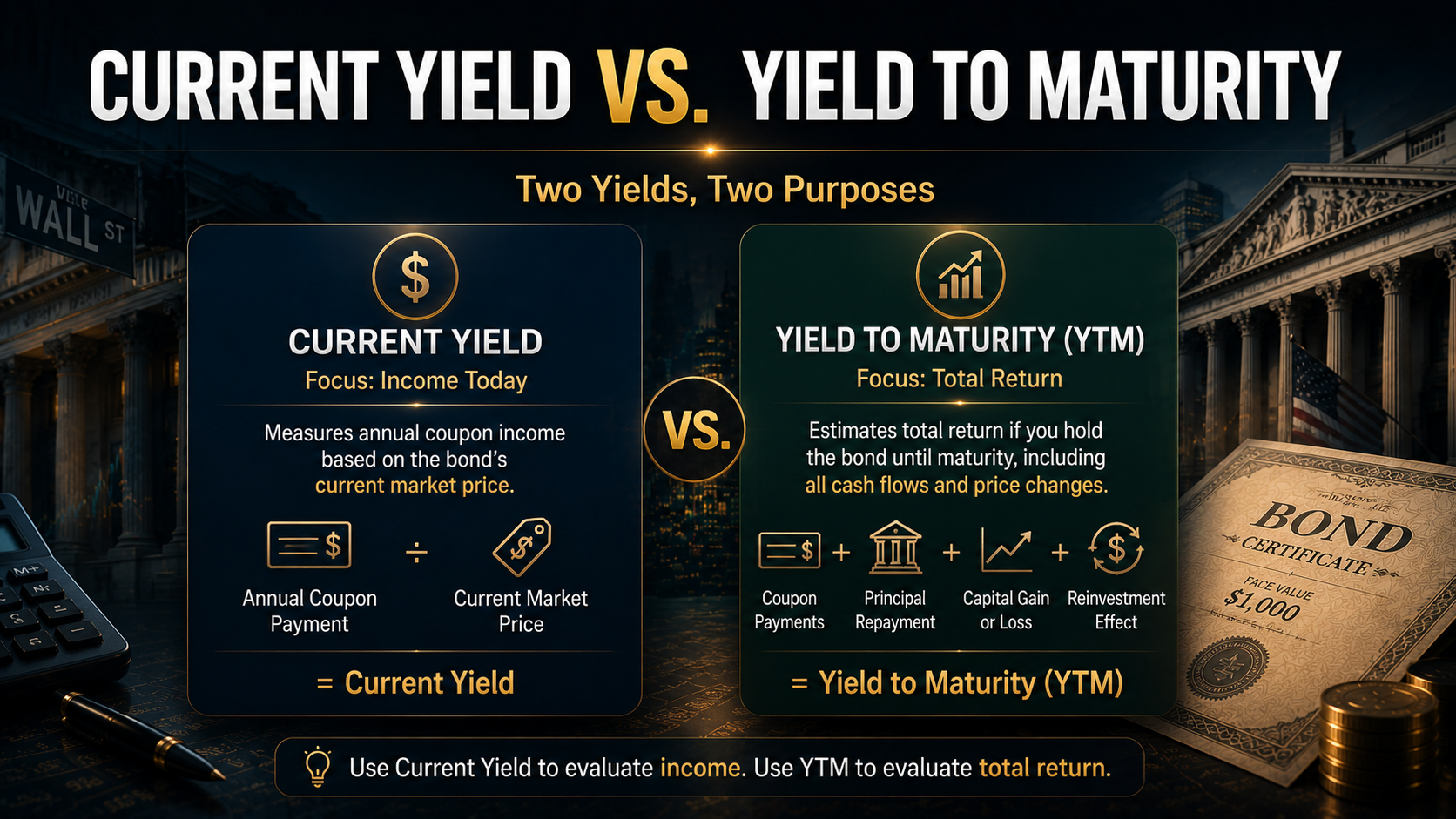
Current Yield tells you how much annual income a bond generates based on today's market price. Yield to Maturity goes much further by estimating your total return if you hold the bond until it matures.
Understanding the difference isn't just an academic exercise—it can help investors avoid misleading income expectations and make better long-term decisions.

Key Takeaway
Current Yield measures the annual income generated by a bond at its current market price, while Yield to Maturity (YTM) estimates the bond's total expected return, including coupon payments, capital gains or losses, and principal repayment.
What Is Current Yield?
Current Yield is one of the simplest ways to evaluate the income potential of a bond.
It measures the annual coupon payment relative to the bond's current market price rather than its face value.
The formula is straightforward
Current Yield = Annual Coupon Payment ÷ Current Market Price × 100
For example, imagine a Treasury or corporate bond with
- Face value: $1,000
- Annual coupon payment: $50
- Current market price: $900
Its Current Yield would be
$50 ÷ $900 = 5.56%
Although the bond's coupon rate is only 5%, buying it below face value increases the income you receive relative to the amount you invested.
Conversely, if the same bond trades for $1,100, the Current Yield falls to approximately 4.55%, even though the coupon payment remains exactly the same.
This is why bond prices and Current Yield always move in opposite directions.

How Does Current Yield Work?
Unlike stocks, bonds generally pay a fixed coupon throughout their lives.
What changes every day is the bond's market price.
Interest-rate expectations, Federal Reserve policy, inflation, credit quality, and investor demand constantly influence bond prices.
Because the coupon payment stays fixed while the market price fluctuates, Current Yield changes automatically.
Think of it like buying a rental property.
If the annual rental income stays the same but the property's purchase price drops, the rental yield rises.
If the property's price increases, the rental yield falls.
Current Yield follows exactly the same principle.

Current Yield vs. Yield to Maturity (YTM)
This is where many new investors become confused.
Current Yield only measures today's annual income.
Yield to Maturity (YTM), however, estimates the bond's total return if you hold it until maturity.
YTM includes
- Coupon payments
- Principal repayment
- Capital gains or losses from buying above or below par value
- The remaining time until maturity
The assumption that coupon payments are reinvested at comparable rates
| Metric | Current Yield | Yield to Maturity |
| Annual Coupon Income | ✓ | ✓ |
| Current Market Price | ✓ | ✓ |
| Principal Repayment | ✗ | ✓ |
| Capital Gain or Loss | ✗ | ✓ |
| Reinvestment Effect | ✗ | ✓ |
| Total Expected Return | ✗ | ✓ |
A useful way to remember the difference is
- Current Yield answers: "How much income will this bond generate today?"
- Yield to Maturity answers: "What total return should I expect if I hold this bond until maturity?"
Why Current Yield Matters
Current Yield is especially valuable for income-focused investors.
Retirees, pension funds, insurance companies, and dividend-oriented portfolios often prioritize stable cash flow over short-term price appreciation.
Current Yield provides a quick snapshot of how much income a bond generates at today's price.
However, relying on Current Yield alone can be misleading.
A bond with an attractive Current Yield may still produce a lower overall return if it was purchased at a premium and loses value at maturity.
Likewise, a discounted bond may have a Current Yield that understates its true investment potential because investors will also receive a capital gain when the bond matures at face value.
How Current Yield Affects Financial Markets
Changes in bond yields influence virtually every major asset class.
| Asset | Higher Current Yield (Lower Bond Prices) | Lower Current Yield (Higher Bond Prices) |
| Stocks | May reduce equity valuations as fixed income becomes more attractive | Can improve the relative appeal of equities |
| Bonds | Better income opportunities for new buyers | Higher capital gains for existing holders |
| U.S. Dollar | Often supported by rising Treasury yields | May weaken if rate-cut expectations increase |
| Gold | Faces higher opportunity costs | Often benefits from declining yields |
| Bitcoin | Liquidity-sensitive assets may experience greater volatility | Easier financial conditions can support demand |
Markets are driven by far more than one yield metric, but Current Yield provides valuable insight into how capital is flowing between risk assets and fixed income.
What Investors Should Remember
- Current Yield measures income based on today's market price.
- Bond prices and Current Yield always move in opposite directions.
- Current Yield does not include capital gains or losses.
- Yield to Maturity provides a more complete picture of long-term returns.
- Discount bonds generally have YTM > Current Yield > Coupon Rate.
- Premium bonds generally have YTM < Current Yield < Coupon Rate.
- Investors should never rely on Current Yield alone when evaluating a bond investment.
What Wealthy Investors Focus On
Professional investors rarely chase the highest yield.
Instead, they ask a different question
Why is the yield high in the first place?
A rising Current Yield may simply reflect higher interest rates.
But it can also signal deteriorating credit quality, recession fears, or increased default risk.
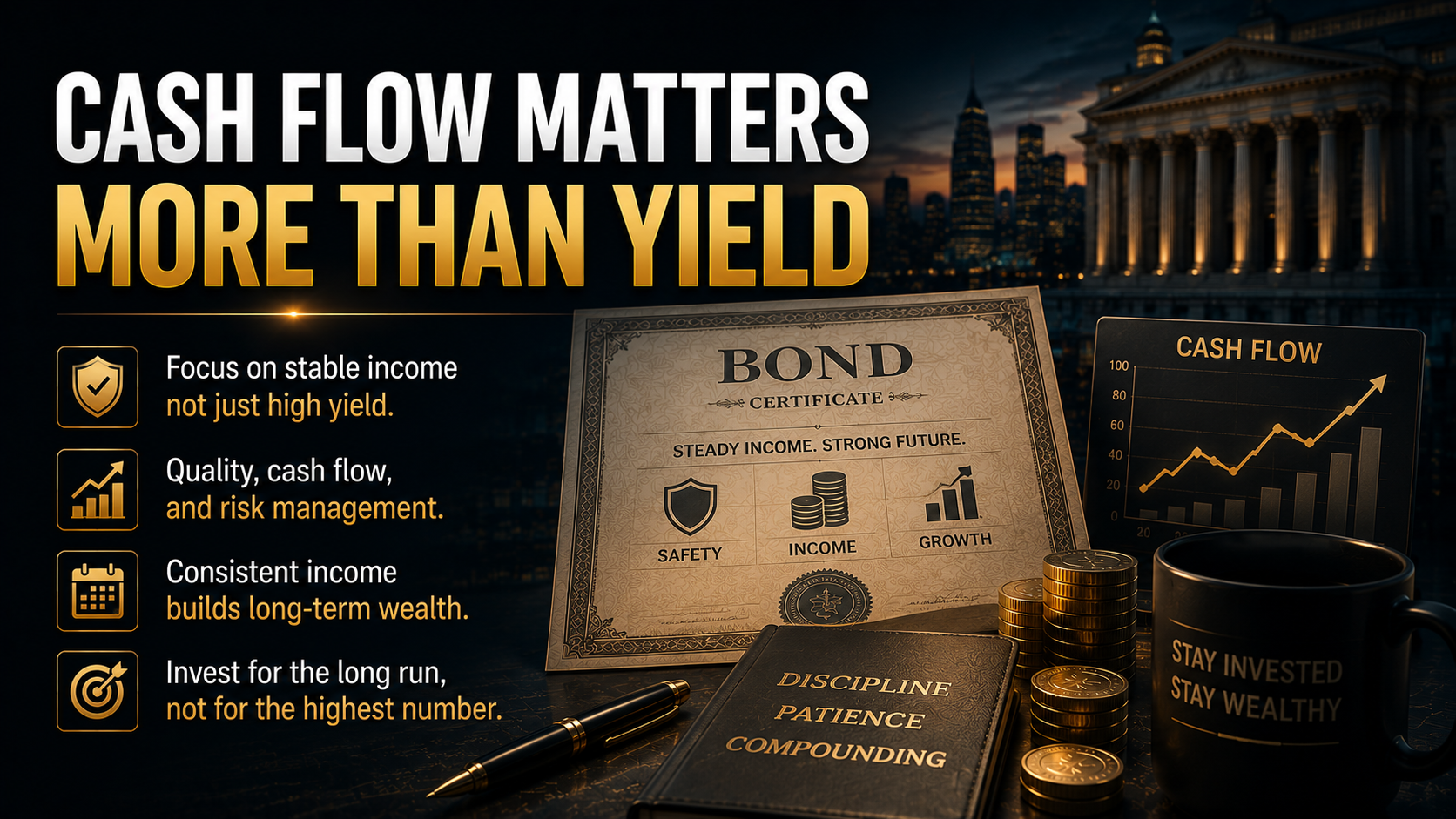
Experienced investors don't focus solely on yield—they focus on cash flow, capital preservation, and long-term resilience.
Rather than trying to predict every market move, they seek assets capable of generating reliable income across different economic environments.
Before purchasing a bond, consider asking yourself
- Is this yield being driven by opportunity or by risk?
- How secure are the issuer's future cash flows?
- Does the bond fit my long-term income strategy?
- Am I evaluating today's income or my total return?
In investing, survival matters more than chasing the highest advertised yield.
Final Thoughts
Current Yield is one of the most useful indicators for understanding how much income a bond generates at today's market price.
However, it tells only part of the story.
To fully evaluate a bond investment, investors should consider Yield to Maturity alongside Current Yield, allowing them to assess both present cash flow and long-term total return.
The best bond investors don't simply pursue higher yields—they seek sustainable cash flow, disciplined risk management, and investments that can preserve wealth over time.
MasterMind.
'[Global] Success Blueprints' 카테고리의 다른 글