Nasdaq Market Close August 18, 2026: AI and Semiconductor Stocks Tumble as Treasury Yields Surge


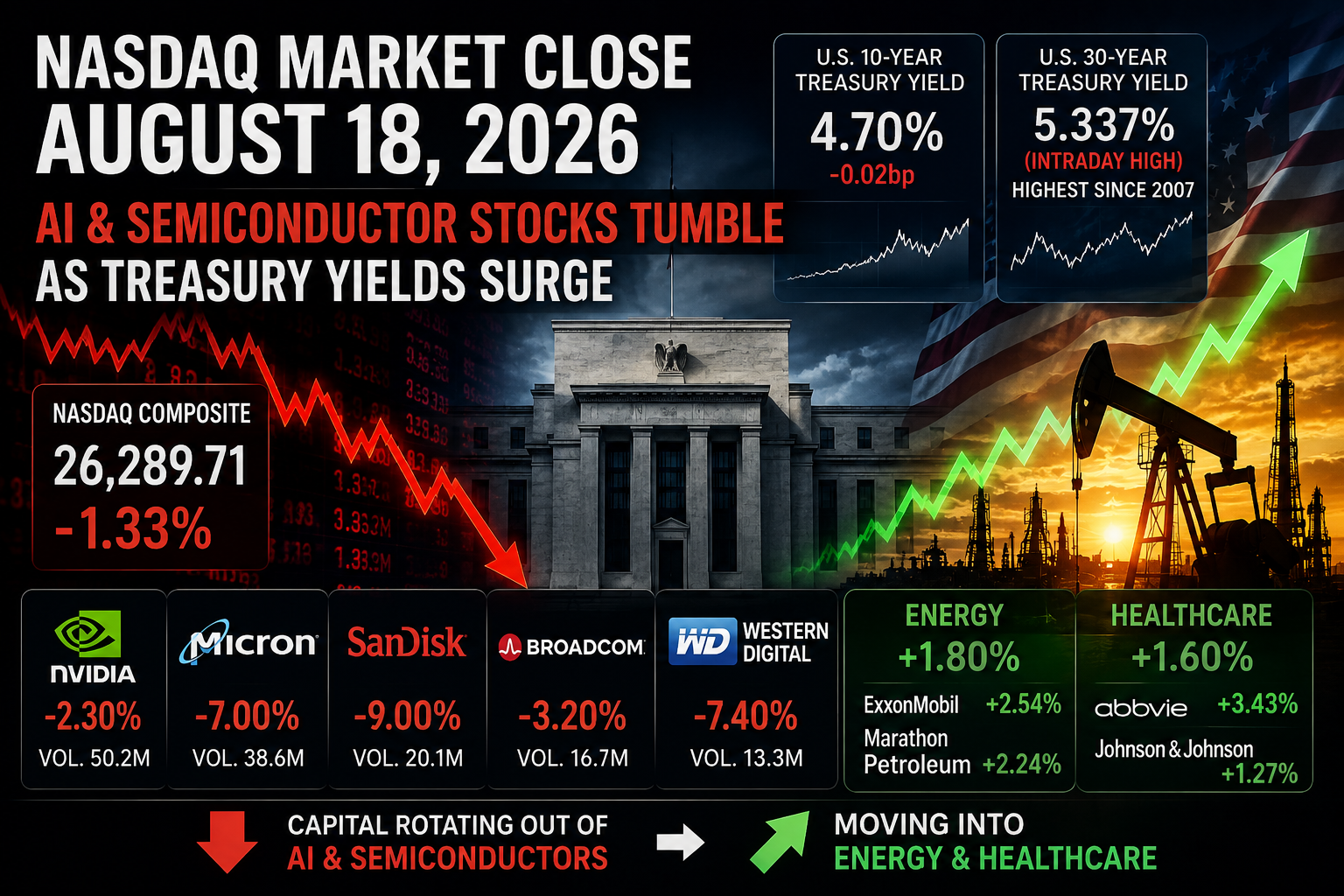
U.S. stocks moved lower on Tuesday, August 18, 2026, with the Nasdaq Composite falling 1.33% to 26,289.71 as selling intensified across AI, semiconductor, memory, and data-center hardware stocks.
The S&P 500 declined 0.69%, while the Dow Jones Industrial Average slipped just 0.22%. The divergence mattered: this was not simply a broad risk-off session. The heaviest pressure was concentrated in the growth and AI trades that had generated some of the market's strongest gains.
Micron Technology (MU) fell 7%, Nvidia (NVDA) lost 2.3%, Broadcom (AVGO) declined 3.2%, SanDisk (SNDK) dropped roughly 9%, and Western Digital (WDC) fell 7.4%. The Philadelphia Semiconductor Index sank about 5%.
At the same time, energy gained about 1.8%, healthcare rose 1.6%, and consumer staples advanced 1.1%.
That contrast tells us more than the Nasdaq's headline decline.
The key question from Tuesday's session is not simply why tech stocks fell. It is whether capital is beginning to rotate away from high-duration AI assets and toward sectors with stronger current cash flows and defensive characteristics.
Key takeaway: Elevated long-term Treasury yields and renewed inflation concerns pressured richly valued AI and semiconductor stocks, while capital rotated toward energy, healthcare, and other areas less dependent on distant future earnings.
1. U.S. Stock Market Close
| Index | Close | Change |
| Nasdaq Composite | 26,289.71 | -1.33% |
| S&P 500 | 7,691.76 | -0.69% |
| Dow Jones Industrial Average | 53,343.40 | -0.22% |
| Russell 2000 | 3,017.89 | -1.30% |
The relative performance across indexes is important.
The Dow lost only 0.22%, while the Nasdaq and Russell 2000 each fell about 1.3%. That suggests investors were not indiscriminately selling every part of the equity market.
Instead, pressure was heavier in two areas particularly sensitive to financial conditions: long-duration growth stocks and smaller companies.
Market breadth was also negative, with declining stocks outnumbering advancing stocks on both the NYSE and Nasdaq.
Within the S&P 500, the contrast was even clearer.
Technology was among the weakest areas of the market, while energy gained approximately 1.8%, healthcare 1.6%, and consumer staples 1.1%.
This was therefore more than a simple Nasdaq pullback.
It was a session characterized by sector rotation and a reduction in exposure to some of the market's highest-valuation growth trades.
2. Why Did the Nasdaq Fall?
Three forces mattered most.
Long-Term Treasury Yields Remained a Valuation Problem
Long-duration Treasury yields remained historically elevated as investors continued to wrestle with inflation risks, energy prices, geopolitical uncertainty, and the outlook for monetary policy.
The 30-year Treasury yield briefly reached approximately 5.337%, its highest level since 2007, before easing later in the session.
That matters enormously for growth stocks.
A simplified valuation framework looks like this
Higher inflation risk
↓
Higher required bond yields
↓
Higher discount rates
↓
Lower present value of future corporate earnings
↓
Greater pressure on high-multiple growth stocks
AI companies are particularly exposed to this mechanism because investors are paying today for earnings expected many years into the future.
When the discount rate rises, those distant profits become less valuable in today's dollars.
Treasury Yields Eased Later, but Tech Selling Continued
There is an important nuance in Tuesday's bond-market action.
The 10-year Treasury yield did not ultimately finish sharply higher. It edged down to roughly 4.70% from 4.72% late Monday, even though yields remained extremely elevated compared with levels seen before the Iran conflict.
This changes the interpretation of the stock-market decline.
Tuesday was not simply
Treasury yields rise → Nasdaq falls.
Instead, the market experienced an early long-duration yield shock, after which yields moderated but selling in AI and semiconductor stocks persisted.
That suggests investors were dealing with more than a one-day bond move.
They were also questioning how much valuation premium should be assigned to AI winners in a structurally higher-rate environment.
AI Valuations Came Under Renewed Scrutiny
The Philadelphia Semiconductor Index fell approximately 5%.
Micron dropped 7%, Nvidia fell 2.3%, and Broadcom lost 3.2%.
These companies do not occupy exactly the same part of the semiconductor market.
Nvidia dominates AI accelerators.
Micron is a major memory supplier.
Broadcom has exposure to networking and custom AI silicon.
When all three decline together, the move is more significant than company-specific weakness.
It suggests investors were reducing exposure across multiple layers of the AI infrastructure trade.
The fundamental AI growth story did not disappear on Tuesday.
What changed was the price investors were willing to pay for that growth.
3. U.S. 10-Year Treasury Yield
U.S. 10-Year Treasury Yield: approximately 4.70% at the close
The 10-year yield edged lower from roughly 4.72% late Monday, but remained far above the 3.97% level seen shortly before the Iran war began.
The 30-year yield was arguably even more important during Tuesday's session because it briefly reached its highest level since 2007.
Why should equity investors care?
Consider a company expected to generate much of its value from profits several years into the future.
Those future earnings must be discounted back to today's value.
When the risk-free rate rises, the discount rate used by investors also tends to rise. The farther into the future those profits are expected, the larger the valuation impact.
That is why high-growth technology companies can remain fundamentally strong while their stocks decline.
Earnings expectations and valuation multiples are two different variables.
Tuesday's action was largely about the second.
4. Top 5 Stocks With Meaningful Buying Activity
Tuesday's strongest stocks were not concentrated in a single theme. Instead, meaningful buying appeared in companies with clear company-specific catalysts, while energy and healthcare also benefited from broader sector rotation.
| Company | Business | Change | Volume | Key Catalyst |
| Amylyx Pharmaceuticals (AMLX) | Biotechnology | +63.84% | Heavy volume | Positive Phase 3 LUCIDITY trial |
| Targa Resources (TRGP) | Natural Gas Infrastructure | about +8.0% | about 1.86M | 20-year ExxonMobil agreements |
| AbbVie (ABBV) | Pharmaceuticals | +3.43% | 4.9M | Healthcare rotation |
| Exxon Mobil (XOM) | Integrated Energy | +2.54% | 18.9M | Higher oil prices and energy-sector strength |
| Marathon Petroleum (MPC) | Refining | +2.24% | 2.0M | Energy strength and new 52-week high |
The list is not simply a ranking of the market's five largest percentage gainers. The stocks were selected based on the combination of price movement, trading activity, company size, identifiable catalysts, and what their moves reveal about broader capital flows.
Amylyx Pharmaceuticals (AMLX) +63.84%
Amylyx Pharmaceuticals was one of Tuesday's standout gainers, surging 63.84% after reporting positive topline results from its Phase 3 LUCIDITY trial of avexitide in patients with post-bariatric hypoglycemia.
The clinical trial met its primary endpoint, giving investors a concrete reason to reassess the potential commercial value of avexitide.
This is important because Amylyx's move was not driven by a vague biotechnology theme or general risk appetite. It was a classic event-driven revaluation following a meaningful clinical result.
That distinction matters on a day when the broader Nasdaq was falling. Investors were still willing to aggressively buy individual growth companies when new fundamental information materially changed their outlook.
Targa Resources (TRGP) About +8%
Targa Resources surged roughly 8% after announcing expanded long-term agreements with ExxonMobil subsidiaries covering natural-gas gathering, processing and downstream NGL infrastructure in the Permian Basin.
Trading activity was elevated at roughly 1.86 million shares, compared with average volume of about 1.20 million shares.
The agreements include 20-year acreage commitments and support additional processing plants and pipeline infrastructure.
Targa's rally is particularly interesting because it connects two major investment themes: energy infrastructure and rising power demand.
The company benefits from traditional Permian Basin production growth, but natural gas infrastructure is also becoming increasingly relevant as data centers and AI workloads increase U.S. electricity demand.
This was therefore more than a simple oil-price trade.
AbbVie (ABBV) +3.43%
AbbVie climbed 3.43% to $258.92, significantly outperforming the S&P 500's 0.69% decline.
Approximately 4.9 million shares changed hands during the session.
There was no comparable single-day corporate catalyst behind AbbVie's move. Instead, the stock benefited from broader strength in healthcare as investors reduced exposure to high-duration technology.
The healthcare sector's relative strength alongside gains in AbbVie, Johnson & Johnson and Amgen suggests that some investors were favoring companies with more established earnings and defensive characteristics.
That makes AbbVie useful not because it was one of the market's most spectacular gainers, but because it helps confirm the day's sector rotation away from technology and toward healthcare.
Exxon Mobil (XOM) +2.54%
Exxon Mobil gained 2.54%, closing at $165.56 despite weakness across the broader equity market.
Trading volume reached approximately 18.9 million shares, above its 50-day average of roughly 16 million shares.
That volume increase makes Exxon particularly relevant to Tuesday's capital-flow analysis.
Higher crude prices and renewed concerns about Middle East supply supported the energy sector, while investors simultaneously reduced exposure to high-valuation technology stocks.
Exxon also participated in the long-term infrastructure agreements announced with Targa Resources.
The key signal was broader than Exxon itself
Exxon +2.54%
Chevron +1.50%
ConocoPhillips +1.69%
Energy stocks were rising together while semiconductors were being sold.
That is much stronger evidence of sector rotation than the performance of any single energy stock.
Marathon Petroleum (MPC) +2.24%
Marathon Petroleum advanced 2.24% to $366.21, setting another 52-week high during a session in which the S&P 500 fell 0.69%.
Approximately 2.0 million shares traded during the session.
Marathon is one of the largest U.S. refiners, meaning its earnings exposure differs somewhat from integrated producers such as Exxon.
Its strength alongside Exxon, Chevron and other energy companies reinforces the view that investors were buying across multiple parts of the energy complex rather than chasing one isolated stock.
The important takeaway from Tuesday's winners is therefore not simply that a biotechnology stock surged or several energy companies rose.
The broader pattern was
Clear fundamental catalyst → Amylyx and Targa
Energy-sector capital inflow → Exxon and Marathon Petroleum
Defensive rotation → AbbVie
Against a backdrop of heavy selling in semiconductors, memory, storage and AI networking stocks, this combination provides further evidence that capital was moving away from expensive long-duration technology while selectively rewarding companies with immediate catalysts, current cash flows, and defensive earnings characteristics.
5. Where Was the Selling?
Tuesday's downside provided the clearest evidence of where capital was leaving.
| Company | Business | Change | Primary Issue |
| Klarna (KLAR) | Fintech / BNPL | -22.8% | 2026 outlook cut |
| SanDisk (SNDK) | NAND / Storage | about -9.0% | AI hardware selloff |
| Western Digital (WDC) | Data Storage | -7.4% | Storage-sector selling |
| Micron Technology (MU) | Memory / HBM | -7.0% | Semiconductor valuation reset |
| Meta Platforms (META) | Digital Platforms / AI | -4.4% | Tech weakness and litigation concerns |
Klarna (KLAR) -22.8%
Klarna was one of the day's most dramatic individual losers.
The buy-now-pay-later company fell 22.8% after cutting its 2026 forecast.
This is an important distinction from the semiconductor selloff.
Klarna's decline had a clear company-specific catalyst: investors lowered the value of the business after management reduced expectations for future performance.
It reinforces one of the market's current themes
Guidance matters at least as much as reported earnings.
SanDisk (SNDK) About -9%
SanDisk fell roughly 9% as selling intensified across memory and data-storage stocks.
The stock had benefited substantially from enthusiasm surrounding AI infrastructure and storage demand.
Tuesday showed the other side of that trade.
When investors reduce AI infrastructure exposure, the selling does not necessarily stop at GPU manufacturers.
It can move downstream into memory and storage.
Western Digital (WDC) -7.4%
Western Digital dropped approximately 7.4%.
Its simultaneous decline with SanDisk is particularly important.
When several companies exposed to the same underlying demand theme fall sharply together, the move becomes more useful as evidence of an industry-level capital shift rather than an isolated corporate event.
Micron Technology (MU) -7.0%
Micron fell 7%, making it one of the largest drags on the S&P 500.
This deserves attention because Micron has been one of the biggest beneficiaries of AI-driven memory demand.
Its shares had more than tripled in 2026 even after Tuesday's decline.
That creates an important distinction
The market was not necessarily rejecting Micron's AI memory story.
It was taking risk out of a stock where substantial future optimism had already been reflected in the price.
Meta Platforms (META) -4.4%
Meta declined approximately 4.4%.
The company sits in a different part of the AI ecosystem, but it is also one of the world's largest spenders on AI infrastructure.
Its weakness showed that pressure was not completely confined to semiconductor manufacturers.
High-capex technology platforms were also vulnerable as investors reassessed the relationship between enormous AI investment requirements and future returns.
6. Where Did the Money Go?
This was the most important feature of Tuesday's market.
The selling was not confined to Nvidia.
It spread across several layers of the AI infrastructure stack
Nvidia
↓
Broadcom
↓
Micron
↓
Western Digital
↓
SanDisk
The Philadelphia Semiconductor Index's roughly 5% decline confirms that this was a sector-level event rather than a collection of unrelated stock moves.
That distinction matters.
In recent sessions, investors have often rotated within the AI ecosystem.
Capital might move from mega-cap GPU stocks into memory, storage, networking, or other data-center infrastructure companies.
Tuesday looked different.
Multiple parts of the AI hardware chain fell simultaneously.
That points toward capital moving out of the AI hardware complex rather than merely rotating from one AI subsector into another.
Where did some of that capital go?
The strongest evidence came from sector performance
Energy: +1.8%
Healthcare: +1.6%
Consumer Staples: +1.1%
This does not prove that every dollar sold from semiconductors immediately flowed into those sectors.
But the relative performance clearly shows investors favoring industries with more immediate cash flows and defensive characteristics while reducing exposure to long-duration growth.
7. MasterMind's Insight
First: The Level of Yields Matters More Than the Daily Change
The 10-year Treasury yield actually edged lower by the close.
Yet technology stocks still fell sharply.
That tells investors something important.
The issue is no longer simply whether the 10-year yield rises or falls five basis points on a particular day.
The problem for high-multiple equities is that long-term rates remain structurally high.
The 10-year yield remained around 4.70%, while the 30-year yield briefly touched its highest level since 2007.
AI stocks therefore have to justify premium valuations against a much more demanding risk-free alternative.
Second: This Was Not an AI Rotation — It Was an AI De-Risking Session
There is a major difference between
Nvidia falls → Micron rises
and
Nvidia falls → Micron falls → storage falls → networking falls.
The first is rotation within AI.
The second is broader risk reduction.
Tuesday looked much closer to the second scenario.
That does not establish a long-term trend from one trading session, but it gives investors a useful signal to monitor over the next several sessions.
If money quickly returns to memory, networking, or storage, this may prove to be another short-term reset.
If heavy selling continues across the entire AI hardware chain, the interpretation becomes more significant.
Third: Wall Street Is Asking AI Companies to Prove the Return on Capital
The AI debate is gradually changing.
For much of the rally, the central question was
How large will AI infrastructure spending become?
The question increasingly becoming relevant is
What return will companies earn on that spending?
AI demand can remain enormous while stocks still struggle if expectations embedded in valuations are even larger.
That is why Tuesday's selloff should not automatically be interpreted as evidence that the AI investment cycle is ending.
It is better understood as a reminder that great businesses and great investments are not always the same thing at every valuation.
8. What U.S. Investors Should Watch Next
The first variable remains long-term Treasury yields.
A renewed move above Tuesday's intraday highs would increase the valuation challenge for growth stocks. Stabilization in yields, on the other hand, would remove one source of pressure.
Second, watch the breadth of the semiconductor selloff.
Nvidia alone is not enough.
Micron, SanDisk, Western Digital, Broadcom and other AI infrastructure names should be monitored together. Continued weakness across multiple layers of the data-center supply chain would be more meaningful than another isolated decline in a mega-cap stock.
Third, watch whether energy and defensive sectors continue to outperform.
One strong session is not enough to establish a durable rotation.
But several sessions of relative strength accompanied by persistent weakness in high-duration technology would provide stronger evidence that institutional positioning is changing.
Finally, investors are looking toward the Federal Reserve's July meeting minutes and the upcoming Jackson Hole symposium for clues about the policy outlook. Markets are particularly sensitive to how policymakers balance softer economic data against inflation risks created by high energy prices.
The Bottom Line
Elevated long-term Treasury yields forced another valuation reset across AI and semiconductor stocks, pushing the Nasdaq down 1.33% as selling spread from GPUs into memory and storage, while relative strength in energy, healthcare, and consumer staples showed investors shifting toward sectors supported by current cash flows and defensive earnings.
Final Thoughts
August 18 was not simply another down day for the Nasdaq.
The more important story was underneath the index.
Long-term yields remained historically high. Semiconductor stocks fell sharply. Selling spread across several layers of the AI data-center supply chain. Meanwhile, energy, healthcare, and consumer staples moved higher.
That is why daily market analysis should move beyond simply asking whether the Nasdaq finished green or red.
The more useful sequence is
Indexes → Treasury yields → volume → sectors → individual stocks.
Then ask three questions
What caused the move?
Where was trading activity concentrated?
Where did capital appear to leave — and where did it find relative strength?
Those questions provide a much clearer picture of the U.S. equity market than the headline index return alone.
This is MasterMind, designing the path to success.
Disclaimer: This article is for market information and educational purposes only and does not constitute a recommendation to buy or sell any security.
'[Global] Success Blueprints' 카테고리의 다른 글