$1 Million in Dividend ETFs: How Much Monthly Income Do You Keep After Taxes?


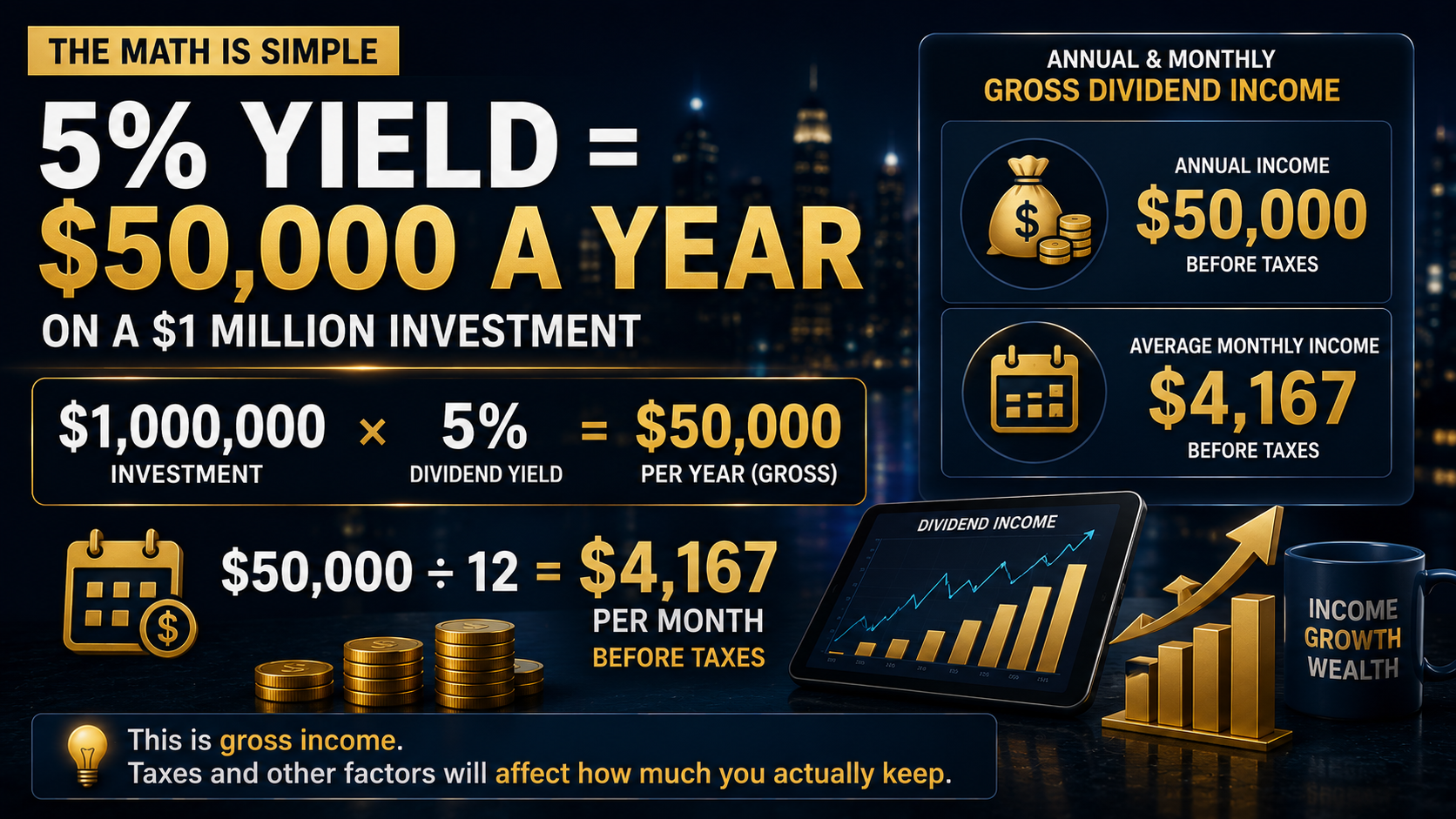
A $1 million portfolio invested in dividend ETFs yielding 5% would generate $50,000 a year in gross dividend income, or about $4,167 per month on average.
But $4,167 is not necessarily the amount you can spend.
The actual income you keep depends on whether those distributions are qualified dividends or ordinary income, your federal tax bracket, state taxes, potential Net Investment Income Tax, and—perhaps most importantly—the type of account holding the ETF.
For an investor building a dividend portfolio for retirement, the number that matters isn't simply the 5% dividend yield.
It's after-tax cash flow.
1. What Does a $1 Million Dividend Portfolio Actually Generate?
Start with the simplest calculation
$1,000,000 × 5% = $50,000 per year
Divide that by 12
$50,000 ÷ 12 = approximately $4,167 per month
At first glance, this sounds straightforward.
A retiree with $1 million could theoretically build a portfolio yielding 5% and generate more than $4,000 per month without selling shares.
But this calculation only tells us the gross income.
It doesn't tell us how much money ultimately remains available for spending.
There's another important distinction: a 5% annual yield does not mean every ETF will deposit exactly $4,167 into your account every month.
Some dividend ETFs pay monthly, while many pay quarterly. Distribution amounts can also fluctuate.
So $4,167 should be viewed as an average monthly equivalent, not a guaranteed monthly paycheck.
2. The First Tax Question: Are the Dividends Qualified?
This is where U.S. dividend taxation becomes especially important.
Not all dividends are taxed the same way.
Many dividends from U.S. corporations may qualify for the preferential federal tax rates applied to qualified dividends, assuming the applicable requirements are met.
Qualified dividends are generally taxed at long-term capital gains tax rates.
Depending on taxable income, the federal rate can be
0%, 15%, or 20%.
That can make a major difference.
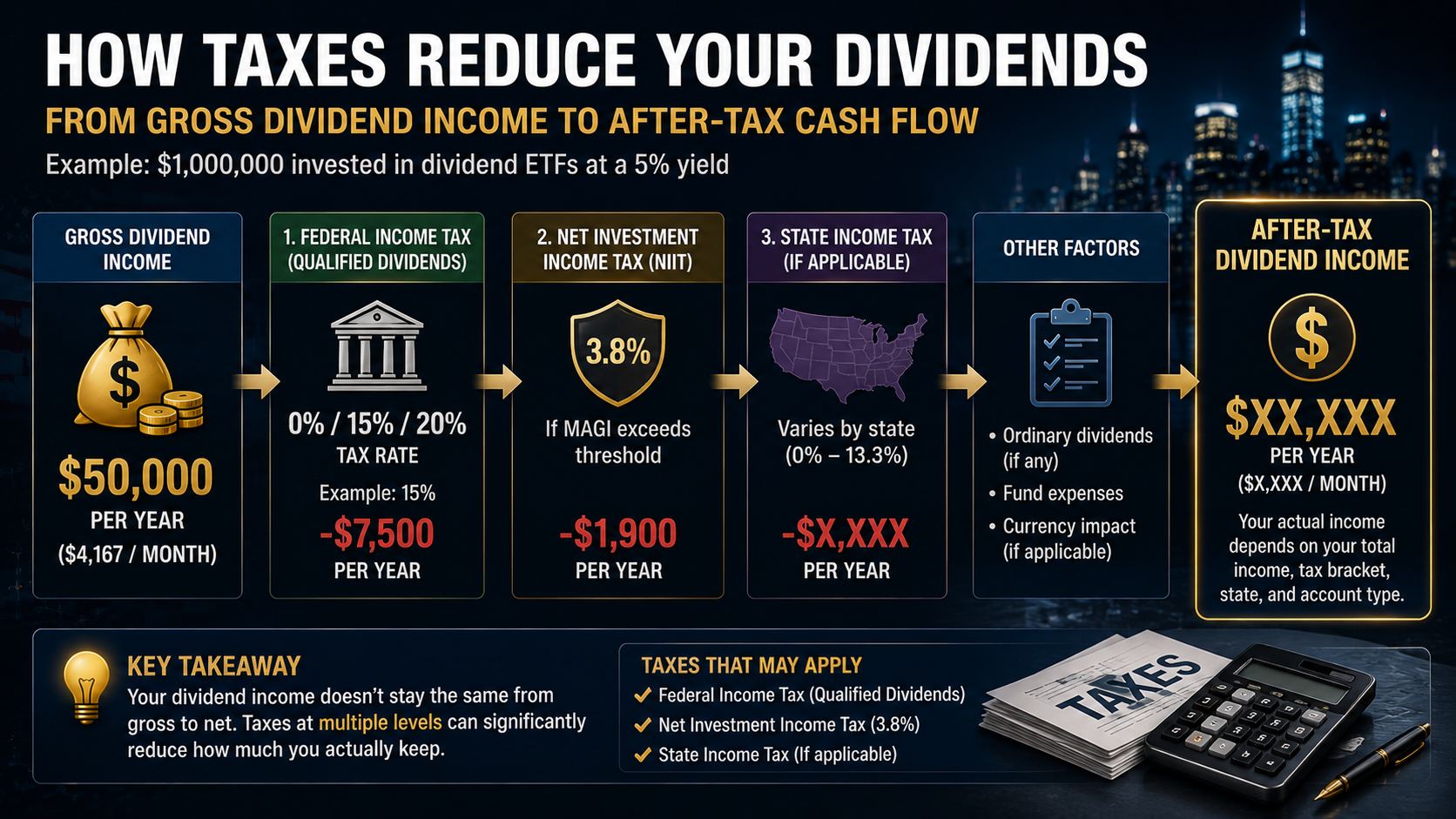
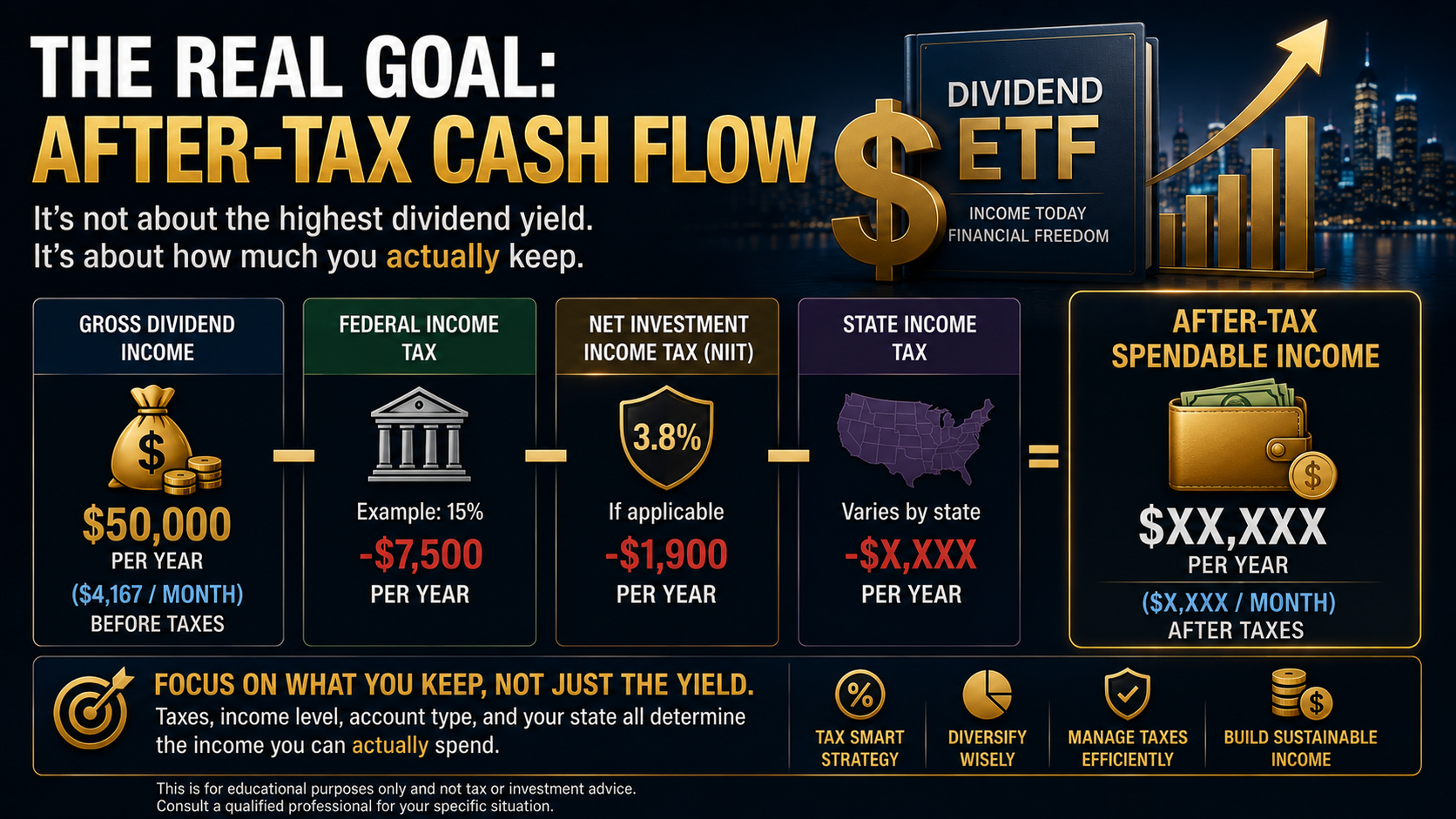
Suppose, purely as an illustration, that the entire $50,000 qualifies for the 15% federal qualified-dividend rate.
The federal tax would be
$50,000 × 15% = $7,500
That leaves
$42,500 per year
or approximately
$3,542 per month
But this is still not necessarily your final spendable income.
3. Some ETF Distributions Can Be Taxed Differently
A common mistake is assuming that every dollar distributed by a dividend ETF receives the qualified-dividend tax rate.
That isn't always the case.
ETF distributions can potentially include different tax components, such as
- Qualified dividends
- Nonqualified or ordinary dividends
- Capital gain distributions
- Return of capital
- Interest-related income
The composition depends on what the fund owns and how its distributions are generated.
This is one reason two ETFs with identical headline yields can produce different after-tax results.
A 5% yield that receives favorable tax treatment can be worth more to a taxable investor than a 6% distribution that is largely taxed as ordinary income.
In other words
Higher yield does not automatically mean higher after-tax income.
4. High-Income Investors Need to Consider NIIT
There's another federal tax that higher-income investors need to keep on their radar: the Net Investment Income Tax, commonly known as NIIT.
NIIT can impose an additional 3.8% tax on certain net investment income once modified adjusted gross income exceeds applicable thresholds.
Investment income potentially subject to NIIT can include dividends, interest and capital gains.
This means an investor with substantial salary, business, retirement or investment income could face a higher effective tax rate on dividends than someone whose primary income comes from a smaller investment portfolio.
That's why two people holding the exact same $1 million dividend ETF portfolio can end up with very different after-tax cash flows.
The portfolio is identical.
Their tax situations aren't.
5. Don't Forget State Income Taxes
Federal taxes are only part of the equation.
Where you live can also materially affect the amount you keep.
Some states do not impose individual state income taxes, while others can add meaningful state-level taxation to investment income.
That creates an important distinction for retirement planning.
A $50,000 dividend stream received by an investor in one state may produce a different after-tax result from the same portfolio held by an investor living elsewhere.
For investors planning to fund retirement with dividends, location can therefore become part of the portfolio's overall tax strategy.
6. So How Much of the $4,167 Could You Actually Keep?
Let's return to our hypothetical portfolio.
Portfolio: $1,000,000
Dividend yield: 5%
Gross annual dividends: $50,000
Average gross monthly income: approximately $4,167
Now assume, purely for illustration, that the dividends qualify for a 15% federal tax rate and that no additional taxes apply.
Federal tax
$7,500
After-tax annual dividends
$42,500
Average after-tax monthly income
approximately $3,542
But change the investor's circumstances and the answer changes.
An investor who qualifies for the 0% qualified-dividend bracket could potentially keep substantially more.
A higher-income investor facing the 20% qualified-dividend rate, NIIT and state taxes could keep considerably less.
And an investor holding the same assets inside certain tax-advantaged retirement accounts could face an entirely different tax timeline.
So there is no universal answer to
“How much monthly income does a $1 million dividend portfolio provide?”
The accurate answer is
It depends on the tax character of the distributions, your total taxable income, your state and the account holding the investment.
7. The Account Can Matter as Much as the ETF
This is one of the most important principles in dividend investing.
Investors often spend enormous amounts of time choosing between dividend ETFs while paying far less attention to where those ETFs are held.
But asset location can significantly influence long-term after-tax returns.
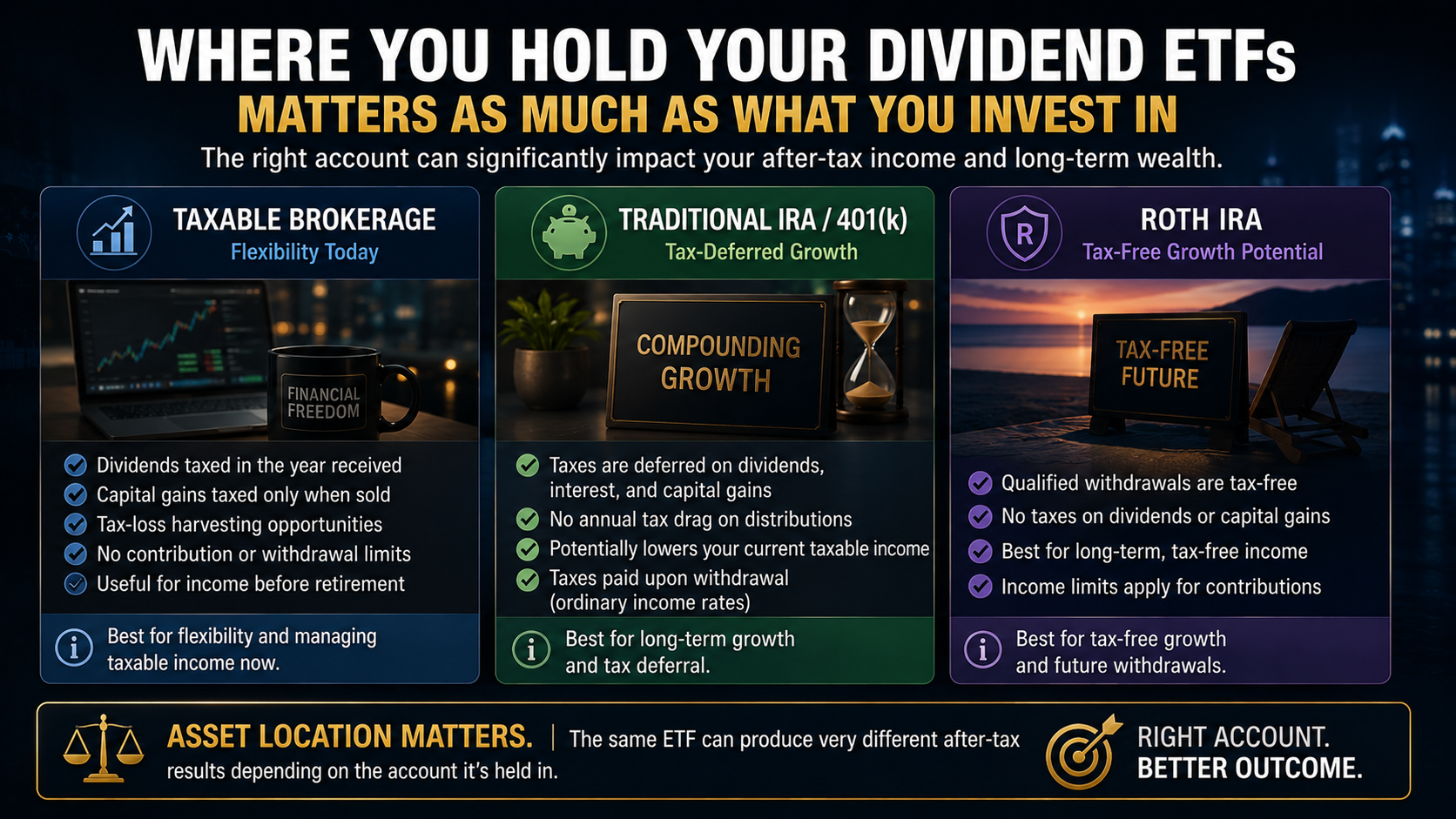
Consider three broad account types
Taxable Brokerage Account
Dividends are generally taxable in the year they're received.
The advantage is flexibility.
There are no retirement-account withdrawal restrictions, and investors may also benefit from long-term capital gains treatment and tax-loss harvesting opportunities where applicable.
For investors who need dividend income before retirement age, taxable brokerage accounts can play an important role.
Traditional IRA or 401(k)
Investment income generally grows tax-deferred inside these accounts.
You typically don't pay annual taxes simply because an ETF distributes dividends inside the account.
Instead, taxation generally occurs when money is withdrawn, with distributions typically taxed according to the applicable rules.
This can be valuable because the portfolio can compound without annual dividend taxes reducing the amount being reinvested.
Roth IRA
For eligible investors who follow the applicable rules, qualified Roth IRA withdrawals can be tax-free.
That can make Roth space particularly valuable for long-term compounding.
The central lesson is simple
Choosing the right account can sometimes matter more than squeezing another fraction of a percentage point out of an ETF's dividend yield.
8. A 5% Yield Isn't Necessarily Better Than a 3% Yield
This sounds counterintuitive.
If you're investing for income, why wouldn't you always want the higher yield?
Because investors should care about total return and after-tax wealth, not yield alone.
Imagine two portfolios.
Portfolio A focuses heavily on high current distributions.
Portfolio B produces a smaller dividend but generates stronger long-term capital appreciation.
Depending on taxes and investment performance, Portfolio B could ultimately create more spendable wealth—even though its current yield is lower.
This becomes particularly relevant in taxable accounts.
Capital appreciation generally isn't taxed simply because the market value of an investment rises. Taxes generally become relevant when gains are realized through a sale.
That gives investors some control over the timing of taxable events.
Dividends are different.
Once a taxable dividend is distributed, the investor generally has a current-year tax event.
That's why maximizing dividend yield isn't always the same as maximizing financial independence.
9. Consider Dividend Growth, Not Just Current Yield
Another approach is combining current income with dividend growth.
Instead of putting an entire $1 million portfolio into the highest-yielding funds available, an investor might combine
Dividend ETFs + dividend-growth stocks or ETFs + broader equity exposure + bonds or cash reserves
The goal isn't simply to maximize today's distribution.
It's to build a portfolio capable of producing sustainable income while preserving purchasing power and long-term capital.
A 5% yield today isn't particularly attractive if distributions decline or the underlying capital deteriorates.
Conversely, a lower-yielding portfolio with growing earnings and dividends may generate considerably more income years later.
For retirees who may need their portfolio to last several decades, that distinction matters.
10. Married Couples Can Also Benefit From Household-Level Tax Planning
Tax planning shouldn't always be viewed at the individual-account level.
Married couples often need to think about the entire household balance sheet.
Taxable brokerage accounts, Traditional IRAs, Roth IRAs, employer retirement plans and cash reserves can each serve different purposes.
The objective isn't simply to split money equally.
It's to determine which assets belong in which accounts and how future withdrawals may affect taxable income.
A household that coordinates asset location and withdrawal sequencing may generate the same gross investment return as another household while keeping more of it after taxes.
11. The Real Goal Is After-Tax Cash Flow
Let's put the original example back together.
A $1 million portfolio yielding 5% produces
$50,000 in annual gross dividends
or approximately
$4,167 per month before taxes.
If those dividends were taxed at a hypothetical 15% federal rate with no other taxes, the investor would retain approximately
$42,500 per year
or
$3,542 per month.
But that number could be higher or lower depending on
Qualified vs. ordinary dividend treatment
Federal taxable income
Net Investment Income Tax
State taxes
Account type
Other household income
That's why the headline yield should never be the final calculation.
The real equation is
Portfolio value
→ Gross dividend income
→ Tax treatment of distributions
→ Federal and state taxes
→ Account structure
→ After-tax spendable income
Final Takeaway
A $1 million dividend portfolio yielding 5% can generate an impressive $50,000 of annual cash flow.
But that doesn't automatically mean you have $50,000 available to spend.
The investor who focuses only on dividend yield sees one number.
The investor who focuses on after-tax cash flow sees the entire financial picture.
That's why building a dividend portfolio isn't simply about finding the ETF with the highest yield.
It's about combining sustainable distributions, dividend growth, total return, tax-efficient asset location and an appropriate withdrawal strategy.
Ultimately, the most useful question isn't
“What dividend yield can I get?”
It's
“After federal taxes, state taxes and account-level tax treatment, how much of this income can I actually spend?”
That is the number that determines what a $1 million dividend portfolio can really do for your lifestyle.
This article is for general educational purposes only and does not constitute individualized investment, tax, or legal advice. U.S. tax treatment depends on income, filing status, state of residence, account type, the tax characteristics of individual fund distributions, and applicable tax law. Investors should verify current IRS rules and consult qualified professionals when appropriate.
'[Global] Success Blueprints' 카테고리의 다른 글