Nasdaq Market Close August 17, 2026: Semiconductor and Memory Stocks Rally, Top Gainers and Losers, AI Capital Flows


U.S. stocks finished lower on Monday, August 17, 2026, but the headline indexes told only part of the story.
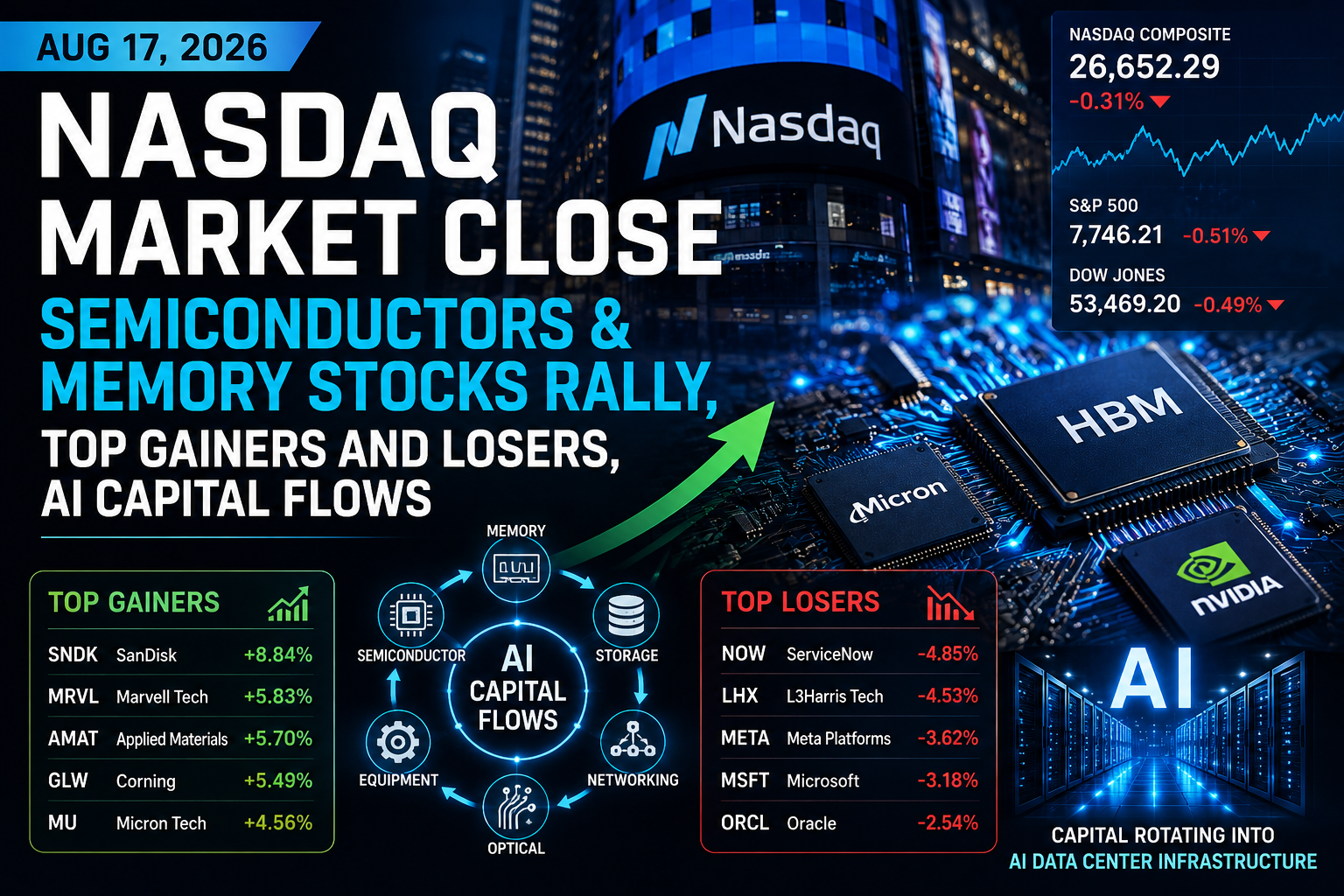
The Nasdaq Composite fell 0.31% to 26,652.29, the S&P 500 declined 0.51% to 7,746.21, and the Dow Jones Industrial Average lost 0.49% to close at 53,469.20.
Behind those modest index declines, however, a much more important rotation was taking place.
The 30-year U.S. Treasury yield climbed to roughly 5.31%, its highest level since 2007, creating a challenging backdrop for long-duration growth stocks. Yet several semiconductor, memory, storage, networking, and optical-infrastructure stocks rallied sharply.
At the same time, major software and platform companies including Microsoft (MSFT), Meta Platforms (META), ServiceNow (NOW), and Oracle (ORCL) came under selling pressure.
That divergence is the key to understanding Monday's market.
This wasn't simply a risk-off session for technology.
Capital was rotating within the AI ecosystem—from software toward the physical infrastructure required to build and scale AI data centers.
Bottom Line: Even as the 30-year Treasury yield climbed above 5.3% to its highest level since 2007, investors continued buying selected AI infrastructure plays, with capital rotating toward memory, storage, semiconductor equipment, networking, and optical connectivity while software stocks came under pressure.
1. U.S. Stock Market Close
| Index | Close | Change |
| Nasdaq Composite | 26,652.29 | -0.31% |
| S&P 500 | 7,746.21 | -0.51% |
| Dow Jones Industrial Average | 53,469.20 | -0.49% |
The major indexes all finished lower, but the relatively small headline declines masked significant dispersion beneath the surface.
Technology was anything but uniform.
Semiconductor and AI infrastructure stocks attracted buyers, while several major software names suffered sharp declines.
That distinction matters.
The market wasn't abandoning the AI trade altogether. Investors appeared to be repositioning within it.
Rather than paying up indiscriminately for anything associated with artificial intelligence, the market increasingly favored companies positioned around the physical bottlenecks of AI infrastructure.
That included memory, storage, networking, semiconductor manufacturing equipment, and optical connectivity.
2. What Drove the Nasdaq Today?
Three factors shaped Monday's trading.
First: Softer U.S. Economic Data Complicated the Growth Outlook
Recent consumer and labor-market data have raised questions about the strength of U.S. economic growth.
Normally, weaker economic data can help growth stocks through a straightforward monetary-policy channel
Slower consumer and labor activity
↓
Less economic overheating
↓
Less pressure on the Federal Reserve to tighten
↓
Potential relief for growth-stock valuations
But there is another side to that equation.
Slower consumption can eventually mean slower revenue growth.
The second transmission mechanism looks like this
Weaker consumption
↓
Slower corporate revenue growth
↓
Potential earnings estimate reductions
That leaves investors balancing two competing forces.
A softer economy can reduce Fed tightening risk, but an economy that slows too much can eventually damage corporate earnings.
The unusual part of Monday's session was what happened in the bond market.
Even as economic data reduced some expectations for additional Fed tightening, long-term Treasury yields moved higher.
That brings us to the most important macro development of the session.
Second: The 30-Year Treasury Yield Reached Its Highest Level Since 2007
The 30-year Treasury yield rose to approximately 5.31%, reaching its highest level since June 2007.
The 10-year Treasury yield also increased, moving from roughly 4.695% to 4.725%.
This divergence deserves attention.
If investors were focused only on expectations for the federal funds rate, softer economic data should theoretically have pushed long-duration yields lower.
Instead, the long end of the Treasury curve remained under pressure.
Why?
Because long-term yields reflect much more than expectations for the next Fed meeting.
They also incorporate
- long-term inflation expectations,
- Treasury supply,
- federal fiscal conditions,
- term premium,
- and the market's required compensation for locking up capital over decades.
Large corporate financing needs, including borrowing associated with the buildout of AI infrastructure, can also contribute to the broader supply of long-duration debt competing for investor capital.
This means U.S. equity investors increasingly need to separate two questions
What will the Fed do?
and
What is the bond market actually doing?
They are not always the same thing.
Third: Geopolitical Risk Added Another Inflation Variable
Geopolitical uncertainty surrounding Iran pushed oil prices higher, bringing energy inflation back into focus.
Oil matters for technology stocks indirectly.
The transmission mechanism is straightforward
Geopolitical risk
↓
Oil supply concerns
↓
Higher energy prices
↓
Potential inflation pressure
↓
Higher long-term yield pressure
↓
Higher discount rates for equities
That creates a difficult combination for high-multiple growth stocks.
Economic activity may be slowing, but long-term yields can remain elevated if inflation, fiscal, and supply concerns prevent the bond market from rallying.
3. The Most Important Market Signal: 10-Year vs. 30-Year Treasury Yields
Two rates deserve attention after Monday's session
10-Year Treasury Yield: 4.725% — up roughly 3 basis points
30-Year Treasury Yield: approximately 5.31% — highest since 2007
For equity investors, the significance comes down to the discount rate.
A large portion of a growth company's valuation depends on profits expected years into the future.
When long-term interest rates rise, those future earnings are discounted back to the present at a higher rate.
In simplified form
Higher long-term yields
↓
Higher discount rates
↓
Lower present value of future earnings
↓
Greater pressure on high-multiple growth stocks
This makes Monday's semiconductor rally particularly interesting.
The correct interpretation isn't
"Tech rallied because rates fell."
Rates didn't fall.
A better interpretation is
Parts of the AI infrastructure trade rallied despite the 30-year Treasury yield reaching its highest level since 2007.
That suggests investors were willing to tolerate higher discount rates in areas where they see sufficiently strong earnings and demand visibility.
4. Five Notable Stocks That Rallied
Rather than simply ranking stocks by percentage gain, the more useful approach is to identify companies with meaningful trading activity, market relevance, and a clear connection to broader industry trends.
| Company | Busines | Change | Volume | Key Theme |
| SanDisk (SNDK) | NAND & storage | +8.84% | 16.23M | AI storage demand |
| Marvell Technology (MRVL) | AI networking & semiconductors | +5.83% | 17.08M | AI networking infrastructure |
| Applied Materials (AMAT) | Semiconductor equipment | +5.70% | 6.36M | Semiconductor capex |
| Corning (GLW) | Optical fiber & specialty materials | +5.49% | 9.18M | Data-center optical connectivity |
| Micron Technology (MU) | DRAM, HBM & NAND | +4.56% | 28.91M | AI memory demand |
SanDisk (SNDK) +8.84%
SanDisk gained 8.84% on approximately 16.23 million shares traded.
The company sits directly in the storage portion of the data-center value chain.
AI infrastructure doesn't stop at computing.
As AI models process and generate larger amounts of data, that information must ultimately be stored somewhere.
The basic progression is
More AI compute
↓
More data generated
↓
Greater storage requirements
That makes the simultaneous strength across storage and memory companies more significant than SanDisk's move by itself.
The important signal for investors is therefore not simply SanDisk +8.84%.
It is the possibility that AI capital is expanding from compute into the storage layer of the data center.
Marvell Technology (MRVL) +5.83%
Marvell gained 5.83% with approximately 17.08 million shares traded.
Marvell provides networking semiconductors and custom silicon used in data-center infrastructure.
As AI clusters become larger, connecting thousands—or eventually hundreds of thousands—of accelerators becomes increasingly difficult.
That means AI infrastructure spending doesn't stop with GPUs.
The industry also needs
Compute
↓
Memory
↓
High-speed networking
↓
Optical connectivity
Marvell's strength therefore fits into a broader shift toward the infrastructure needed to connect massive AI computing systems.
Applied Materials (AMAT) +5.70%
Applied Materials rose 5.70% on approximately 6.36 million shares traded.
AMAT is one of the world's largest semiconductor manufacturing-equipment companies.
Its position in the AI value chain is one step removed from chip demand itself.
The logic is
Higher AI chip demand
↓
More semiconductor production
↓
Fab expansion and process upgrades
↓
More semiconductor-equipment spending
Applied Materials has also been positioning its equipment portfolio around advanced DRAM, HBM, and next-generation semiconductor manufacturing.
That makes equipment stocks particularly useful indicators.
If AI demand is moving from a product cycle toward a broader semiconductor capital-expenditure cycle, equipment suppliers should increasingly participate.
Corning (GLW) +5.49%
Corning gained 5.49% with approximately 9.18 million shares traded.
Most investors still associate Corning primarily with specialty glass.
But the company's optical-fiber business gives it exposure to another critical AI data-center bottleneck: connectivity.
An AI cluster containing huge numbers of accelerators must move enormous amounts of data between servers.
That requires increasingly sophisticated optical infrastructure.
The simultaneous strength of other optical-related companies reinforces the idea that investors are looking beyond chips toward the infrastructure connecting those chips.
Micron Technology (MU) +4.56%
Micron gained 4.56% on approximately 28.91 million shares traded, making it one of the session's more heavily traded semiconductor names.
Micron produces DRAM, NAND, and high-bandwidth memory, or HBM.
HBM has become a critical component of modern AI accelerators because AI workloads require enormous memory bandwidth.
The relationship is straightforward
More AI accelerators
↓
More HBM
↓
More server DRAM
↓
More data storage
The fact that Micron, SanDisk, and other memory/storage names strengthened together matters more than any individual stock move.
It suggests investors were buying the memory and storage layer of the AI infrastructure stack.
5. Five Notable Stocks That Fell
The other side of Monday's rotation appeared in software and platform stocks.
| Company | Business | Change | Volume | Key Issue |
| ServiceNow (NOW) | Enterprise cloud software | -4.85% | 16.48M | AI disruption concerns |
| L3Harris Technologies (LHX) | Defense & communications | -4.53% | 2.11M | CEO transition |
| Meta Platforms (META) | Social media, advertising & AI | -3.62% | 12.75M | AI capex/monetization scrutiny |
| Microsoft (MSFT) | Software, Azure & AI | -3.18% | 18.99M | Software weakness and AI spending |
| Oracle (ORCL) | Database & cloud infrastructure | -2.54% | 17.76M | AI capex and software pressure |
ServiceNow (NOW) -4.85%
ServiceNow fell 4.85% on approximately 16.48 million shares traded.
The enterprise software sector is facing an increasingly complicated AI narrative.
AI is clearly an opportunity for software companies, but it can also threaten parts of the traditional SaaS business model.
If generative AI allows enterprises to automate workflows, write software, and build internal applications more easily, investors may eventually question the pricing power and growth assumptions embedded in some traditional software valuations.
Monday's decline therefore appears more meaningful when viewed alongside weakness across other software stocks.
This wasn't simply one company falling.
It was a broader reassessment of who actually captures the economics of AI spending.
L3Harris Technologies (LHX) -4.53%
L3Harris fell 4.53% on approximately 2.11 million shares traded.
Unlike the software names, the catalyst here was company-specific.
The defense and communications company announced a leadership transition following an internal board review.
The company said the matter was unrelated to its financial reporting, operations, or customer relationships, and maintained its 2026 outlook.
Nevertheless, an unexpected CEO transition creates uncertainty, explaining why the stock sold off even though the issue wasn't representative of the broader defense sector.
Meta Platforms (META) -3.62%
Meta fell 3.62% to $568.49, with approximately 12.75 million shares traded.
Meta remains one of the largest investors in AI infrastructure.
But the market is increasingly distinguishing between two questions
How much is a company spending on AI?
and
How quickly is that spending generating incremental earnings and cash flow?
Those questions become even more important when long-term interest rates are rising.
Higher discount rates raise the hurdle that future AI-related earnings must clear to justify premium valuations.
Microsoft (MSFT) -3.18%
Microsoft declined 3.18% on approximately 18.99 million shares traded.
Microsoft sits at the center of the enterprise AI ecosystem through Azure, cloud infrastructure, software, and AI services.
But massive AI infrastructure investment also means higher depreciation and capital costs.
That creates an increasingly important distinction
AI revenue growth
versus
the cost of building the infrastructure required to generate that growth.
With the 30-year Treasury yield above 5.3%, investors have an even greater incentive to demand evidence that AI capex will translate into sufficiently strong earnings growth.
Microsoft's weakness, contrasted with strength in memory and semiconductor equipment, illustrates that shift.
Oracle (ORCL) -2.54%
Oracle declined 2.54% to $146.69, with approximately 17.76 million shares traded.
Oracle has become an important player in the AI infrastructure buildout through its cloud and data-center expansion.
But that expansion requires substantial capital.
As a result, investors are increasingly focused not simply on the size of AI contracts but on how quickly those contracts convert into earnings and free cash flow.
That distinction becomes more important as the cost of long-term capital rises.
6. Where Did the Money Actually Go?
This is the most important section of today's analysis.
The market did not simply abandon AI.
Instead, money moved within the AI ecosystem.
Monday's winners can be mapped across the infrastructure stack
Micron (MU)
Memory / HBM
↓
SanDisk (SNDK)
NAND / Storage
↓
Marvell (MRVL)
AI Networking
↓
Applied Materials (AMAT)
Semiconductor Manufacturing Equipment
↓
Corning (GLW) and optical suppliers
Data-Center Connectivity
That translates into a broader economic chain
More AI compute
↓
More GPUs
↓
More HBM and DRAM
↓
More data generation
↓
More storage
↓
More data movement
↓
More networking and optical connectivity
↓
More semiconductor manufacturing capacity
At the same time, several software names were being sold.
That makes the phrase "AI stocks were strong" too simplistic.
A better description is
Capital rotated away from parts of the software layer and toward the physical infrastructure required to build and scale AI data centers.
One day doesn't establish a structural trend.
But the combination of price gains + meaningful trading volume + simultaneous strength across related companies makes this a rotation worth tracking over the next several sessions.
7. MasterMind's Insight
First: Fed Expectations and Long-Term Yields Are No Longer Telling the Same Story
This may be the most important macro takeaway from Monday's market.
Softer consumer and labor data have reduced some expectations for additional Fed tightening.
Yet long-term Treasury yields rose.
The 10-year reached roughly 4.725%, while the 30-year climbed to around 5.31%, its highest level since 2007.
That tells investors something important
The federal funds rate is not the entire bond market.
Long-term yields also reflect Treasury supply, fiscal policy, inflation expectations, term premium, and demand for long-duration capital.
For growth investors, watching the Fed alone is no longer enough.
The more useful framework is
Fed expectations
↓
10-year Treasury
↓
30-year Treasury
↓
Equity discount rates
↓
Growth-stock valuations
Second: AI Capital Is Moving From "Theme" to "Bottleneck"
The market's AI framework is becoming more sophisticated.
The question is no longer simply
"Which companies are exposed to AI?"
The better question is
"What becomes scarce as AI infrastructure scales?"
GPUs were the first obvious bottleneck.
HBM followed.
Then power, cooling, and networking became increasingly important.
Now investors are paying closer attention to memory, storage, optical connectivity, and semiconductor manufacturing capacity.
In other words, the market is increasingly searching for the next physical bottleneck in the AI data-center stack.
That may be more informative than watching Nvidia alone.
Third: Watch What Rallies When Rates Are Rising
The 30-year Treasury yield hitting its highest level since 2007 should theoretically be a difficult environment for long-duration growth assets.
Yet SanDisk gained 8.84%, Marvell 5.83%, Applied Materials 5.70%, Corning 5.49%, and Micron 4.56%.
At the same time, ServiceNow fell 4.85%, Microsoft 3.18%, and Oracle 2.54%.
That divergence tells us something.
When falling rates lift nearly every growth stock, it can be difficult to distinguish between macro-driven gains and company-specific strength.
When rates are rising but investors continue aggressively buying specific industries, the market may be signaling where it sees the strongest earnings visibility.
The next question is whether that behavior persists.
8. What to Watch Next
U.S. Housing Starts and Building Permits
July housing starts and building permits are scheduled for 8:30 a.m. ET on August 18.
That is 9:30 p.m. Korea Standard Time.
Housing is one of the most interest-rate-sensitive parts of the U.S. economy, making the data particularly relevant with long-term Treasury and mortgage rates elevated.
A major surprise could quickly move the bond market.
Home Depot Earnings
Home Depot (HD) is also scheduled to report earnings.
The key issue isn't simply whether the company beats consensus EPS.
Investors should focus on what management says about
- consumer spending,
- big-ticket purchases,
- housing activity,
- and demand for home-improvement projects.
With recent consumer data showing signs of slowing, large retailers can provide important real-time evidence about the health of the U.S. consumer.
The 30-Year Treasury Yield at 5.3%
The 10-year Treasury remains important, but the 30-year now deserves equal attention.
A sustained move above 5.3% could increase valuation pressure across high-multiple technology stocks.
If long-term yields stabilize while AI hardware continues to outperform, however, the rotation toward physical AI infrastructure could gain credibility.
Memory, Storage, Networking and Optical Volume
Monday's numbers provide a useful baseline
- SanDisk: +8.84%, 16.23M shares
- Micron: +4.56%, 28.91M shares
- Marvell: +5.83%, 17.08M shares
- Applied Materials: +5.70%, 6.36M shares
- Corning: +5.49%, 9.18M shares
The key isn't whether these stocks rise again tomorrow.
The important question is whether we continue seeing
Price strength + elevated volume + broad participation across related companies.
If that pattern persists for several sessions, the case for a genuine capital rotation becomes considerably stronger.
Can Software Stocks Stabilize?
ServiceNow, Microsoft, Oracle, and other software names are equally important.
If they rebound immediately, Monday's divergence may prove to be little more than a short-term rotation.
But if the market continues to produce
Semiconductor and infrastructure strength
while
Software remains weak
then the internal structure of the AI trade may be changing in a more meaningful way.
Today's Bottom Line
Even as softer economic data reduced some Fed tightening concerns, the 30-year Treasury yield climbed to roughly 5.31%—its highest level since 2007—and pressured the broader Nasdaq. Yet capital continued flowing into memory, storage, AI networking, semiconductor equipment, and optical infrastructure while major software stocks came under pressure, highlighting a significant rotation within the AI ecosystem.
Final Thoughts
Monday wasn't a dramatic selloff.
The Nasdaq fell just 0.31%, the S&P 500 declined 0.51%, and the Dow lost 0.49%.
But underneath those modest index moves, the market delivered several important signals.
The 30-year Treasury yield reached its highest level since 2007.
Software stocks weakened.
Memory, storage, semiconductor equipment, networking, and optical-infrastructure stocks rallied.
Taken together, those moves suggest investors weren't simply deciding whether to own AI or avoid AI.
They were deciding which parts of the AI value chain deserve capital in a high-rate environment.
That's why reading the market through the headline indexes alone isn't enough.
A more useful framework is
Economic Data
↓
Fed Expectations
↓
10-Year & 30-Year Treasury Yields
↓
Nasdaq
↓
Trading Volume
↓
Industries
↓
Individual Stocks
↓
Capital Rotation
The goal isn't merely to know whether the Nasdaq rose or fell.
The goal is to understand why it moved, where trading activity concentrated, and where capital is moving next.
This was MasterMind, designing the blueprint for success.
Disclaimer: This article is for market information and educational purposes only and does not constitute a recommendation to buy or sell any security.
'[Global] Success Blueprints' 카테고리의 다른 글