What Is Bond Total Return? How Interest Rates Affect Bond Investment Returns


Hello, this is MasterMind.
When investors think about bonds, they often focus on one number: the yield.
If a Treasury bond yields 4%, it may seem reasonable to assume that an investor will earn roughly 4% per year. But if that were always true, why can long-term Treasury ETFs rise sharply during one period and suffer significant losses during another?
Why can a bond fund generate a negative return even while the bonds inside the portfolio continue paying interest?
The answer is that bond returns are not determined by interest income alone.
A bond investor's actual performance can come from several sources: coupon income, changes in the market value of the bond, and the return earned by reinvesting cash flows.
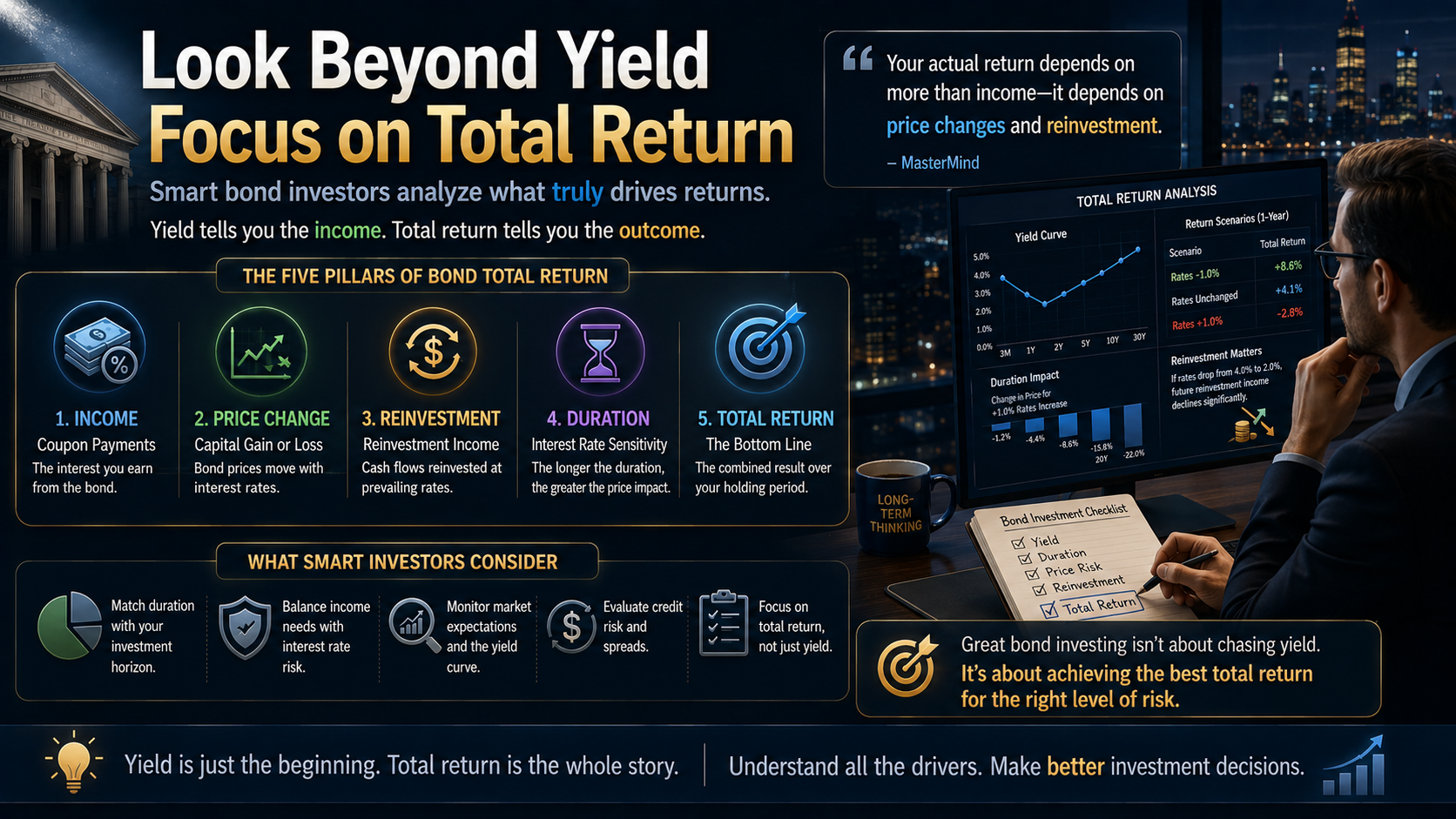
Together, these components form what investors call bond total return.
Understanding total return is especially important for U.S. investors because movements in Treasury yields influence much more than the bond market. They affect equity valuations, mortgage rates, corporate borrowing costs, the U.S. dollar, gold, and financial conditions across the global economy.
The Bottom Line
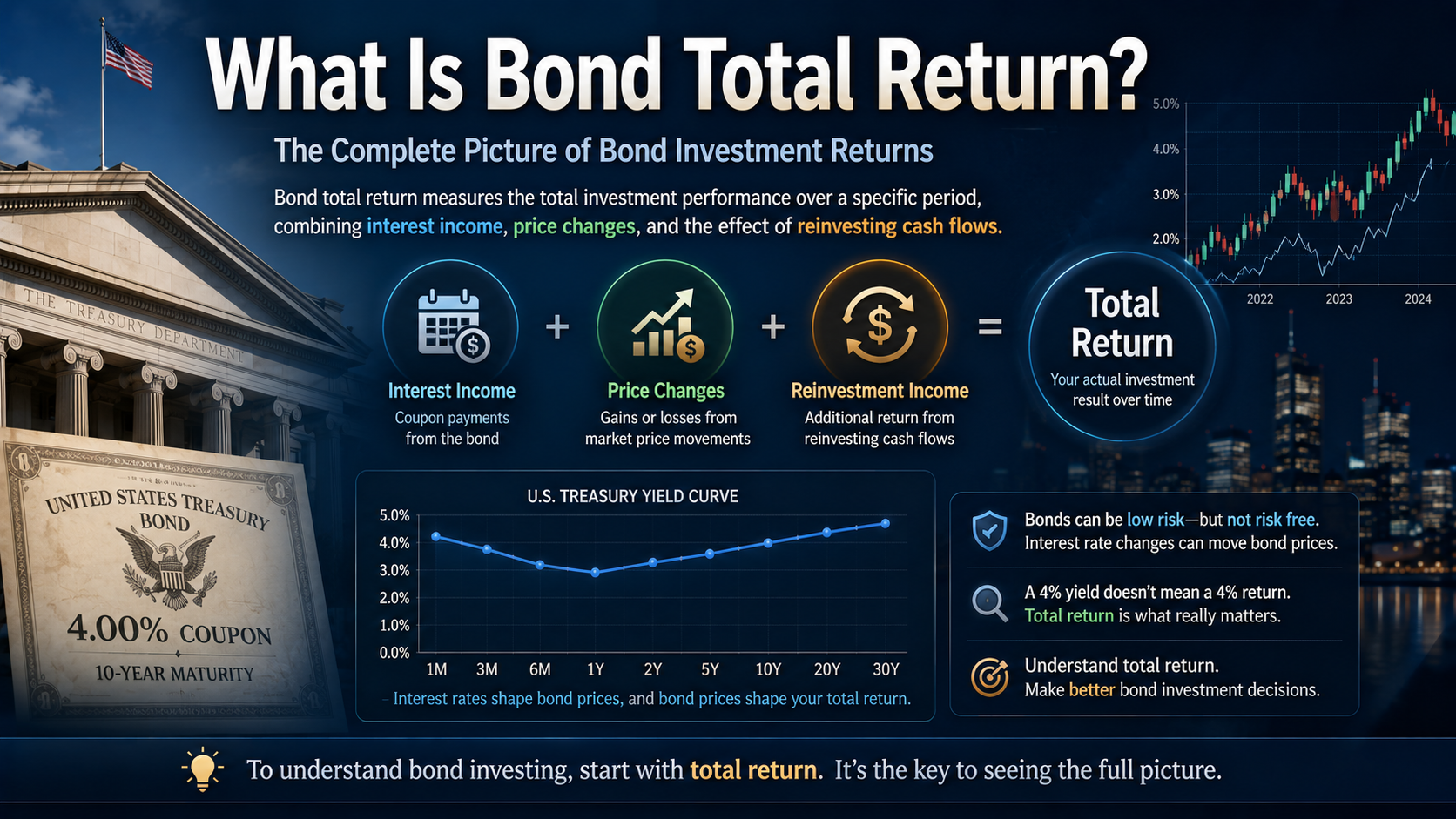
Bond total return measures the complete investment result over a specific period by combining coupon income, changes in the bond's market price, and the effect of reinvesting cash flows.
The key question is therefore not simply
"What does this bond yield?"
A better question is
"What could my total return look like over the period I actually plan to own it?"
That distinction changes the way investors should think about bonds.
What Is Bond Total Return?
Bond investors regularly encounter several different yield and return concepts.
The three most important are the coupon rate, yield to maturity, and total return.
| Measure | What It Means | Primary Use |
| Coupon Rate | Contractual interest payment relative to the bond's face value | Measuring scheduled interest payments |
| Yield to Maturity (YTM) | Annualized yield implied by the bond's current price if held to maturity under standard assumptions | Comparing bonds and expected yield |
| Total Return | Overall investment performance during a specific holding period | Measuring actual or scenario-based investment results |
Bond total return can be understood through three major components
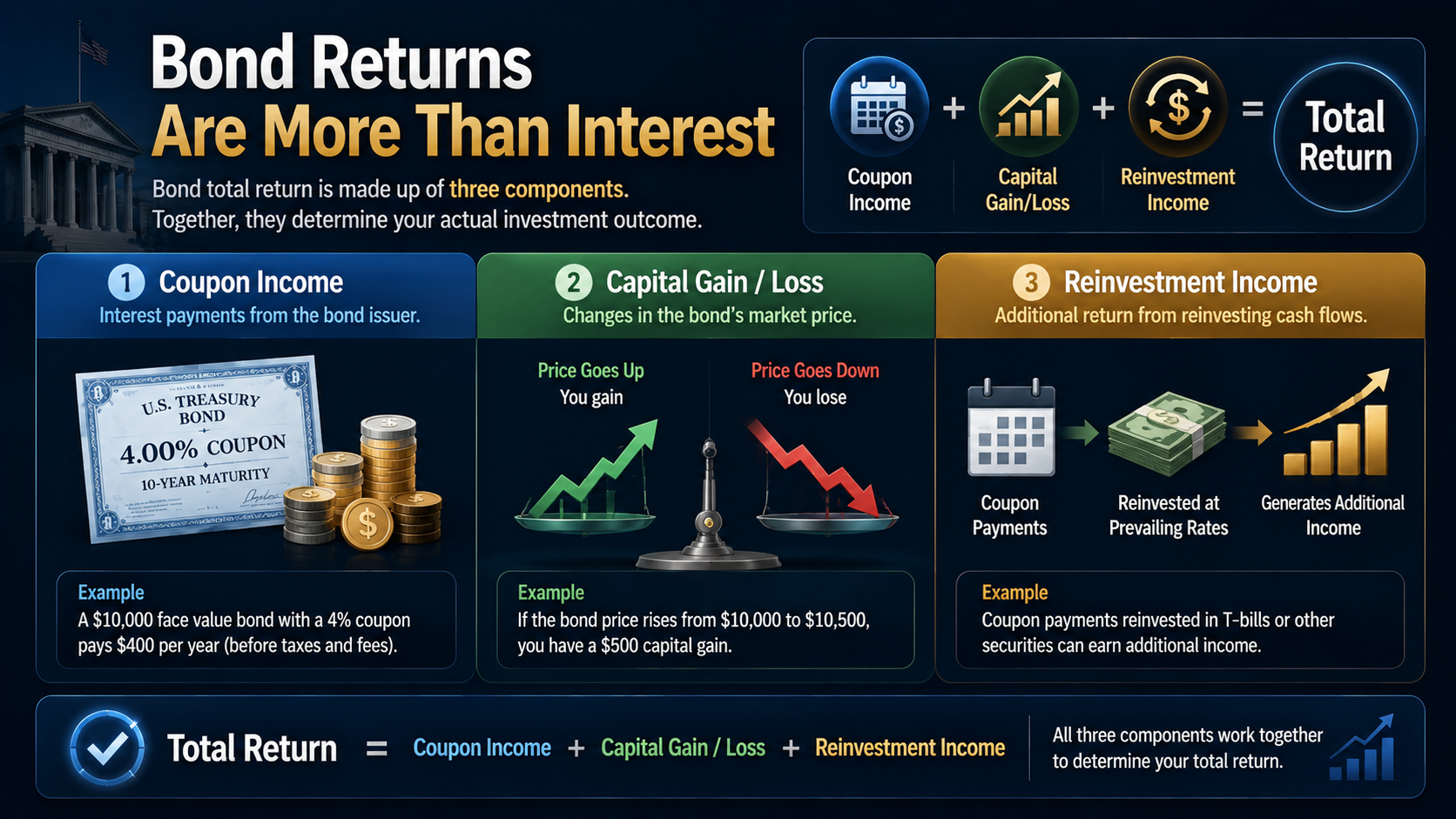
Bond Total Return = Coupon Income + Capital Gain/Loss + Reinvestment Income
1. Coupon Income
Coupon income is the interest paid by the bond issuer.
Suppose an investor owns $10,000 face value of a bond with a 4% annual coupon. Ignoring payment frequency and other details, the bond would generate approximately $400 in annual coupon income.
This is the most visible component of a bond's return.
But it is only one component.
2. Capital Gain or Loss
Bonds trade in financial markets, which means their prices change.
If an investor buys a bond and later sells it for more than the purchase price, the investor realizes a capital gain.
If the bond is sold for less, the investor realizes a capital loss.
One of the most important forces behind these price changes is the movement of market interest rates.
3. Reinvestment Income
Coupon payments create cash flows before the bond reaches maturity.
If those payments are reinvested in Treasury bills, money market instruments, other bonds, or similar assets, they can generate additional income.
The rate available when those cash flows are reinvested therefore influences the investor's realized return.
Over long investment horizons, this reinvestment effect can become increasingly important.
A Simple Bond Total Return Example
Suppose an investor purchases a bond for $10,000.
Over the next year, the bond pays $400 in coupon income.
Now assume Treasury yields decline and the market value of the bond rises to $10,500.
Ignoring reinvestment income for simplicity
- Coupon income: +$400
- Price appreciation: +$500
- Total gain: +$900
The investor's simplified total return would be approximately
$900 ÷ $10,000 = 9%
The bond's coupon rate was only 4%, but the investment generated a 9% total return because the investor also benefited from price appreciation.
Now consider the opposite scenario.
Suppose interest rates rise and the bond's market price falls to $9,300.
The result becomes
- Coupon income: +$400
- Price decline: -$700
- Total result: -$300
The simplified total return becomes approximately
-$300 ÷ $10,000 = -3%
The investor received the promised interest payments and still experienced a negative total return.
This is one of the most important principles in bond investing
A bond paying a 4% coupon does not necessarily produce a 4% investment return over your holding period.
Why Do Interest Rates Affect Bond Total Return?
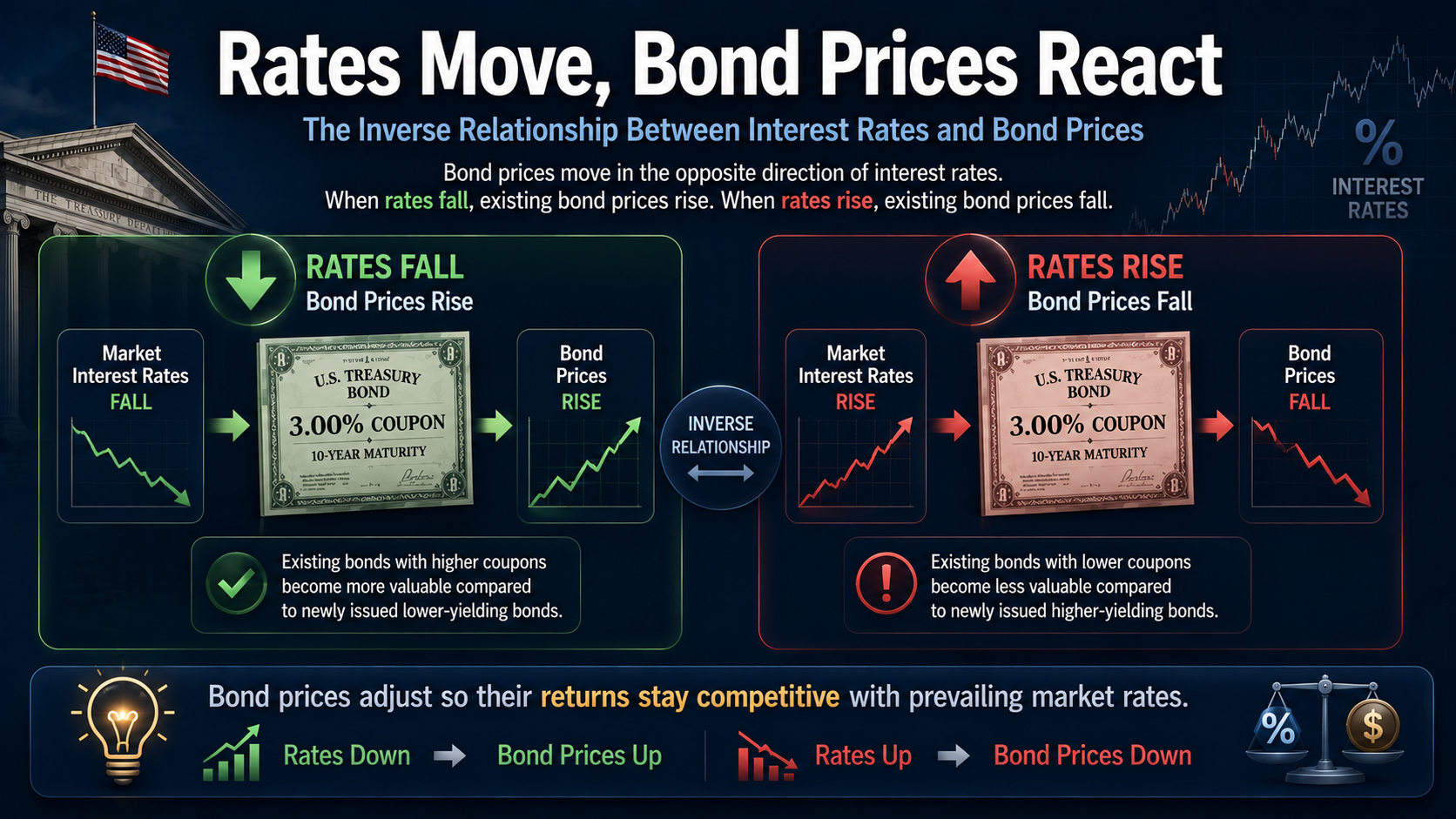
The core mechanism behind bond price movements is the inverse relationship between market yields and bond prices.
In general
Interest rates fall → Existing bond prices rise
Interest rates rise → Existing bond prices fall
Consider a simplified example.
Suppose an existing Treasury security offers a 3% coupon.
If newly issued Treasury securities with similar characteristics begin offering 5%, investors would have little reason to pay the same price for the older 3% bond.
The price of the existing bond must adjust downward until its return becomes competitive with prevailing market yields.
Now reverse the situation.
If comparable newly issued securities yield only 1%, an existing bond paying 3% becomes more attractive.
Investors may be willing to pay a higher price for it.
This repricing mechanism is fundamental to the bond market.
Falling Rates vs. Rising Rates: The Two Forces Affecting Bond Returns
Interest-rate movements create two competing effects for bond investors: the price effect and the reinvestment effect.
When Interest Rates Fall
Existing bonds generally become more valuable because their coupon payments look attractive relative to newly issued bonds.
Bond prices therefore tend to rise.
An investor can potentially receive both
Coupon income + Capital appreciation
This is why long-duration Treasury securities can sometimes generate returns significantly above their current yields during a major decline in interest rates.
But falling rates have a disadvantage.
Future coupon payments must now be reinvested at lower yields.
In other words
Falling rates generally help existing bond prices but reduce future reinvestment opportunities.
When Interest Rates Rise
Rising yields usually push existing bond prices lower.
An investor can continue collecting coupon payments while simultaneously experiencing mark-to-market losses.
If the price decline is large enough, total return can become negative.
However, rising rates also create a long-term benefit.
New cash and future coupon payments can now be invested at higher yields.
Therefore
Rising rates hurt existing bond prices but improve future reinvestment opportunities.
This tension between price risk and reinvestment risk is central to understanding long-term fixed-income performance.
Why Duration Matters for Bond Total Return
Not every bond responds to interest-rate movements in the same way.
This is where duration becomes important.
Duration has several technical definitions, but from an investment perspective it provides a useful framework for understanding how sensitive a bond's price is to changes in interest rates.
Generally
The longer the duration, the greater the bond's sensitivity to changes in yields.
This is why long-term Treasury securities can experience surprisingly large price movements.
If Treasury yields decline significantly, long-duration bonds may experience substantial capital appreciation.
But the same sensitivity works in reverse.
If inflation remains persistent and yields rise further than expected, long-duration bonds can suffer substantial mark-to-market losses.
The important lesson is
Long duration does not automatically mean higher returns. It means greater sensitivity to interest-rate changes.
Investors are accepting more interest-rate risk in exchange for greater exposure to potential changes in bond prices.
Total Return vs. Yield to Maturity
One of the most common mistakes in fixed-income investing is treating yield to maturity (YTM) and total return as interchangeable.
They are not.
| Factor | Total Return | Yield to Maturity |
| Main Purpose | Measures performance over a holding period | Estimates annualized yield if held to maturity under standard assumptions |
| Holding Period | Determined by the investor | Generally assumes holding until maturity |
| Market Price Changes | Important if the bond is sold or marked to market | Current market price is an input to the calculation |
| Reinvestment | Depends on actual future conditions | Relies on simplifying reinvestment assumptions |
| Best Used For | Performance and scenario analysis | Comparing bond yields |
A useful way to think about the difference is
YTM is a forward-looking yield framework at the time of purchase. Total return is the investment outcome over the period that matters to the investor.
For an investor purchasing an individual Treasury and holding it until maturity, YTM can be extremely useful.
For investors using bond ETFs, mutual funds, or strategies involving sales before maturity, total return becomes especially important.
Why Bond ETF Returns Can Differ From Their Yield
This distinction matters enormously for American investors because many gain their fixed-income exposure through bond ETFs rather than individual bonds.
A bond ETF continuously owns a portfolio of securities.
As bonds approach maturity or no longer satisfy the fund's index requirements, they may be replaced with other bonds.
As a result, the investor does not simply buy one bond and wait for principal to be returned on a predetermined date.
The ETF's total return can be influenced by
- Coupon income
- Changes in Treasury yields
- Portfolio duration
- Credit spreads
- Reinvestment conditions
- Portfolio turnover
- Fund expenses
This means that an ETF displaying a 4% yield does not guarantee that shareholders will earn a 4% total return over the next year.
If yields rise sharply, falling bond prices can overwhelm the income generated by the portfolio.
If yields decline substantially, price appreciation can push total return well above the portfolio's starting yield.
Why Is Bond Total Return Important?
Bonds are frequently described as safe assets.
But investors need to distinguish between credit safety and price stability.
A U.S. Treasury security may carry very little traditional default risk, but that does not mean its market price cannot fluctuate significantly.
Long-duration Treasury securities can experience substantial price changes when interest rates move rapidly.
Investors therefore need to separate two questions
"How much income does this bond generate?"
from
"What could happen to my overall investment value during my actual holding period?"
The first question focuses primarily on income.
The second focuses on total return.
And financial markets ultimately care about the second.
Interest Rates, Expectations, and the Bond Market
Another important principle is that bond markets are forward-looking.
Treasury yields do not simply wait for the Federal Reserve to change the federal funds rate.
Investors continuously price expectations about
- Inflation
- Economic growth
- Federal Reserve policy
- Future short-term interest rates
- Treasury supply
- Risk appetite
As a result, long-term Treasury yields may decline before the Federal Reserve begins cutting rates.
Likewise, yields may rise even while the Fed is cutting if investors become concerned about inflation, fiscal conditions, or stronger-than-expected economic growth.
This leads to an important market insight
Bond investors should not focus only on what the Federal Reserve is doing today. They need to understand what the bond market already expects the Fed and the economy to do tomorrow.
Expectations can already be embedded in bond prices long before the actual policy decision arrives.
How Bond Returns Affect Stocks, the Dollar, Gold, and Bitcoin
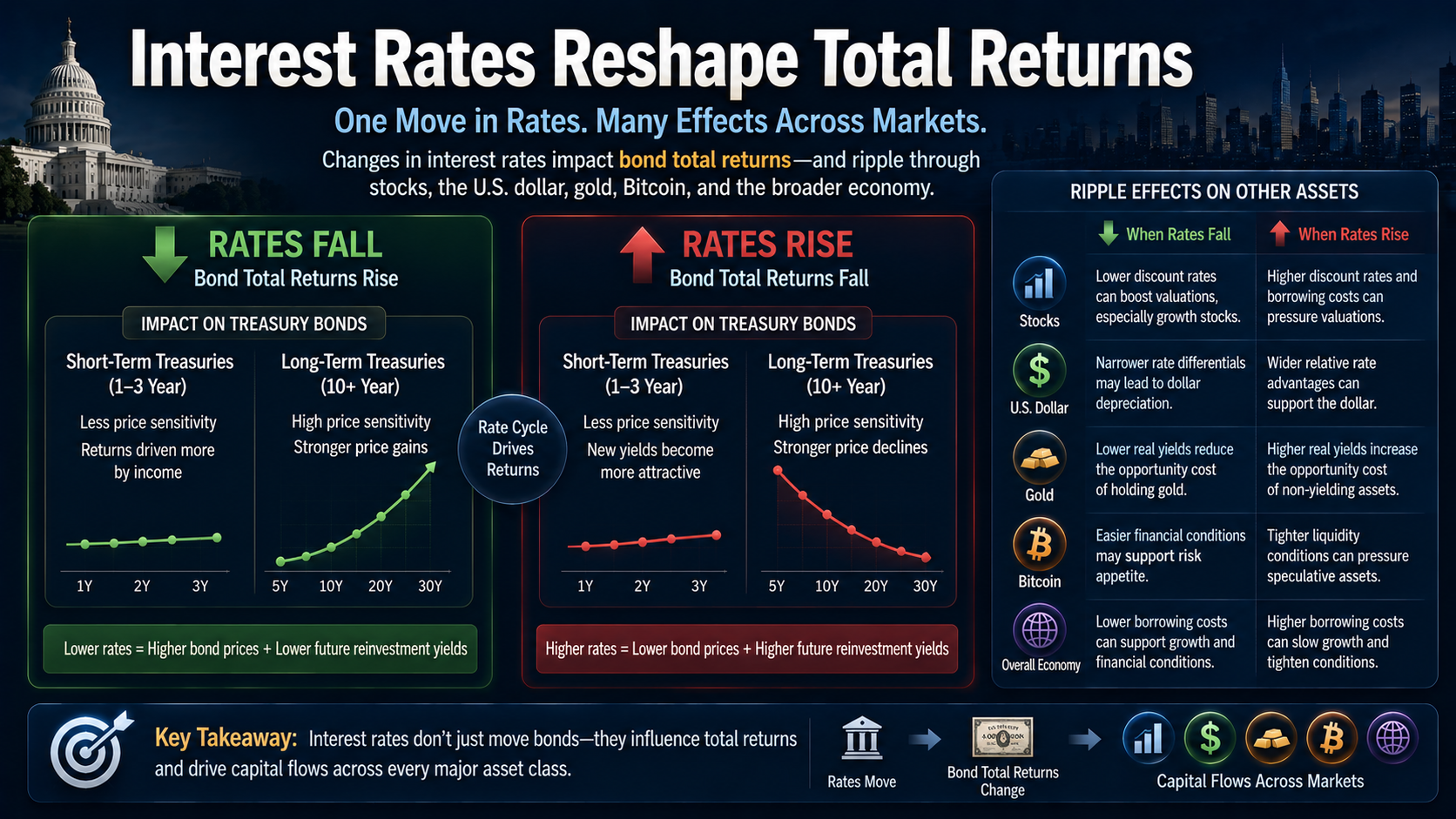
The U.S. Treasury market sits near the center of the global financial system.
Changes in Treasury yields therefore influence the relative attractiveness of many other assets.
| Asset | Falling-Rate Environment | Rising-Rate Environment |
| U.S. Treasuries | Existing bond prices may rise, especially at longer durations | Existing bond prices face downward pressure while new yields become more attractive |
| U.S. Stocks | Lower discount rates can support valuations, particularly for growth stocks | Higher discount rates and borrowing costs can pressure valuations |
| U.S. Dollar | Narrower rate differentials may create depreciation pressure | Wider relative rate advantages can support the dollar |
| Gold | Lower real yields can reduce the opportunity cost of holding gold | Higher real yields can increase the opportunity cost of non-yielding assets |
| Bitcoin | Easier financial conditions may support risk appetite | Tighter liquidity conditions can pressure speculative assets |
These relationships are not mechanical.
The reason interest rates are changing matters enormously.
For example, falling Treasury yields caused by declining inflation and a soft economic landing may support equities.
Falling yields caused by a severe recession may produce a completely different stock-market response.
Likewise, rising yields caused by stronger economic growth may affect markets differently from rising yields caused by renewed inflation fears.
Investors should therefore ask not only where rates are going, but why they are moving.
Credit Spreads Matter Too
Treasury yields are not the only force affecting bond returns.
Corporate bonds introduce another important variable: credit spreads.
A credit spread represents the additional yield investors demand for holding a corporate bond instead of a comparable Treasury security.
During periods of economic stress, investors may demand greater compensation for default risk.
Credit spreads can therefore widen.
This creates an important scenario.
Suppose Treasury yields decline because investors fear a recession.
Government bond prices may rise.
But lower-quality corporate bonds may not experience the same benefit because widening credit spreads can offset the decline in Treasury yields.
This is why investors analyzing corporate bond total returns must consider both
Interest-rate risk + Credit risk
A falling federal funds rate does not automatically mean every part of the bond market will perform well.
What Bond Investors Should Watch
1. Don't Judge a Bond Only by Its Coupon
Coupon income represents only one component of total return.
A high coupon does not eliminate interest-rate risk or credit risk.
2. Match Duration With Your Investment Horizon
Investors with short liquidity needs should understand the risks of taking excessive duration exposure.
A bond can be fundamentally sound and still experience significant price declines before the investor needs to sell it.
3. Distinguish Holding to Maturity From Trading
An investor buying an individual Treasury and holding it to maturity has a different experience from someone trading a long-duration Treasury ETF.
The investment vehicle matters.
4. Watch Market Expectations, Not Just Fed Decisions
If investors already expect substantial Federal Reserve rate cuts, bond prices may have adjusted before those cuts occur.
The market reaction depends partly on the gap between expectations and reality.
5. Watch Credit Spreads
For corporate bonds, Treasury yields tell only part of the story.
A deteriorating economy can cause credit spreads to widen and weaken corporate bond performance even while government yields decline.
6. Consider Inflation
Nominal returns do not necessarily represent increases in purchasing power.
If a bond portfolio earns 4% while inflation runs at 3%, the investor's real gain in purchasing power is much smaller than the headline return suggests.
If Interest Rates Have Peaked, Are Long-Term Treasuries Automatically Attractive?
One popular bond strategy is to increase duration when investors believe the interest-rate cycle is approaching a peak.
The logic makes sense.
If yields subsequently decline, long-duration Treasury securities can potentially generate meaningful capital gains in addition to coupon income.
But there are several risks.
Inflation could remain higher than expected.
The Federal Reserve could keep policy restrictive for longer.
Economic growth could remain surprisingly strong.
Long-term Treasury yields could also remain elevated because of factors that are not directly controlled by the federal funds rate.
Most importantly, markets may have already priced in much of the expected rate decline.
Therefore
"The Fed will eventually cut rates" is not, by itself, a complete long-term Treasury investment thesis.
Investors must consider the yield curve, market expectations, duration exposure, inflation risk, and their own investment horizon.
What Do Wealthy Investors Look for in This Environment?
Wealthy investors and institutional portfolio managers generally do not look at bonds and ask only
"What yield can I get today?"
They are more likely to think about capital flows, cash flow, portfolio resilience, and long-term purchasing power.
Capital Flows
When short-term rates are high, Treasury bills, money market funds, and other cash-like instruments can offer attractive income with limited duration exposure.
If markets begin anticipating a sustained decline in rates, some capital may gradually move farther out on the yield curve to lock in yields and gain exposure to potential price appreciation.
Understanding where capital is moving can sometimes reveal more than simply watching the latest Federal Reserve decision.
Cash Flow
One of the fundamental strengths of fixed income is its ability to generate relatively predictable cash flows.
For large portfolios, maximizing price appreciation on every dollar is not always necessary.
Bonds can provide income that helps investors tolerate volatility elsewhere in the portfolio.
Portfolio Survival
Higher expected returns almost always come with additional risk.
Long-duration Treasuries carry substantial interest-rate sensitivity.
Corporate bonds add credit risk.
High-yield bonds can become particularly vulnerable during recessions and periods of declining market liquidity.
The important question is therefore not simply
"Which bond has the highest yield?"
It is
"What risk am I being paid to accept?"
Long-Term Purchasing Power
Ultimately, investors care about what their money can buy.
That means nominal total return should also be considered alongside inflation.
A portfolio that produces positive nominal returns but consistently fails to preserve purchasing power may not be achieving its long-term objective.
Investors can ask themselves several questions
- Am I buying bonds primarily for income or potential capital appreciation?
- Can I hold these securities through a period of rising yields?
- Does the duration of my bond exposure match my investment horizon?
- If I own corporate bonds, how much credit risk am I accepting?
- What rate cuts or economic outcomes are already priced into the market?
- Is my return keeping pace with inflation?
- Would my portfolio remain viable if my interest-rate forecast is wrong?
These questions move the discussion away from predicting the next Federal Reserve meeting and toward building a portfolio capable of surviving multiple economic environments.
Conclusion
Bond total return is much broader than the interest payment printed on a bond certificate.
It combines coupon income, capital gains or losses caused by market price changes, and the effect of reinvesting cash flows.
That is why investors should not evaluate bonds using the coupon rate or yield to maturity alone.
They should also consider duration, investment horizon, interest-rate expectations, credit spreads, inflation, and the structure of the investment vehicle they own.
This is particularly important for bond ETF investors, because an ETF does not behave exactly like an individual bond held to maturity.
The central lesson is simple
The true return on a bond investment is not just the interest you receive. It is what you earn or lose after income, price changes, and reinvestment are considered together.
Interest rates are the price of money. When that price changes, bond valuations change, borrowing costs change, and capital begins moving between Treasuries, stocks, cash, the dollar, gold, and other assets.
Understanding bond total return is therefore about more than understanding bonds.
It is one of the foundations for understanding how interest rates transmit through financial markets and influence the global flow of capital.
And in investing, the objective is not to perfectly predict the next move in interest rates. It is to build a structure that can survive when the forecast turns out to be wrong.
This was MasterMind.
'[Global] Success Blueprints' 카테고리의 다른 글