What Is Recency Bias? Why Investors Think Rising Stocks Will Keep Going Up.


Hello, this is MasterMind.
Have you ever watched a stock rally for months and suddenly felt that staying on the sidelines was becoming more dangerous than buying it?
Maybe a technology stock keeps hitting record highs. Bitcoin surges. An AI-related company doubles within a relatively short period. Financial media becomes increasingly bullish, social media fills with screenshots of impressive returns, and analysts begin raising their price targets.
Eventually, a simple thought becomes difficult to ignore:
"What if it just keeps going up?"
The opposite happens during market declines.
After several months of falling stock prices, recession fears, disappointing earnings, or tightening financial conditions, investors can begin to feel as though the weakness will continue indefinitely.
The underlying businesses may not have changed nearly as dramatically as their stock prices, yet investors' expectations about the future can change almost overnight.
Behavioral finance describes one important reason for this phenomenon as recency bias.
Recency bias affects far more than individual stock selection. It can influence how investors perceive risk, chase momentum, react to market crashes, and move capital between asset classes.
Understanding it is therefore essential for anyone trying to separate market price from underlying value.

Key Takeaway
Recency bias is the tendency to give disproportionate importance to recent events and assume that current market trends will continue into the future. In investing, it can cause investors to become overly confident after rallies and excessively pessimistic after declines.
What Is Recency Bias?
Recency bias is a cognitive tendency in which people place greater weight on information and experiences that occurred recently than on older information or long-term evidence.
In financial markets, this can significantly distort expectations.
Imagine an asset that produced mediocre returns for many years but suddenly rose dramatically over several months.
An investor looking at that chart may mentally assign far more importance to the recent rally than to the previous decade.
The question gradually changes from:
"What is this asset actually worth?"
to:
"How much higher can it go?"
The same psychological mechanism works in reverse.
A fundamentally strong company may experience several months of declining stock prices. Even if its competitive position and long-term cash-generating ability remain largely intact, investors may begin treating the recent decline as evidence that the company's future has permanently deteriorated.
This is the central problem created by recency bias:
Investors can mistake the most recent chapter of the market for the entire story.
Why Does Recency Bias Happen?
The human brain cannot process every available piece of information with equal precision.
Instead, it relies on mental shortcuts, commonly called heuristics, to make complicated decisions more efficiently.
Recent information is particularly powerful because it is easier to remember.
Emotionally intense events are even more influential.
A sharp rally, a portfolio loss, a market crash, or an unexpected windfall can remain vivid in an investor's memory and influence future decisions long after the event itself.
Why Recent Gains Feel Like Future Gains
Imagine watching the same stock rise repeatedly:
Rally → new high → another rally → another new high
Eventually, the sequence begins to look predictable.
An investor who initially bought because of earnings growth, free cash flow, or competitive advantages may gradually begin using the stock price itself as evidence supporting the investment thesis.
But prices can rise for many reasons.
Fundamentals may genuinely be improving.
Alternatively, falling interest-rate expectations, abundant liquidity, expanding valuation multiples, leverage, momentum strategies, or concentrated investor enthusiasm may be contributing to the rally.
Recency bias makes it easier to ignore these distinctions.
The recent direction of the price becomes a substitute for deeper analysis.
Recent Experience Can Overpower Long-Term History
Investors generally understand that bear markets, recessions, corrections, and periods of volatility are normal features of financial markets.
But after several years of rising prices, those risks can begin to feel increasingly theoretical.
The risks have not necessarily disappeared.
The investor's perception of them has changed.
The opposite can occur after a severe bear market.
After experiencing large losses, investors may continue treating equities as unusually dangerous even as valuations decline, monetary conditions change, or economic fundamentals begin recovering.
This leads to one of the most important lessons of recency bias:
Markets attempt to price the future, while human psychology often extrapolates the recent past.
How Recency Bias Works in Financial Markets
Recency bias rarely operates alone.
It often interacts with market prices, financial media, social proof, and capital flows.
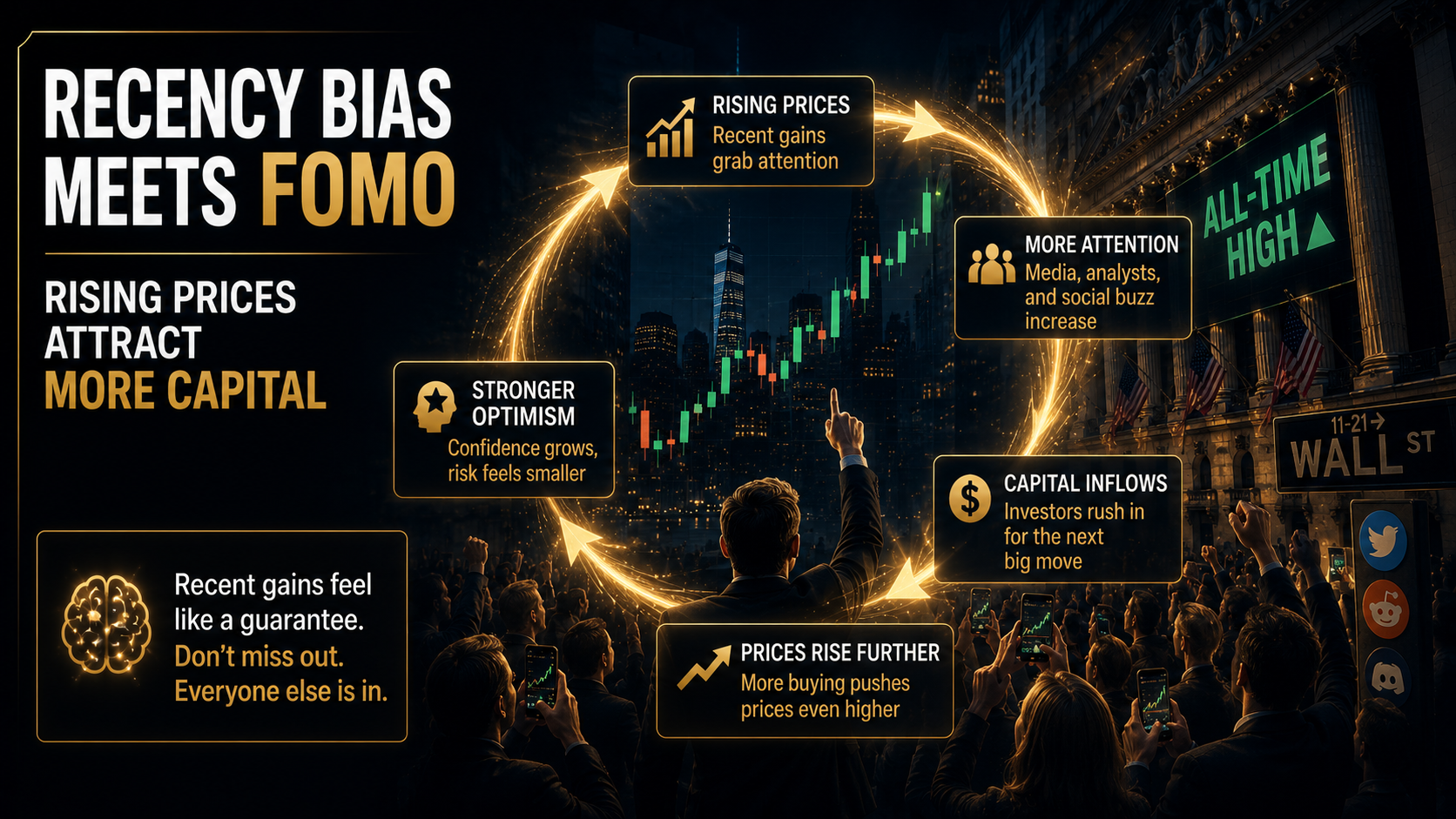
A typical cycle may look like this:
Asset prices rise
↓
Media coverage increases
↓
Successful investors receive more attention
↓
Recent gains become psychologically dominant
↓
Expectations for future returns rise
↓
More capital enters the trade
↓
Prices rise further
At first, the rally may have strong fundamental justification.
But as the cycle continues, something important can change.
The rising price itself begins attracting additional buyers.
That creates a potential feedback loop in which price increases generate optimism, optimism generates capital inflows, and those inflows contribute to additional price increases.

Recency Bias and FOMO
Recency bias becomes particularly powerful when combined with FOMO — the fear of missing out.
Recency bias tells investors:
"The market has been going up, so it will probably keep going up."
FOMO adds another thought:
"If I don't buy now, everyone else will make money except me."
This combination can be extremely powerful during speculative phases of a bull market.
Rising prices attract media attention.
Social media begins highlighting large gains.
Analysts become more optimistic.
Friends, coworkers, and online communities begin discussing the same investments.
The psychological cycle can become:
Recent gains → optimism → FOMO → capital inflows → higher prices → stronger optimism
This does not mean every powerful rally is a bubble.
Some rallies reflect genuine structural changes in earnings, productivity, technology, or economic conditions.
The important question is whether fundamentals are improving quickly enough to support the expectations embedded in the price.
Why Recency Bias Matters for Investors
The biggest danger of recency bias is not simply buying something after it rises.
The deeper problem is that it can change an investor's perception of risk.
During prolonged bull markets, rising prices often make investors feel safer.
But price and risk do not always move in the same direction.
Suppose a company's earnings rise 20% while its stock price rises 100%.
The business may genuinely be improving, but investors are now paying a much higher price for those earnings.
The margin of safety may therefore be smaller than it was before the rally.
The reverse can happen during market declines.
A falling stock price may make an investment feel more dangerous.
Sometimes that perception is justified because the company's fundamentals have deteriorated.
But if cash flow, balance-sheet strength, and competitive advantages remain intact while valuation falls substantially, the relationship between price and potential long-term return may have improved.
The key question is therefore not simply:
"Is the stock going up or down?"
A better question is:
"What future expectations are already reflected in today's price?"
Why Recency Bias Can Become Dangerous Late in a Bull Market
Recency bias can become especially influential after a long period of strong market performance.
Early in a bull market, investors often remain skeptical.
The previous bear market is still fresh in their memories.
They question whether the recovery is sustainable.
As prices continue rising, however, attitudes gradually change.
"This rally probably won't last."
can become:
"I'll buy the next dip."
And eventually:
"This market always comes back."
The longer favorable conditions persist, the easier it becomes to treat them as permanent.
Valuations that once looked expensive can begin to appear normal because investors develop new narratives to justify them.
This is where an important distinction becomes essential:
A great company is not automatically a great investment at every price.
Even an exceptional business can produce disappointing returns when investors have already priced extremely optimistic assumptions into the stock.
Markets do not respond only to whether news is good or bad.
They respond to the difference between expectations and reality.
A company can report excellent earnings and still fall if investors expected even more.
A struggling company can rally if the results are simply less bad than feared.
That is why understanding expectations is often as important as understanding fundamentals.
Recency Bias and the Market Cycle
Recency bias also helps explain how investor psychology evolves throughout market cycles.
A simplified emotional cycle might look like this:
Disbelief → optimism → confidence → excessive optimism → correction → anxiety → pessimism → recovery
Markets do not follow this sequence perfectly, and no psychological model can reliably predict exact market tops or bottoms.
Still, the pattern illustrates an important tendency.
As markets rise, recent positive experiences can gradually reduce perceived risk.
As markets fall, recent negative experiences can increase perceived risk.
This creates an interesting paradox.
Investors may feel safest after prices have already risen significantly and most frightened after prices have already fallen significantly.
Yet valuation risk can sometimes move in the opposite direction.
The higher the price relative to underlying fundamentals, the smaller the potential margin of safety may become.
The lower the price relative to durable cash flows and business value, the more attractive the risk-reward relationship may become.
Again, this does not mean investors should automatically buy falling assets.
Some companies decline because their businesses are genuinely deteriorating.
The lesson is simpler:
Price direction and fundamental risk are not the same thing.
How Recency Bias Affects Different Asset Classes
Recency bias is not limited to stocks.
It can influence expectations across virtually every major financial market.
| Asset Class | During Strong Markets | During Weak Markets |
| U.S. Stocks | Investors may extrapolate recent earnings growth and multiple expansion indefinitely | Strong businesses may be treated as permanently impaired because their stock prices recently declined |
| Treasuries | Falling yields may encourage investors to assume the bond rally will continue | Rising yields may cause investors to extrapolate higher rates indefinitely |
| U.S. Dollar | Dollar strength or weakness may be treated as a permanent macro trend | Short-term FX moves can be mistaken for structural economic changes |
| Gold & Commodities | Recent price increases may be interpreted as evidence of permanent inflation or scarcity | Corrections can cause investors to overlook longer-term supply, demand, or hedging dynamics |
| Bitcoin & Crypto | Rapid rallies can cause investors to underestimate historical volatility and downside risk | Severe declines can cause investors to dismiss the possibility of longer-term technological or market development |
The lesson is not that every trend must reverse.
Some trends persist for years because the underlying economic environment has genuinely changed.
The purpose of recognizing recency bias is therefore not to become a permanent contrarian.
It is to avoid assuming that recent price action alone proves what will happen next.
Recency Bias and Mean Reversion
Recency bias is often discussed alongside mean reversion.
Mean reversion describes the tendency of certain financial or economic variables to move back toward longer-term norms after reaching unusually high or low levels.
But investors should be careful with this concept.
Mean reversion does not mean:
"Everything that goes up must come down."
Nor does it mean:
"Every falling stock will eventually recover."
Companies can fail.
Industries can disappear.
Profit margins can structurally change.
Interest-rate regimes can shift.
Technological breakthroughs can permanently change the economics of an industry.
The relevant question is not whether every price must return to an old historical average.
It is whether recent price changes reflect a genuine structural improvement in fundamentals or whether expectations, liquidity, and investor positioning have moved much faster than the underlying economics.
Recency Bias and the Flow of Money
One of the most useful ways to understand recency bias is through capital flows.
Assets with strong recent performance naturally attract attention.
Attention attracts capital.
Capital inflows can push prices higher.
Higher prices generate more attention.
The cycle becomes:
Price appreciation → attention → capital inflows → further appreciation → more attention
This dynamic can help explain why certain sectors suddenly dominate financial markets.
Technology stocks, artificial intelligence, clean energy, commodities, small caps, cryptocurrencies, or defensive assets can all become the destination of concentrated capital during different phases of the market cycle.
But capital flows are not permanent.
Eventually, investors begin comparing expected returns across opportunities.
If valuations become extremely demanding while another asset class becomes relatively attractive, capital can begin rotating elsewhere.
This is why investors should ask more than:
"What is going up?"
They should also ask:
"Why is money moving here, and what economic mechanism would allow that flow to continue?"
Price and Value Are Not the Same Thing

One of the best defenses against recency bias is learning to separate price from value.
A rising stock price does not automatically mean the underlying business became proportionally more valuable.
A falling stock price does not automatically mean the business became proportionally worse.
Investors should distinguish between several variables:
- Stock price
- Revenue growth
- Earnings growth
- Free cash flow
- Balance-sheet strength
- Valuation multiples
- Market expectations
- Interest rates and liquidity
- Investor positioning and capital flows
Market price reflects the interaction of all these forces.
It is not the same thing as intrinsic value.
If a stock rises 50%, the most useful question may not be:
"Can it rise another 50%?"
Instead, ask:
"What changed in the company's future cash-flow potential to justify the new valuation?"
That question immediately shifts the analysis away from recent price action and toward economic reality.
What Investors Should Watch
Recency bias cannot be completely eliminated.
It is part of normal human cognition.
A more realistic goal is to build an investment process that reduces its influence.
Separate Recent Returns From the Investment Thesis
Ask yourself why you want to own an asset.
If the first answer is:
"Because it keeps going up,"
more analysis may be necessary.
Momentum itself can contain useful information, but it should not automatically replace analysis of earnings, cash flows, valuation, and risk.
Expand the Time Horizon
A one-month chart can tell a very different story from a five-year or ten-year chart.
Looking across multiple time horizons can provide context that recent price action alone cannot.
Compare Price With Fundamentals
If a stock price is rising rapidly, determine whether earnings and free cash flow are improving at a similar pace.
When prices rise much faster than fundamentals, valuation expansion may be doing much of the work.
That does not guarantee an imminent decline.
It simply means future returns may increasingly depend on investors accepting even higher expectations.
Build the Opposite Scenario
When analyzing a recent winner, ask:
"What could realistically cause this trend to end?"
When analyzing a deeply unpopular asset, ask:
"What could turn out better than the market currently expects?"
The purpose is not to predict the future perfectly.
It is to prevent one recent narrative from becoming the only scenario considered.
Why Systems Matter More Than Emotions
Simply knowing that recency bias exists does not make investors immune to it.
Market psychology becomes most powerful precisely when prices are moving quickly.
This is why disciplined investors often rely on predetermined rules.
Those rules may involve portfolio allocation limits, diversification, valuation frameworks, rebalancing policies, or clearly defined conditions that would invalidate an investment thesis.
The purpose of a system is not to eliminate losses or predict every market turn.
It is to prevent emotions created by extreme market conditions from completely rewriting the investment process.
What Do Wealthy Investors Look for in This Environment?
Investors managing substantial long-term capital often have a different problem from traders seeking the next short-term winner.
Their primary concern is not simply maximizing upside.
It is preserving capital while allowing it to compound over long periods.
That changes what matters.
Follow the Money
When enormous amounts of capital enter a sector, sophisticated investors want to understand why.
Is the capital responding to genuine improvements in productivity and earnings?
Is falling interest-rate pressure supporting valuations?
Is leverage increasing?
Or is money entering primarily because recent returns have been unusually strong?
Capital flows can reinforce trends, but they can also reverse.
Understanding why money is moving is often more useful than simply observing that prices are rising.
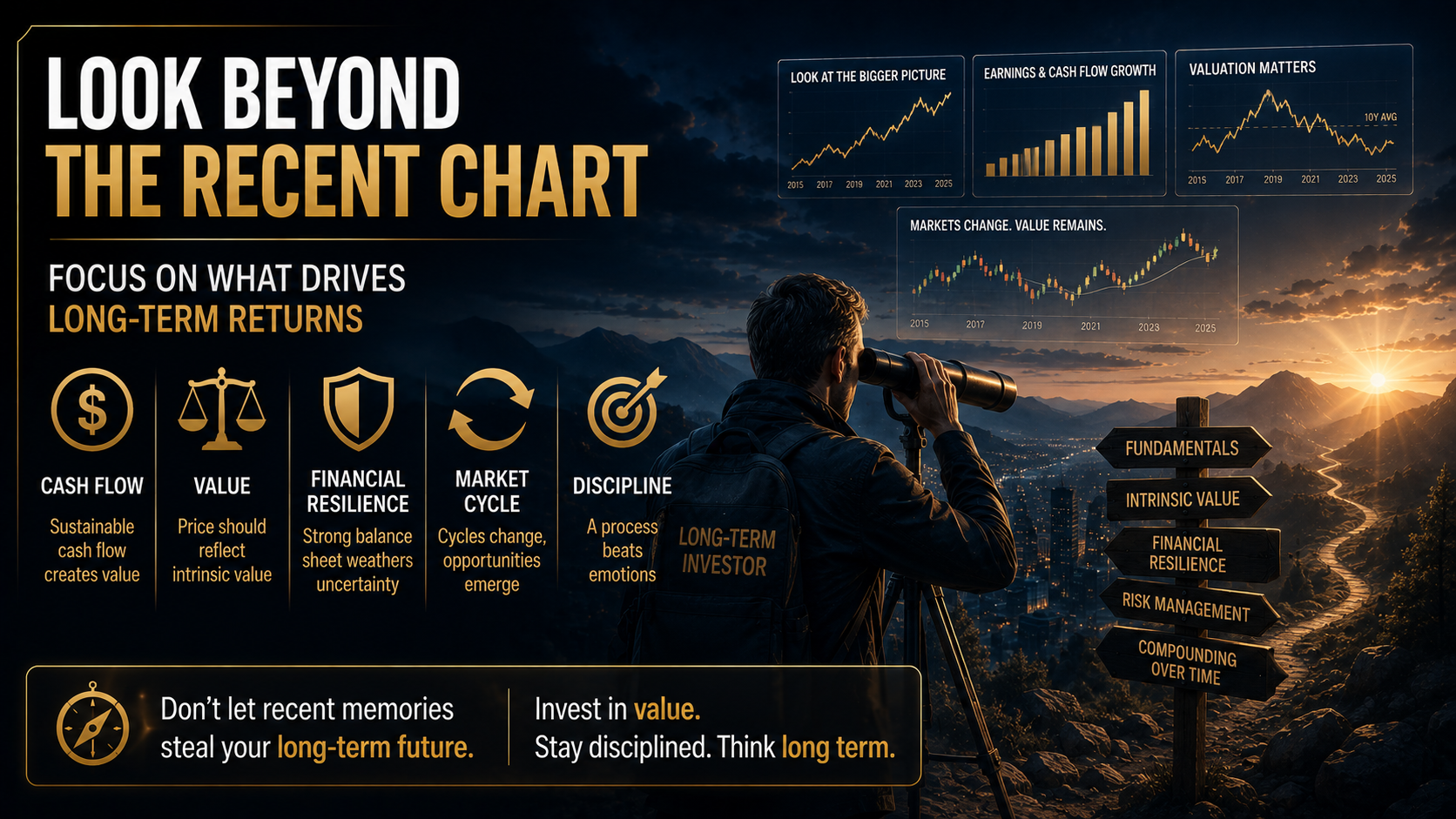
Focus on Cash Flow
Ultimately, financial assets need some economic mechanism supporting their value.
For businesses, that usually means the ability to generate sustainable cash flow.
During euphoric markets, investors can become increasingly focused on potential capital gains.
Long-term investors tend to ask a different question:
What cash-generating ability ultimately supports this valuation?
Evaluate Survival
Bull markets can make almost every business model look stronger.
Tighter financial conditions reveal the differences.
Companies with excessive debt, weak cash generation, or fragile competitive positions can struggle when liquidity disappears.
Long-term investors therefore ask:
Can this asset survive if the environment becomes significantly worse than expected?
Survival matters because compounding only works if capital remains available to participate in the next cycle.
Maintain a Long-Term Perspective
Three-month charts show market sentiment.
Five- and ten-year periods reveal much more about business economics and market cycles.
Investors can therefore ask themselves:
Do I like this asset because the underlying economics improved, or because the price recently went up?
Would my investment thesis still make sense if the recent trend disappeared tomorrow?
If the price fell sharply, would the original thesis remain intact, or would the decline reflect genuine deterioration in fundamentals?
Is today's valuation supported by current cash flows, or primarily by expectations about the distant future?
These questions do not eliminate uncertainty.
They help separate analysis from emotion.
How to Reduce Recency Bias in Investing
There are several practical ways to reduce the influence of recency bias.
First, try explaining your investment thesis without mentioning recent price performance.
Second, examine several years of revenue, earnings, cash flow, and valuation data instead of focusing only on the latest quarter or chart.
Third, deliberately construct a scenario in which your current view is wrong.
Fourth, when an asset moves sharply, investigate what changed before changing your long-term thesis.
Finally, consider keeping an investment journal.
Write down why you believe an asset is attractive before major price movements occur.
Then revisit those notes later.
If your reasoning becomes dramatically more optimistic after prices rise—or dramatically more pessimistic after they fall—you may discover that the market price has been influencing your narrative more than the underlying fundamentals.
The Deeper Market Lesson Behind Recency Bias
One of the hardest parts of investing is not a lack of information.
It is the way investors interpret the same information differently depending on recent market performance.
After prices rise, ambiguous information tends to look more positive.
After prices fall, the same uncertainty can suddenly look dangerous.
Recency bias helps explain why.
Long bull markets can make risk feel invisible.
Long bear markets can make opportunity feel impossible.
But financial markets are forward-looking mechanisms.
The critical task is therefore not to automatically follow a trend or automatically bet against it.
It is to understand what expectations are embedded in today's price and whether future earnings and cash flows can realistically meet those expectations.
Final Thoughts
Recency bias is one of the most important psychological forces affecting investment decisions.
It causes investors to place disproportionate weight on recent events and extrapolate current trends into the future.
During bull markets, it can transform recent gains into excessive confidence.
During bear markets, it can transform recent losses into excessive pessimism.
Combined with FOMO, recency bias can also contribute to powerful feedback loops in which rising prices attract capital, capital pushes prices higher, and higher prices create even stronger expectations.
But recent performance is not the same thing as future value.
When prices rise dramatically, investors should ask what changed in earnings, cash flows, competitive advantages, liquidity, and expectations.
When prices fall dramatically, investors should determine whether the underlying asset has genuinely deteriorated or whether sentiment and valuation have changed more than fundamentals.
The most important lesson is simple:
The most recent chart may be the easiest information to remember, but that does not make it the best guide to the future.
Markets change.
Expectations change.
Liquidity moves.
Capital rotates.
Today's market leader will not necessarily remain the leader forever, and today's unpopular asset will not necessarily remain unpopular forever.
Long-term investing therefore requires the ability to separate price from value, expectations from reality, and recent momentum from sustainable cash flow.
Because successful investing is not ultimately about predicting every market move.
It is about building a process capable of surviving when your predictions are wrong.
This was MasterMind.
'[Global] Success Blueprints' 카테고리의 다른 글