What Is CPO (Co-Packaged Optics)? How It Solves Power and Data Bottlenecks in AI Data Centers


Hello, this is MasterMind.
The AI race is usually framed around one question: Who can build the fastest GPU?
But as AI clusters scale from thousands to tens of thousands of accelerators, another constraint is becoming increasingly important.
Moving the data.
A powerful GPU is only as useful as the infrastructure that can continuously feed it data and connect it with thousands of other accelerators.
That means the next phase of AI infrastructure may not be determined by compute performance alone. Network bandwidth, power consumption, memory, interconnects, cooling, and data movement are becoming critical parts of the equation.
This is where CPO, or Co-Packaged Optics, enters the picture.
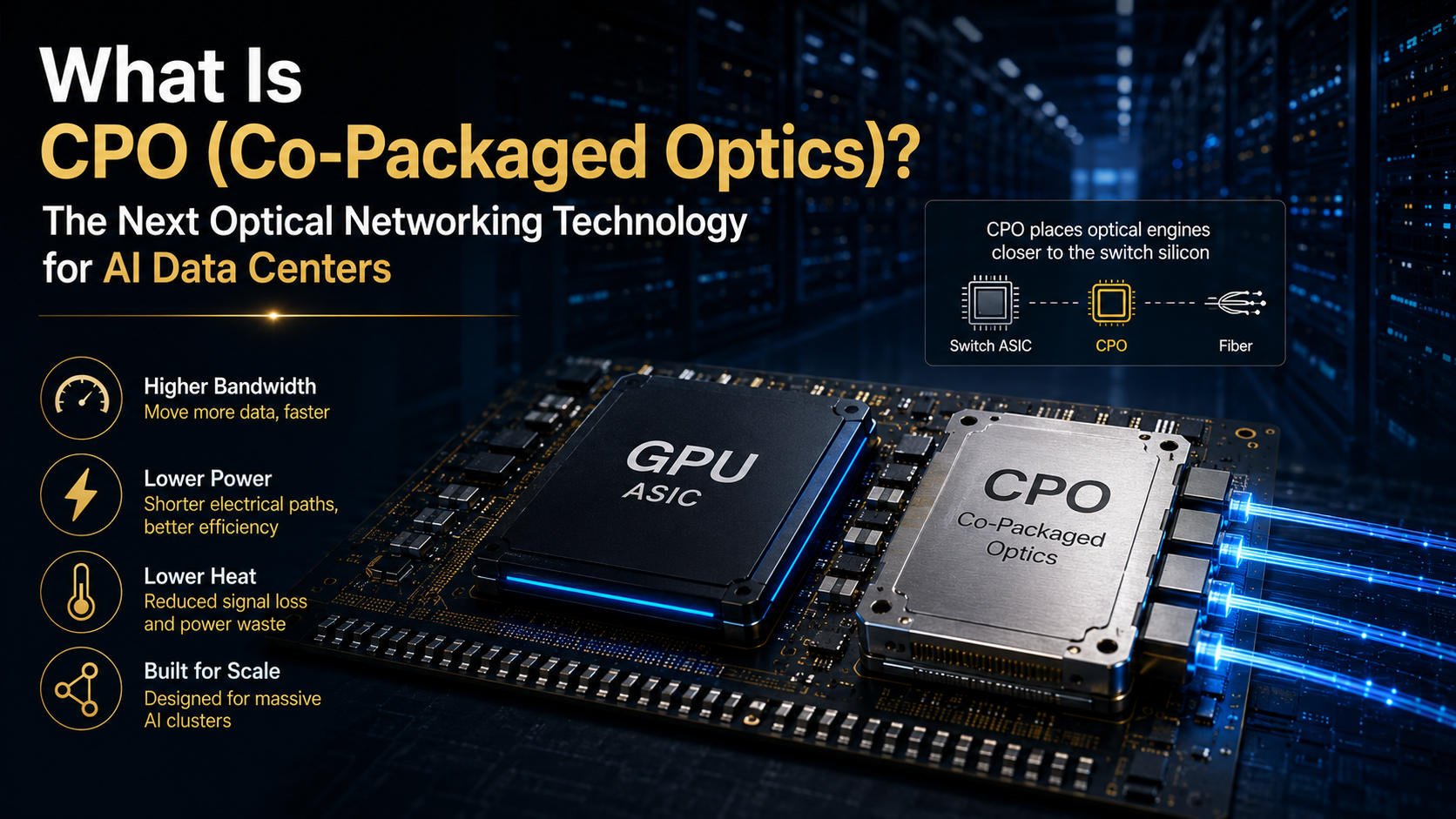
CPO represents a fundamental shift in data center architecture: bringing optical communication much closer to the chips responsible for processing and switching enormous volumes of data.
For investors, understanding CPO is not simply about identifying another semiconductor technology.
It is about understanding where the next bottleneck in AI infrastructure could emerge—and where capital may move when that bottleneck becomes economically important.
The Bottom Line
Co-Packaged Optics (CPO) integrates optical engines much closer to high-performance switch ASICs and other semiconductor components, shortening electrical signal paths and potentially improving bandwidth density and power efficiency in next-generation AI data centers.
In simple terms
Keep electrical connections short. Move data into light sooner.
That is the fundamental idea behind CPO.
What Is CPO (Co-Packaged Optics)?
Traditional data center networking relies heavily on pluggable optical transceivers.
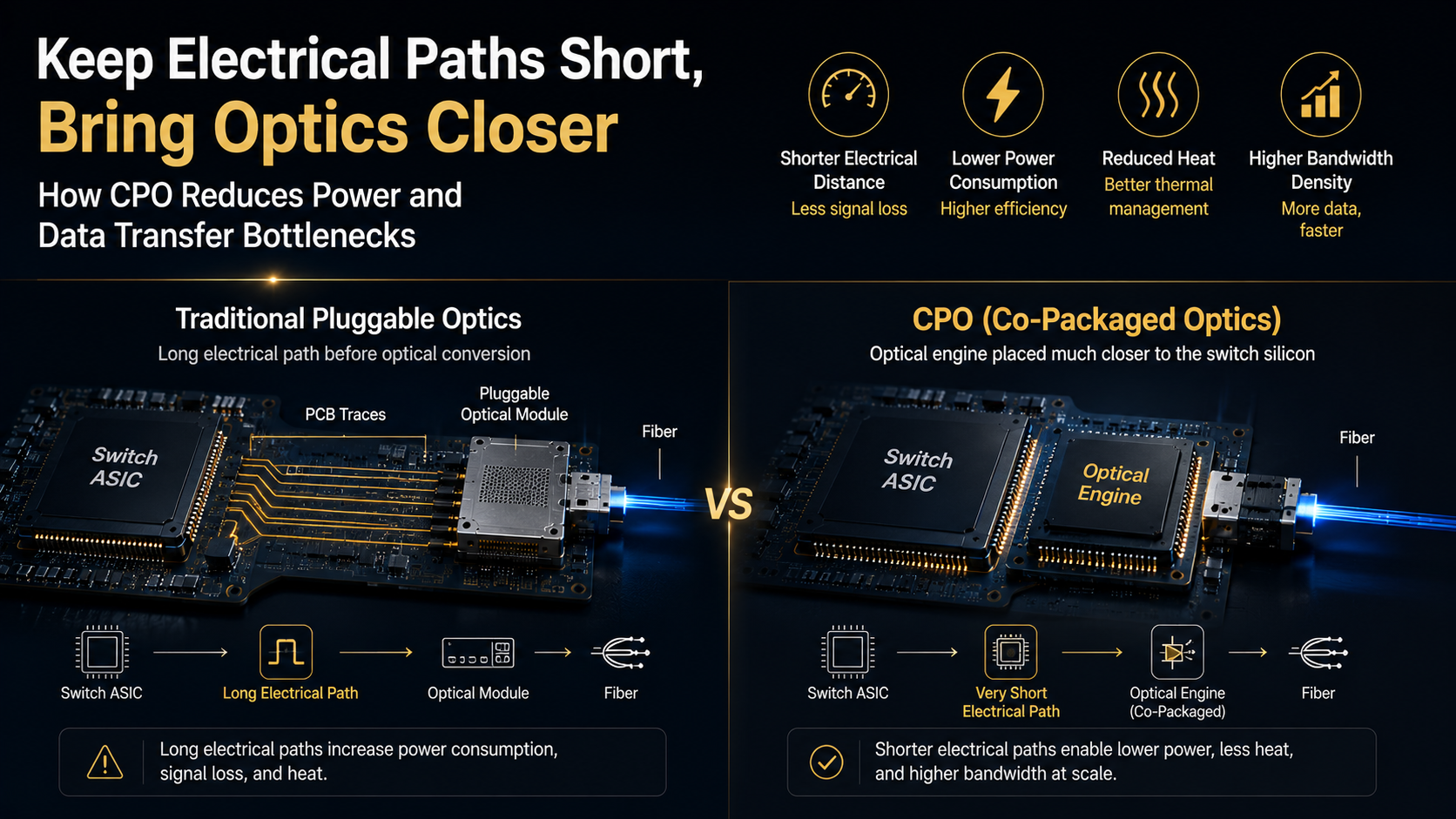
A high-performance network switch processes data electrically inside its switch ASIC. That electrical signal then travels across a printed circuit board before reaching an optical transceiver mounted near the front of the networking equipment.
The transceiver converts the electrical signal into light, which is then transmitted through optical fiber.
A simplified version looks like this
Switch ASIC → Electrical Signal → PCB → Optical Transceiver → Optical Signal → Fiber
This architecture has worked extremely well for modern data centers.
It also has a major practical advantage: pluggable optical modules can be removed and replaced relatively easily.
But as network speeds increase, the electrical portion of that connection becomes more difficult to manage.
High-speed electrical signals traveling across a circuit board face signal integrity challenges. Maintaining those signals can require additional components and power.
CPO changes the architecture.
Instead of keeping the optical transceiver relatively far from the switch ASIC, the optical engine is moved much closer to the chip.
The architecture becomes more like this
Switch ASIC → Very Short Electrical Connection → Optical Engine → Fiber
The goal is straightforward
Reduce the distance that extremely high-speed data must travel electrically and convert that data into optical signals earlier.
How Does Co-Packaged Optics Work?
A useful way to understand CPO is to think about logistics.
Imagine a massive factory producing goods that need to be shipped overseas.
Under the traditional model, trucks carry those goods over a long highway before reaching a port. At the port, the cargo is transferred onto ships.
That works reasonably well when shipping volumes are manageable.
But imagine the factory suddenly produces 10 or 100 times more goods.
The highway becomes a bottleneck.
More trucks are needed. Congestion increases. Energy consumption rises. Expanding the highway becomes increasingly expensive.
CPO effectively moves the port next to the factory.
The goods travel only a short distance by truck before being transferred to the more efficient long-distance transportation system.
In this analogy
- The factory is the switch ASIC.
- The highway is the electrical connection.
- The port is the optical engine.
- The ship is optical communication.
CPO tries to minimize the "highway."
Why Is the Industry Moving From Electrical Toward Optical Interconnects?
Electrical connections remain extremely effective over short distances.
The problem emerges as bandwidth rises and electrical signals must travel farther.
At very high data rates, maintaining signal integrity becomes increasingly difficult. Additional signal-processing components can add power consumption, heat, complexity, and cost.
Optical communication has a different advantage.
Light can move enormous quantities of data across fiber with relatively low loss over distances where electrical connections become increasingly challenging.
This leads to one of the most important principles behind CPO
Electrical connections are excellent when they are short. Optical connections become increasingly attractive as bandwidth and distance increase.
That is why the long-term evolution of high-performance computing is increasingly pushing optics closer to the processor and network switch.
Why CPO Matters for AI Data Centers
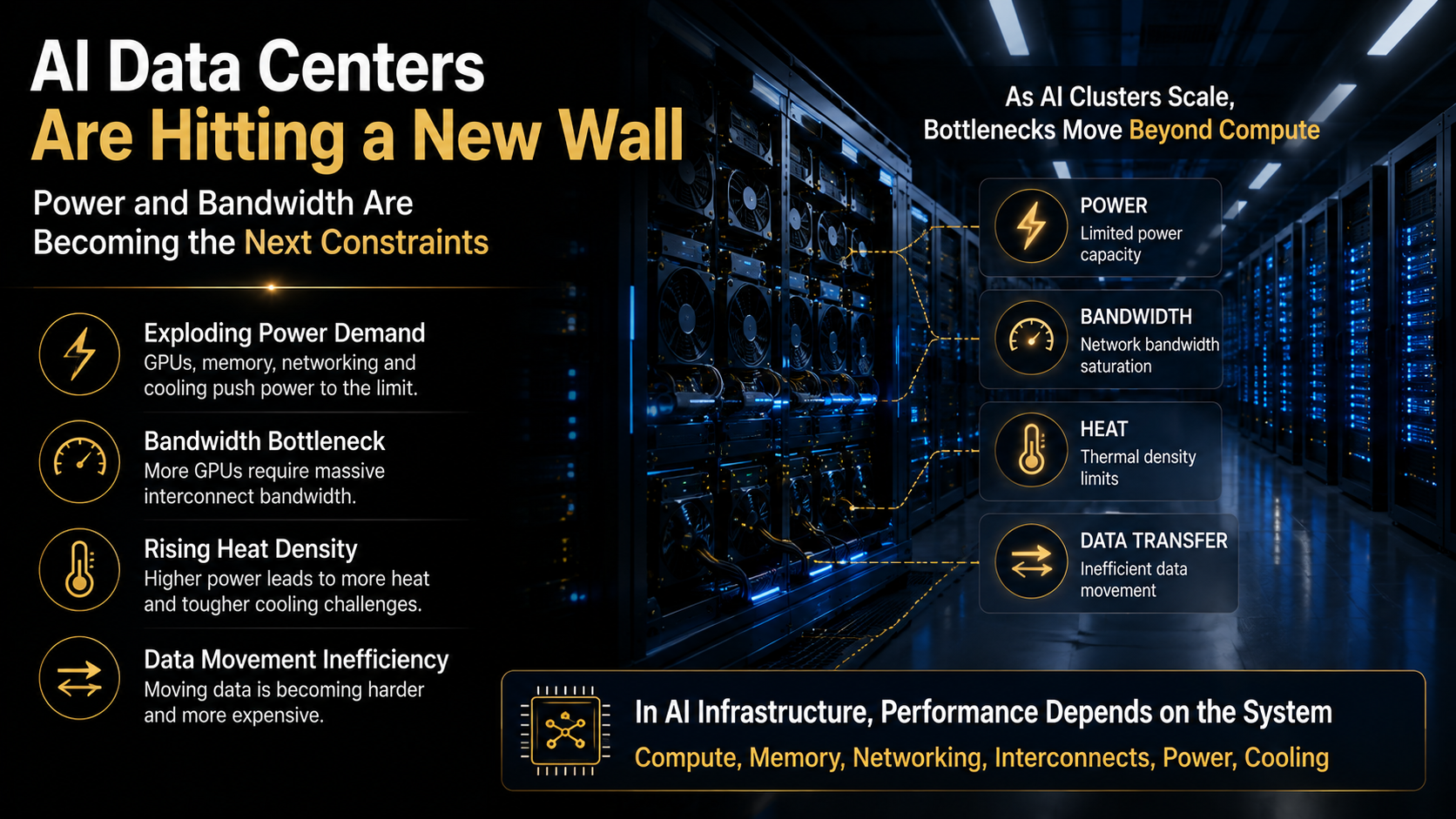
CPO is receiving attention because AI infrastructure is creating several simultaneous bottlenecks.
1. The AI Networking Bottleneck
Traditional computing often allowed servers to perform relatively independent workloads.
Large-scale AI works differently.
Training and increasingly sophisticated inference workloads can require thousands of GPUs and accelerators to exchange enormous amounts of information.
As the number of accelerators increases, communication between them becomes more important.
That means AI infrastructure is evolving from a compute problem into a systems problem
Compute → Memory → Networking → Interconnect → Power → Cooling
A data center can own some of the world's fastest accelerators and still fail to achieve optimal utilization if those accelerators spend too much time waiting for data.
The value of the GPU therefore depends partly on the infrastructure surrounding it.
2. The Power Wall
Power has become one of the defining constraints of AI infrastructure.
GPUs consume enormous amounts of electricity, but compute is only part of the equation.
Memory, networking equipment, optical modules, storage systems and cooling infrastructure also consume power.
As AI clusters grow, the amount of energy required simply to move data becomes increasingly important.
This is why investors should pay attention to energy per bit.
The question is no longer simply
"How fast can this network move data?"
It is increasingly
"How much data can this network move for every watt of electricity consumed?"
CPO attempts to improve this equation by reducing the length and complexity of high-speed electrical connections.
3. Bandwidth Density
AI clusters require enormous network bandwidth.
The industry has moved through generations of higher-speed connectivity, and the pressure for additional bandwidth continues as AI systems scale.
But increasing the speed of individual optical modules does not solve every problem.
There is also a physical limit to how many modules and electrical connections can fit around the front panel of networking equipment.
This creates a front-panel density problem.
By bringing optical engines closer to the switching silicon, CPO offers another path toward increasing bandwidth density without relying entirely on traditional pluggable architectures.
4. Heat and Signal Integrity
Power consumption and cooling are closely connected.
More electrical power typically means more heat.
More heat requires additional cooling infrastructure.
Additional cooling consumes more electricity.
The relationship can become self-reinforcing
Higher Power Consumption → More Heat → More Cooling → Higher Operating Costs
Reducing unnecessary electrical signal paths can therefore matter beyond networking itself.
It can influence the economics of the entire AI data center.
CPO vs. Traditional Pluggable Optics
CPO should not be viewed as an immediate replacement for every pluggable optical transceiver.
Both architectures have advantages.
| Category | Pluggable Optics | Co-Packaged Optics |
| Optical engine location | Front panel | Close to switch ASIC |
| Electrical path | Relatively longer | Much shorter |
| Serviceability | Strong | More challenging |
| Bandwidth density | Increasingly constrained | Potentially higher |
| Power efficiency at extreme bandwidth | More challenging | Potential advantage |
| Technology maturity | Highly mature | Developing and scaling |
| Flexibility | High | Lower |
| Primary opportunity | Broad networking market | High-performance AI networking |
The biggest advantage of traditional pluggable optics is simple
You can replace the module.
If an optical transceiver fails, a technician can remove the module and install another one.
CPO complicates that model because the optical components are much more tightly integrated with expensive switching silicon.
That creates one of the most important trade-offs in the CPO debate
Performance and power efficiency versus serviceability and flexibility.
CPO vs. LPO: What's the Difference?
Another technology investors may encounter is LPO, or Linear Pluggable Optics.
LPO attempts to improve efficiency while retaining much of the familiar pluggable architecture.
In simplified terms
LPO tries to make the existing pluggable model more efficient.
CPO changes the physical architecture by moving optics closer to the silicon.
LPO can potentially retain important advantages in cost and serviceability, while CPO may offer greater long-term potential when bandwidth density and power constraints become severe enough.
This is why investors should be cautious about narratives suggesting that one architecture will immediately eliminate all others.
Different solutions may coexist depending on performance requirements, cost, reliability and deployment environment.
CPO and Silicon Photonics
CPO is frequently discussed alongside silicon photonics, but the two terms are not interchangeable.
Silicon photonics uses semiconductor manufacturing techniques to create components that manipulate and transmit light.
CPO is more about system architecture and packaging—where those optical components are placed relative to the networking or computing silicon.
A simple way to think about the relationship is
Silicon photonics helps build the optical engine. CPO determines how that optical engine is integrated into the system.
This distinction matters for investors because the CPO opportunity is much broader than one product category.
Potential beneficiaries can exist across
- Silicon photonics
- Optical engines
- Lasers
- Switch silicon
- Advanced semiconductor packaging
- Substrates
- Fiber
- Connectors
- Testing and manufacturing equipment
CPO is better understood as an ecosystem transition than as a single semiconductor product.
Why CPO Matters for Advanced Semiconductor Packaging
One of the most important trends in semiconductors is the shift from transistor scaling alone toward system-level integration.
For decades, semiconductor performance improvements were closely associated with making transistors smaller.
That remains important, but modern AI systems increasingly depend on integrating different technologies inside advanced packages.
GPUs must communicate with HBM.
Compute dies may communicate with I/O chiplets.
Network processors must handle rapidly expanding traffic.
Optical engines may eventually move closer to those processors.
As a result, semiconductor competition is expanding
Process Technology → Memory → Advanced Packaging → Interconnects → Optics
CPO is another expression of this transition.
The package itself is becoming part of the computing architecture.
How CPO Could Reshape the AI Supply Chain
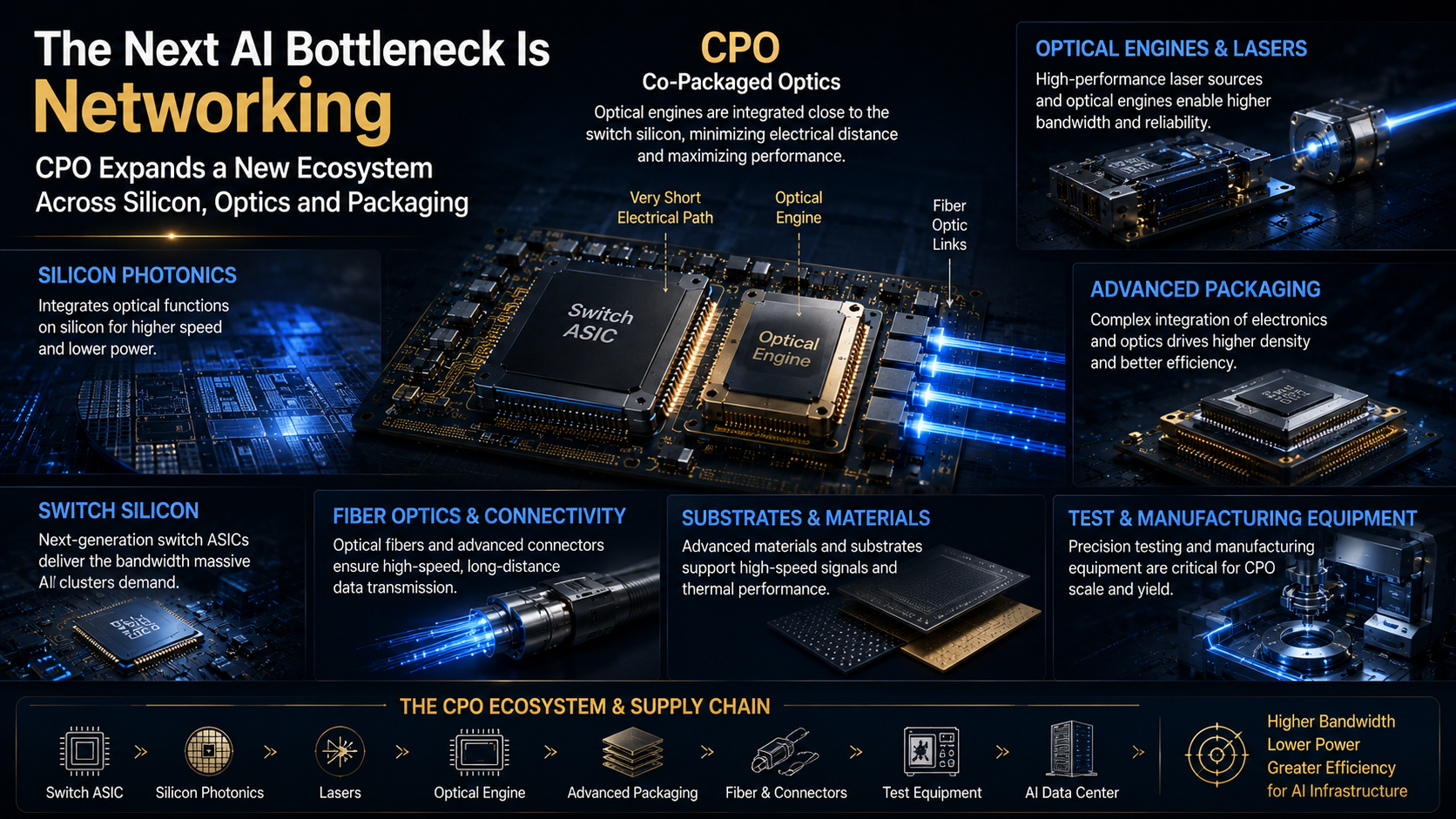
The investment implications extend well beyond optical transceiver manufacturers.
| Industry | Potential Structural Change |
| Hyperscale Data Centers | Greater focus on network and power efficiency |
| Network Semiconductors | Higher importance of advanced switch ASICs |
| Silicon Photonics | Increased integration of optical functions |
| Optical Engines | Higher demand for compact, high-bandwidth optical systems |
| Lasers | Greater importance of reliable optical light sources |
| Advanced Packaging | More complex integration of electronics and optics |
| Substrates & Materials | Higher precision, density and thermal requirements |
| Fiber & Connectors | More optical connectivity inside AI infrastructure |
| Traditional Optical Modules | Greater competition from new architectures |
The key word here is potential.
Technology transitions rarely happen in a straight line.
Existing technologies become cheaper. Competing architectures improve. Customers prioritize reliability and cost. Standards evolve.
That is why investors should focus less on predicting an exact winner today and more on identifying which companies have strategic positions across multiple possible architectures.
Why CPO Matters to U.S. Investors
CPO itself is unlikely to move Treasury yields, the dollar, gold or Bitcoin.
Its importance is different.
CPO helps investors understand where AI capital expenditures may move next.
The first phase of the generative AI investment cycle was dominated by compute scarcity.
GPUs became the obvious bottleneck.
But large infrastructure cycles tend to create new bottlenecks as the original bottleneck is addressed.
The progression can look something like this
GPUs → HBM → Advanced Packaging → Networking → Optical Connectivity → Power → Cooling
This does not mean capital leaves GPUs entirely.
It means the addressable AI infrastructure investment pool broadens.
This is particularly relevant for U.S. investors because hyperscaler spending increasingly depends on building complete AI systems rather than simply purchasing accelerators.
The most expensive GPU in the world creates limited economic value if the network cannot keep it sufficiently utilized.
Follow the Bottleneck, Not the Hype
There is a broader market principle behind CPO.
Capital tends to migrate toward bottlenecks.
When GPU supply is scarce, investors focus on GPUs.
When memory bandwidth becomes constrained, attention moves toward HBM.
When packaging capacity becomes scarce, advanced packaging becomes strategically valuable.
If data movement and power efficiency become major constraints, networking and optical interconnect technologies can capture a larger share of infrastructure spending.
This is why focusing exclusively on the most visible AI semiconductor companies can provide an incomplete picture of the AI investment cycle.
Sometimes the most important component is not the engine.
It is the road connecting thousands of engines together.
The Major Risks Facing CPO
CPO has compelling technical advantages, but investors should not mistake technological potential for guaranteed commercial success.
Several challenges remain.
Serviceability
Pluggable optics are easy to replace.
CPO integrates optical components much more closely with expensive switching hardware.
If part of the optical system fails, repair and replacement can become more complicated.
For hyperscale data center operators, downtime and maintenance costs matter enormously.
Thermal Management
High-performance switch ASICs generate significant heat.
Optical components can also have demanding thermal requirements.
Bringing them physically closer together creates engineering challenges that must be solved through packaging, cooling and system design.
Laser Reliability
The location of the laser source is another important architectural decision.
External Laser Source, or ELS, designs can separate the laser from the hottest portions of the package and potentially improve reliability and serviceability.
This means the development of CPO could create opportunities not only for optical engines but also for laser suppliers and associated components.
Manufacturing Yield
Advanced packages can contain multiple expensive components.
When more components are integrated into a single package, manufacturing yield becomes extremely important.
A failure in one component can potentially affect the economics of the entire assembly.
Ultimately, CPO will not win simply because it is technologically impressive.
It must demonstrate attractive total cost of ownership.
What Investors Should Watch
Investors evaluating the CPO ecosystem should focus on several indicators.
AI Network Bandwidth Growth
The faster AI clusters scale, the more valuable high-bandwidth and power-efficient networking becomes.
Watch whether network bandwidth requirements continue rising fast enough to justify architectural changes.
CPO vs. Pluggable Optics vs. LPO
Do not assume the market will immediately standardize around one solution.
Compare power, bandwidth, reliability, serviceability and cost.
Silicon Photonics Adoption
CPO adoption could accelerate demand for silicon photonics and related manufacturing capabilities.
But investors should distinguish between technological announcements and meaningful commercial deployments.
Hyperscaler Deployment
Proof-of-concept demonstrations are interesting.
Large customer orders are more important.
Watch for evidence that hyperscalers, network equipment providers and AI infrastructure operators are moving from testing to production deployments.
Revenue and Free Cash Flow
This is ultimately the most important test.
The commercial progression should eventually look like
Technology → Customer Qualification → Orders → Revenue → Margins → Free Cash Flow
A company mentioning CPO in an investor presentation does not automatically make it a long-term beneficiary of the transition.
What Would Long-Term Capital Look for in the CPO Transition?
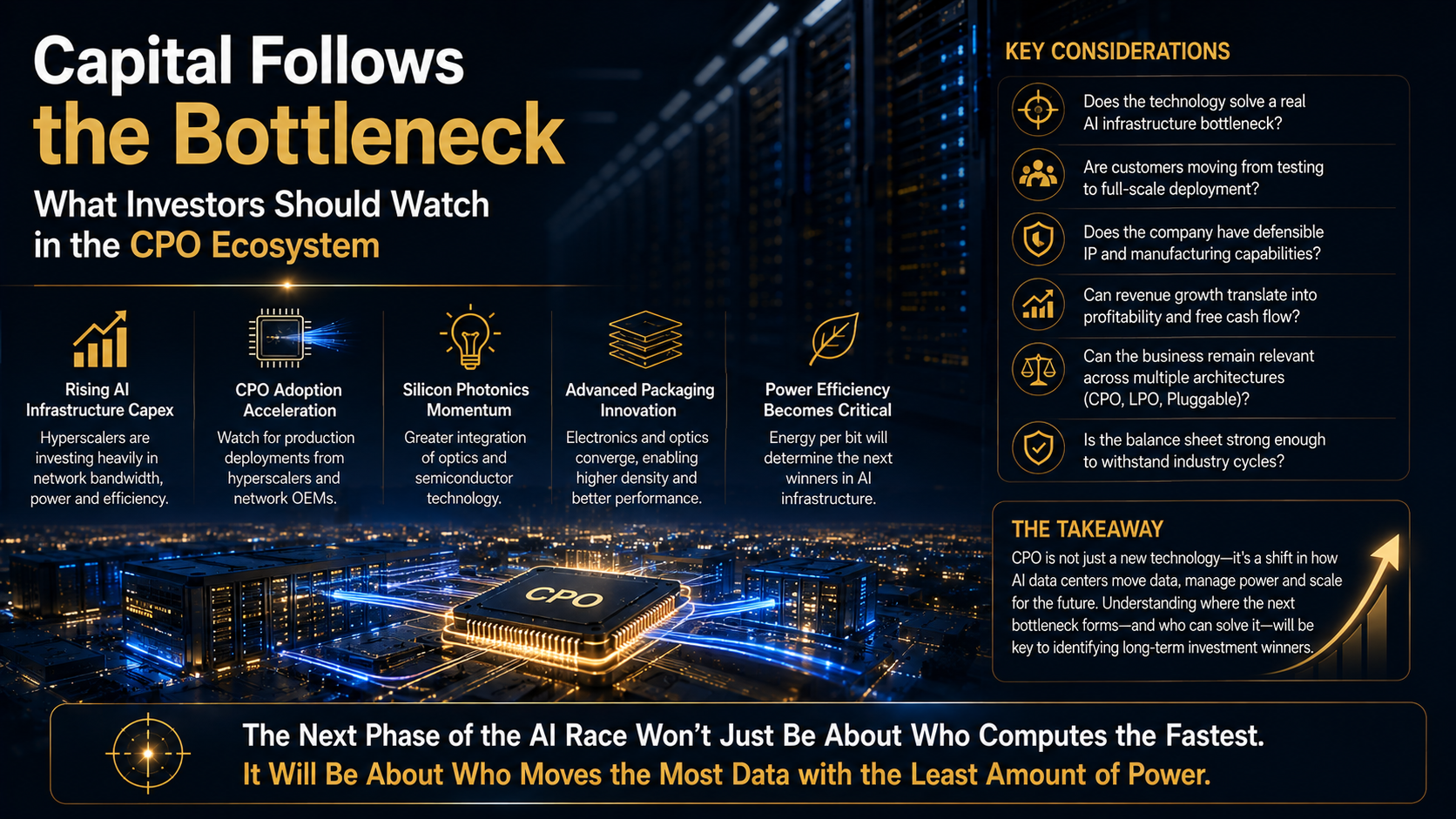
Sophisticated investors are unlikely to stop at the question
"Which stocks are CPO stocks?"
The more useful question is
Where is economic value likely to accumulate as the architecture changes?
Follow the Money
AI capital spending began with an extraordinary focus on compute.
But infrastructure spending expands as bottlenecks migrate.
HBM became more valuable because GPUs needed memory bandwidth.
Advanced packaging became more valuable because AI processors and HBM needed tighter integration.
Networking becomes more valuable as increasingly large clusters must operate as unified computing systems.
Optics becomes more valuable when electrical data movement begins running into physical and economic limits.
Understanding that sequence is more useful than chasing individual technology buzzwords.
Follow the Cash Flow
A great technology does not automatically create a great business.
A company may operate in a rapidly growing market and still struggle to generate attractive returns if competition destroys pricing power.
Long-term investors should therefore look for businesses with defensible intellectual property, manufacturing expertise, customer relationships, scale and pricing power.
The ultimate question is whether technological leadership becomes sustainable free cash flow.
Focus on Survivability
New technology cycles attract enormous expectations.
They also attract enormous competition.
As standards mature, some suppliers will lose relevance, others will be acquired, and a smaller group may capture a disproportionate share of the economics.
Investors should therefore consider not only upside potential but also survivability.
Questions worth asking include
Does this company's technology solve a real AI infrastructure bottleneck?
Are customers moving from testing to production deployment?
Does the company own intellectual property or manufacturing capabilities that are difficult to replicate?
Does revenue growth translate into operating profit and free cash flow?
Can the business remain relevant if CPO adoption develops more slowly than expected?
Can it participate if pluggable optics, LPO and CPO coexist longer than the market expects?
Does the balance sheet provide enough resilience to survive an AI capital-spending downturn?
The objective is not to perfectly predict which architecture wins.
It is to understand which businesses can survive—and potentially benefit—across multiple outcomes.
Final Thoughts
Co-Packaged Optics is more than another optical networking technology.
It represents a broader shift in AI infrastructure.
As compute performance increases, the bottleneck increasingly moves outside the processor itself.
Memory must feed the processor.
Networks must connect thousands of processors.
Optical links must move enormous volumes of data.
Power systems must supply the infrastructure.
Cooling systems must remove the resulting heat.
AI is therefore evolving from a semiconductor story into a full-stack infrastructure story.
CPO sits directly inside that transition because it addresses one of the most fundamental challenges facing large AI systems: moving more data without allowing power consumption and electrical complexity to scale at the same rate.
The key idea to remember is simple
The next phase of the AI race may not be about who can compute the fastest. It may also be about who can move the most data with the least amount of power.
For investors, the opportunity is not merely identifying CPO as an emerging technology.
The deeper task is identifying where the next infrastructure bottleneck is forming, where capital expenditures are moving to solve it, and which companies can convert that technological transition into durable cash flow.
In long-term investing, accurately predicting every technological transition is impossible.
Finding businesses capable of surviving—and compounding value—through those transitions is far more important.
This was MasterMind.
'[Global] Success Blueprints' 카테고리의 다른 글