What Is an AI Factory? How AI Data Centers Are Becoming the New Infrastructure of the Intelligence Economy


Hello, this is MasterMind.
For more than a century, the word “factory” meant a physical place where raw materials were transformed into products.
Steel mills turned iron ore into steel. Auto plants turned components into vehicles. Semiconductor fabs turned silicon wafers into chips.
But what if one of the most important factories of the AI era does not primarily manufacture physical goods?
What if it manufactures intelligence?
That is the idea behind the AI Factory.
As artificial intelligence becomes embedded across software, cloud computing, autonomous systems, robotics, healthcare, finance, and scientific research, the infrastructure required to train and operate AI models is becoming increasingly important.
This helps explain why the AI investment cycle is expanding beyond GPUs.
It is reaching servers, networking equipment, data centers, power generation, transmission infrastructure, transformers, cooling systems, and other physical assets required to keep AI computing running.
For investors, the key question is no longer simply
Which company has the best AI model?
A more fundamental question is emerging
Who can produce AI intelligence at scale, at the lowest sustainable cost?
Key Takeaway
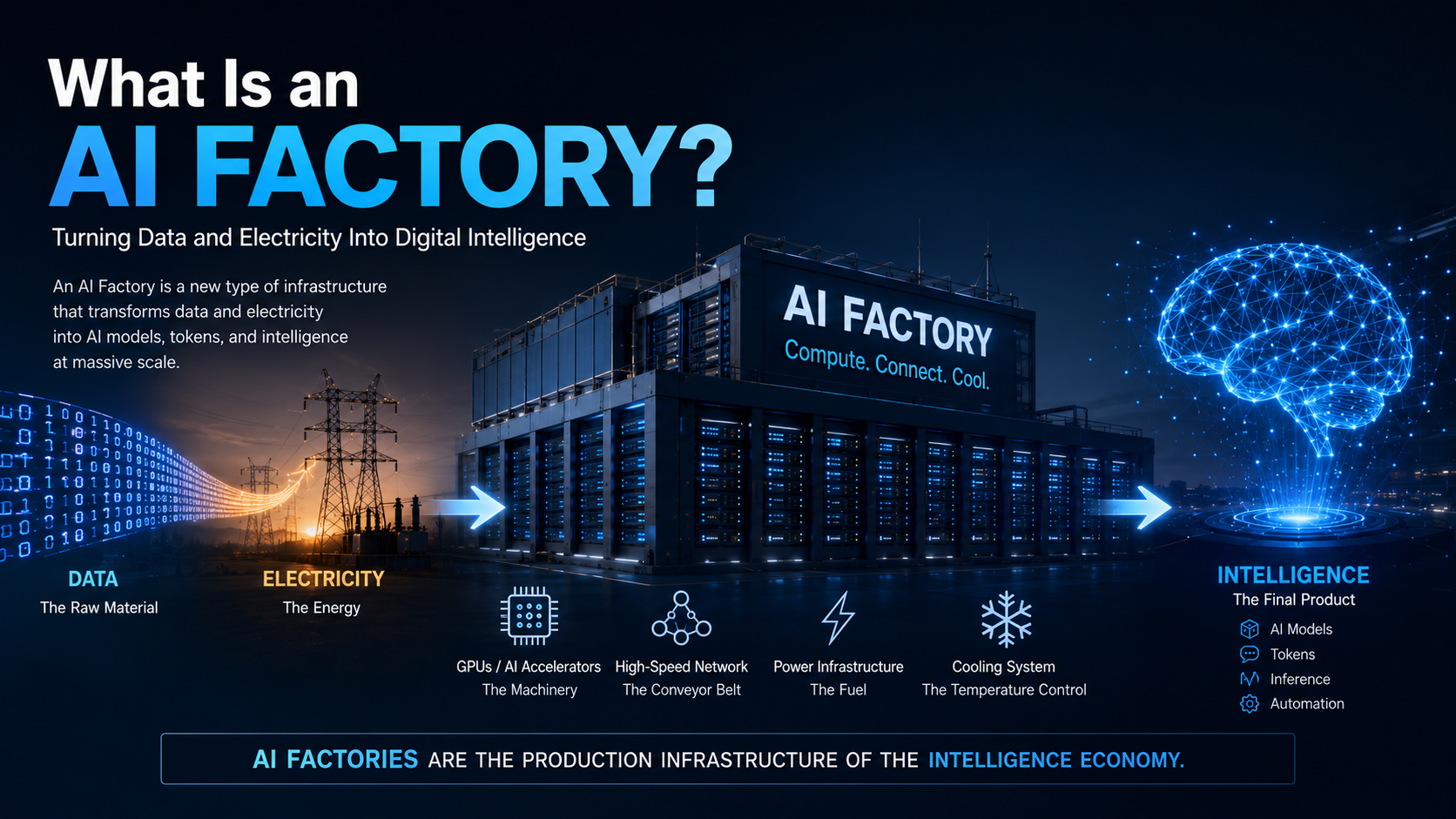
An AI Factory is a computing infrastructure system designed to transform data and electricity into AI models, tokens, inference outputs, and digital intelligence at scale. Unlike traditional data centers focused largely on storing and processing information, AI factories are optimized for high-density accelerated computing, networking, power, and cooling.
What Is an AI Factory?
An AI Factory can be thought of as the industrial infrastructure behind artificial intelligence.
Instead of converting steel, chemicals, or mechanical components into physical products, an AI factory converts
Data + Electricity → Computing → Training and Inference → Digital Intelligence
This comparison helps explain the concept.
| Traditional Factory | AI Factory |
| Raw materials | Data |
| Energy | Electricity |
| Production machinery | GPUs and AI accelerators |
| Internal logistics | High-speed networking |
| Production line | AI computing clusters |
| Final product | Models, tokens, inference outputs |
| Productivity measure | Compute efficiency and cost per output |
The analogy is important because AI is often viewed primarily as software.
But software alone cannot run artificial intelligence.
Behind every large AI model sits an increasingly complex physical infrastructure.
AI requires chips.
Those chips require servers.
Those servers require networking.
The entire system requires enormous amounts of electricity.
And all that electricity ultimately becomes heat that must be removed.
The AI revolution may look digital from the consumer side, but underneath it is becoming increasingly physical.
AI Factory vs. Traditional Data Center
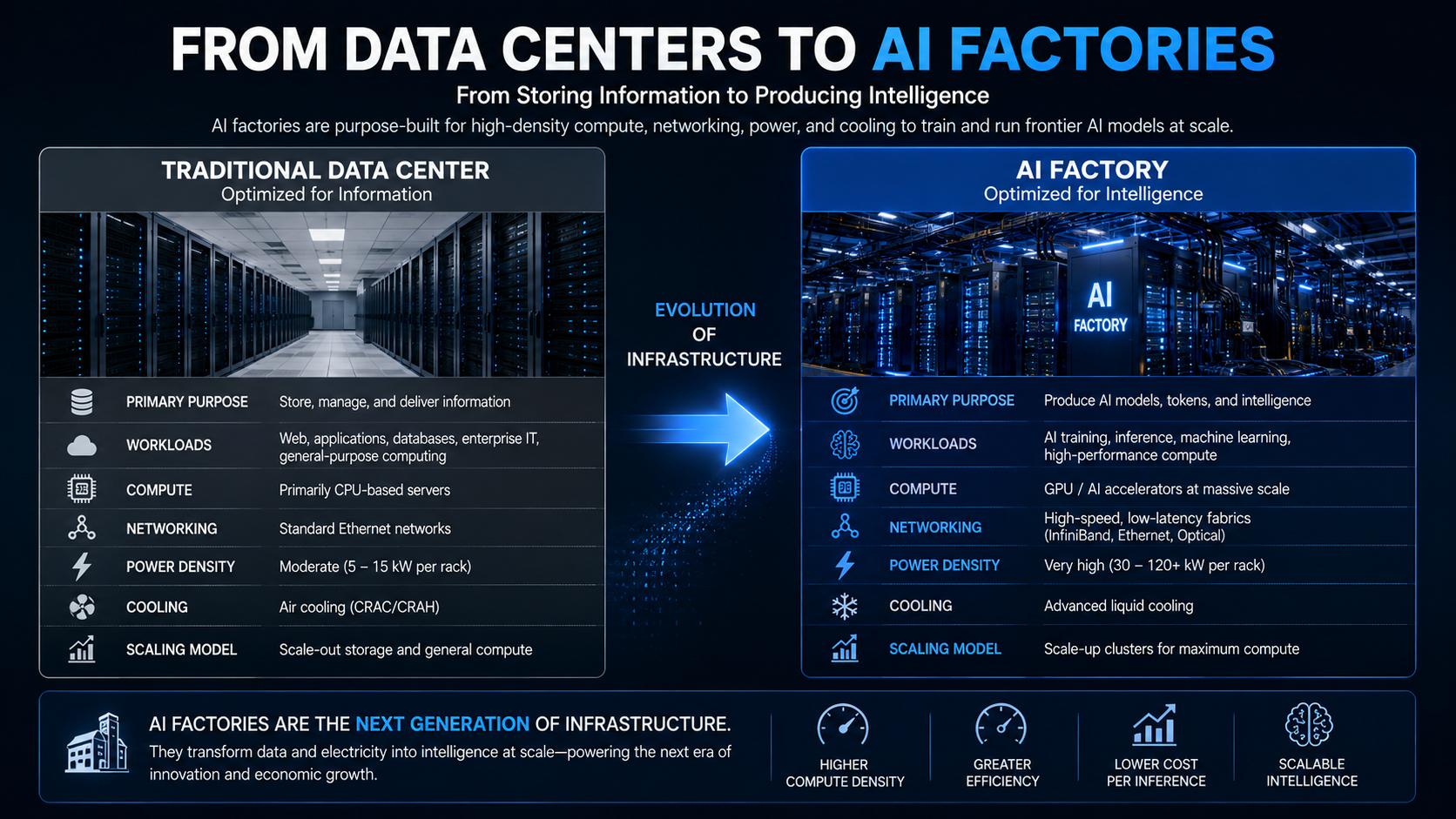
One of the most common questions surrounding AI factories is how they differ from traditional data centers.
Both contain servers, networking equipment, storage systems, and power infrastructure.
The difference is largely about what the infrastructure is optimized to do.
Traditional Data Centers
Traditional data centers were designed primarily for workloads such as
- Data storage
- Cloud applications
- Websites
- Enterprise software
- Databases
- General-purpose computing
CPU-based servers have historically played a major role in these environments.
Their purpose is broadly to store, process, manage, and deliver information.
AI Factories
AI factories are designed around large-scale accelerated computing.
Two workloads are particularly important.
AI Training
Training is the process of using large datasets to build and improve AI models.
Modern frontier models can require massive clusters of AI accelerators working together.
That creates extraordinary demands on computing capacity, networking bandwidth, power density, and cooling.
AI Inference
Inference happens when a trained model actually performs useful work.
When an AI assistant answers a question, an image model creates a picture, or an autonomous system makes a real-time decision, inference is taking place.
This distinction matters for investors.
Training helped drive the first major wave of AI infrastructure investment.
But as AI adoption spreads across businesses and consumers, inference could become an increasingly important source of long-term computing demand.
The economics of AI may therefore become less about how many GPUs a company owns and more about how efficiently those GPUs produce useful AI outputs.
How Does an AI Factory Work?
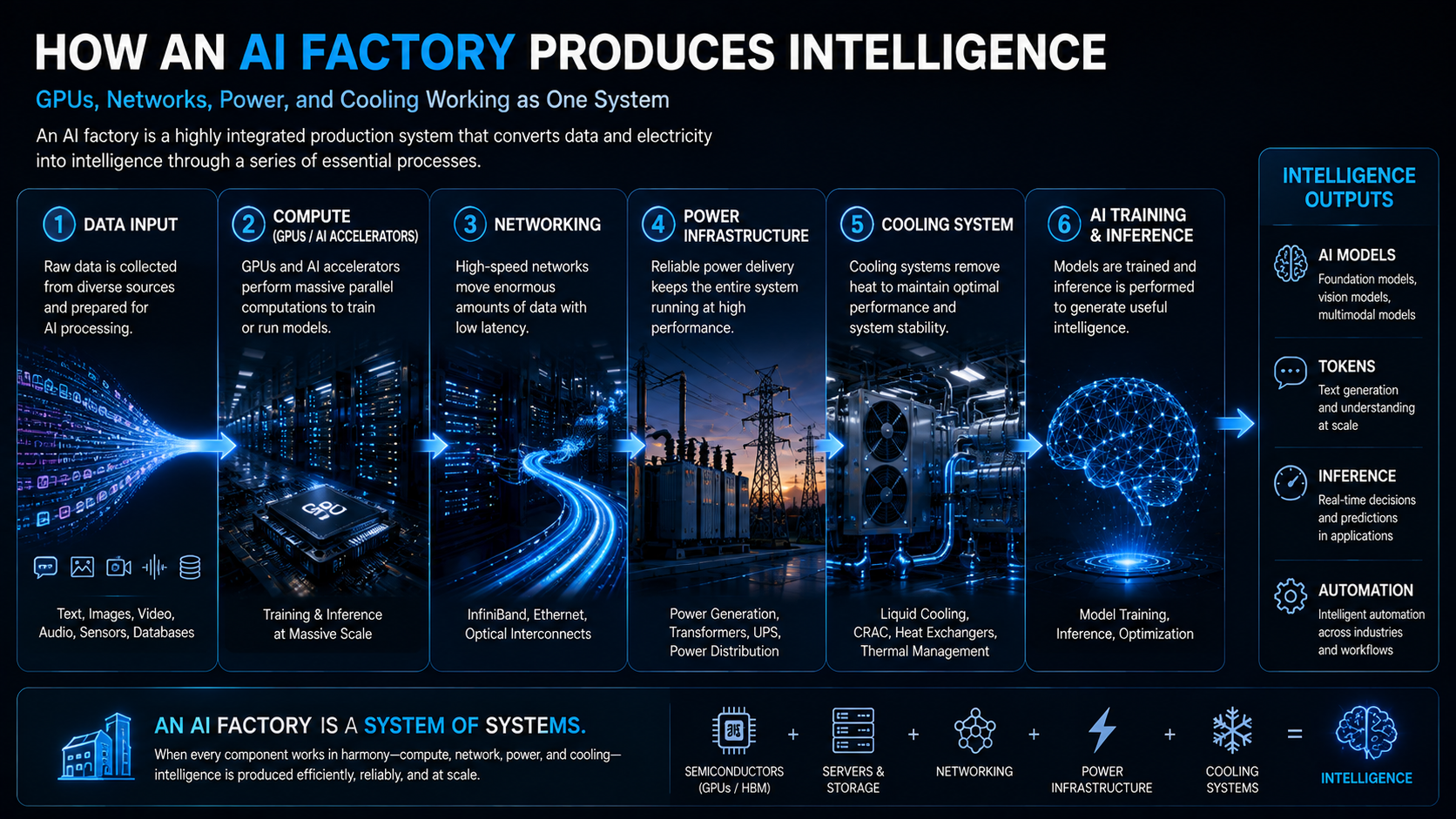
The easiest way to understand an AI factory is to imagine a modern industrial production line.
1. Data Is the Raw Material
AI systems require data.
Text, images, video, audio, financial information, scientific datasets, and sensor readings can all become inputs into AI systems.
But raw materials alone do not create economic value.
They must be processed.
2. GPUs and AI Accelerators Are the Machinery
GPUs and specialized AI accelerators provide the computational capacity needed to train and run modern AI models.
Large AI workloads often require thousands of accelerators to operate together.
That means the performance of an AI factory cannot be measured simply by counting chips.
The real question is
How efficiently can the entire computing system operate as one machine?
3. Networking Is the Conveyor Belt
In a manufacturing plant, production slows when parts cannot move efficiently between machines.
AI computing has a similar constraint.
Thousands of accelerators need to exchange enormous amounts of data with very low latency.
If networking becomes a bottleneck, expensive AI chips can sit underutilized.
That is why high-speed interconnects, switches, optical networking, and related infrastructure have become increasingly important to the AI buildout.
4. Electricity Is the Fuel
AI computing consumes large amounts of electricity.
And the electricity requirement does not stop with the processors.
Power is also needed for servers, networking equipment, storage, cooling systems, and power conversion.
This creates a fundamental shift in the AI investment story.
The competition is no longer only about securing advanced chips.
It is increasingly about securing reliable power at scale.
5. Cooling Protects the Production System
Electricity used by computing equipment ultimately generates heat.
As rack densities increase, thermal management becomes more difficult.
That is why liquid cooling and other advanced thermal-management technologies are becoming increasingly relevant to high-density AI infrastructure.
Put everything together and an AI factory looks like a connected production system
Semiconductors → Servers → Networking → Power → Cooling → Software
A shortage in any one of these areas can limit the productivity of the entire system.
The Core Economics of an AI Factory: Turning Electricity Into Intelligence
The fundamental economic idea behind an AI factory can be summarized simply
Electricity is converted into computation, and computation is converted into intelligence.
This changes how AI infrastructure should be evaluated.
The most powerful individual chip is not necessarily enough.
What ultimately matters is how much useful AI output can be produced from a given amount of capital and energy.
That makes several variables increasingly important
- Performance per watt
- Computing utilization
- Networking efficiency
- Cooling efficiency
- Cost per token
- Cost per inference
- Revenue generated per unit of AI infrastructure
In other words, AI infrastructure is beginning to develop its own version of industrial productivity.
The winners may not simply be the companies that build the largest AI factories.
They may be the companies that operate them most efficiently.
What Does an AI Factory Produce?
An AI factory can produce several forms of economic output.
AI Models
Large language models, vision models, autonomous-driving systems, scientific models, and other forms of machine intelligence are created through training.
Tokens
For generative AI, tokens are units used to process and generate language.
As AI usage grows, the number of tokens processed across the global economy can grow dramatically.
Inference
Inference is where trained AI models perform actual tasks.
This includes
- AI assistants
- Coding tools
- Image and video generation
- Enterprise automation
- Robotics
- Autonomous systems
- Scientific research
- Healthcare applications
This leads to one of the most important long-term questions in AI economics.
The first phase of competition focused heavily on
Who can build the most capable AI model?
The next phase may increasingly focus on
Who can deliver useful intelligence at the lowest cost and greatest scale?
That is where the AI Factory concept becomes economically important.
Why AI Factories Matter
AI factories matter because artificial intelligence is moving from a software story into a capital-intensive infrastructure cycle.
AI may be digital, but scaling AI requires physical assets.
It requires semiconductors.
It requires memory.
It requires servers.
It requires networking.
It requires land.
It requires electricity.
It requires cooling.
And it requires enormous amounts of capital.
This means the economic impact of AI can spread far beyond the technology sector.
Computing Is Becoming a New Form of Capital Equipment
Every major industrial era has been built around critical forms of capital equipment.
During the Industrial Revolution, machinery and steam engines increased physical productivity.
In the automobile era, assembly plants transformed manufacturing.
In the semiconductor era, fabrication plants became strategic infrastructure.
In the AI economy, computing capacity itself is becoming a form of productive capital.
Companies build AI infrastructure today because they expect it to generate future services, productivity gains, and cash flows.
That makes an AI factory economically similar to other large industrial investments.
It requires significant upfront capital expenditures, while the financial return may arrive over many years.
This is why AI CAPEX matters so much to investors.
The AI Factory Supply Chain Is Much Larger Than GPUs
Suppose a hyperscaler wants to build another major AI computing campus.
It cannot simply order more accelerators and switch them on.
It may need
- GPUs and AI accelerators
- High-bandwidth memory
- AI servers
- High-speed networking
- Optical components
- Storage
- Power-management equipment
- Transformers
- Transmission infrastructure
- Cooling systems
- Land and construction
- Reliable sources of electricity
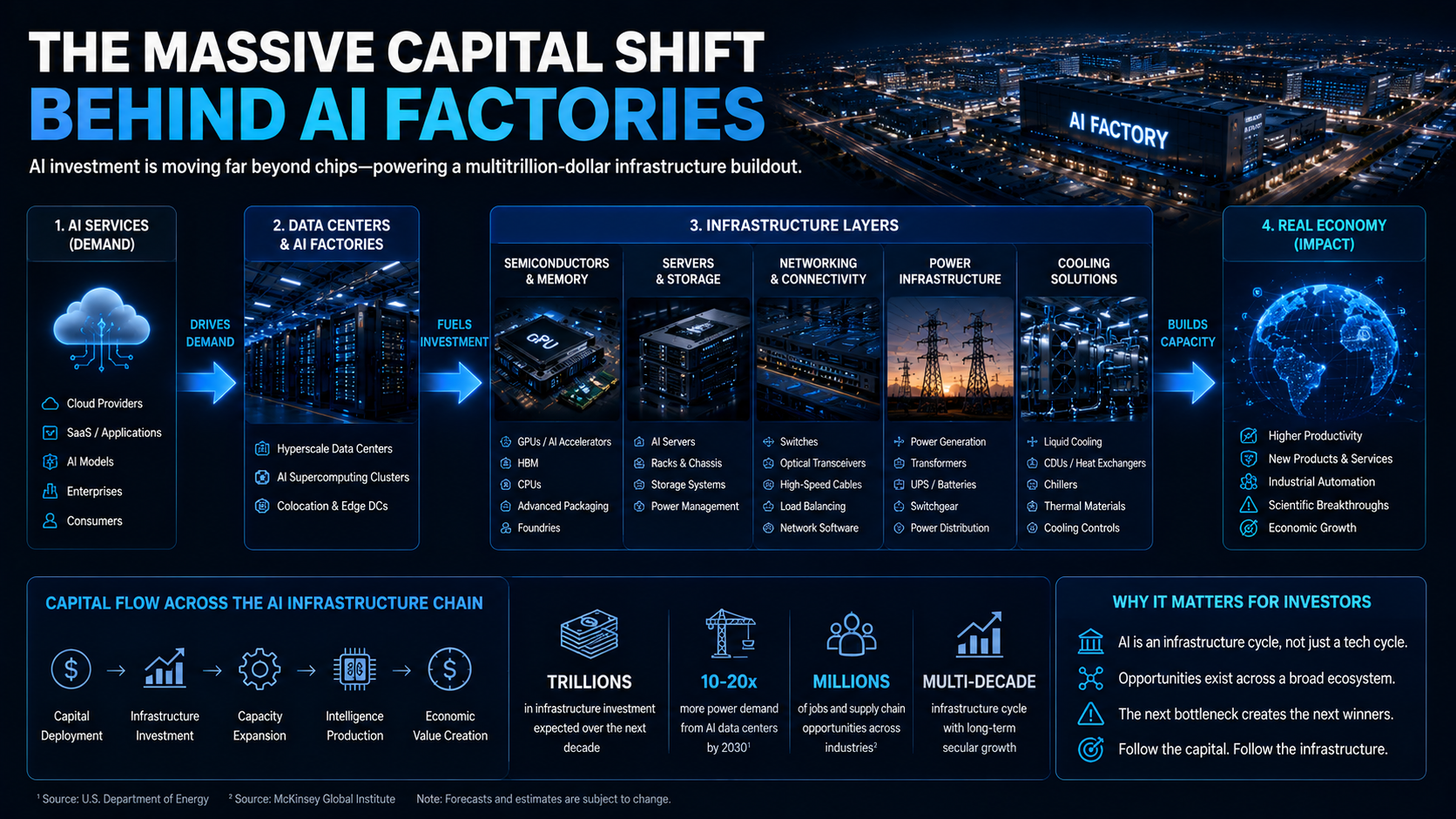
Capital therefore moves through a much broader chain
AI Services → Data Centers → Semiconductors and Memory → Networking → Power Infrastructure → Cooling → Construction
This is one reason the AI investment cycle has increasingly become an infrastructure story.
Investors focusing exclusively on the most visible semiconductor companies may miss where the next bottleneck — and potentially the next major wave of capital spending — develops.
The Most Important Variable in AI Infrastructure May Be the Bottleneck
Industrial systems are often constrained by their scarcest critical input.
AI factories are no different.
At one stage, advanced GPUs may be the bottleneck.
At another stage, high-bandwidth memory may become constrained.
Later, networking capacity, transformers, available land, cooling capacity, or electricity could limit expansion.
This creates a useful framework for investors
If another major AI factory needed to be built tomorrow, what would be the hardest component to secure?
That question matters because markets often assign greater economic value to resources that constrain the expansion of an entire system.
The AI infrastructure opportunity may therefore move over time.
GPU → Memory → Networking → Power → Cooling → Data Center Capacity
The sequence will not necessarily be linear, but the principle remains the same
Follow the bottleneck.
Why Power Is Becoming Central to the AI Investment Story
One of the most important consequences of the AI buildout is rising demand for electricity.
A company can have access to advanced chips and capital, but without sufficient power, those chips cannot generate economic output.
This makes energy availability increasingly relevant to AI competitiveness.
The investment chain can extend into
- Power generation
- Natural gas
- Nuclear energy
- Renewable generation
- Energy storage
- Transmission lines
- Transformers
- Grid equipment
- Power-management systems
For the United States, this is particularly important because the AI infrastructure race increasingly intersects with an aging electric grid, permitting challenges, regional power constraints, and long lead times for major infrastructure projects.
The AI race is therefore becoming partly an energy and infrastructure race.
AI Factories and the CAPEX Cycle
AI factories are extremely capital intensive.
That means the AI boom cannot be evaluated only through revenue growth.
Investors also need to watch the capital required to generate that growth.
The first question is
How much are companies spending on AI?
But eventually the more important question becomes
How much economic return is that spending producing?
This is where CAPEX and ROI become critical.
If AI demand grows rapidly enough, large infrastructure investments can generate substantial future cash flows.
But if monetization develops more slowly than expected, aggressive spending can pressure free cash flow and returns on invested capital.
This leads to an important distinction
A growing industry does not automatically mean every company participating in that industry will generate attractive returns.
The AI infrastructure boom may be real while individual investments can still become uneconomic.
How AI Factories Could Affect Financial Markets
The AI Factory buildout can influence a much wider group of industries than technology alone.
| Market / Industry | Potential Impact |
| Semiconductors | Demand for GPUs, accelerators, memory, and advanced chips |
| Servers | Expansion of specialized AI server infrastructure |
| Networking | Higher demand for switches, optics, and interconnects |
| Data Centers | Growth of high-density AI computing facilities |
| Utilities | Rising electricity demand from computing infrastructure |
| Grid Equipment | Greater need for transformers and transmission capacity |
| Cooling | Expansion of liquid cooling and thermal-management systems |
| Commodities | Potential structural demand for copper and electrical materials |
| Cloud Computing | Competition to provide scalable AI compute |
| Capital Markets | Financing needs associated with massive infrastructure investment |
U.S. Equities
For equity investors, AI factories broaden the opportunity set beyond AI software and semiconductor designers.
Potential beneficiaries can exist across servers, networking, power equipment, utilities, cooling, construction, and other infrastructure industries.
But investors should distinguish between revenue exposure to AI spending and actual improvements in earnings and free cash flow.
A company can participate in a rapidly growing market without creating durable shareholder value.
Bonds and Credit Markets
Large AI infrastructure projects require substantial capital.
If corporations and utilities increase borrowing to fund data centers, generation capacity, transmission infrastructure, or related assets, the AI investment cycle can increasingly intersect with credit markets.
The financial impact will depend on leverage, funding costs, project economics, and the ability of borrowers to convert capital spending into durable cash flows.
Commodities
Copper and other industrial materials are important to electrical infrastructure.
An extended buildout of power generation, transmission systems, data centers, and electrical equipment could support structural demand.
However, commodity prices are also driven by global growth, supply responses, China, currency movements, and inventories.
AI demand should therefore be treated as one structural factor rather than a standalone price forecast.
Energy
AI factories require reliable electricity around the clock.
That creates renewed interest in the mix of generation technologies capable of supplying large computing loads, including natural gas, nuclear power, renewable energy, and storage.
The key investment question is not necessarily which energy technology “wins.”
It is
Which combination can deliver reliable, scalable, economically competitive power to AI infrastructure?
The Dollar, Gold, and Bitcoin
AI factories do not directly determine the price of the U.S. dollar, gold, or Bitcoin.
The relationship is more indirect.
If AI investment increases U.S. productivity, capital spending, economic growth, electricity demand, and investment flows, it could influence interest rates and capital allocation.
Those changes can eventually affect broader financial assets.
The useful framework is therefore
AI investment → Growth and capital spending → Rates and liquidity → Asset prices
rather than assuming a direct relationship between AI infrastructure and individual asset prices.
What Investors Should Watch
Long-term investors do not need to predict every technological development.
They need to identify the variables that determine whether the AI infrastructure cycle remains economically sustainable.
Is AI CAPEX Producing Revenue and Cash Flow?
Capital spending alone does not create value.
Investors should watch whether AI infrastructure spending is producing higher revenue, operating income, and ultimately free cash flow.
Is the Market Moving From Training Toward Inference?
Training created enormous demand for high-end computing.
But widespread AI adoption could make inference increasingly important.
If millions of businesses and consumers use AI continuously, inference could become a much larger and more recurring computing workload.
Where Is the Bottleneck Moving?
Investors should watch whether constraints are moving from chips toward
- Memory
- Networking
- Electricity
- Transformers
- Cooling
- Data-center capacity
The location of the bottleneck can influence pricing power and capital allocation.
Is the Cost of Intelligence Falling?
AI becomes more economically useful as the cost of generating intelligence falls.
Lower inference costs can make entirely new applications viable.
This means cost per token, energy efficiency, and utilization rates can become important indicators of AI economics.
Can Companies Secure Enough Power?
Computing equipment has little economic value if it cannot operate.
Access to reliable electricity may therefore become an increasingly important competitive advantage for hyperscalers and data-center operators.
Why Investors Should View AI Factories as a Full Supply Chain
It is easy to think of AI as a competition among model developers and semiconductor companies.
But the AI Factory framework reveals something larger.
More AI usage creates more inference.
More inference creates more compute demand.
More compute requires more servers and networking.
More servers require more electricity.
More electricity creates greater demand for grid infrastructure and cooling.
The digital AI revolution therefore produces very physical investment requirements.
AI software ultimately translates into demand for semiconductors, data centers, electricity, copper, networking, cooling, and construction.
That is why understanding AI factories matters for macro investors as well as technology investors.
What Do Long-Term Capital Allocators Look For?
Sophisticated investors often look beyond the most visible technology.
They follow the movement of capital.
If hundreds of billions of dollars flow into AI infrastructure, that money does not remain inside a single semiconductor company.
It moves through the entire production chain.
Capital Flows
Where is AI CAPEX moving next?
From accelerators to memory?
From memory to networking?
From networking to power infrastructure?
Understanding these transitions can be more useful than chasing whichever part of the AI story is currently receiving the most attention.
Cash Flow
Infrastructure investment ultimately needs to generate economic returns.
Long-term investors should distinguish between companies benefiting from temporary spending booms and businesses capable of converting AI demand into durable free cash flow.
Survivability
Not every company participating in the AI boom will survive the full investment cycle.
Capital-intensive industries can become vulnerable when demand slows, competition increases, or financing costs rise.
Balance-sheet strength therefore matters.
Long-Term Infrastructure Value
A useful question is whether an asset remains valuable even if today's AI architecture changes.
Power infrastructure, efficient cooling, networking capacity, and strategic data-center locations may retain economic value across multiple generations of computing technology.
Investors can ask
Would this company survive if AI CAPEX slowed?
Is its AI exposure generating real cash flow?
Is its product optional, or is it a critical bottleneck?
Will this infrastructure remain necessary if AI technology changes?
Can the company maintain pricing power as competition increases?
The goal of investing is not to perfectly predict every technological transition.
It is to understand the structure well enough to survive when the prediction is wrong.

Final Thoughts
An AI Factory is more than a new name for a data center.
It represents a change in how the AI economy produces value.
Traditional factories transform raw materials and energy into physical goods.
AI factories transform data and electricity into digital intelligence.
And that production process requires much more than GPUs.
It requires semiconductors, high-bandwidth memory, servers, networking, data centers, electricity, transformers, cooling systems, and software operating as one integrated production system.
Understanding AI factories therefore means understanding where capital is flowing across the AI economy.
Instead of asking only
“Which AI model is the best?”
Investors may increasingly need to ask
“What becomes more scarce as AI usage grows?”
And
“Where will the next bottleneck emerge?”
Those questions may provide a better map of the long-term AI investment cycle than short-term market narratives.
The central idea is simple
AI factories are the production infrastructure of the intelligence economy, turning electricity and data into scalable digital intelligence while transforming AI from a software revolution into a semiconductor, data-center, networking, power, and industrial-infrastructure cycle.
This was MasterMind.
'[Global] Success Blueprints' 카테고리의 다른 글