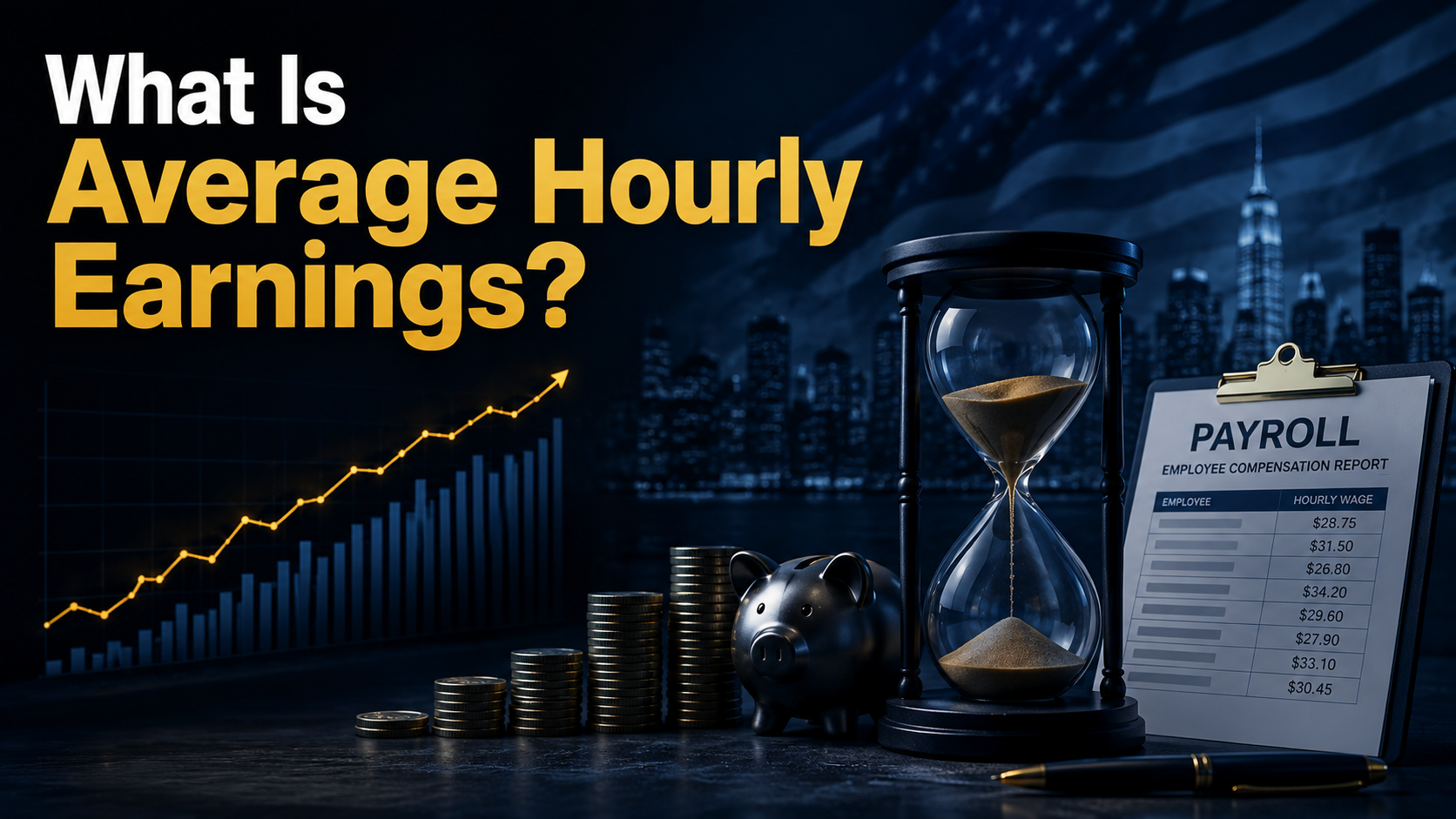
What Is Average Hourly Earnings (AHE)? The Key Inflation Indicator That Drives Interest Rates


Welcome to MasterMind.
Every month, millions of investors wait for the U.S. jobs report, expecting it to reveal the next move in the economy. Most headlines focus on Nonfarm Payrolls or the unemployment rate. Yet on Wall Street, many institutional investors look at a different number first: Average Hourly Earnings (AHE).
Why does a simple measure of hourly wages often move stocks, Treasury yields, the U.S. dollar, gold, and even Bitcoin?
The answer is straightforward. Wage growth is one of the clearest signals of future inflation. Inflation influences Federal Reserve policy, interest rates shape financial conditions, and financial conditions ultimately determine how capital flows across every major asset class.
Understanding Average Hourly Earnings isn't just about reading an employment report—it's about understanding how the U.S. economy transmits inflation into financial markets.
Key Takeaway
Average Hourly Earnings is one of the most important leading indicators of inflation because rising wages can influence consumer spending, business costs, Federal Reserve policy, and ultimately the direction of financial markets.
What Is Average Hourly Earnings?
Average Hourly Earnings (AHE) measures the average hourly pay received by private-sector employees in the United States. It is released each month by the U.S. Bureau of Labor Statistics (BLS) as part of the Employment Situation Report.
While many investors focus on how many jobs were created, experienced market participants often pay even closer attention to how fast wages are growing.
Markets primarily monitor two figures
- Month-over-Month (MoM): Measures the latest pace of wage growth.
- Year-over-Year (YoY): Shows the longer-term trend in wage inflation.
For economists, wages are more than employee income.
They are also
- A major business expense
- The primary source of household purchasing power
- A leading indicator of inflationary pressure
Because of this, Average Hourly Earnings has become one of the most influential economic indicators in modern financial markets.
How Average Hourly Earnings Works
The calculation itself is relatively simple.
Average Hourly Earnings equals the total wages paid divided by the total hours worked across surveyed private-sector employees.
However, the market rarely focuses on the absolute dollar amount.
Instead, investors ask a more important question
"Are wages accelerating faster or slower than expected?"
That distinction matters because markets trade expectations, not historical data.
A stronger-than-expected wage report suggests labor demand remains tight, increasing the probability that inflation could remain elevated.
A weaker report may indicate inflationary pressures are gradually easing.
Why Wage Growth Matters for Inflation

One of the strongest relationships in macroeconomics is the connection between wages and inflation.
When labor markets become tight, businesses compete for workers by offering higher wages.
Higher wages increase household income, encouraging stronger consumer spending.
At the same time, companies face higher labor costs and often pass those costs on to consumers through higher prices.
The result is a feedback loop commonly known as the Wage-Price Spiral.
The process typically looks like this
Labor shortages
↓
Higher wages
↓
Higher household spending
↓
Higher business costs
↓
Higher consumer prices
↓
Persistent inflation
↓
Higher interest rates
This is why investors rarely treat wage data as simply another employment statistic.
Instead, they see it as one of the earliest signals of future inflation.
Why the Federal Reserve Watches Average Hourly Earnings
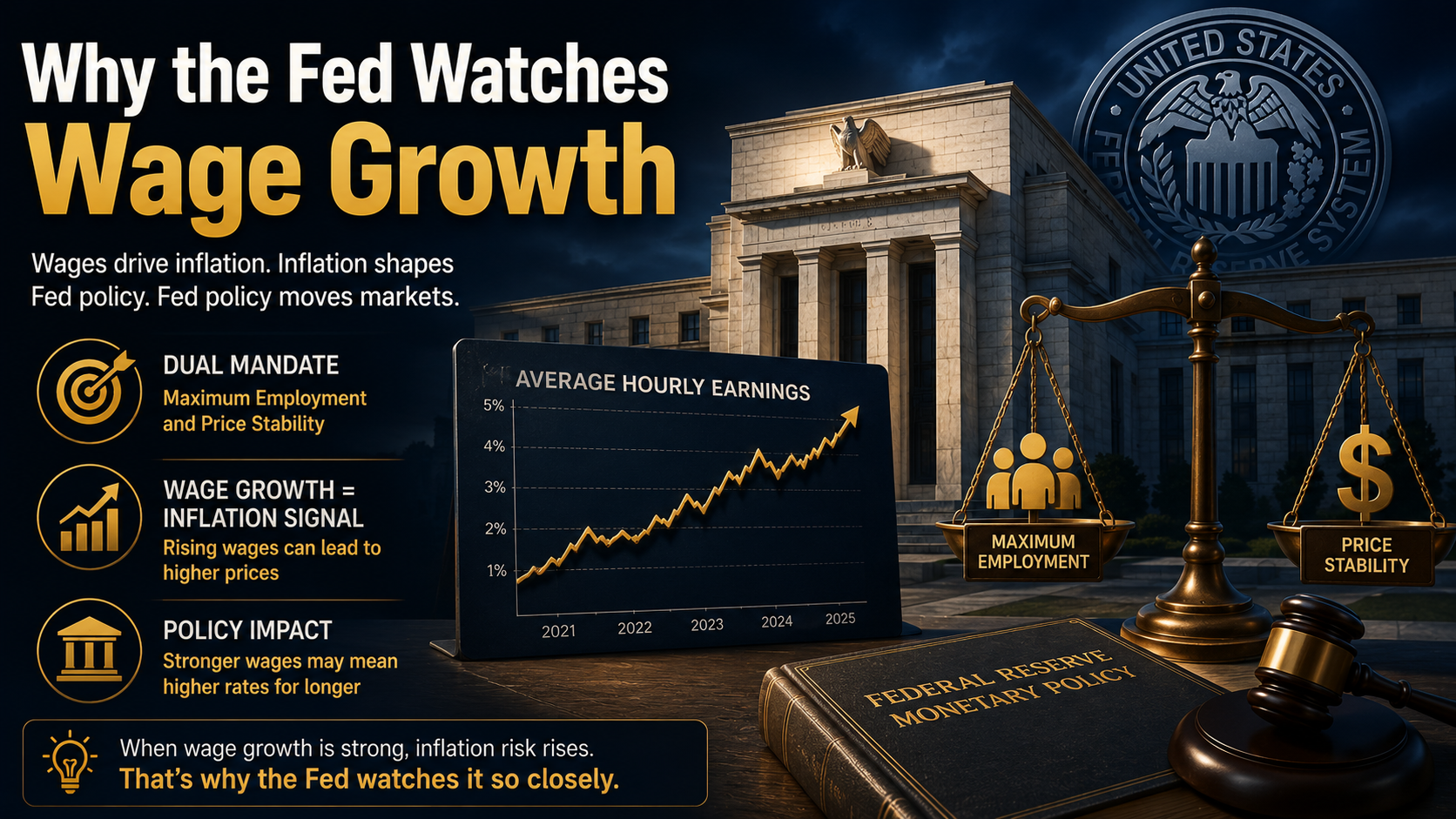
The Federal Reserve operates under a dual mandate
- Maximum employment
- Price stability
A healthy labor market is generally positive for the economy.
However, when wages rise too quickly, inflation can become more persistent—especially within the service sector, where labor represents a significant share of total operating costs.
Unlike commodity prices, wages are typically sticky downward.
Once businesses raise compensation, reducing wages later is extremely difficult.
For that reason, persistent wage growth often leads policymakers to keep interest rates higher for longer.
Conversely, slowing wage growth may provide evidence that inflationary pressure is cooling, giving the Fed more flexibility to consider future rate cuts.
Because of this relationship, Average Hourly Earnings frequently has a larger impact on Treasury yields than the headline payroll number itself.
How Average Hourly Earnings Affects Financial Markets
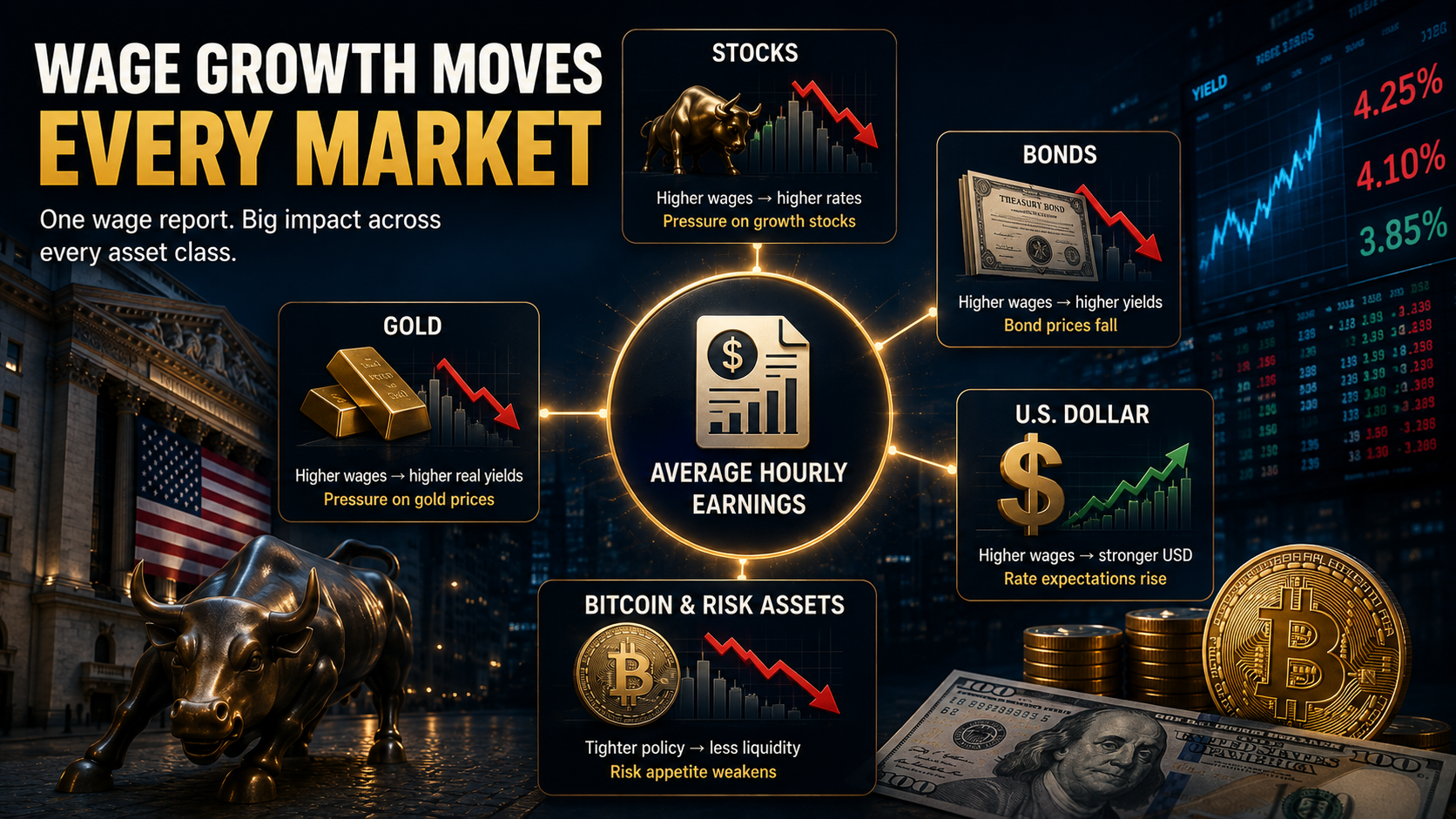
Markets compare every wage report with economists' consensus expectations.
The surprise—not simply the number itself—is what drives asset prices.
| Asset Class | Higher-Than-Expected Wage Growth | Lower-Than-Expected Wage Growth |
| U.S. Stocks | Pressure on growth stocks due to higher rate expectations | Positive for growth-oriented sectors |
| Treasury Bonds | Higher yields, lower bond prices | Lower yields, higher bond prices |
| U.S. Dollar | Often strengthens as rate expectations rise | May weaken as easing expectations increase |
| Gold | Faces pressure from higher real yields | Often benefits from falling yields |
| Bitcoin & Risk Assets | Liquidity concerns may reduce risk appetite | Easier financial conditions may support risk assets |
Technology stocks are particularly sensitive because higher interest rates reduce the present value of future earnings, making valuation multiples more vulnerable.
Investors Should Never View Wage Data in Isolation
Average Hourly Earnings is extremely important, but it should never be analyzed alone.
Professional investors evaluate wage growth alongside several other indicators, including
- Nonfarm Payrolls (NFP)
- Unemployment Rate
- Labor Force Participation Rate
- Labor Productivity
- Consumer Price Index (CPI)
- Personal Consumption Expenditures (PCE) Inflation
For example, strong wage growth accompanied by rising productivity is much less inflationary than strong wage growth without productivity gains.
Similarly, payroll growth may appear robust, but slowing wages can still reduce concerns about persistent inflation.
Context matters more than any single data point.
What Smart Investors Look For
Professional investors rarely react to one monthly report.
Instead, they ask deeper questions about the direction of capital flows.
- Is wage growth strong enough to keep interest rates elevated?
- Which industries have pricing power to offset rising labor costs?
- Which companies can maintain profit margins despite higher payroll expenses?
- Is capital rotating toward defensive assets or returning to growth sectors?
These questions help investors understand not only today's market reaction but also the broader economic cycle.
The market isn't pricing today's wages.
It's pricing tomorrow's monetary policy.

Final Thoughts
Average Hourly Earnings is far more than a labor market statistic.
It connects employment, consumer spending, inflation, Federal Reserve policy, and financial markets into one continuous economic chain.
For long-term investors, understanding wage growth provides valuable insight into where interest rates may be headed and how capital is likely to move across different asset classes.
Rather than focusing solely on whether payrolls beat or missed expectations, experienced investors pay close attention to wage growth because it often reveals the underlying inflation trend before it becomes visible elsewhere in the economy.
In investing, success comes not from predicting every monthly report but from understanding the economic forces that shape long-term market cycles.
Average Hourly Earnings is one of those forces.
'[Global] Success Blueprints' 카테고리의 다른 글