What Is the Labor Force Participation Rate? Why It Matters More Than the Unemployment Rate


Hello, this is MasterMind.
Every month, investors eagerly wait for the U.S. Employment Situation Report. Headlines often focus on one number: the unemployment rate.
But have you ever wondered why the unemployment rate can fall while consumers still feel economic pressure or businesses continue struggling to hire workers?
The answer lies in a metric that professional investors, Federal Reserve officials, and Wall Street economists monitor just as closely—the Labor Force Participation Rate (LFPR).
While the unemployment rate tells us how many people are actively looking for work but cannot find a job, the labor force participation rate reveals something even more important: how many Americans are actually participating in the labor market.
Understanding this distinction can help investors better interpret inflation, interest rates, economic growth, and ultimately the direction of financial markets.
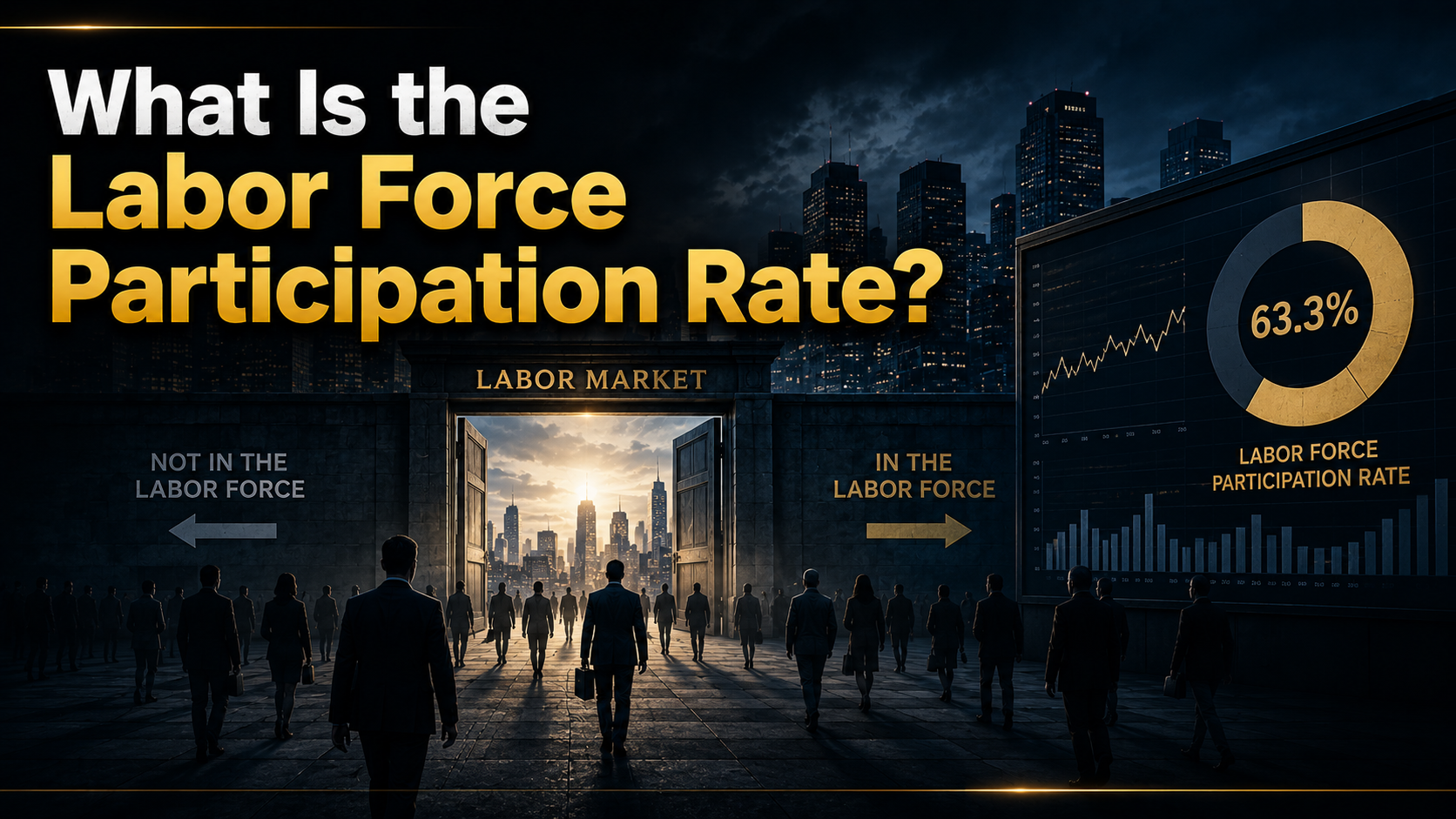
Key Takeaway
The Labor Force Participation Rate measures the percentage of the working-age population that is either employed or actively seeking employment, making it one of the most important indicators of the true strength of the U.S. labor market.
What Is the Labor Force Participation Rate?
The Labor Force Participation Rate (LFPR) measures the share of the civilian working-age population that is actively participating in the labor market.
In the United States, the Bureau of Labor Statistics (BLS) generally defines the working-age population as the civilian noninstitutional population aged 16 and older.
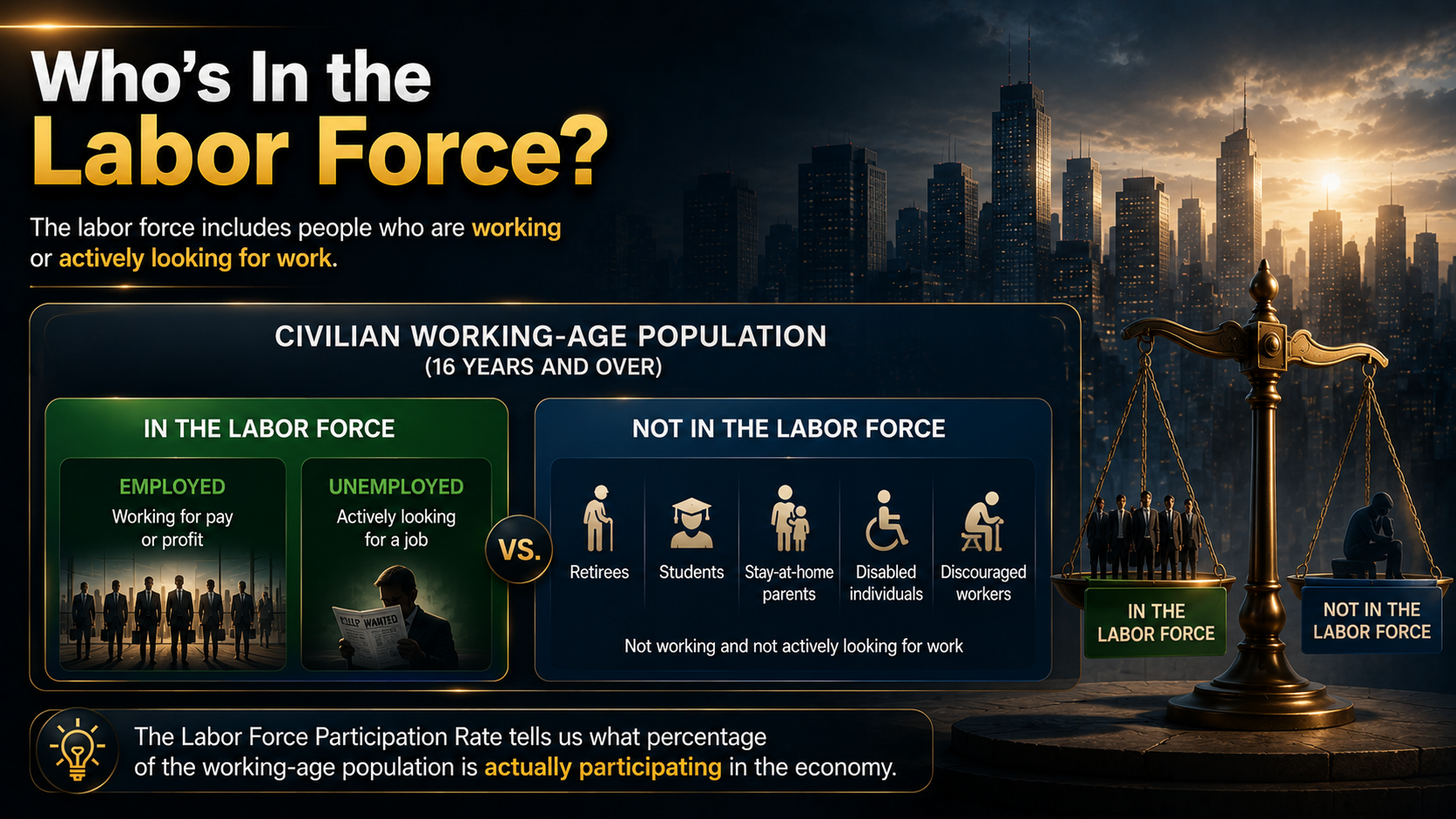
The population can be divided into two groups.
Labor Force
People who are actively participating in the economy, including
- Employed workers
- Unemployed individuals actively searching for a job
Not in the Labor Force
People who are not currently participating in the labor market, such as
- Retirees
- Full-time students
- Stay-at-home parents
- Individuals with long-term illnesses or disabilities
- Discouraged workers who have stopped looking for employment
In simple terms, the labor force participation rate answers a straightforward question:
"Out of everyone who could potentially work, how many are actually participating in the labor market?"
How Is the Labor Force Participation Rate Calculated?
The calculation is straightforward.
Labor Force Participation Rate = Labor Force ÷ Civilian Working-Age Population × 100
For example
- Working-age population: 1,000 people
- Employed: 620
- Unemployed but actively looking: 30
The labor force equals 650 people.
Therefore
650 ÷ 1,000 × 100 = 65%
Although the calculation is simple, its implications for investors are significant.
Why the Unemployment Rate Can Be Misleading
Many investors assume a falling unemployment rate automatically signals a healthier economy.
That isn't always true.
The unemployment rate only counts people who are actively looking for work.
If someone stops searching for a job, that person is no longer classified as unemployed.
Instead, they move into the "not in the labor force" category.
This creates one of the most misunderstood statistical effects in economics.
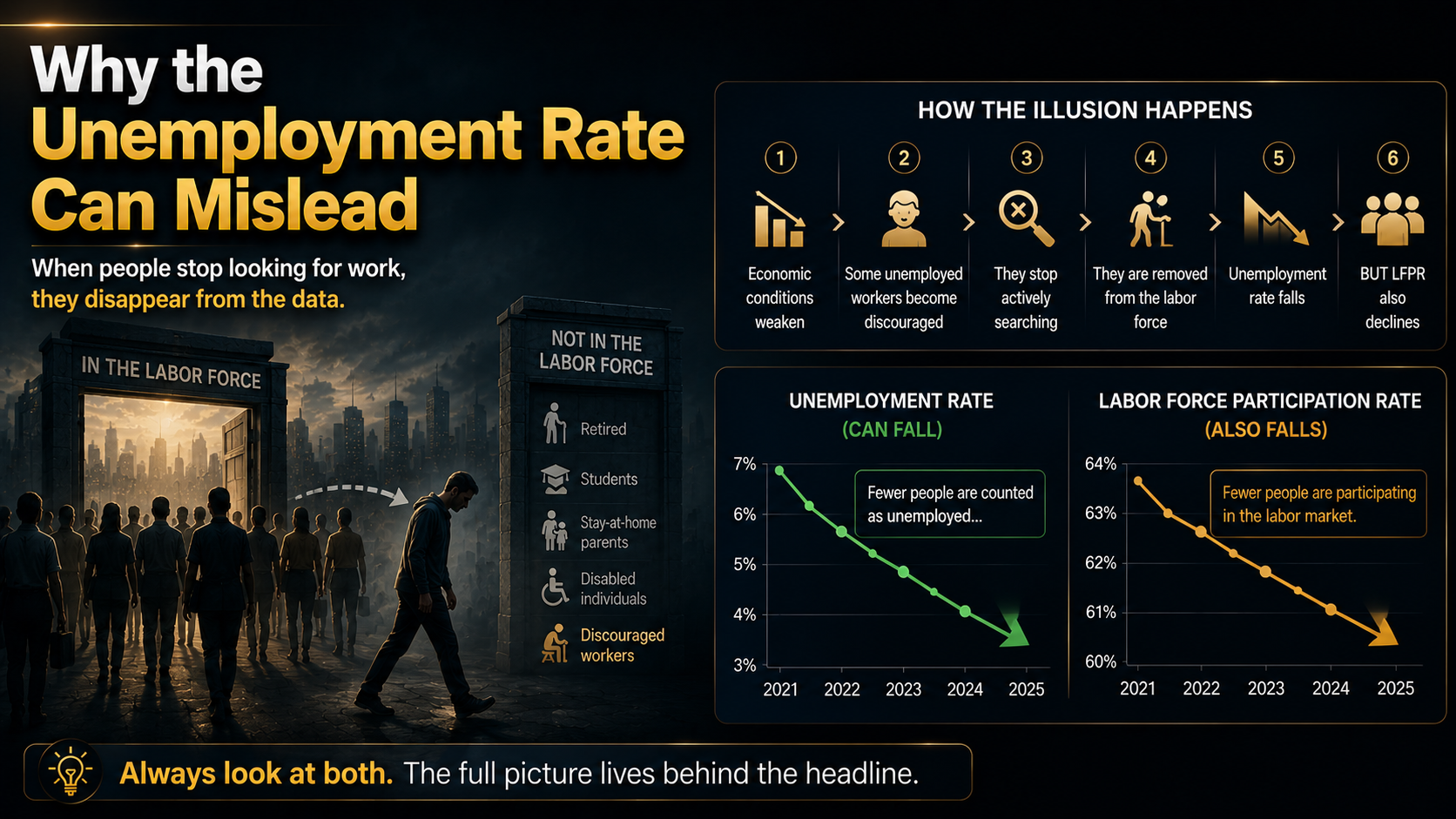
How the Illusion Happens
- Economic conditions weaken.
- Some unemployed workers become discouraged.
- They stop actively searching for jobs.
- They are removed from the labor force.
- The unemployment rate falls because fewer people are counted as unemployed.
- At the same time, the labor force participation rate also declines.
This is why professional economists rarely analyze the unemployment rate in isolation.
The labor force participation rate provides the missing context.
Why the Federal Reserve Watches the Labor Force Participation Rate
The Federal Reserve has two primary objectives
- Maximum employment
- Price stability
A strong labor market is not simply one with a low unemployment rate.
It is one where labor supply is sufficient to support economic growth without generating excessive inflation.
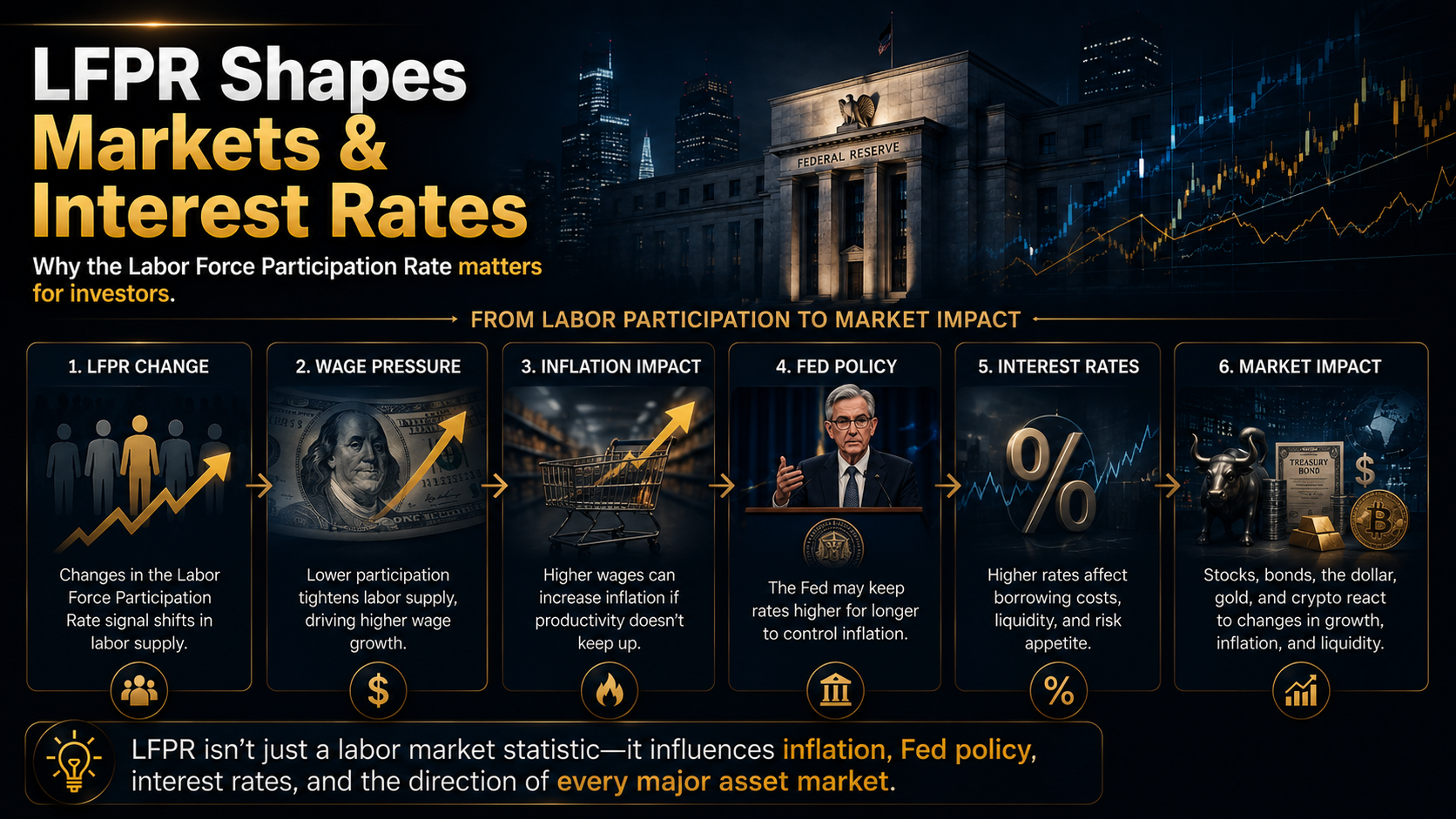
If labor force participation declines, businesses may struggle to find workers.
To attract employees, companies often increase wages.
Higher wages can support consumer spending, but they can also contribute to persistent inflation if productivity does not improve at the same pace.
Conversely, rising labor force participation expands labor supply, easing wage pressures and potentially reducing inflationary risks.
This is one reason Federal Reserve officials carefully monitor LFPR alongside payroll growth, wage inflation, and other labor market indicators.
Why Investors Should Care
Labor force participation influences far more than employment statistics.
It affects the entire macroeconomic landscape.
Inflation
Lower labor participation can tighten labor supply, increasing wage growth and inflationary pressure.
Interest Rates
Persistent labor shortages may encourage the Federal Reserve to keep interest rates higher for longer.
Corporate Earnings
Rising labor costs can compress corporate profit margins, particularly in labor-intensive industries.
Economic Growth
A larger workforce generally supports stronger long-term GDP growth by increasing production capacity and consumer income.
Market Impact
| Asset Class | Rising Labor Force Participation | Falling Labor Force Participation |
| U.S. Stocks | Lower wage pressure may improve corporate margins and support growth stocks. | Rising labor costs may pressure earnings, especially in labor-intensive sectors. |
| Treasuries | Lower inflation expectations can support bond prices. | Persistent inflation concerns may push Treasury yields higher. |
| U.S. Dollar | Softer Fed expectations may weigh on the dollar. | Higher-for-longer interest rate expectations may strengthen the dollar. |
| Gold | Lower real yields often benefit gold. | Higher real yields can pressure gold prices. |
| Bitcoin & Risk Assets | Improved liquidity expectations can support risk appetite. | Tight monetary policy may increase volatility across risk assets. |
Importantly, markets do not react to the labor force participation rate itself—they react to what it implies about inflation, Federal Reserve policy, and future liquidity conditions.
What Investors Should Watch
The labor force participation rate should never be analyzed in isolation.
It becomes far more valuable when viewed alongside
- Nonfarm Payrolls (NFP)
- Average Hourly Earnings
- Unemployment Rate
- JOLTS Job Openings
- Employment Cost Index (ECI)
Looking at these indicators together provides a more complete picture of labor market conditions than any single statistic alone.
What Smart Money Sees
Experienced investors rarely focus on one monthly employment report.
Instead, they look for structural trends.
Capital Flows
If labor participation continues to decline, labor becomes more expensive.
Over time, capital often flows toward businesses that improve productivity through automation, artificial intelligence, robotics, and software.
Cash Flow Resilience
Companies with strong free cash flow, pricing power, and healthy balance sheets tend to perform better during prolonged periods of elevated labor costs and higher interest rates.
Long-Term Perspective
Rather than trying to predict every Federal Reserve decision, long-term investors focus on understanding how labor market trends influence the broader economic cycle.
Ask yourself
- Is the unemployment rate improving because more people found jobs—or because fewer people are looking?
- Is wage growth being driven by productivity or labor shortages?
- Can the companies I own absorb higher labor costs?
- How might changes in labor participation influence future Fed policy?
- Which sectors are likely to benefit from long-term labor market trends?
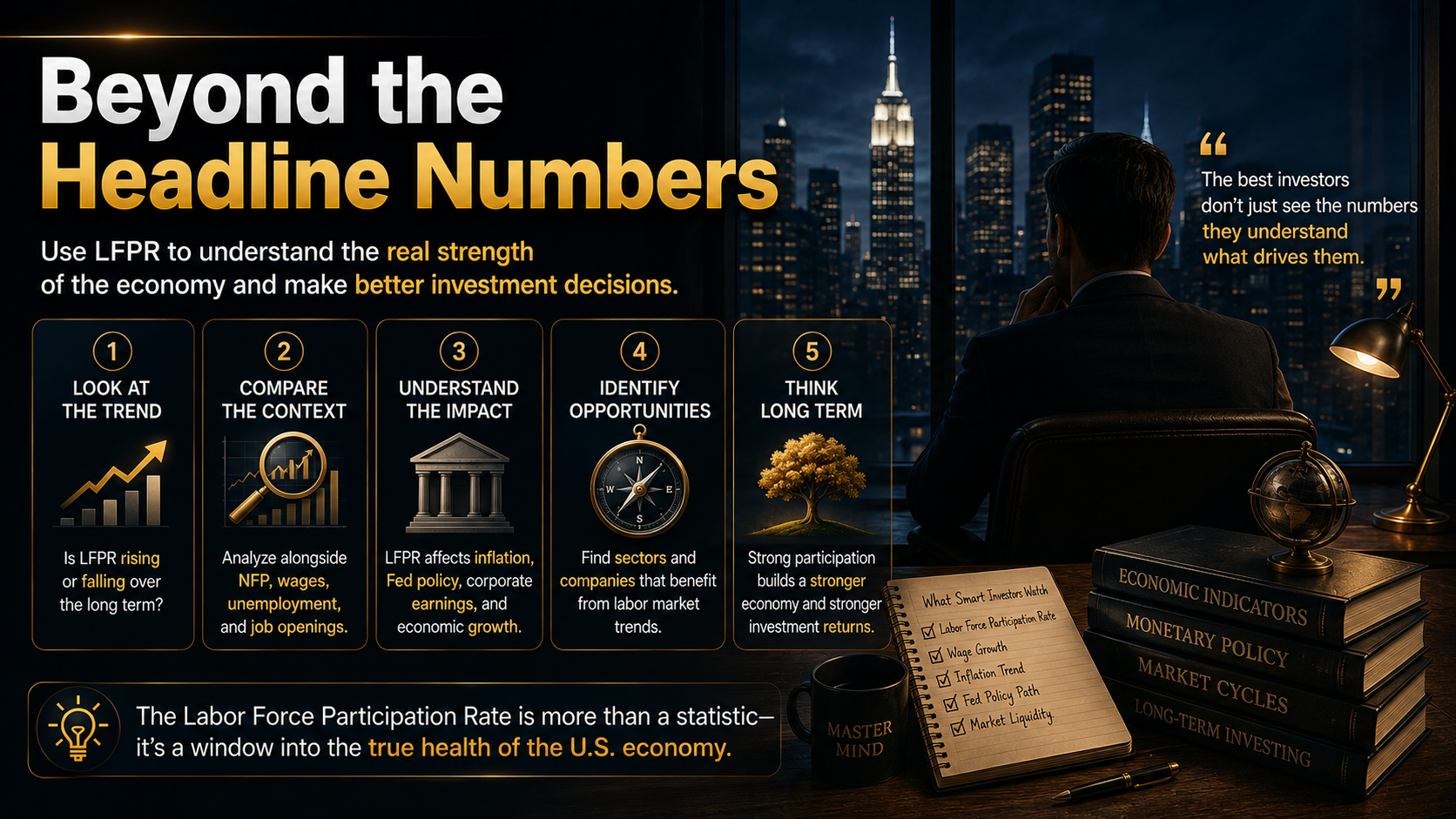
The best investors don't simply analyze employment statistics—they analyze how those statistics influence capital flows, corporate earnings, and long-term economic resilience.
Final Thoughts
The Labor Force Participation Rate is far more than another employment statistic.
It provides critical insight into labor supply, inflation, Federal Reserve policy, and the long-term health of the U.S. economy.
While the unemployment rate often dominates financial headlines, the labor force participation rate helps investors understand what is happening beneath the surface.
Successful investing is rarely about reacting to a single number.
It is about understanding the underlying economic forces that shape liquidity, corporate profits, and market cycles.
The Labor Force Participation Rate remains one of the most valuable indicators for seeing the bigger picture.
This was MasterMind.
'[Global] Success Blueprints' 카테고리의 다른 글