What Is the Halo Effect? Why Investors Mistake Great Companies for Great Stocks


Hello, this is MasterMind.
Have you ever looked at a company like Apple, NVIDIA, Costco, or Microsoft and thought, "This is an incredible business, so buying the stock must be a smart investment"?
It's one of the most common assumptions investors make—and one of the most dangerous.
A company can have world-class products, a powerful brand, exceptional leadership, and years of profitable growth. Yet its stock can still produce disappointing returns if investors pay too much for it.
This disconnect is often driven by a psychological bias known as the Halo Effect.
Instead of evaluating a company objectively, investors allow one outstanding characteristic—such as a beloved brand or visionary CEO—to shape their opinion of everything else, including whether the stock is worth buying.
Understanding this bias is essential because successful investing is not just about finding great businesses. It's about knowing when the market has already priced that greatness into the stock.
Key Takeaway
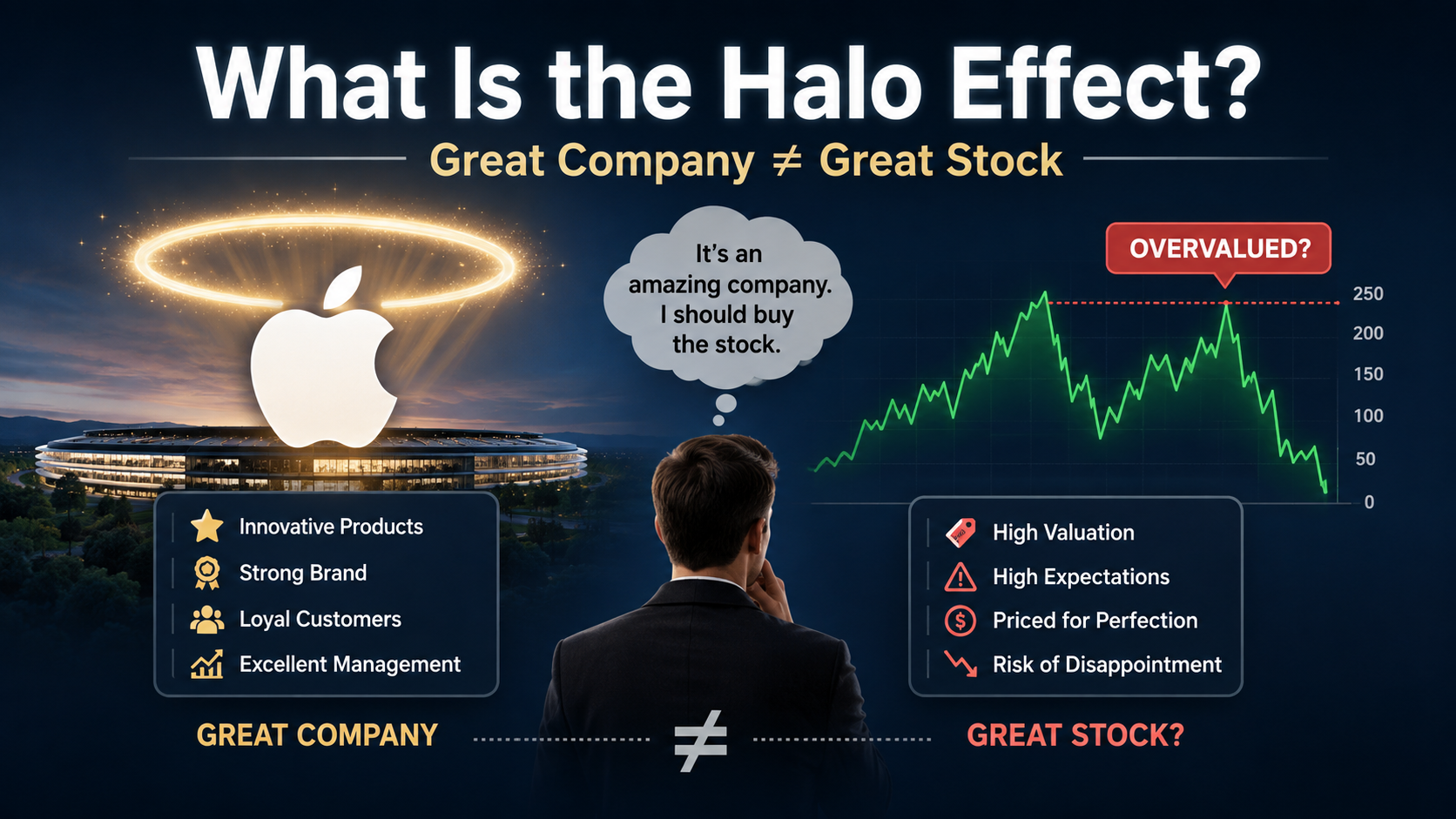
The Halo Effect is a cognitive bias that causes investors to mistake a great company for a great investment, often ignoring valuation, expectations, and future return potential.
What Is the Halo Effect?
The Halo Effect is a cognitive bias in which one positive characteristic influences our overall judgment of a person, company, or product.
Originally introduced by psychologist Edward Thorndike, the concept explains why people often assume that excellence in one area automatically means excellence in others.
In investing, the Halo Effect appears when investors think things like
- "Apple makes amazing products, so its stock must be a great buy."
- "NVIDIA dominates AI, so the shares can only keep rising."
- "This CEO has an incredible track record, so the company will always outperform."
- "Everyone loves this brand, so paying any price is justified."
The problem is that a great business and a great stock are not the same thing.
A stock is not simply a claim on today's company. It is a claim on future expectations that have already been reflected in today's market price.
If those expectations become too optimistic, even an outstanding company can become a disappointing investment.
How the Halo Effect Works
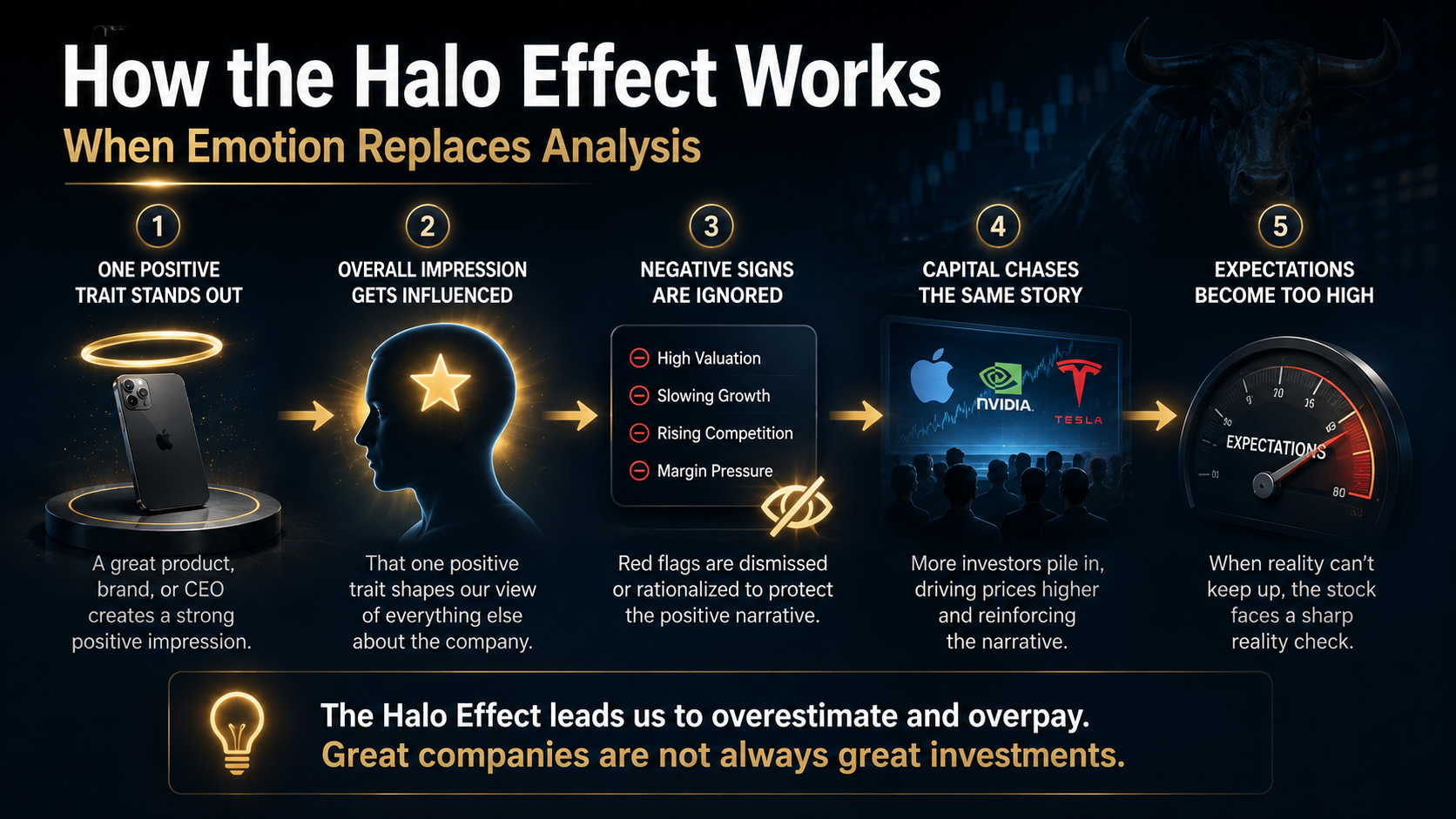
Although financial markets appear to be driven by numbers, they are ultimately driven by human decisions.
The Halo Effect follows a predictable psychological process.
1. Investors Simplify Complex Decisions
Analyzing financial statements, competitive advantages, cash flow, and valuation requires time and effort.
Instead, the brain prefers shortcuts.
The thought process often looks like this
Great product → Great company → Great stock
While this feels logical, each step represents a completely different question.
A company's quality does not automatically determine whether its shares are attractively priced.
2. Confirmation Bias Reinforces the Story
Once investors believe a company is exceptional, they naturally seek information that confirms their opinion.
Positive headlines receive attention.
Warning signs such as slowing earnings growth, expensive valuations, or weaker margins are often dismissed as temporary setbacks.
Instead of challenging their assumptions, investors become emotionally attached to the narrative.
3. Capital Begins to Chase the Same Story
The Halo Effect doesn't influence only individual investors.
When Wall Street embraces a compelling story—whether it's artificial intelligence, cloud computing, electric vehicles, or another major trend—institutional money, ETFs, and retail investors often move in the same direction.
As more capital flows into the same companies, valuations expand rapidly.
Eventually, stock prices may rise far faster than the underlying business itself.
Why the Halo Effect Matters
One of the biggest lessons in investing is that great companies don't always make great investments.
The market doesn't reward quality alone.
It rewards the difference between expectations and reality.
If investors already expect perfection, even strong earnings may not be enough to push a stock higher.
On the other hand, companies with modest expectations can outperform dramatically simply by delivering better-than-expected results.
This is why experienced investors spend just as much time evaluating valuation and market expectations as they do studying the business itself.
The market is constantly pricing the future—not the present.

How the Halo Effect Influences Financial Markets
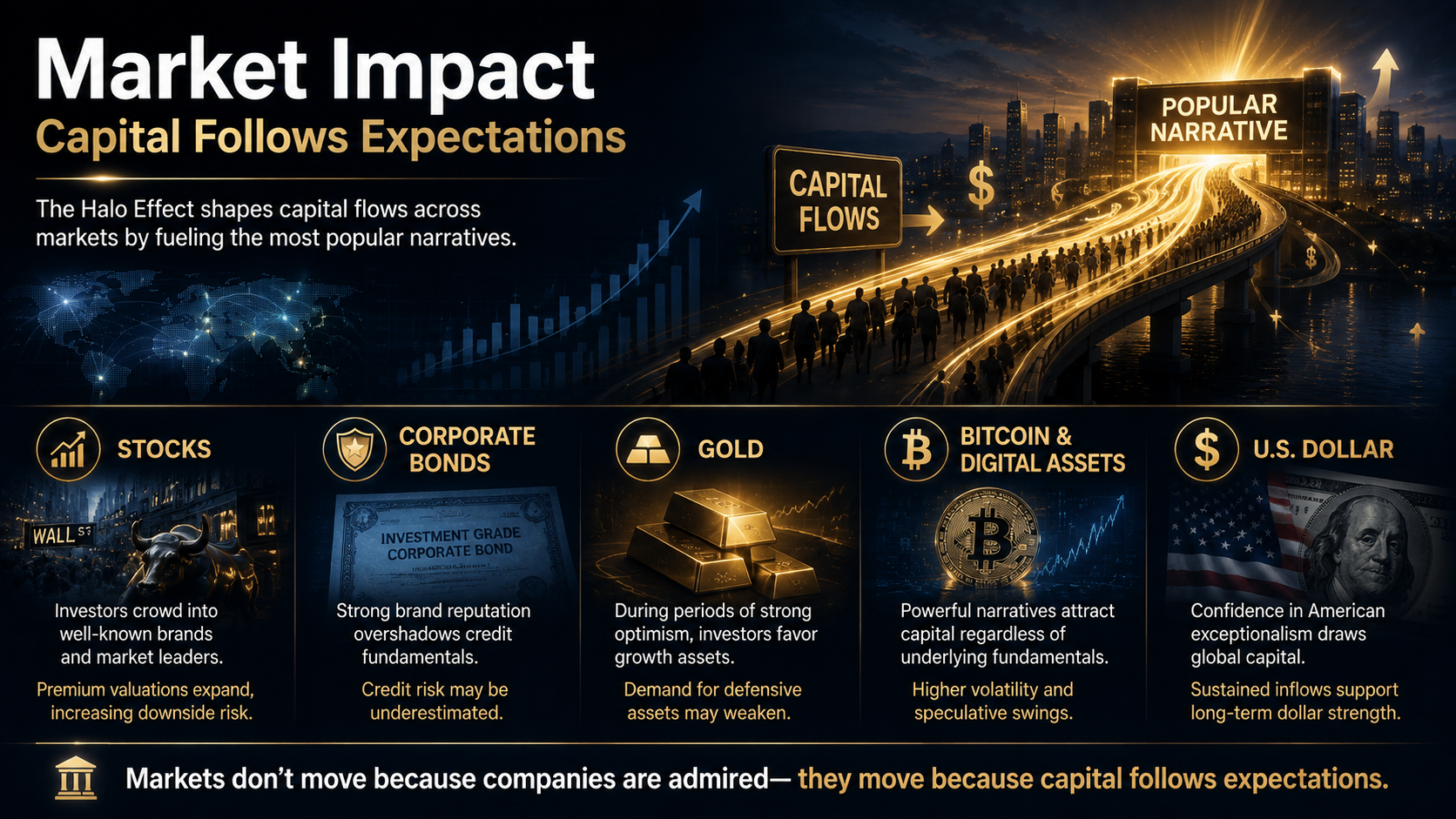
The Halo Effect doesn't affect just individual stock picks. It can shape capital flows across entire asset classes by directing money toward the most popular narratives.
| Asset Class | How the Halo Effect Appears | Potential Market Impact |
| Stocks | Investors crowd into well-known brands and market leaders. | Premium valuations expand, increasing downside risk if expectations aren't met. |
| Corporate Bonds | Strong brand reputation overshadows credit fundamentals. | Investors may underestimate credit risk and accept lower risk premiums. |
| Gold | During periods of strong optimism, investors often favor growth assets over safe havens. | Demand for defensive assets may temporarily weaken. |
| Bitcoin & Digital Assets | Powerful narratives attract capital regardless of underlying fundamentals. | Higher volatility and speculative price swings become more likely. |
| U.S. Dollar | Confidence in American exceptionalism draws global capital into U.S. assets. | Sustained capital inflows can support long-term dollar strength. |
Ultimately, markets don't move because companies are admired—they move because capital follows expectations.
Practical Lessons for Investors
Avoiding the Halo Effect doesn't mean avoiding great companies.
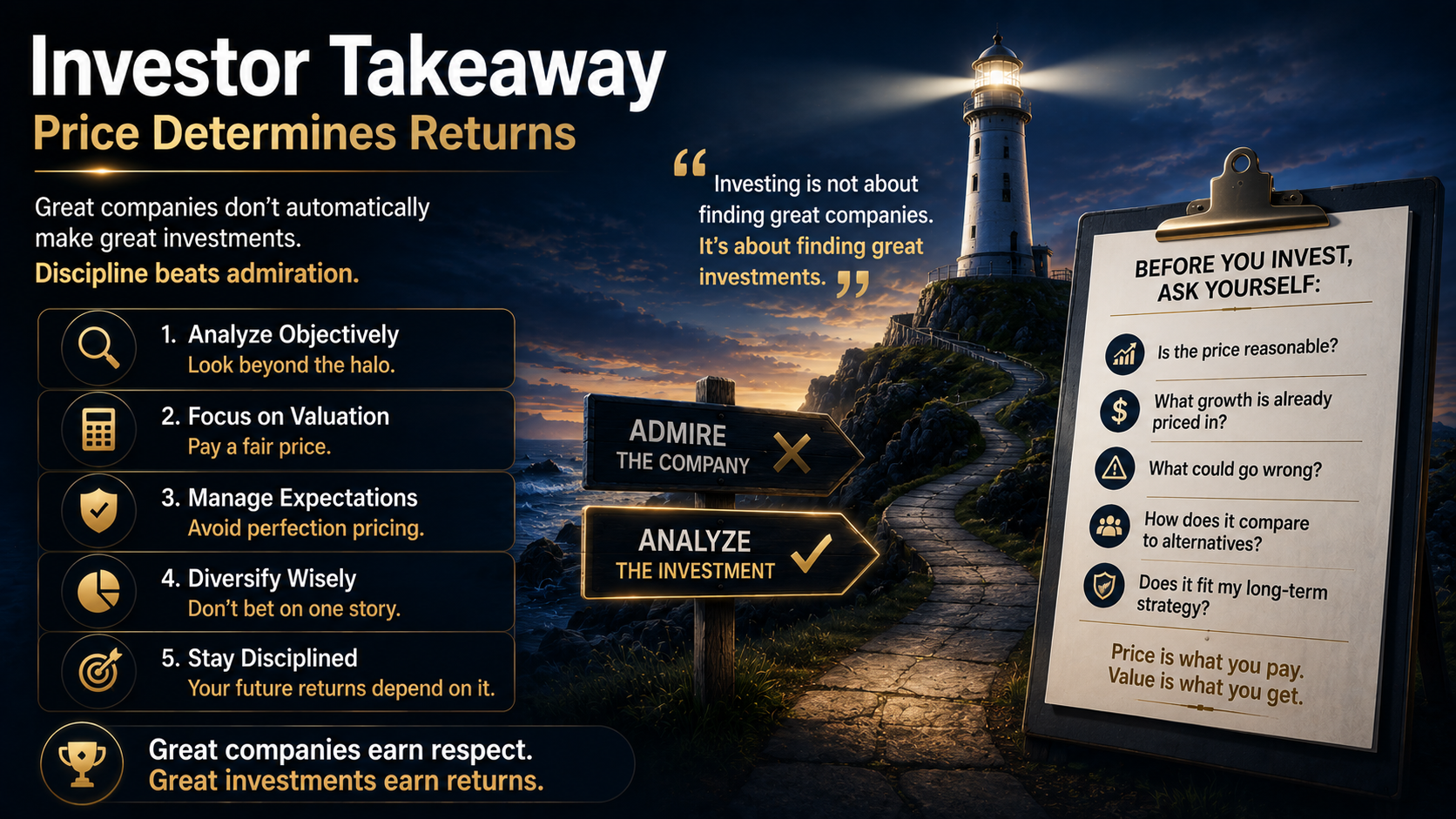
It means evaluating great companies with the same discipline you would apply to any investment.
Before buying a stock, ask yourself
- Is this company's valuation significantly above its historical average?
- Is revenue growth translating into earnings and free cash flow?
- Am I buying the business, or simply paying for its reputation?
- Has Wall Street already priced in years of future success?
- Does the financial performance justify the current market price?
The best investments aren't always the most popular ones.
Often, they're the businesses whose future potential is still underestimated by the market.
What Do Experienced Investors See?
Professional investors rarely chase popularity.
Instead, they focus on where capital is flowing, how cash is being generated, and whether expectations have become unrealistic.
They Follow Capital, Not Headlines
When public enthusiasm reaches extreme levels, experienced investors begin asking a different question
"How much of the good news is already reflected in today's stock price?"
Sometimes the greatest risk isn't buying a bad company—it's paying too much for an outstanding one.
They Prioritize Cash Flow
A powerful brand can attract customers.
Consistent free cash flow creates shareholder value.
Experienced investors understand that over the long run, businesses are ultimately valued by their ability to generate sustainable cash—not by how exciting their story sounds.
They Think About Survival
Every market cycle eventually changes.
Companies with strong balance sheets, durable competitive advantages, and reliable cash generation are generally better positioned to survive periods of economic uncertainty.
Long-term investing isn't about predicting every market move.
It's about owning assets that can continue compounding through multiple market cycles.
Ask yourself
- Am I investing because the fundamentals justify the price?
- Or am I simply following a company that everyone else already loves?
- If market sentiment changed tomorrow, would I still want to own this business?
- Is today's valuation supported by future cash flows?
The answers to these questions often separate disciplined investors from emotional ones.
Final Thoughts
The Halo Effect is one of the most subtle psychological traps in investing.
Exceptional products, iconic brands, and visionary leadership are all valuable strengths—but they do not guarantee attractive future returns.
Markets reward the gap between expectations and reality, not popularity alone.
The most successful investors understand that buying a wonderful business is only half of the equation.
The other half is making sure the price leaves room for future returns.
In investing, long-term success comes not from predicting the future with certainty, but from consistently making rational decisions while avoiding costly psychological biases.
Thank you for reading.
This was MasterMind.
'[Global] Success Blueprints' 카테고리의 다른 글