What Is the Dollar Smile Theory? Why the U.S. Dollar Gets Stronger in Both Good and Bad Times


Hello, this is MasterMind.
Why does the U.S. dollar often strengthen during a global financial crisis—and also when the U.S. economy is outperforming the rest of the world?
At first glance, this seems contradictory. Conventional wisdom suggests that a country's currency should appreciate only when its economy is strong. Yet the U.S. dollar behaves differently.
Whether investors are fleeing risk during a global recession or chasing higher returns in America's booming economy, the result can be the same: a stronger U.S. dollar.
This unique pattern is explained by one of the most widely recognized frameworks in foreign exchange markets—the Dollar Smile Theory.
Understanding this concept can help investors look beyond exchange rates and better interpret movements in stocks, bonds, commodities, gold, and even cryptocurrencies through the lens of global capital flows.
The One-Sentence Takeaway
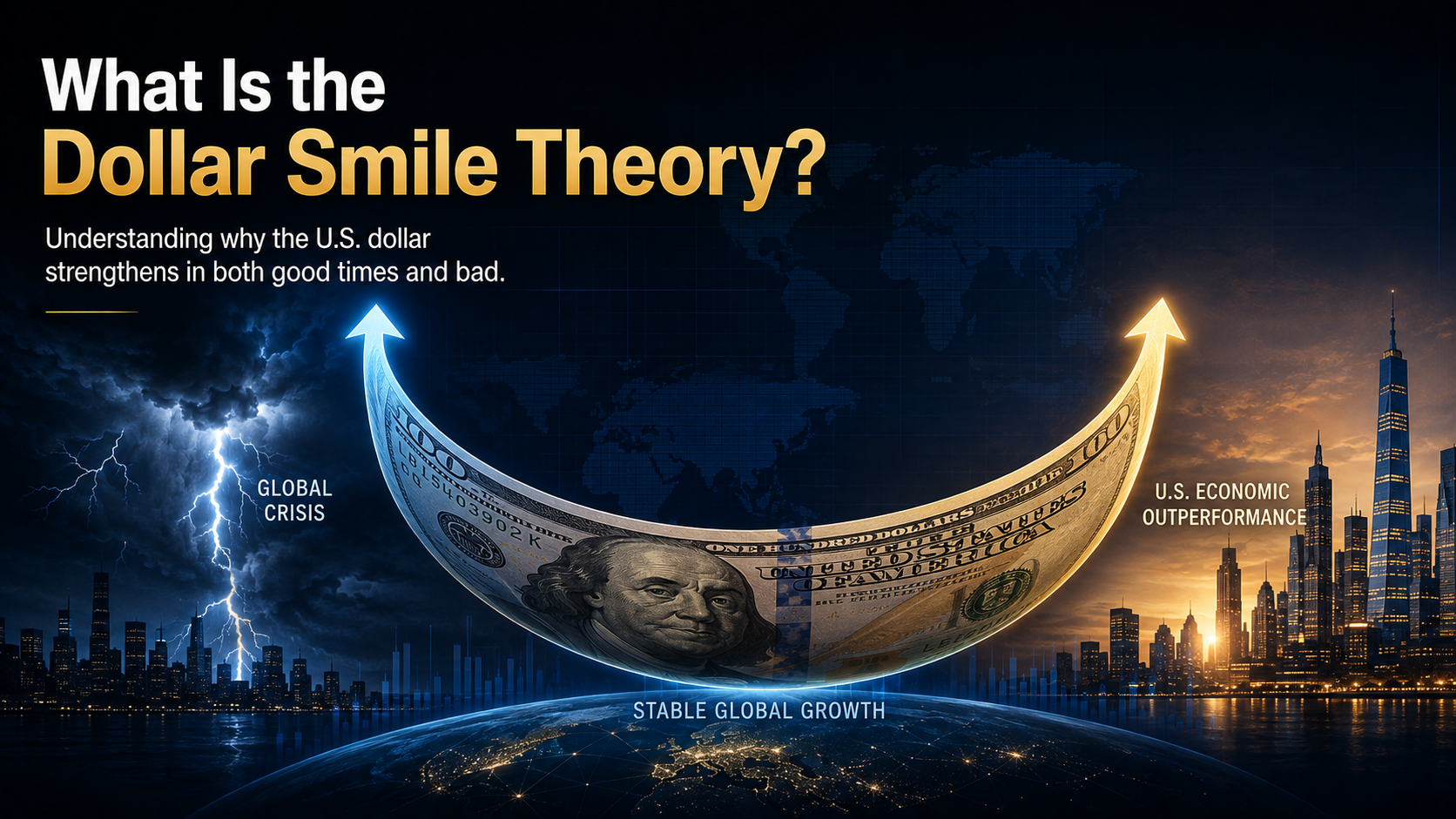
The Dollar Smile Theory explains why the U.S. dollar tends to appreciate during two opposite economic extremes—periods of global fear and periods of exceptional U.S. economic strength—while weakening during synchronized global growth.
What Is the Dollar Smile Theory?
The Dollar Smile Theory was introduced by Stephen Jen, a former Morgan Stanley currency strategist, in the early 2000s.
The theory suggests that the value of the U.S. dollar follows a "smile-shaped" pattern rather than moving in a straight line.
Imagine plotting the dollar's strength against the relative performance of the U.S. economy.
At both extremes, the dollar becomes stronger.
- On one side, investors rush into the dollar because they fear global risk.
- On the other side, investors buy dollars because they want exposure to America's stronger economy and higher returns.
In the middle—when the global economy is expanding broadly and risk appetite is healthy—the dollar often weakens.
This creates a curve that resembles a smile.
More importantly, the Dollar Smile Theory is not simply a currency model.
It is a framework for understanding how global liquidity and investor psychology influence international capital flows.
Rather than asking, "Where is the dollar going?"
The better question is
"Why is money moving into the dollar in the first place?"
How the Dollar Smile Theory Works

The theory consists of three distinct phases.
Phase 1: Global Crisis and Safe-Haven Demand (Left Side of the Smile)
The first source of dollar strength occurs during periods of global uncertainty.
Examples include
- The 2008 Global Financial Crisis
- The COVID-19 pandemic
- Banking stress
- Geopolitical conflicts
- Severe recession fears
When uncertainty dominates financial markets, investors stop prioritizing returns.
Instead, they prioritize capital preservation.
Money flows out of
- Equities
- High-yield bonds
- Emerging markets
- Risk assets
and into
- U.S. Treasury securities
- Cash
- U.S. dollars
This is known as a flight to safety.
Although the global economy may be weakening, demand for the dollar rises because it remains the world's primary reserve currency and the most liquid financial asset.
In other words, the dollar becomes stronger because investors are seeking protection.
Phase 2: Broad Global Expansion (Middle of the Smile)
The middle of the smile represents periods when the global economy is growing steadily.
Economic conditions generally include
- Expanding global trade
- Improving corporate earnings
- Strong investor confidence
- Rising demand for risk assets
During these environments, investors become more willing to seek higher returns outside the United States.
Capital begins flowing toward
- Emerging markets
- International equities
- Commodities
- Higher-growth regions
Demand for dollars gradually declines, causing the currency to weaken.
This is typically considered a risk-on environment, where investors are rewarded for taking additional risk rather than holding defensive assets.
Phase 3: U.S. Economic Outperformance (Right Side of the Smile)
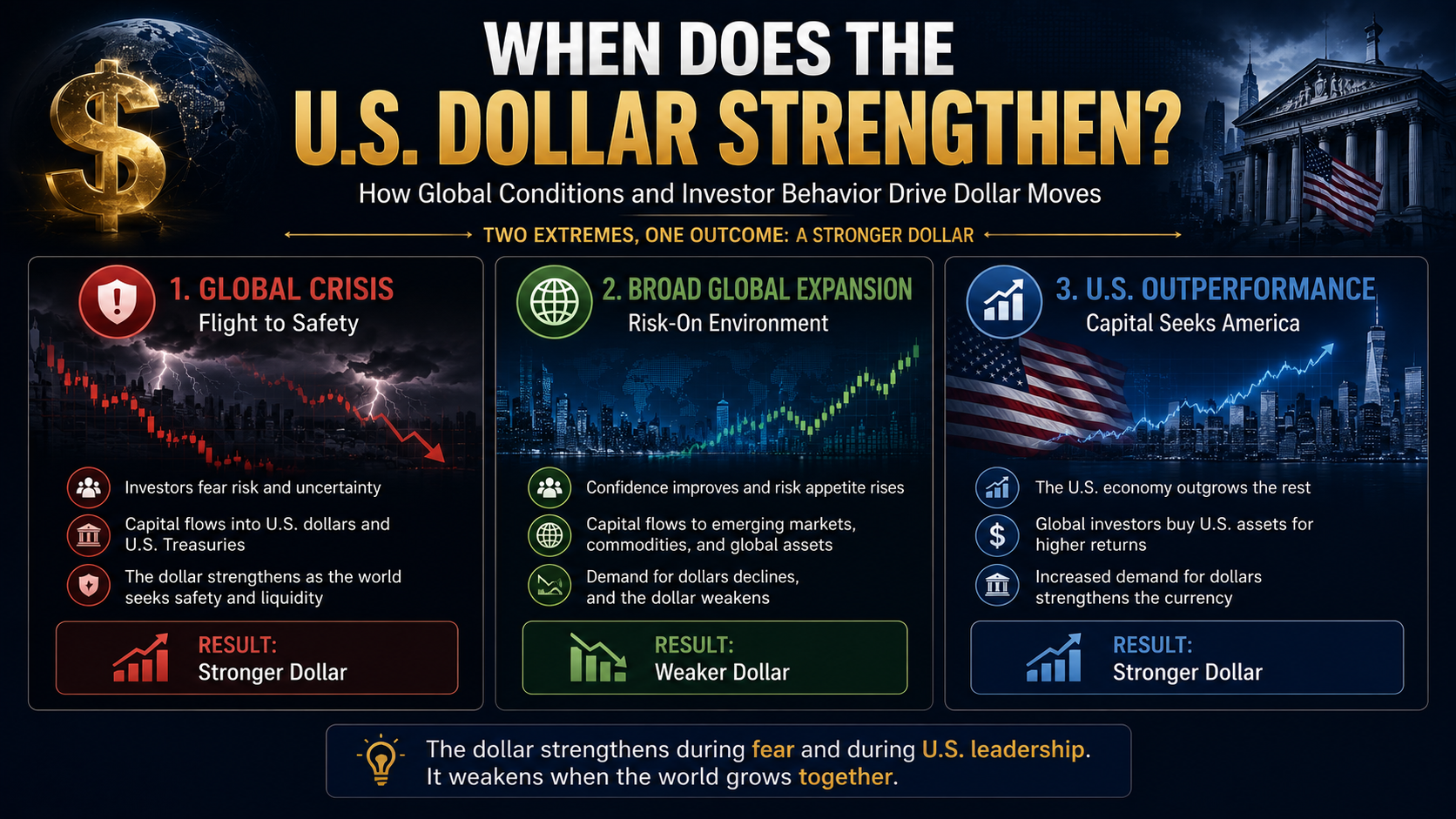
The third phase produces another period of dollar strength—but for an entirely different reason.
Instead of fear, this phase is driven by confidence.
When the U.S. economy significantly outperforms the rest of the world, several factors often emerge simultaneously
- Faster GDP growth
- Higher productivity
- Strong corporate earnings
- Elevated interest rates
- Greater investment opportunities
Global investors increasingly allocate capital toward U.S. financial assets because America offers both stronger economic fundamentals and potentially higher returns.
As foreign investors purchase
- U.S. stocks
- Treasury securities
- Corporate bonds
- Real estate
- Dollar-denominated assets
they must first buy U.S. dollars.
That additional demand strengthens the currency.
Unlike the left side of the smile, where investors buy dollars for safety, the right side reflects investors buying dollars because they want exposure to America's economic leadership.
Why the Dollar Smile Theory Matters
Many investors think of the dollar simply as an exchange rate.
In reality, the U.S. dollar functions as the backbone of the global financial system.
International trade, commodity pricing, sovereign reserves, and cross-border capital flows are all heavily linked to the dollar.
Because of that, changes in the dollar often influence far more than currency markets.
A stronger dollar can affect
- Global liquidity
- Corporate financing conditions
- Emerging market debt
- Commodity prices
- International investment flows
Conversely, a weaker dollar often supports global risk assets by increasing liquidity and encouraging investors to allocate capital beyond the United States.
Markets are rarely driven by economic data alone. They move because capital continuously seeks the safest destination—or the highest expected return.
Understanding the Dollar Smile Theory helps investors recognize why capital is moving, not just where it is moving.
How the Dollar Smile Theory Affects Financial Markets
The impact of the U.S. dollar extends far beyond the foreign exchange market.
Because the dollar sits at the center of the global financial system, changes in its strength can influence virtually every major asset class.
However, one of the biggest mistakes investors make is assuming that every dollar rally has the same meaning.
The reason behind a stronger dollar often matters more than the strength itself.
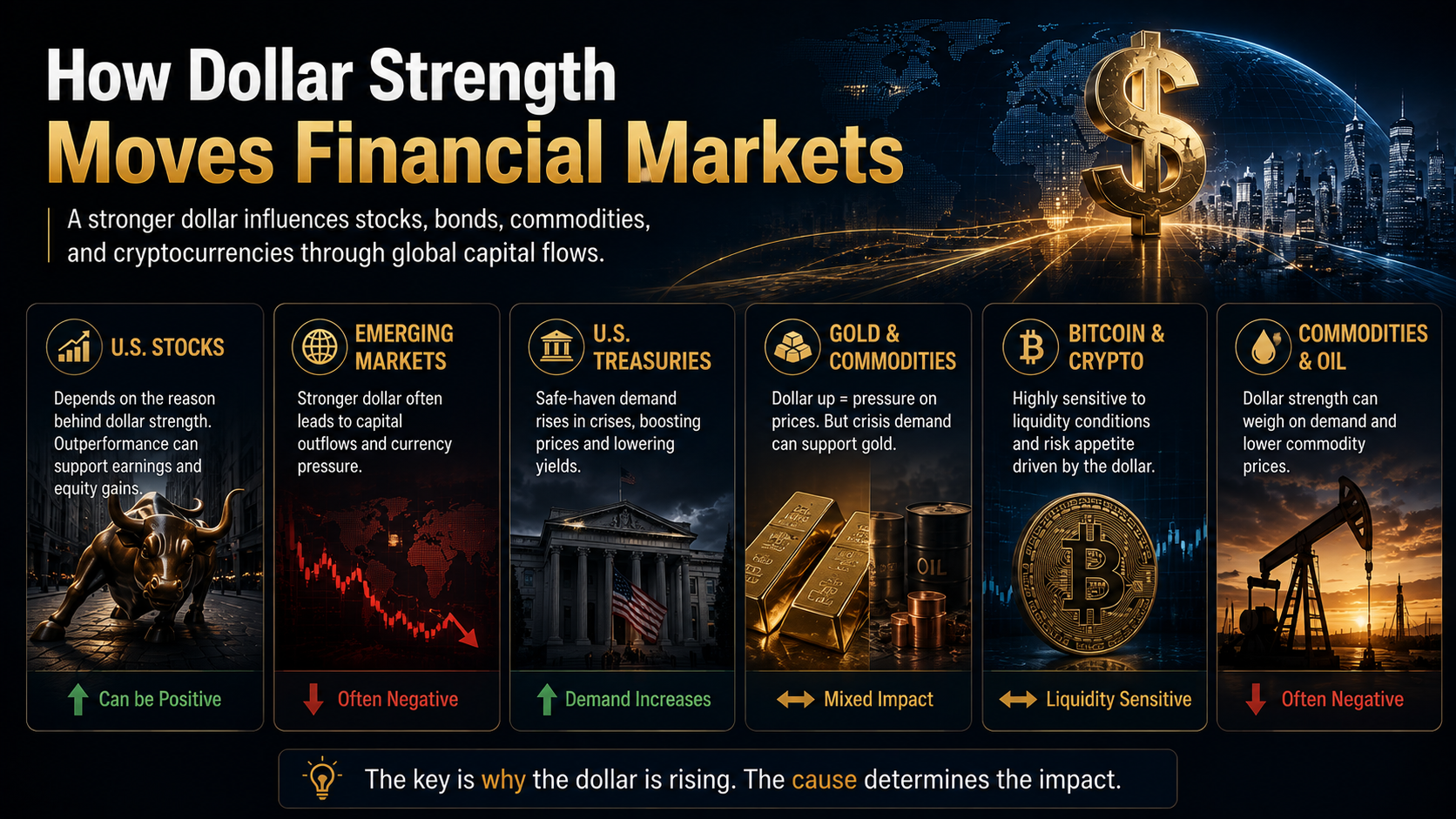
| Asset Class | Global Crisis (Left Smile) | Global Expansion (Middle) | U.S. Outperformance (Right Smile) |
| U.S. Dollar | Strong | Weak | Strong |
| U.S. Stocks | Higher volatility | Broad gains | Growth stocks often outperform |
| Emerging Markets | Capital outflows | Capital inflows | Relative underperformance |
| U.S. Treasuries | Higher demand | Stable | Pressure from rising yields |
| Gold | Mixed initially, often recovers | Often benefits | Faces headwinds |
| Commodities | Demand concerns | Stronger performance | Often pressured |
| Bitcoin & Crypto | Higher volatility | Liquidity-driven gains | Depends on liquidity conditions |
A Strong Dollar Is Not Always Bad for Stocks
Many investors automatically assume that a rising dollar is bearish for equities.
The Dollar Smile Theory shows why that assumption can be misleading.
When the Dollar Rises Because Investors Are Afraid
During financial crises, investors seek liquidity and safety.
Money flows into
- Cash
- U.S. Treasuries
- The U.S. dollar
At the same time, investors reduce exposure to equities and other risk assets.
In this environment, a stronger dollar usually reflects tighter financial conditions and weaker investor confidence.
When the Dollar Rises Because America Is Leading Global Growth
The situation changes dramatically when the U.S. economy is outperforming.
If economic growth is accelerating, corporate earnings are improving, and productivity is rising, investors buy U.S. assets because they expect stronger long-term returns.
This type of dollar strength often accompanies
- Expanding corporate profits
- Higher business investment
- Strong labor markets
- Innovation-driven growth
- Rising equity valuations
In other words, a stronger dollar can coexist with a strong stock market when it reflects economic leadership rather than fear.
The cause matters far more than the headline.
Key Takeaways for Investors
1. Focus on Why the Dollar Is Moving
The exchange rate is only the outcome.
The real question is
- Is the dollar rising because investors are avoiding risk?
- Or because the U.S. economy is attracting global capital?
Those two environments often produce very different investment opportunities.
2. Watch Relative Strength, Not Absolute Growth
Currencies move based on relative performance.
The dollar doesn't strengthen simply because the U.S. economy is improving.
It strengthens when the United States performs better than other major economies.
This is why investors closely monitor
- Federal Reserve policy
- Treasury yields
- Economic growth differentials
- Inflation trends
- Global capital flows
3. Liquidity Often Matters More Than Headlines
Short-term news can create volatility.
Liquidity creates trends.
Understanding where global capital is flowing provides a much clearer picture of market direction than reacting to individual headlines.
Professional investors spend far more time tracking money flows than predicting tomorrow's news.
What Professional Investors Watch
Experienced investors rarely focus only on the dollar index itself.
Instead, they ask what the dollar is signaling about the broader financial system.
They pay attention to four key areas.
Capital Flows
Is money moving into defensive assets such as U.S. Treasuries?
Or is it flowing into equities, private markets, and higher-risk investments?
Following capital often reveals market direction before prices fully adjust.
Liquidity Conditions
Liquidity determines how easily money moves throughout financial markets.
When liquidity expands, risk assets generally benefit.
When liquidity contracts, volatility often increases.
The dollar provides valuable clues about these shifts.
Portfolio Resilience
Professional investors understand that predicting every market move is impossible.
Instead of trying to forecast every economic cycle, they build portfolios capable of surviving multiple environments.
Resilience matters more than precision.
Long-Term Perspective
The Dollar Smile Theory is not designed for short-term currency speculation.
It provides a framework for understanding where global capital is likely to move over longer economic cycles.
Investors who recognize these shifts can make more informed decisions about risk exposure, diversification, and asset allocation.
Ask yourself
- Why is the dollar strengthening today?
- Is capital seeking safety or better returns?
- Are liquidity conditions becoming tighter or more supportive?
- Would my portfolio remain resilient if market conditions suddenly changed?
These questions often provide better investment guidance than trying to predict the next market headline.

Conclusion
The Dollar Smile Theory is far more than a foreign exchange concept.
It explains why the U.S. dollar can strengthen during both severe global downturns and periods of exceptional American economic performance.
More importantly, it reminds investors that markets are ultimately driven by capital flows rather than headlines.
Understanding where money is moving—and why—offers a deeper perspective than simply watching currency charts.
The next time the U.S. dollar begins to rally, don't ask only whether the dollar is getting stronger.
Ask what is causing investors around the world to demand more dollars.
The answer may reveal far more about the future direction of financial markets than the exchange rate itself.
Thank you for reading.
– MasterMind
'[Global] Success Blueprints' 카테고리의 다른 글