What Is the U.S. Debt Ceiling? Why It Matters to Investors and Financial Markets


Welcome to MasterMind.
Every few years, headlines warn that the United States is approaching its debt ceiling, raising fears of a government shutdown, a potential default, or intense political battles in Congress.
Yet many investors wonder the same thing
If Congress has already approved government spending, why does the debt ceiling matter? And why does a political debate in Washington move Treasury yields, stocks, the U.S. dollar, gold, and even Bitcoin?
The answer is that the debt ceiling is far more than a political headline. It sits at the intersection of government finance, Treasury markets, and global liquidity.
Understanding how the debt ceiling works helps investors interpret market volatility through the lens of capital flows and liquidity, rather than reacting to sensational news.
Key Takeaway
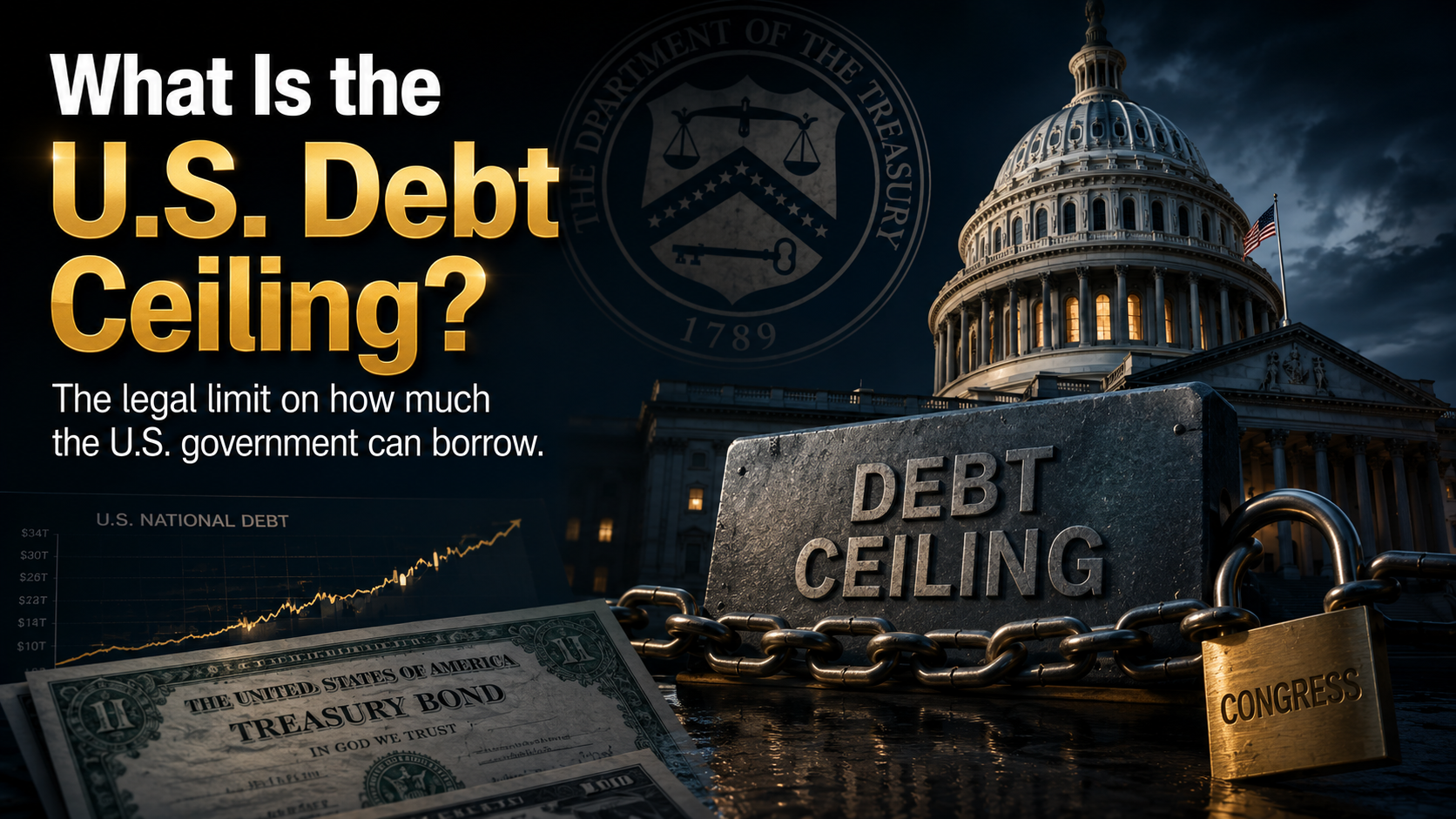
The U.S. debt ceiling is a legal limit on how much the federal government can borrow. For investors, it is important not because it determines government spending, but because it influences Treasury issuance, market liquidity, and confidence in the world's benchmark risk-free asset.
What Is the Debt Ceiling?
The Debt Ceiling is the legal limit on the total amount of money the U.S. federal government is authorized to borrow.
When government spending exceeds tax revenue, the Treasury finances the difference by issuing Treasury securities such as Treasury bills, notes, and bonds.
Unlike many countries, however, the U.S. Treasury cannot borrow without limit.
Once total federal debt reaches the statutory ceiling established by Congress, additional borrowing generally requires Congress to either raise, suspend, or modify the debt ceiling.
One of the biggest misconceptions is that raising the debt ceiling authorizes new government spending.
It does not.
Instead, it allows the government to finance obligations that Congress has already approved.
A useful analogy is a household that has already made purchases with a credit card. Increasing the credit limit does not create new spending—it simply allows the cardholder to pay for commitments that already exist.
The debt ceiling functions in much the same way.
Why Does the United States Have a Debt Ceiling?
The modern debt ceiling traces its origins to the Second Liberty Bond Act of 1917.
Before then, Congress had to approve nearly every individual issuance of federal debt.
As government financing became more complex—particularly during World War I—the system was changed to give the Treasury greater flexibility while still preserving Congressional oversight.
Today, the debt ceiling serves as a legal check on federal borrowing.
In practice, however, it has also become a recurring political negotiation, with lawmakers often using debt ceiling legislation to debate broader fiscal priorities.
This political dynamic is one reason debt ceiling discussions receive so much attention from financial markets.
How Does the Debt Ceiling Work?
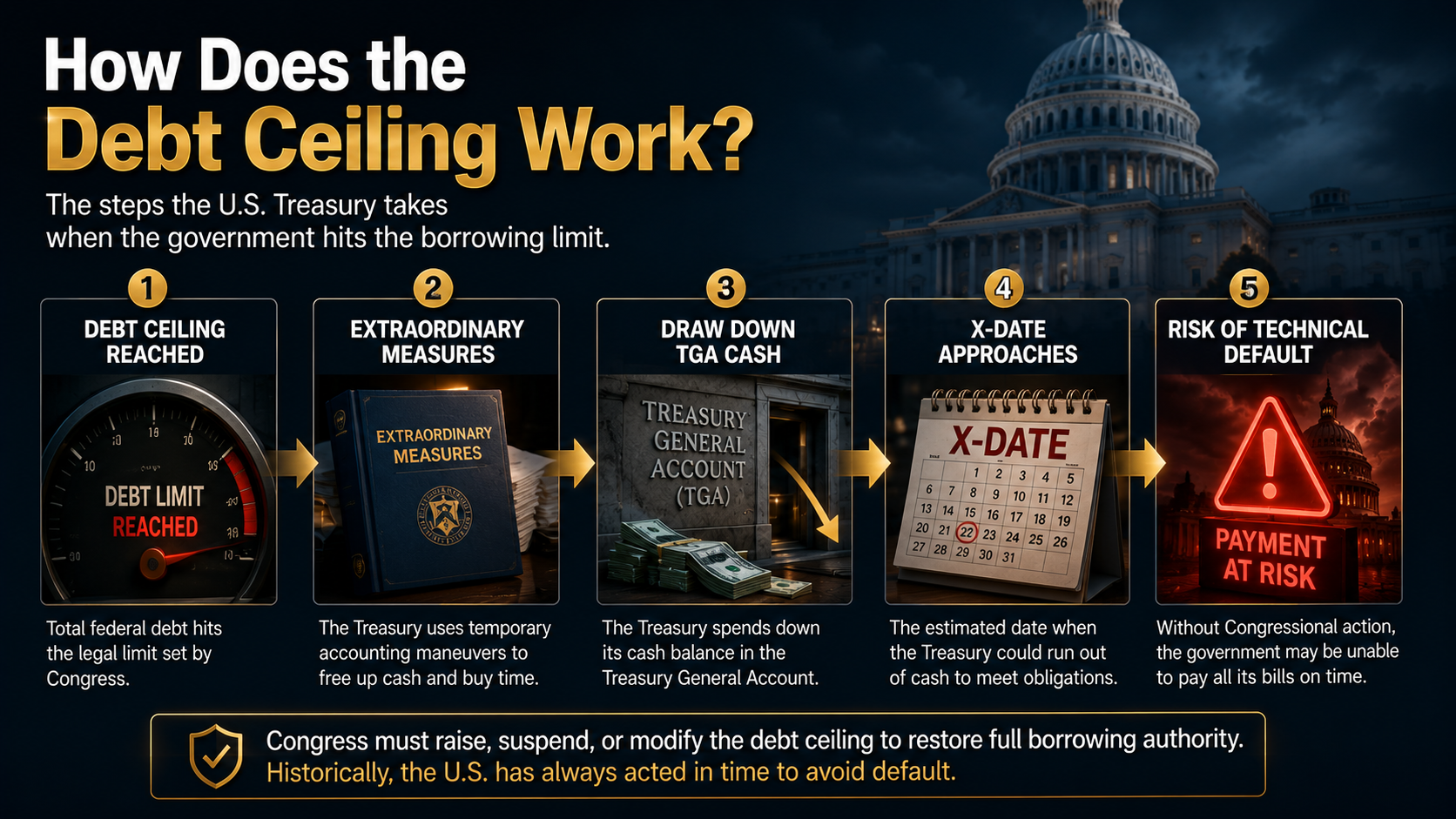
Once outstanding federal debt reaches the statutory limit, the Treasury cannot freely issue additional debt to finance government operations.
Instead, it follows a sequence of temporary measures designed to buy time.
Debt Ceiling Reached
        │
        ▼
Extraordinary Measures
        │
        ▼
Treasury General Account (TGA) Drawdown
        │
        ▼
X-Date
        │
        ▼
Potential Technical Default
1. Extraordinary Measures
The Treasury first implements a series of accounting maneuvers known as Extraordinary Measures.
These actions may include temporarily suspending certain investments in government retirement funds or using other legally authorized cash-management techniques.
These measures do not solve the underlying problem—they simply delay it.
2. Treasury General Account (TGA)
If Extraordinary Measures are exhausted, the Treasury relies on the Treasury General Account (TGA)—its primary cash account held at the Federal Reserve.
Think of the TGA as the federal government's checking account.
As long as cash remains in the account, the government can continue paying its obligations despite being unable to issue significant new debt.
Eventually, however, the balance declines.
3. The X-Date
The X-Date is the estimated day when the Treasury runs out of both borrowing authority and available cash.
If Congress has not acted before then, the government could face a technical default, meaning it may be unable to meet all of its financial obligations on time.
Importantly, investors focus on the probability of reaching the X-Date, not simply the existence of the debt ceiling itself.
Why Does the Debt Ceiling Matter to Investors?
Many people view the debt ceiling as little more than a political dispute in Washington.
Financial markets see something very different.
Professional investors focus on confidence, liquidity, and capital flows because those forces ultimately drive asset prices.

Why Wall Street Pays Close Attention to the Debt Ceiling
1. U.S. Treasuries Are the Foundation of the Global Financial System
U.S. Treasury securities are widely regarded as the world's benchmark risk-free asset.
They are used to
- Price virtually every major asset class
- Serve as collateral in global financial markets
- Support money market funds and institutional financing
- Establish benchmark interest rates across the economy
When uncertainty surrounds Treasury securities, the impact extends far beyond government finance.
It influences the pricing of stocks, corporate bonds, mortgages, and countless other financial assets.
2. Treasury Yields Influence Asset Valuations
Investors value future cash flows by discounting them using interest rates.
Treasury yields serve as the starting point for those calculations.
When Treasury yields rise because of increased borrowing or market uncertainty, the present value of future earnings declines.
Growth stocks, technology companies, and other long-duration assets are often the most sensitive to these changes.
This is why debt ceiling debates can affect equity valuations even when corporate fundamentals remain unchanged.
3. Liquidity Often Matters More Than Politics
One of the most important concepts investors should understand is market liquidity.
During debt ceiling negotiations, investors often focus on whether Congress will reach an agreement.
Professional investors ask a different question
What happens after the agreement?
Once the debt ceiling is raised or suspended, the Treasury typically rebuilds its cash balance by issuing a large amount of new Treasury securities.
The proceeds replenish the Treasury General Account (TGA), but they also pull cash out of the private financial system.
This process is commonly referred to as a liquidity drain.
In other words
- Before an agreement, markets worry about political uncertainty.
- After an agreement, markets begin evaluating the effects of reduced market liquidity.
That shift explains why financial markets do not always rally simply because the debt ceiling issue has been resolved.
How the Debt Ceiling Can Affect Major Asset Classes
| Asset Class | During Debt Ceiling Uncertainty | After a Debt Ceiling Agreement |
| U.S. Treasuries | Short-term Treasury yields may become volatile, particularly around the projected X-Date. | Increased Treasury issuance can keep yields elevated or increase volatility. |
| Stocks | Political uncertainty often weighs on investor sentiment and raises market volatility. | Liquidity withdrawal may reduce momentum for risk assets. |
| U.S. Dollar | Safe-haven demand can provide temporary support despite political uncertainty. | Strong Treasury demand may continue supporting the dollar. |
| Gold | Investors often seek gold during periods of financial uncertainty. | Reduced uncertainty may slow safe-haven demand, although inflation expectations also matter. |
| Bitcoin | Reactions vary depending on liquidity conditions and overall risk appetite. | Liquidity tightening may pressure speculative assets despite improving sentiment. |
| Emerging Markets | A stronger U.S. dollar and higher Treasury yields can pressure capital flows into emerging economies. | Ongoing liquidity tightening may continue to affect global risk assets. |
Market reactions are never guaranteed.
Economic growth, Federal Reserve policy, inflation expectations, and investor positioning all influence how markets ultimately respond.

Key Takeaways for Investors
When evaluating debt ceiling headlines, investors should remember several important points.
- The debt ceiling does not authorize new government spending. It allows the government to finance obligations that have already been approved.
- Markets usually react more to political uncertainty than to the actual probability of a U.S. default.
- After an agreement, investors should monitor Treasury issuance and the rebuilding of the Treasury General Account (TGA).
- Large Treasury auctions can temporarily reduce liquidity available for other financial assets.
- The interaction between Treasury borrowing and Federal Reserve policy often matters more than the political headlines themselves.
What Do Experienced Investors Watch?
Most market participants ask one question
"Will Congress reach a deal?"
Experienced investors ask several others.
- How much new debt will the Treasury issue?
- How quickly will the Treasury rebuild the TGA?
- Where is liquidity flowing?
- Are financial conditions becoming tighter or looser?
- Is Federal Reserve policy reinforcing or offsetting Treasury liquidity changes?
These questions focus on the underlying mechanics of financial markets rather than the daily news cycle.
Ultimately, markets move because capital moves.
Liquidity acts as the fuel that powers asset prices.
Understanding where money is flowing often provides greater insight than simply following political headlines.
Before reacting to debt ceiling news, consider asking yourself
- Is liquidity expanding or contracting?
- Are Treasury auctions absorbing capital from financial markets?
- Is my portfolio positioned to withstand periods of tighter liquidity?
- Am I reacting to headlines, or am I following the underlying flow of capital?

Final Thoughts
The U.S. debt ceiling is much more than a recurring political debate.
It is a critical component of the government's financing framework and an important driver of global market liquidity.
While headlines often focus on the possibility of default, long-term investors pay closer attention to Treasury issuance, the Treasury General Account, liquidity conditions, and the movement of capital throughout the financial system.
Markets are shaped not only by earnings, interest rates, or economic data—but also by where money is flowing.
Investors who understand those capital flows are often better prepared to navigate uncertainty without becoming distracted by short-term market noise.
MasterMind
'[Global] Success Blueprints' 카테고리의 다른 글