What Is the Treasury General Account (TGA)? The Hidden Liquidity Engine Behind Financial Markets


Hello, this is MasterMind.
Most investors closely follow Federal Reserve interest rate decisions because they know monetary policy influences everything from stocks to bonds. But have you ever wondered why financial markets sometimes become more liquid—or suddenly run short of cash—even when the Fed hasn't changed interest rates?
The answer often lies in a little-known government account called the Treasury General Account (TGA).
While the Federal Reserve controls the price of money through interest rates, the U.S. Treasury influences the amount of money circulating in the financial system through the Treasury General Account.
For institutional investors and macro hedge funds, tracking the TGA is almost as important as following Federal Reserve policy. Changes in its balance can remove hundreds of billions of dollars from financial markets—or inject that same liquidity back into the system—without a single interest rate change.
Understanding how the TGA works helps explain many market moves that traditional interest-rate analysis alone cannot.

Key Takeaway
The Treasury General Account (TGA) is the U.S. government's primary operating account at the Federal Reserve. When its balance rises, liquidity is drained from financial markets. When it falls, liquidity flows back into the economy, influencing stocks, bonds, the U.S. dollar, gold, and cryptocurrencies.
What Is the Treasury General Account (TGA)?
The Treasury General Account (TGA) is the official checking account of the U.S. Department of the Treasury, held at the Federal Reserve Bank of New York.
Think of it as the federal government's main bank account.
Almost every major cash transaction involving the U.S. government flows through the TGA, including
- Federal tax receipts
- Treasury debt issuance
- Government payroll
- Social Security payments
- Medicare spending
- Defense expenditures
- Infrastructure investments
- Interest payments on U.S. Treasury securities
Whenever the government collects money, funds flow into the TGA.
Whenever the government spends money, funds flow out of the TGA.
Although this sounds like a simple accounting process, it has enormous implications for financial markets because those cash movements directly affect banking system reserves and overall market liquidity.
Why Is the TGA So Important?
Many investors assume that the Federal Reserve is the only institution capable of influencing market liquidity.
In reality, the U.S. Treasury also plays a significant role.
The Fed primarily controls the cost of money by adjusting interest rates and managing its balance sheet.
The Treasury, through the TGA, influences how much money remains inside the financial system.
This distinction is critical.
A market can experience tighter financial conditions even if interest rates remain unchanged simply because government cash is temporarily being pulled out of the private sector.
Conversely, government spending can increase liquidity even without additional monetary easing from the Federal Reserve.
For this reason, many macro investors monitor both Fed policy and Treasury cash management simultaneously.
How the Treasury General Account Affects Market Liquidity
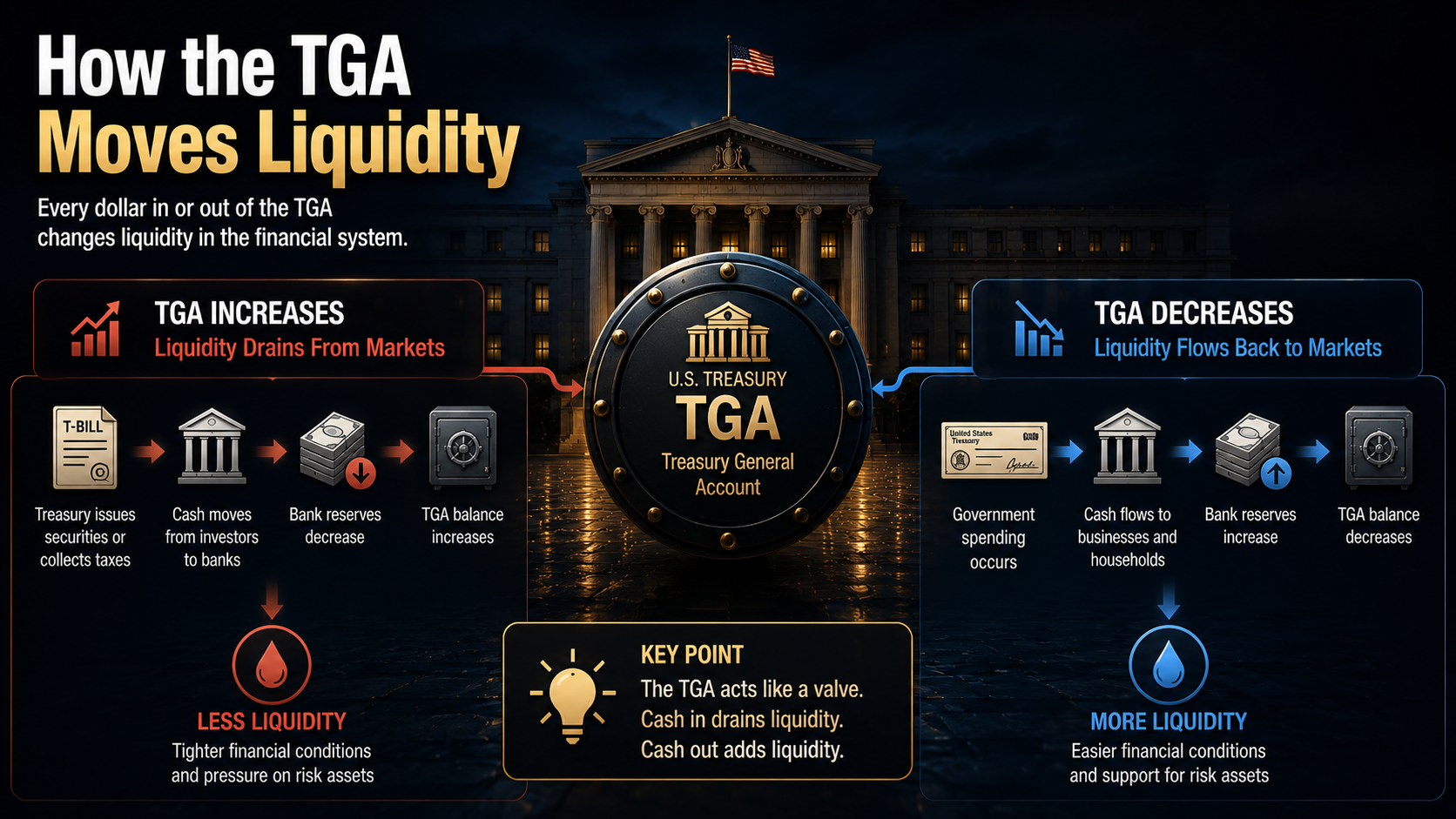
The mechanics behind the TGA are surprisingly straightforward.
When the government collects cash, liquidity leaves the private sector.
When the government spends cash, liquidity returns.
Scenario 1: Rising TGA Balance (Liquidity Drain)
A TGA balance typically increases when
- The Treasury issues large amounts of new debt.
- Quarterly tax payments are collected.
- Federal revenues rise.
The process looks like this
Government issues Treasury securities or collects taxes
↓
Investors and businesses transfer cash
↓
Commercial bank reserves decline
↓
Treasury General Account balance increases
↓
Financial market liquidity decreases
↓
Risk assets may face additional pressure
As money moves into the government's account at the Federal Reserve, fewer reserves remain inside the banking system.
That reduction in available liquidity can tighten financial conditions across markets.
Scenario 2: Falling TGA Balance (Liquidity Injection)
The opposite occurs when the government spends money.
Examples include
- Infrastructure programs
- Social Security benefits
- Federal employee salaries
- Defense contracts
- Treasury debt repayments
The process works in reverse
Government spending
↓
Treasury General Account balance declines
↓
Bank reserves increase
↓
Liquidity returns to financial markets
↓
Risk assets often receive support
As government payments reach businesses and households, cash flows back into the banking system, expanding available liquidity.
This increase in reserves can improve financial conditions and support broader asset prices.
The Bigger Picture
One of the biggest misconceptions in investing is believing that markets move solely because of interest rates.
In reality, markets are driven by both the price of money and the availability of money.
Interest rates influence borrowing costs.
Liquidity determines how much capital is available to purchase financial assets.
That's why experienced macro investors pay close attention not only to Federal Reserve meetings, but also to Treasury issuance schedules, tax collection periods, and changes in the Treasury General Account.
Understanding where liquidity is flowing often provides a clearer picture of market conditions than watching headlines alone.
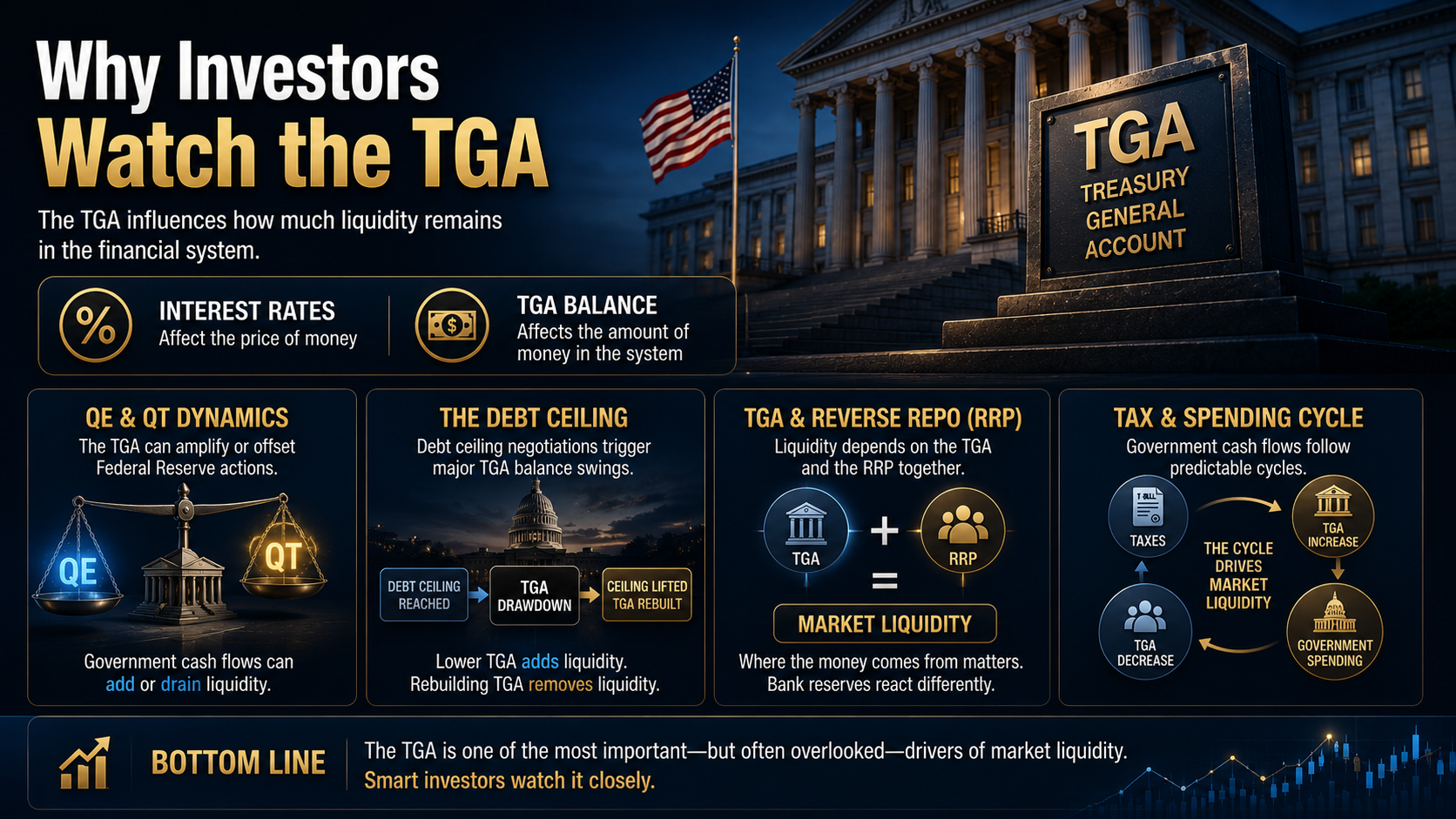
Why the Treasury General Account (TGA) Matters to Investors
Understanding the TGA is about much more than learning how the U.S. government manages its cash.
It is about understanding where liquidity is moving, because liquidity remains one of the most powerful long-term drivers of financial markets.
Even if the Federal Reserve keeps interest rates unchanged, financial conditions can tighten if the Treasury rapidly rebuilds the TGA by issuing large amounts of new debt.
Likewise, when the Treasury spends down the TGA, liquidity flows back into the private sector, often creating a more supportive environment for risk assets.
Simply put, interest rates determine the cost of money, while the TGA influences the amount of money available in the financial system.
Market Insight
Financial markets usually react to cash flows before headlines.
Strong corporate earnings alone cannot sustain higher valuations if liquidity is shrinking. On the other hand, abundant liquidity can support asset prices even when economic news is mixed.
For this reason, professional investors often monitor liquidity conditions alongside earnings, inflation, and Federal Reserve policy.
Ultimately, markets tend to follow where capital is flowing, not simply where expectations are pointing.
Key Factors Investors Should Monitor
1. Quantitative Tightening (QT) and Quantitative Easing (QE)
Changes in the TGA can either reinforce or partially offset Federal Reserve policy.
For example, during Quantitative Tightening (QT), the Treasury may reduce its TGA balance through increased government spending, temporarily adding liquidity back into the financial system.
Conversely, rebuilding the TGA through heavy Treasury issuance can remove liquidity even if the Fed's policy stance remains unchanged.
This is why liquidity analysis requires looking beyond the Federal Reserve alone.
2. The U.S. Debt Ceiling
Debt ceiling negotiations often create meaningful changes in the TGA.
When the Treasury reaches the debt ceiling and cannot issue significant amounts of new debt, it must rely on existing cash balances inside the TGA to continue funding government operations.
As those balances decline, liquidity is generally released into the financial system.
Once Congress raises or suspends the debt ceiling, the Treasury typically rebuilds the TGA by issuing large amounts of Treasury securities, pulling liquidity back out of markets.
This pattern has historically attracted significant attention from macro investors.
3. The Relationship Between TGA and the Reverse Repo Facility (RRP)
Professional investors rarely evaluate the TGA in isolation.
Instead, they also monitor the Federal Reserve's Overnight Reverse Repurchase Facility (RRP).
A simplified way to think about overall market liquidity is
Market Liquidity ≈ Federal Reserve Balance Sheet − (TGA + RRP)
The source of funding matters.
If money used to purchase newly issued Treasury bills comes primarily from money market funds parked in the RRP facility, the impact on bank reserves may be relatively small.
However, if those purchases are funded directly from commercial bank deposits, banking system reserves decline more noticeably, potentially creating tighter financial conditions.
Understanding where Treasury funding originates is often more important than simply watching the size of the TGA itself.
How TGA Changes Can Affect Major Asset Classes
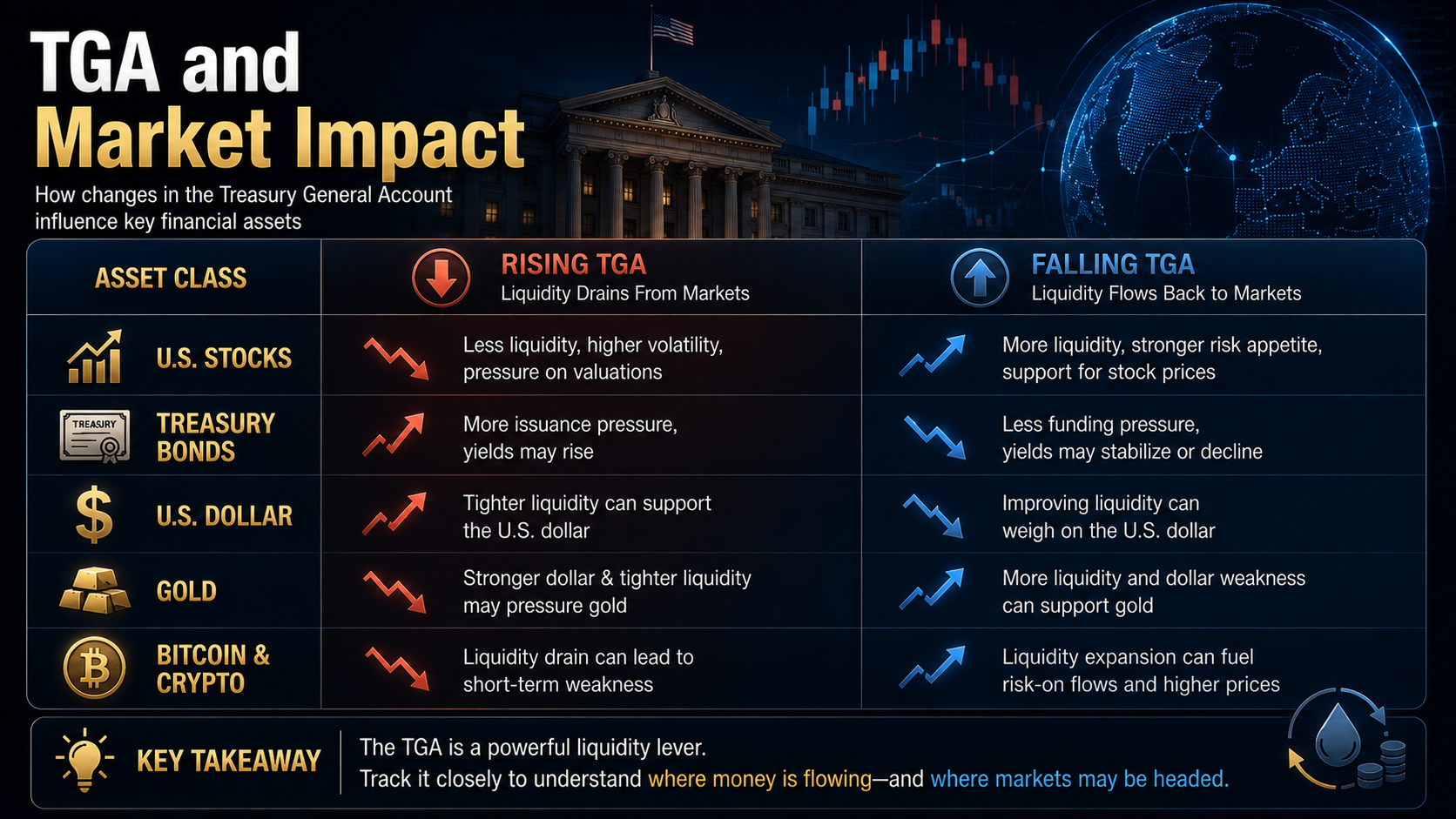
| Asset Class | Rising TGA (Liquidity Drain) | Falling TGA (Liquidity Injection) |
| U.S. Stocks | Valuation pressure and higher volatility | Improved liquidity and stronger risk appetite |
| Treasury Bonds | Increased issuance may push yields higher | Reduced funding pressure may stabilize yields |
| U.S. Dollar | Often supportive for the dollar | May contribute to dollar weakness |
| Gold | Can face short-term pressure | Often benefits from improving liquidity |
| Bitcoin & Digital Assets | Reduced liquidity may weigh on prices | Greater liquidity may support higher valuations |
These relationships are not guaranteed.
Economic growth, inflation, corporate earnings, geopolitical developments, and Federal Reserve policy all interact with liquidity conditions.
Still, the TGA remains one of the most important variables for understanding the broader financial environment.
What Investors Should Remember
When analyzing financial markets, consider the following
- Monitor Treasury issuance alongside Federal Reserve policy.
- Watch changes in the TGA balance rather than focusing only on interest rates.
- Analyze the TGA together with the Reverse Repo Facility (RRP).
- Pay attention to debt ceiling negotiations because they can significantly alter liquidity conditions.
- Remember that liquidity often influences market direction before economic data does.
These factors provide valuable context for understanding broader market trends.
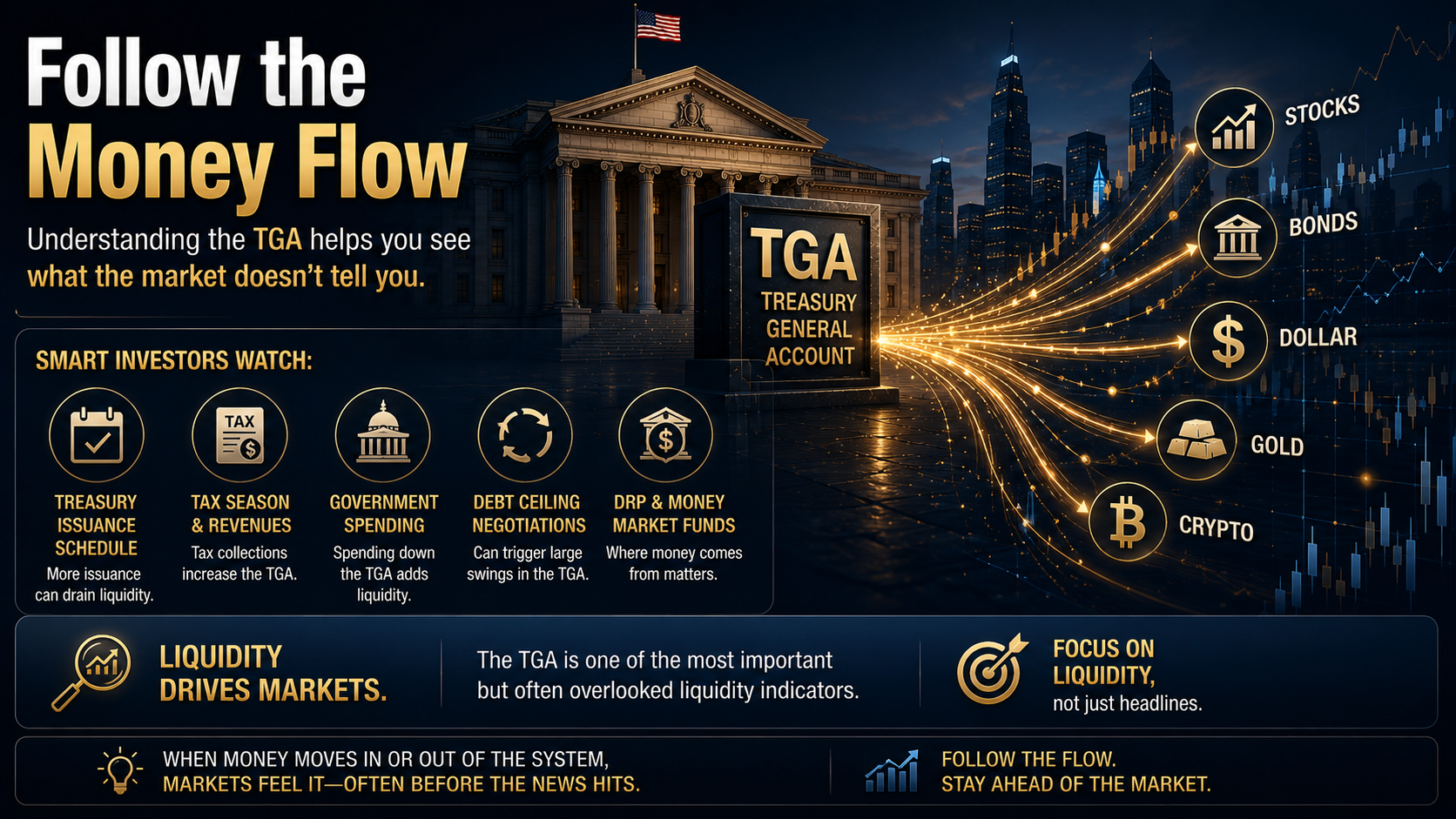
What Smart Money Watches
Institutional investors rarely ask only one question
"Will the market go up or down?"
Instead, they ask a more important one
"Where is liquidity moving?"
Professional investors monitor Treasury funding plans, quarterly refunding announcements, banking system reserves, and government cash balances because these factors influence capital flows across the financial system.
Rather than reacting to every headline, they focus on whether liquidity is expanding or contracting and position portfolios accordingly.
This long-term perspective allows them to distinguish between temporary market volatility and meaningful structural shifts in financial conditions.
Before making an investment decision, consider asking yourself
- Is market liquidity currently expanding or contracting?
- Is my portfolio prepared for tighter financial conditions?
- Am I paying attention only to Federal Reserve interest rates, or also to Treasury cash flows?
- Do current liquidity conditions support higher asset valuations?
Understanding liquidity does not guarantee perfect market timing.
However, it provides a stronger framework for interpreting market behavior over the long run.
Conclusion
The Treasury General Account is far more than the U.S. government's operating bank account.
It is one of the most important channels through which liquidity enters and leaves the financial system.
While the Federal Reserve determines the price of money, the Treasury General Account influences the quantity of money available to financial markets.
That distinction helps explain why markets sometimes move independently of Federal Reserve interest-rate decisions.
For long-term investors, monitoring liquidity conditions alongside monetary policy provides a deeper understanding of how capital flows shape asset prices.
Successful investing is not about predicting every market move.
It is about understanding the forces that drive markets over time and building a portfolio that can remain resilient through changing liquidity cycles.
This was MasterMind.
'[Global] Success Blueprints' 카테고리의 다른 글