What Is the Term Premium? Why It Matters for Treasury Yields and Investors


Hello, this is MasterMind.
When the Federal Reserve signals that interest rate cuts are coming, many investors naturally expect long-term Treasury yields to fall as well. Yet financial markets often tell a different story.
There have been numerous periods when the Fed adopted a more accommodative stance, while the yield on the 10-year U.S. Treasury continued climbing. At first glance, this seems contradictory. If policy rates are expected to move lower, why would long-term borrowing costs rise?
The answer lies in one of the most important—but often overlooked—concepts in fixed-income investing: the Term Premium.
Understanding the Term Premium is about far more than interpreting Treasury yields. It helps explain movements in equities, real estate, the U.S. dollar, gold, and even cryptocurrencies. More importantly, it provides insight into how investors price uncertainty and how capital flows across financial markets.
For long-term investors, learning how the Term Premium works offers a clearer view of the forces driving markets beyond the Federal Reserve's headline decisions.

Key Takeaway
The Term Premium is the additional return investors demand for holding long-term Treasury securities instead of repeatedly investing in short-term bonds. It reflects uncertainty about the future and plays a crucial role in determining long-term interest rates and asset valuations.
What Is the Term Premium?
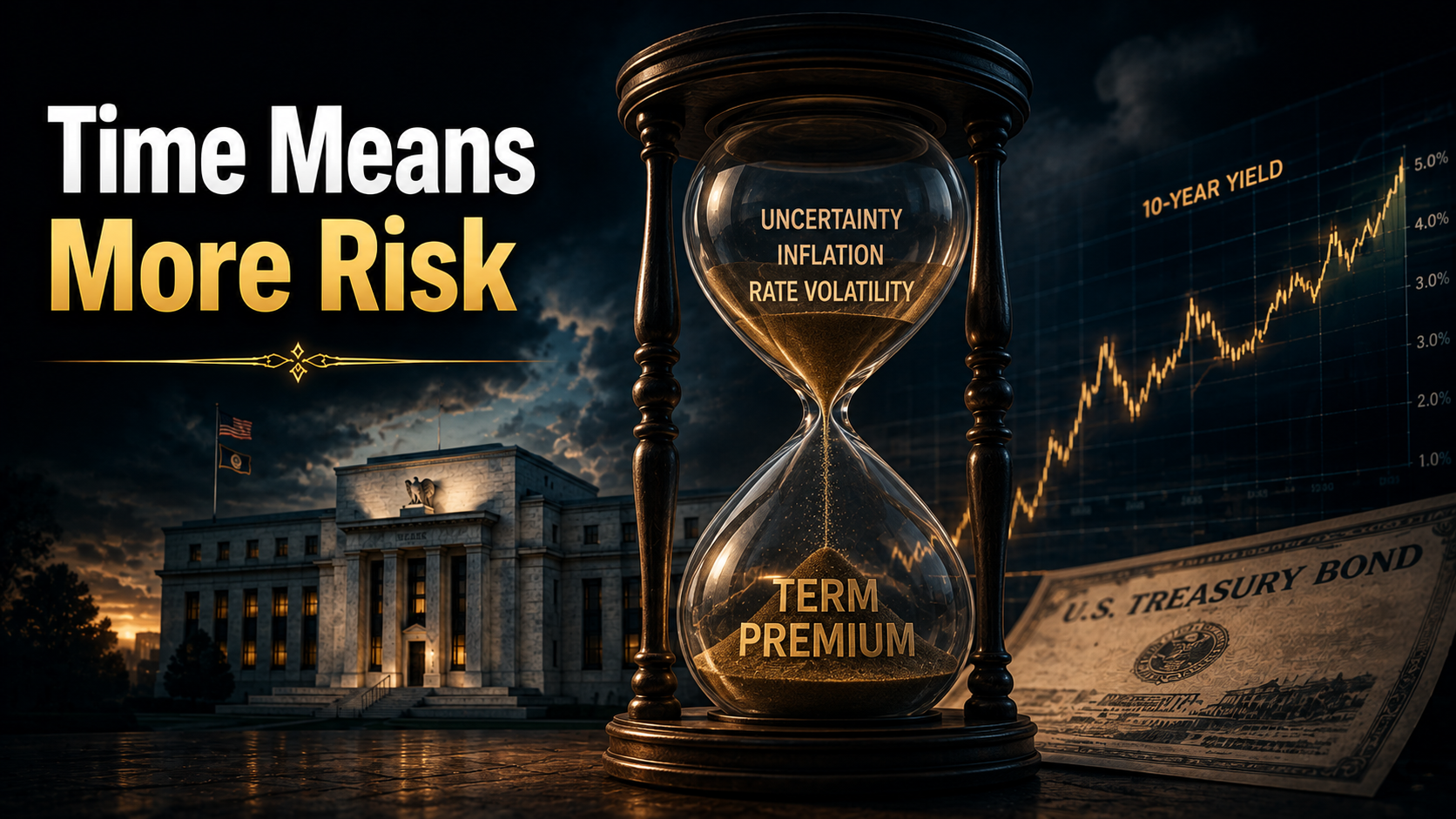
The Term Premium is the extra yield investors require to compensate for the risks of holding a long-term bond rather than continuously rolling over short-term bonds.
In simple terms, it represents the price of uncertainty over time.
Imagine you have two investment choices.
- Lend money for one year.
- Lend money for ten years.
A one-year commitment involves relatively little uncertainty. You have a fairly good idea of where inflation, interest rates, and economic conditions may be over the next twelve months.
A ten-year commitment is completely different.
During that decade
- Inflation may accelerate unexpectedly.
- Interest rates could rise sharply.
- Government borrowing may increase.
- Economic growth may weaken.
- Financial crises or geopolitical events could reshape markets.
Because investors cannot accurately predict these outcomes, they require additional compensation before locking their money away for such a long period.
That additional compensation is known as the Term Premium.
Rather than viewing it simply as another bond-market statistic, investors should think of it as the market's price for uncertainty over time.
How Are Long-Term Treasury Yields Determined?
One of the biggest misconceptions among investors is that Treasury yields move solely because of Federal Reserve policy.
In reality, long-term Treasury yields consist of two separate components.
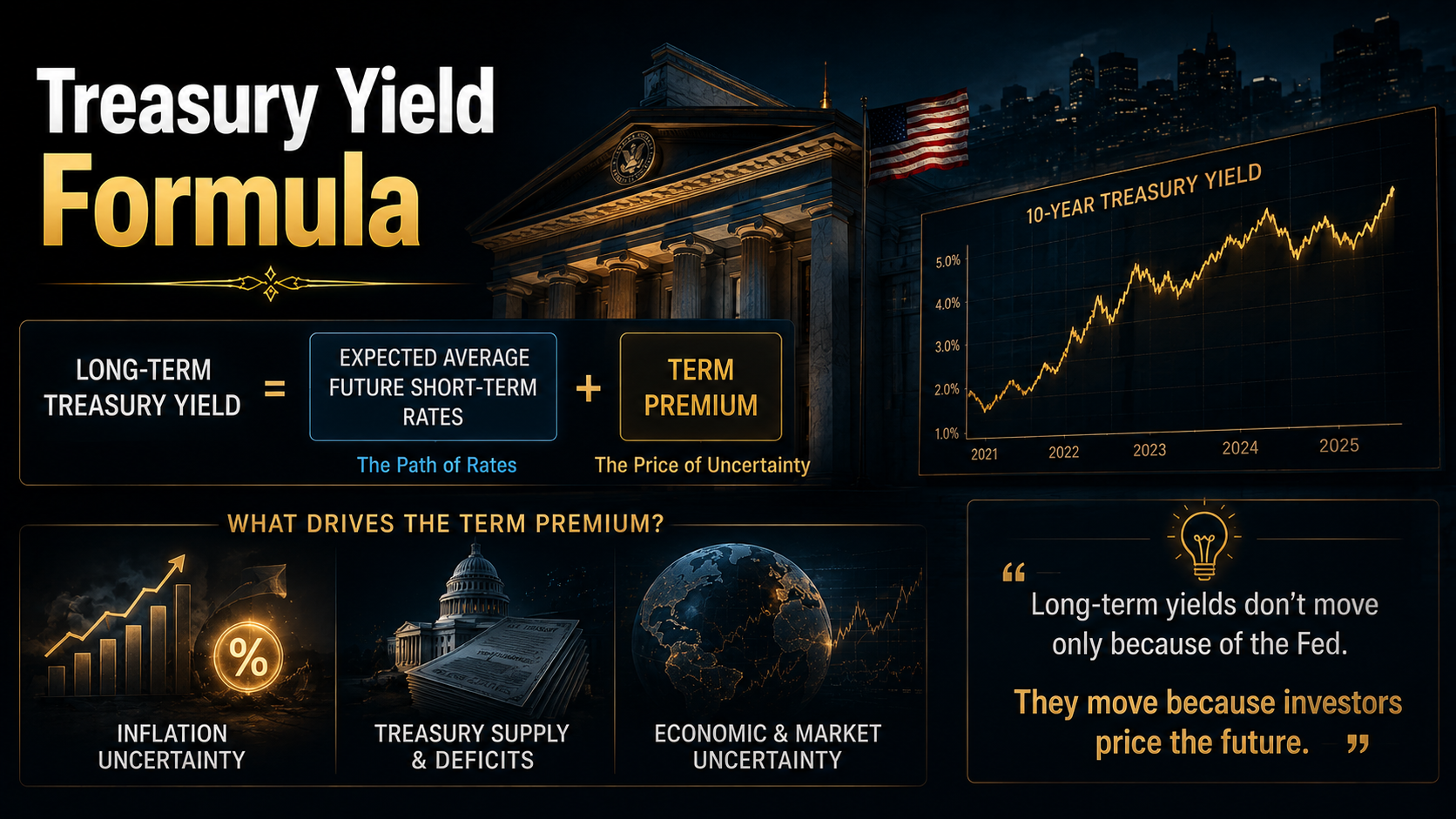
Long-Term Treasury Yield = Expected Average Future Short-Term Interest Rates + Term Premium
This means a 10-year Treasury yield reflects
- Expectations about where the Federal Funds Rate will average over the next decade.
- Additional compensation investors demand for accepting long-term uncertainty.
Because of this structure, long-term yields do not always move in the same direction as the Fed's policy rate.
For example, the Federal Reserve may begin cutting short-term rates while investors simultaneously demand a larger Term Premium due to concerns about inflation, fiscal deficits, or growing Treasury issuance.
In that scenario, the increase in the Term Premium may offset—or even outweigh—the decline in expected policy rates, causing long-term Treasury yields to rise instead of fall.
This is one reason why professional investors often pay closer attention to the 10-year Treasury yield than to the latest Federal Reserve announcement.
The bond market frequently reflects expectations about future economic conditions before central banks fully respond.
Why Does the Term Premium Change?
Unlike the Federal Funds Rate, which is set by the Federal Reserve, the Term Premium is determined by the market.
It constantly changes as investors reassess future risks.
Several factors influence its direction.
1. Inflation Uncertainty
Inflation is one of the biggest risks facing long-term bond investors.
Treasury bonds pay fixed coupon payments. If inflation rises unexpectedly, those future payments lose purchasing power.
For example, earning a 3% annual yield becomes much less attractive if inflation averages 5%.
The greater the uncertainty surrounding future inflation, the larger the compensation investors typically demand.
As a result, the Term Premium tends to rise.
2. Treasury Supply and Government Borrowing
Supply matters just as much as monetary policy.
When the U.S. government runs large fiscal deficits, it must issue more Treasury securities to finance spending.
An increase in Treasury issuance means investors must absorb a greater supply of bonds.
Unless demand rises equally, Treasury prices generally fall while yields move higher.
To attract buyers, investors may require additional yield beyond expectations for future short-term rates.
That additional yield becomes part of the Term Premium.
This is one reason analysts frequently point to rising Treasury issuance when explaining increases in long-term yields.
3. Economic and Market Uncertainty
Periods of heightened uncertainty often reshape investors' required compensation for holding long-duration assets.
Key sources of uncertainty include
- Economic recessions
- Persistent inflation
- Geopolitical tensions
- Fiscal sustainability concerns
- Financial market volatility
However, the relationship is not always straightforward.
During severe financial crises, investors often rush into U.S. Treasuries because they remain one of the world's safest and most liquid assets.
Strong demand for Treasuries can actually reduce—or even temporarily push—the Term Premium below zero.
In other words, the Term Premium does not simply measure risk.
It measures how the market prices long-term uncertainty at any given moment.
Why the Federal Reserve Doesn't Fully Control Long-Term Rates
Many investors assume that once the Federal Reserve begins lowering interest rates, borrowing costs across the economy automatically decline.
The reality is far more complex.
Mortgage rates, corporate bond yields, commercial lending rates, and many long-term financing costs are linked much more closely to Treasury yields than to the Federal Funds Rate itself.
If the Fed cuts short-term rates but the Term Premium rises because investors worry about inflation or expanding federal deficits, long-term Treasury yields may remain elevated—or even move higher.
That means households could continue paying high mortgage rates while businesses still face expensive borrowing costs despite an easing cycle.
This distinction explains why economists often say that financial conditions are determined by market interest rates, not just central bank policy.
Ultimately, the price of money is shaped not only by what the Federal Reserve does, but also by how investors collectively assess future risks.
For long-term investors, that is perhaps the most important lesson of the Term Premium.
Why Should Investors Care About the Term Premium?
Understanding the Term Premium is not just for bond traders.
It is one of the most important concepts for anyone investing in stocks, real estate, ETFs, or other long-term assets because it directly influences the cost of capital across the economy.
While the Federal Reserve controls short-term interest rates, long-term Treasury yields serve as the benchmark for many financial decisions.
These include
- Mortgage rates
- Corporate bond yields
- Commercial real estate financing
- Business investment costs
- Equity valuation models
This means that even if the Federal Reserve begins cutting interest rates, rising long-term Treasury yields can continue tightening financial conditions.
For investors, this distinction is critical.
Markets respond not only to what the Fed says but also to how investors price long-term risk.
How the Term Premium Affects Financial Markets
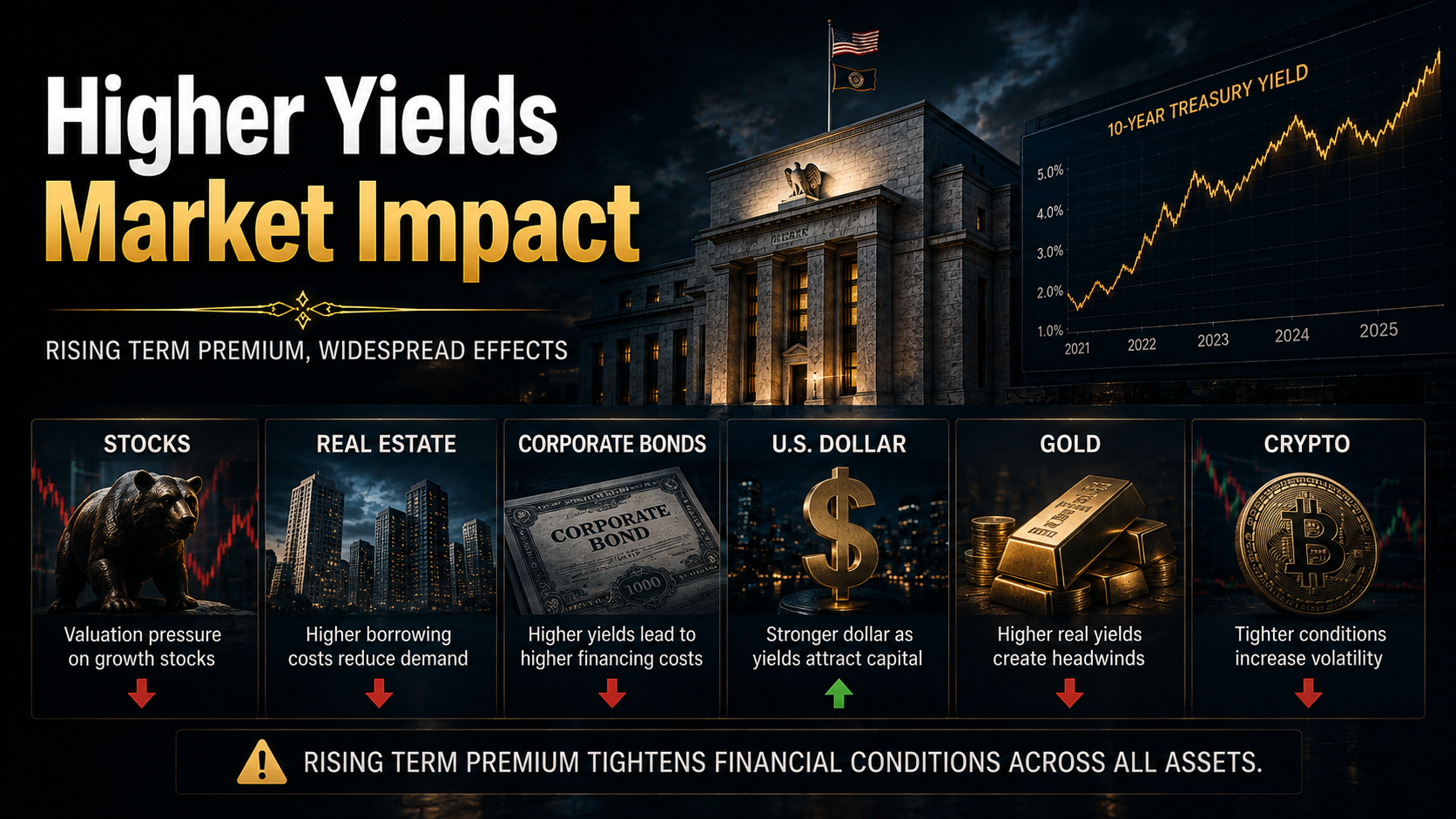
Changes in the Term Premium influence capital flows across nearly every major asset class.
| Asset Class | Typical Impact of a Rising Term Premium | Why It Matters |
| U.S. Treasuries | Bond prices fall, yields rise | Investors demand greater compensation for long-duration risk. |
| Growth Stocks | Valuation pressure increases | Higher discount rates reduce the present value of future earnings. |
| Value Stocks | Generally more resilient | Companies with stable cash flows are less sensitive to rising discount rates. |
| Real Estate | Financing becomes more expensive | Higher mortgage and commercial borrowing costs can reduce demand. |
| Gold | Often faces headwinds | Higher real yields increase the opportunity cost of holding non-yielding assets. |
| U.S. Dollar | May strengthen in the short term | Higher Treasury yields can attract global capital into dollar-denominated assets. |
| Bitcoin & Crypto | Volatility may increase | Tighter financial conditions often reduce risk appetite across speculative assets. |
Of course, no asset moves based on a single variable.
Corporate earnings, economic growth, liquidity, fiscal policy, and geopolitical events all influence market performance.
However, the Term Premium often acts as a bridge connecting these factors through the bond market.
The Difference Between the Federal Funds Rate and the Term Premium
Many investors mistakenly treat the Federal Funds Rate and the Term Premium as interchangeable.
In reality, they represent two very different concepts.
| Federal Funds Rate | Term Premium |
| Set by the Federal Reserve | Determined by the market |
| Short-term policy rate | Compensation for long-term uncertainty |
| Monetary policy tool | Market-based risk pricing |
| Changes during Fed meetings | Changes continuously as expectations evolve |
The Federal Funds Rate reflects monetary policy.
The Term Premium reflects investor confidence—or concern—about the future.
That is why long-term Treasury yields can rise even during an easing cycle.
Markets are constantly pricing risks that extend well beyond the next Federal Reserve meeting.
Key Takeaways for Investors
1. Watch Long-Term Treasury Yields, Not Just the Fed
The Federal Reserve remains important, but the bond market often provides an earlier signal about where financial conditions are heading.
Long-term Treasury yields frequently reflect changes in investor expectations before policymakers respond.
2. Understand Why Interest Rates Are Rising
Not every increase in Treasury yields carries the same message.
If yields rise because the economy is growing, stronger corporate earnings may offset the impact of higher interest rates.
However, if yields rise because investors demand a larger Term Premium due to inflation fears or fiscal concerns, financial conditions may tighten even as economic growth slows.
Understanding the reason behind higher yields is often more valuable than simply observing the increase itself.
3. Remember That Valuations Depend on Discount Rates
Virtually every asset is valued based on future cash flows.
When long-term Treasury yields rise, discount rates also increase.
Higher discount rates reduce the present value of future earnings, which explains why high-growth companies often experience greater valuation pressure during periods of rising long-term yields.
4. Focus on Durable Cash Flows
Periods of elevated Term Premiums tend to reward businesses with
- Strong free cash flow
- Healthy balance sheets
- Consistent profitability
- Sustainable competitive advantages
When capital becomes more expensive, investors often place greater value on financial resilience than on distant growth expectations.
What Do Experienced Investors Look For?
Professional investors rarely focus solely on whether interest rates are moving higher or lower.
Instead, they ask a more important question
Why is the market demanding higher compensation for holding long-term assets?
That question often reveals far more about future market conditions than the direction of the Federal Funds Rate alone.
Capital Flows
Markets continuously move capital toward the most attractive risk-adjusted opportunities.
If the Term Premium rises significantly, investors may shift away from highly valued growth assets toward investments offering stronger current income or greater financial stability.
Understanding where capital is flowing often provides better insight than following daily headlines.
Cash Flow
During periods of higher long-term yields, predictable cash flow becomes increasingly valuable.
Rather than focusing exclusively on revenue growth, experienced investors pay closer attention to
- Free cash flow
- Operating cash flow
- Debt maturity profiles
- Interest coverage ratios
- Balance sheet strength
Reliable cash generation becomes a competitive advantage when financing costs increase.
Financial Resilience
Companies that rely heavily on external financing may struggle if long-term borrowing costs remain elevated.
Businesses capable of funding growth internally are generally better positioned to navigate changing interest-rate environments.
In many cases, financial resilience becomes just as important as growth potential.
A Long-Term Perspective
One of the biggest mistakes investors make is trying to predict every move in interest rates.
Successful long-term investing is less about forecasting the next Federal Reserve meeting and more about understanding how markets price uncertainty.
The Term Premium reminds us that markets are constantly adjusting the price of future risk.
Sometimes that creates challenges.
Other times it creates opportunity.
Periods of elevated uncertainty can eventually produce more attractive valuations for patient investors willing to focus on fundamentals instead of short-term market noise.
Before making investment decisions, consider asking yourself
- Why are long-term Treasury yields moving today?
- Is the market pricing stronger growth or greater uncertainty?
- Can my portfolio perform well if higher interest rates persist?
- Am I following headlines, or am I following capital flows?
In investing, survival is often more important than prediction.
Those who understand how markets price risk are usually better equipped to navigate changing economic environments.

Conclusion
The Term Premium is far more than a technical concept used by bond analysts.
It is one of the hidden forces that influences Treasury yields, equity valuations, borrowing costs, and global capital flows.
While the Federal Reserve shapes short-term interest rates, long-term yields ultimately reflect how investors evaluate inflation, fiscal policy, economic uncertainty, and the risks of committing capital over time.
For long-term investors, understanding the Term Premium provides a broader perspective on financial markets.
Rather than focusing only on where interest rates are headed, consider why investors are demanding greater—or smaller—compensation for long-term risk.
Markets always assign a price to uncertainty.
The Term Premium is one of the clearest expressions of that price.
The most successful investors don't simply watch interest rates—they seek to understand the forces driving them.
Thank you for reading.
This was MasterMind.
'[Global] Success Blueprints' 카테고리의 다른 글