Why AI Stocks Can Fall After Strong Earnings: Lessons From AMD and SpaceX


Hello, this is MasterMind.
For years, Wall Street rewarded companies for investing aggressively in artificial intelligence. The bigger the AI spending, the larger the valuation premium investors were willing to pay.
Today, that mindset is changing.
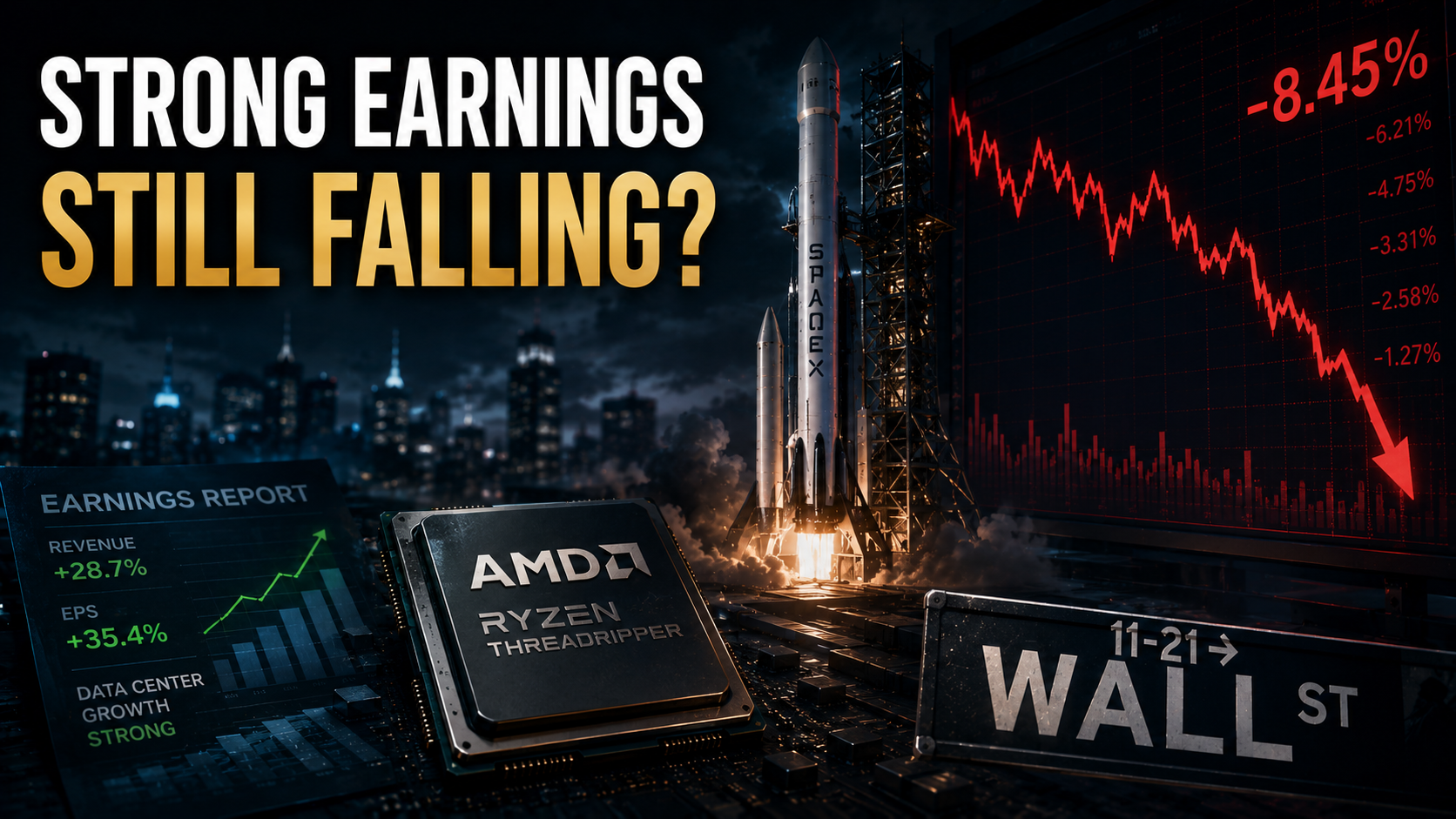
Recent market reactions to AMD and SpaceX demonstrate that strong revenue growth and ambitious AI investments are no longer enough. Investors are asking a different question
Can these investments generate sustainable profits and cash flow?
The AI boom is far from over, but the market has entered a new phase where execution matters more than expectations.
Key Takeaway
The market is moving from the "AI investment phase" to the "AI monetization phase," where profitability, free cash flow, and capital efficiency matter more than growth stories alone.
The End of the "Growth at Any Cost" Era
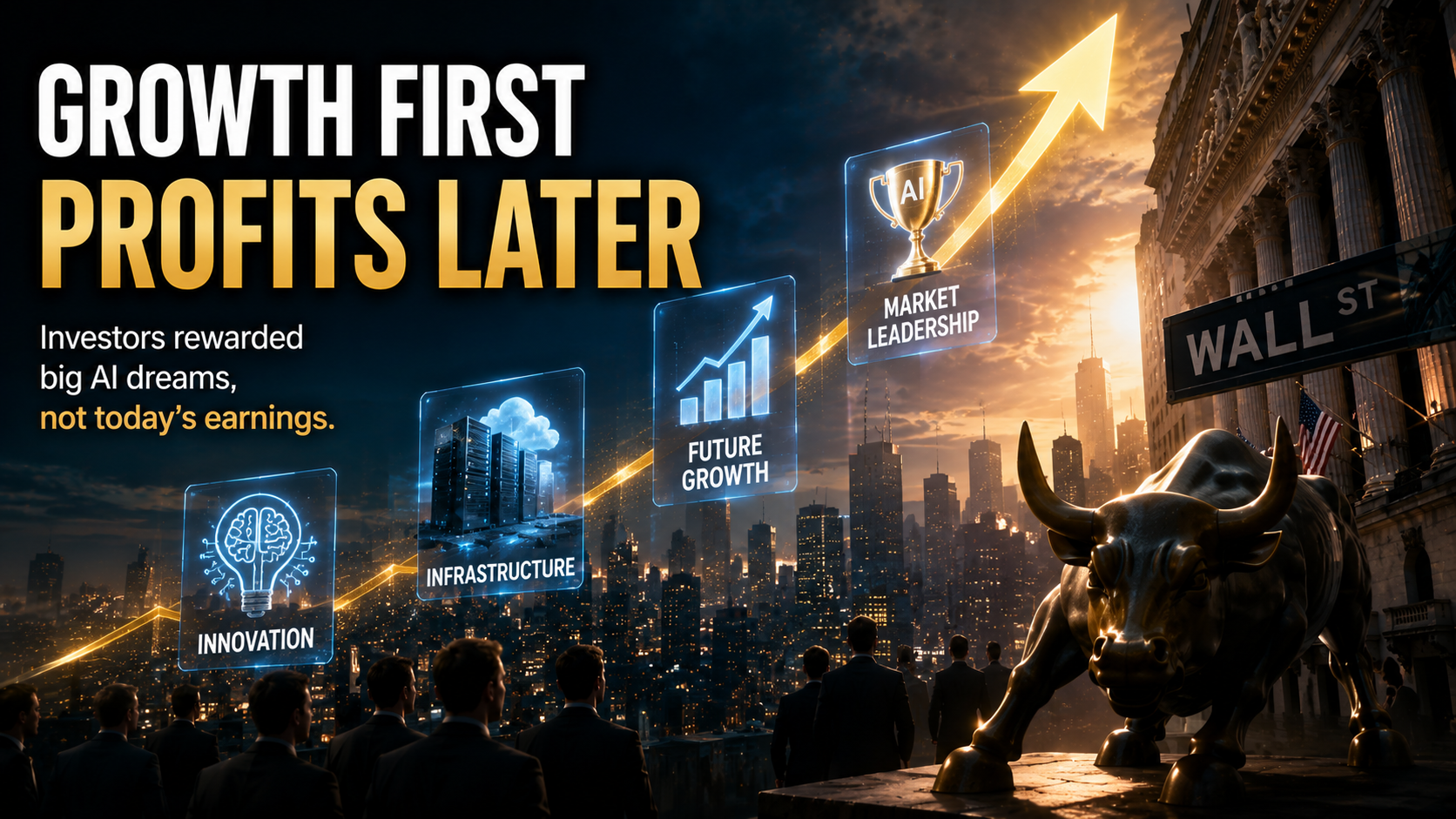
Every transformative technology creates a period where investors prioritize vision over financial results.
The internet, smartphones, cloud computing, and now artificial intelligence all followed a similar pattern.
In the early stages, investors rewarded companies for
- Expanding market share
- Building infrastructure
- Investing heavily in innovation
- Capturing future demand
During this period, valuation was driven largely by what investors believed a company could become rather than what it was currently earning.
This phenomenon is often called the Narrative Premium.
Companies received higher valuation multiples because investors expected future dominance rather than immediate profitability.
Why Wall Street Has Changed Its Priorities
As industries mature, investors inevitably become more demanding.
Instead of asking,
"How much are they investing?"
the market begins asking,
"How much money will those investments actually generate?"
Higher interest rates have accelerated this transition.
Capital is no longer inexpensive, meaning every dollar invested must produce measurable returns.
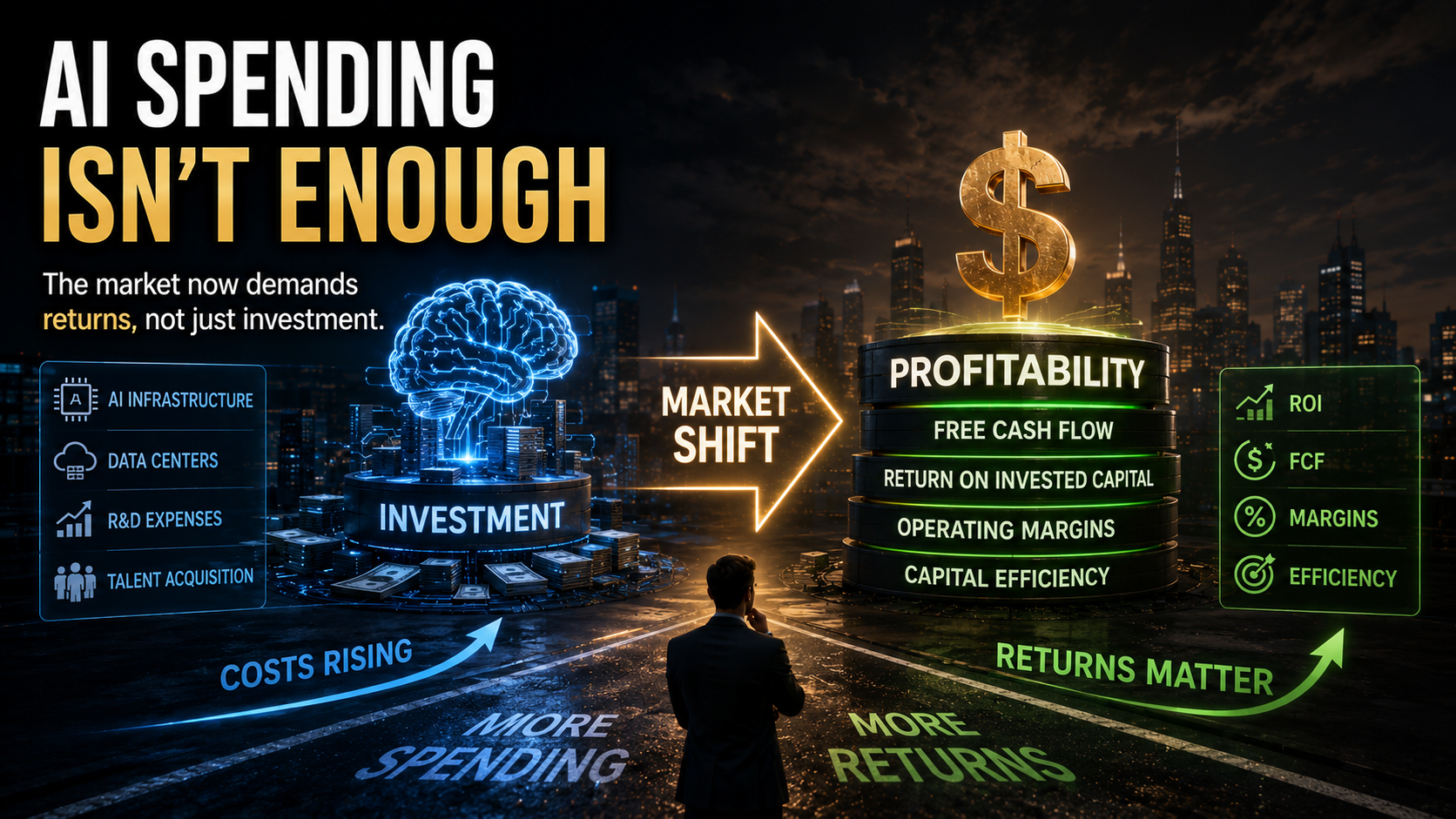
Today's investors increasingly focus on
- Operating margins
- Free Cash Flow (FCF)
- Return on Invested Capital (ROIC)
- Return on Investment (ROI)
- Capital efficiency
- Long-term earnings power
The discussion has shifted from growth potential to profitability potential.
Stock Prices Reflect Expectations, Not Just Earnings
One of the biggest misconceptions among investors is believing that strong earnings automatically lead to higher stock prices.
In reality, markets price companies based on expectations.
A simplified way to think about it is
Stock Price = Actual Results − Market Expectations + Future Cash Flow Outlook
A company can report record revenue and still decline if investors believe
- Margins will weaken
- Capital spending will remain elevated
- Cash generation will take longer than expected
- Future returns may not justify today's valuation
That is exactly what the market has been signaling recently.
What AMD's Earnings Tell Investors
AMD delivered another quarter of impressive growth, supported by strong demand for AI accelerators and data center products.
However, Wall Street focused less on revenue growth and more on questions such as
- Can AMD continue expanding margins while competing with NVIDIA?
- How quickly will AI investments translate into higher earnings?
- Are increasing R&D expenses creating sufficient shareholder returns?
- Will future profitability justify today's valuation?
The concern wasn't whether AMD was growing.
The concern was how efficiently that growth could be converted into long-term profits.

What SpaceX Reveals About the Next Phase of AI Investing
SpaceX also demonstrated that investors have become more disciplined.
Despite strong revenue growth driven by Starlink and expanding commercial operations, investors paid close attention to the company's enormous capital expenditures.
Building AI infrastructure, satellite networks, launch capabilities, and next-generation technologies requires billions of dollars in continuous investment.
The market's primary question is no longer
"How much is SpaceX investing?"
Instead, investors want to know
- When will those investments generate meaningful free cash flow?
- How quickly can capital expenditures produce attractive returns?
- Can long-term profitability keep pace with aggressive expansion?
This is the same shift occurring across much of the AI sector.
The New Metrics That Matter
Today's market increasingly rewards companies that can convert AI investments into durable financial performance.
| Yesterday's Focus | Today's Focus |
| AI spending | Return on Investment (ROI) |
| Revenue growth | Operating margins |
| Market share | Free Cash Flow (FCF) |
| Expansion | Capital efficiency |
| Vision | Sustainable earnings |
The AI race is no longer simply about spending the most money.
It is about earning the highest return on every dollar invested.
How This Shift Impacts Financial Markets
This change extends beyond technology stocks.
| Asset Class | Market Impact |
| AI Stocks | Greater emphasis on profitability and execution |
| Semiconductor Companies | Margin expansion becomes as important as revenue growth |
| Mega-Cap Technology | Investors closely monitor AI monetization and capital returns |
| Bonds | Higher interest rates favor companies with stronger cash generation |
| U.S. Dollar | Capital tends to move toward financially resilient businesses |
| Gold | May benefit during periods of economic uncertainty |
| Bitcoin | Remains sensitive to changes in liquidity conditions |
The broader market is becoming increasingly selective.
Capital is flowing toward businesses capable of producing consistent earnings rather than simply promising future growth.
What Investors Should Watch
When evaluating AI companies, investors should ask
- Is AI investment translating into sustainable earnings?
- Is Free Cash Flow improving over time?
- Are operating margins expanding?
- Does management allocate capital efficiently?
- Can the business generate attractive returns even if AI spending slows?
Technology leadership alone does not guarantee investment success.
Ultimately, shareholder value comes from a company's ability to generate durable profits.
What Long-Term Investors See
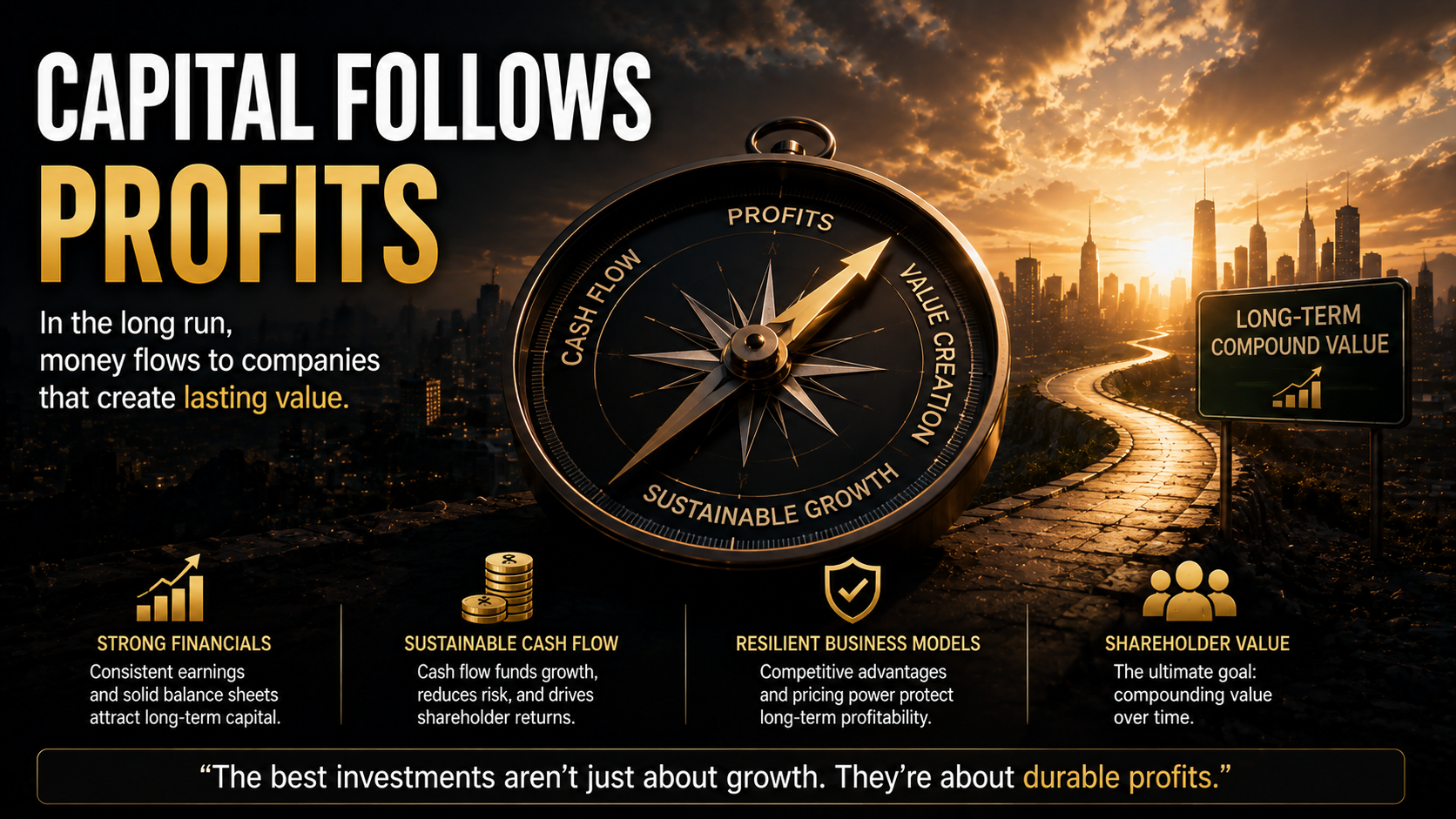
Experienced investors rarely chase the most exciting story.
Instead, they follow the flow of capital.
They understand that every technological revolution eventually reaches a stage where financial discipline becomes more valuable than rapid expansion.
Their analysis focuses on four areas
Capital Flows
Where is institutional money moving?
Is it flowing toward companies with stronger balance sheets and healthier cash generation?
Cash Flow
Can the business finance future growth internally without relying excessively on outside capital?
Business Resilience
Can the company remain profitable even during periods of slower economic growth or tougher competition?
Long-Term Value Creation
Is today's valuation supported by sustainable earnings rather than optimistic assumptions?
One question every investor should ask is
If AI excitement faded tomorrow, would this company still generate enough cash flow to create long-term shareholder value?
That question often separates great businesses from great investment stories.
Final Thoughts
AMD and SpaceX do not suggest that the AI revolution is ending.
Instead, they illustrate that the market has entered a more mature phase.
Investors are no longer satisfied with ambitious AI strategies alone.
They want evidence that those investments can generate higher margins, stronger cash flow, and sustainable returns on capital.
This transition is healthy.
History shows that every major technological revolution eventually rewards the companies that execute most efficiently—not necessarily those that spend the most.
The most important lesson investors should remember is this
Markets always reward growth in the early stages of innovation. Over time, however, capital flows toward businesses that consistently transform growth into profits, cash flow, and long-term shareholder value.
— MasterMind
'[Global] Success Blueprints' 카테고리의 다른 글