What Is Status Quo Bias? Why People Resist Change Even When It's Better


Hello, this is MasterMind.
Why do so many investors hold onto losing stocks long after the facts have changed? Why do they hesitate to rebalance their portfolios even when interest rates, earnings, or economic conditions clearly point toward a different strategy?
At first glance, it looks like patience or discipline. In reality, it is often something else entirely.
Behavioral economists call this tendency Status Quo Bias—the natural preference for keeping things exactly as they are, even when making a change would likely lead to a better outcome.
This psychological bias affects far more than investing. It influences career decisions, retirement planning, spending habits, and even everyday choices. However, in financial markets—where change is constant—the cost of staying the same can quietly compound over time.
Understanding Status Quo Bias is not simply about improving investment returns. It is about recognizing one of the most common mental traps that prevents investors from adapting to new information.

Key Takeaway
Status Quo Bias is the tendency to prefer the current situation over a potentially better alternative because the fear of change often feels greater than the potential reward.
What Is Status Quo Bias?
Status Quo Bias is a behavioral economics concept describing people's tendency to stick with their existing decisions rather than choose a new alternative—even when evidence suggests the new choice may be superior.
Instead of evaluating every decision objectively, the human brain unconsciously treats the current situation as the safest option.
In investing, this often appears as
- Holding losing investments for too long
- Avoiding portfolio rebalancing
- Refusing to sell familiar companies
- Ignoring changing market conditions
- Delaying important financial decisions
The bias is not necessarily caused by a lack of knowledge.
Instead, it reflects how our brains process uncertainty.
Choosing something new creates responsibility, introduces unknown outcomes, and increases the possibility of regret. Maintaining the current position feels psychologically safer, even when it is financially irrational.
Simply put, people often confuse familiarity with safety.

Why Does Status Quo Bias Exist?
Financial markets reward adaptability.
Human psychology, however, evolved to reward stability.
For thousands of years, avoiding unnecessary risks often increased the chances of survival. That instinct still exists today, even though modern investing requires a very different way of thinking.
Several psychological forces combine to create Status Quo Bias.
1. Loss Aversion
Behavioral finance research consistently shows that people experience the pain of losses much more intensely than the pleasure of equivalent gains.
Because changing an investment creates the possibility of making a mistake, many investors prefer avoiding action altogether.
Ironically, the attempt to avoid losses can eventually produce even larger losses.
2. Regret Avoidance
Investors do not only fear losing money.
They also fear blaming themselves.
Selling a stock before it rebounds or buying a new investment before it declines creates emotional regret.
Doing nothing feels emotionally safer because responsibility appears smaller.
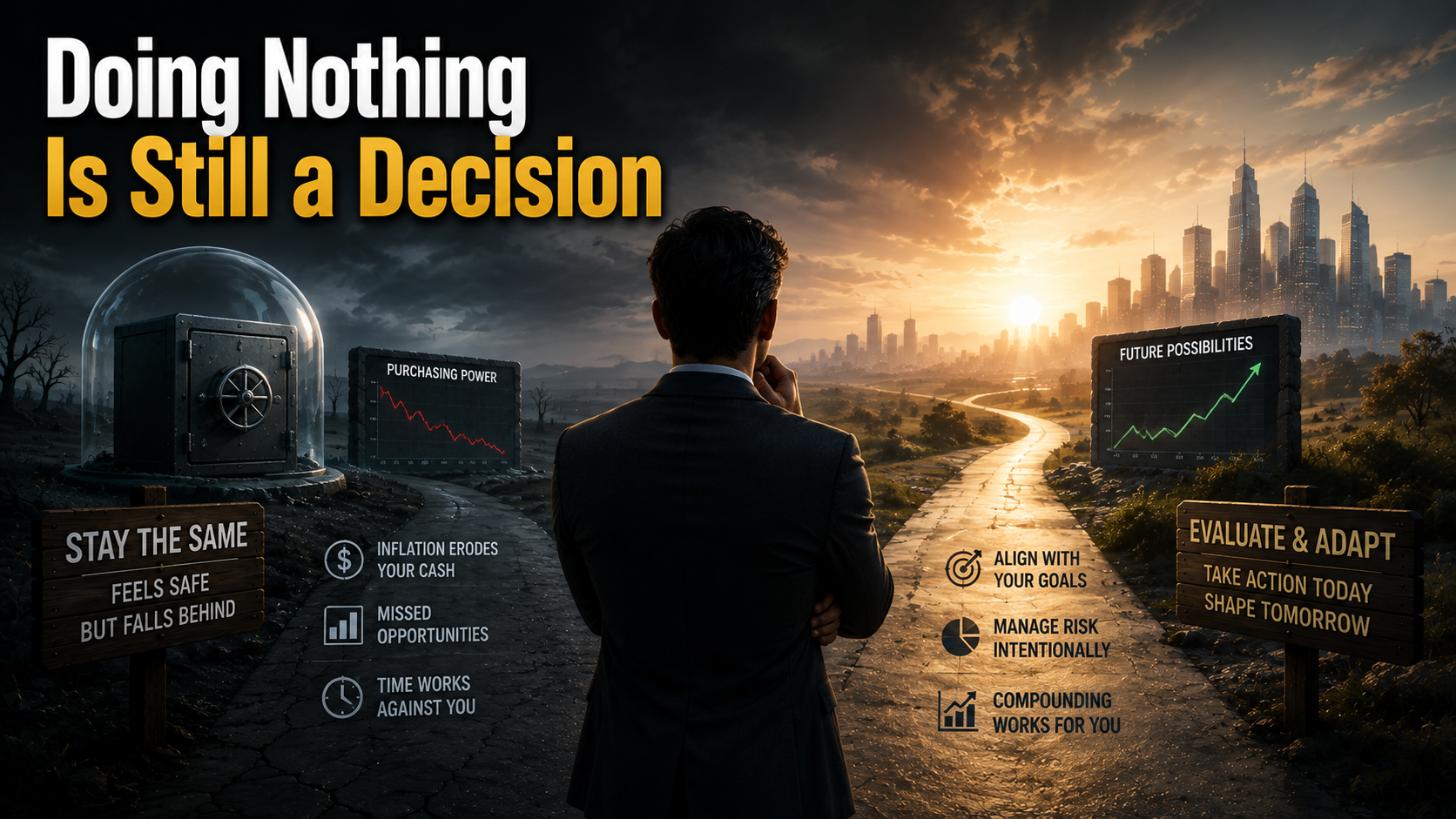
In reality, choosing not to act is still a decision—it simply feels less visible.
3. The Endowment Effect
People naturally assign greater value to things they already own.
This tendency, known as the Endowment Effect, makes existing investments feel more valuable than objectively identical alternatives.
A company that once represented a successful investment can become emotionally attached to an investor's identity.
Instead of asking,
"Would I buy this stock today?"
many investors ask,
"How can I avoid selling something I already own?"
That subtle difference often leads to poor investment decisions.
These Biases Rarely Work Alone
Status Quo Bias rarely appears by itself.
Loss aversion, regret avoidance, confirmation bias, anchoring, and the endowment effect often reinforce one another.
An investor holding a declining stock, for example, may simultaneously
- Fear realizing a loss.
- Regret selling at the wrong time.
- Search only for positive news.
- Focus on the original purchase price.
- Believe the stock is worth more simply because they own it.
The result is predictable.
Instead of responding to changing market conditions, the investor becomes psychologically attached to the past.
Why Understanding This Bias Matters
Markets never stand still.
Interest rates change.
Corporate earnings evolve.
Entire industries rise and decline.
Capital continuously flows toward stronger opportunities while leaving weaker ones behind.
Yet many investors remain anchored to yesterday's decisions.
One of the biggest misconceptions about long-term investing is believing that it means never changing anything.
Successful long-term investing is not about blindly holding the same assets forever.
It is about continuously evaluating whether today's portfolio still matches tomorrow's economic environment.
Markets reward investors who adapt without abandoning discipline.
The greatest investment risk is not always making the wrong decision.
Sometimes, it is refusing to make any decision at all.
How Status Quo Bias Affects Financial Markets
Status Quo Bias is usually discussed as an individual psychological tendency, but its effects can also be seen across financial markets.
When large numbers of investors resist changing their positions, capital may remain trapped in weakening assets longer than fundamentals justify. At the same time, newer opportunities may receive less attention because they feel unfamiliar, speculative, or difficult to evaluate.
This can contribute to delayed portfolio adjustments, crowded positioning, and temporary pricing distortions.
Markets often respond to new information faster than investors change their beliefs. That gap between changing fundamentals and slow-moving psychology is where Status Quo Bias becomes especially costly.
How Status Quo Bias Appears Across Major Asset Classes
| Asset Class | Common Status Quo Behavior | Potential Consequence |
| Stocks | Holding a declining company while waiting to recover the original purchase price | Larger losses and missed opportunities elsewhere |
| Bonds | Keeping the same duration or maturity exposure after the interest-rate environment changes | Greater volatility or weaker risk-adjusted returns |
| Cash | Treating cash as permanently safe during periods of persistent inflation | Erosion of purchasing power |
| Gold | Refusing to consider defensive assets because they do not produce income | Reduced portfolio diversification during periods of monetary stress |
| Bitcoin and Digital Assets | Rejecting or embracing the entire asset class based on old assumptions | Failure to reassess changing adoption, regulation, and risk |
| Retirement Portfolios | Leaving default allocations unchanged for years | A portfolio that no longer matches age, income needs, or risk tolerance |
The important lesson is not that investors should constantly trade between these assets.
Frequent activity can create its own problems, including higher costs, taxes, and emotionally driven decisions.
The real issue is whether the current allocation remains appropriate after the economic environment, valuation, or investment thesis has materially changed.

Why Doing Nothing Is Still an Investment Decision
Many investors treat inaction as a neutral choice.
It is not.
Keeping a portfolio unchanged means continuing to accept its current risks, expected returns, sector exposure, liquidity profile, and sensitivity to interest rates.
That is a decision, even when no trade is placed.
Suppose an investor owns a company whose debt burden is rising, margins are deteriorating, and competitive position is weakening. Choosing not to sell means choosing to remain exposed to those risks.
Likewise, holding excessive cash during a long period of inflation is a decision to accept declining real purchasing power.
Every portfolio position has an opportunity cost.
Capital committed to one asset cannot be used elsewhere at the same time. When investors focus only on the discomfort of making a change, they often overlook the cost of staying where they are.
MasterMind Perspective
Risk does not begin only when an asset falls in price. It also grows when investors ignore where capital is leaving, where cash flow is weakening, and where economic conditions are changing.
Status Quo Bias vs. Long-Term Investing
Status Quo Bias should not be confused with patience.
Patient investing is based on a clear thesis, reasonable valuation, financial strength, and a willingness to endure temporary volatility.
Status Quo Bias is different. It keeps an investor in a position after the original reasoning has weakened or disappeared.
The difference can be summarized simply.
| Long-Term Discipline | Status Quo Bias |
| Holds through temporary volatility | Holds because selling feels uncomfortable |
| Reassesses the original thesis | Avoids new information |
| Focuses on business value and cash flow | Focuses on the purchase price |
| Uses predetermined risk rules | Delays decisions indefinitely |
| Accepts that circumstances can change | Assumes the past will return |
A long-term investor may decide not to act after reviewing the evidence.
That is discipline.
A biased investor avoids reviewing the evidence because change feels threatening.
That is psychological inertia.
How Investors Can Reduce Status Quo Bias
No investor can completely eliminate behavioral bias. The better goal is to build a decision-making process that makes bias easier to detect and harder to follow.
1. Use Zero-Based Thinking
One of the most useful questions an investor can ask is
“If I did not already own this asset, would I buy it today at the current price?”
This question removes the emotional weight of the original purchase.
It forces the investor to evaluate the asset based on current information rather than past decisions.
A “no” does not automatically mean the investment should be sold. Taxes, portfolio construction, liquidity, and time horizon still matter.
However, it is a strong signal that the holding deserves a deeper review.
2. Separate the Purchase Price From the Investment Thesis
The market does not know an investor's cost basis.
A stock purchased at $100 is not obligated to return to $100 simply because that price matters emotionally to the owner.
The relevant questions are
- Has the company's competitive position improved or weakened?
- Are earnings and free cash flow moving in the right direction?
- Has debt become more manageable or more dangerous?
- Is the valuation attractive relative to realistic future growth?
- Does the original investment thesis still hold?
The purchase price may matter for tax and risk-management purposes, but it should not determine the asset's future value.
3. Establish a Rebalancing Schedule
Regular portfolio reviews reduce the temptation to delay uncomfortable decisions.
Investors may choose to review allocations quarterly, semiannually, or annually, depending on their strategy.
The goal is not to trade on a fixed calendar. It is to create a consistent moment for asking whether the portfolio still reflects
- Current financial goals
- Risk tolerance
- Time horizon
- Valuation conditions
- Interest-rate sensitivity
- Sector concentration
- Liquidity needs
A scheduled process turns portfolio management into a system rather than an emotional reaction.
4. Define Thesis-Breaking Conditions in Advance
Before buying an asset, investors can identify the conditions that would invalidate the thesis.
For a company, these might include
- Persistent loss of market share
- Deteriorating balance-sheet quality
- Declining free cash flow
- Management credibility problems
- Structural technological disruption
- A valuation that becomes impossible to justify
Predetermined rules are useful because they are created before fear, pride, or regret takes control.
5. Make Opportunity Cost Visible
Investors often compare a losing position with cash and conclude that holding is preferable to “giving up.”
A better comparison is the expected future return of the current asset versus realistic alternatives.
The key question is not
“How much have I already lost?”
It is
“Where does this capital have the strongest risk-adjusted potential from today?”
Past losses cannot be changed. Future capital allocation can.
6. Keep an Investment Journal
A written record helps separate memory from reality.
For each investment, an investor can document
- Why the asset was purchased
- What assumptions support the thesis
- What risks could invalidate it
- What valuation was considered reasonable
- What evidence would justify adding, holding, or reducing the position
When circumstances change, the investor can compare the current facts with the original reasoning.
This makes it harder to rewrite the past in order to justify doing nothing.
What Do Wealthy Investors Watch in This Environment?
Experienced investors are not immune to Status Quo Bias.
They often reduce its influence by focusing on systems, cash flow, and capital movement rather than emotional attachment to individual positions.
1. The Direction of Capital
Wealthy investors pay close attention to where money is leaving and where it is moving.
Capital may rotate
- From high-growth stocks to cash-generating businesses
- From long-duration assets to short-term bonds
- From speculative markets to defensive sectors
- From weakening industries to emerging technologies
- From risk assets to liquidity during periods of financial stress
They do not assume that yesterday's market leader will remain tomorrow's leader.
However, they also avoid chasing every short-term rotation. The goal is to distinguish a temporary price move from a lasting change in capital flows.
2. Cash Flow Quality
Price attracts attention, but cash flow determines survival.
An asset with dependable cash generation, manageable debt, and pricing power has more flexibility during difficult economic conditions.
By contrast, an asset that depends entirely on cheap financing or optimistic expectations may struggle when liquidity tightens.
This is why experienced investors often ask
- Can the business finance its own growth?
- Can it service its debt under weaker conditions?
- Is demand recurring or highly cyclical?
- Does management allocate capital effectively?
- Can the asset survive without perfect market conditions?
The stronger the cash flow, the less dependent the investment is on favorable sentiment.
3. Asset Survival
Investing is not only about maximizing upside.
It is also about avoiding permanent impairment.
A temporary price decline is not necessarily dangerous if the underlying asset remains financially strong. A seemingly stable price can be dangerous if the business model is deteriorating beneath the surface.
Wealth preservation therefore requires investors to separate market volatility from structural decline.
4. Flexibility
Holding cash, maintaining diversification, and limiting excessive concentration can provide strategic flexibility.
Flexibility allows an investor to respond when valuations change or opportunities emerge.
It also reduces the psychological pressure to defend every existing position.
The objective is not constant movement. It is the ability to move when the facts justify it.
5. Long-Term Survival
The most important objective in investing is not perfect prediction.
It is survival.
An investor who avoids catastrophic losses, controls concentration, and adapts to structural change can remain in the market long enough for compounding to work.
Rigidly maintaining the status quo is not always a survival strategy.
Sometimes survival requires reducing risk, admitting that a thesis was wrong, or reallocating capital toward stronger cash flows.
Questions Every Investor Should Ask
Investors can use the following questions to identify whether Status Quo Bias is influencing their decisions
- Am I holding this asset because the current facts support it?
- Would I purchase it today if I did not already own it?
- Has the original investment thesis changed?
- Am I focusing too heavily on my purchase price?
- What opportunity cost comes with continuing to hold?
- Has the interest-rate, liquidity, or competitive environment changed?
- Is my portfolio still aligned with my financial goals?
- Am I avoiding action because the decision is uncomfortable?
- Would I make the same choice if no one knew about my previous decision?
- Is doing nothing genuinely the best option, or simply the easiest one?
These questions do not guarantee a correct investment decision.
They improve the quality of the decision-making process.
Final Thoughts
Status Quo Bias is one of the most powerful forces in investor behavior because it often disguises itself as patience, loyalty, or discipline.
Sometimes staying invested is the correct decision.
Markets are volatile, strong businesses can experience temporary declines, and excessive trading often destroys value.
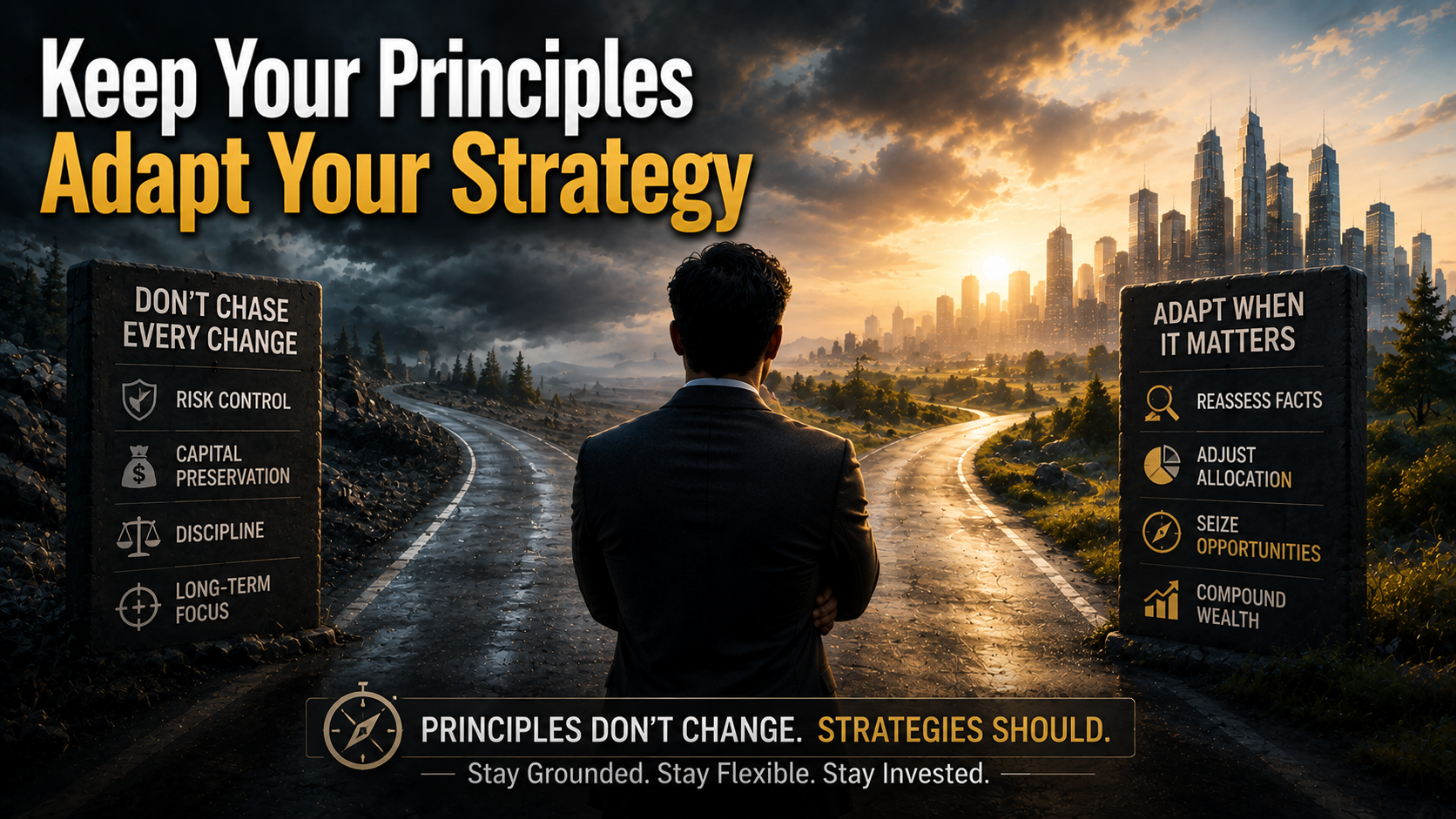
But holding should be an active conclusion supported by current evidence—not a passive habit inherited from the past.
The economy changes.
Interest rates change.
Industries change.
Consumer behavior, technology, liquidity, and competitive advantages all change.
Investors do not need to predict every shift. They do need to remain willing to reassess their assumptions when the evidence changes.
The central lesson is simple
Change creates uncertainty, but refusing to change can create risk of its own.
This has been MasterMind.
'[Global] Success Blueprints' 카테고리의 다른 글