What Is Margin of Safety? Why It Matters in Value Investing


Hello, this is MasterMind.
What separates successful long-term investors from those who consistently buy at the wrong time?
It is rarely faster news, better chart patterns, or the ability to predict the next market move.
Instead, experienced investors ask a different question
"If my assumptions turn out to be wrong, how much protection do I have?"
That question lies at the heart of one of the most important concepts in investing: Margin of Safety.
Popularized by Benjamin Graham and later embraced by Warren Buffett, the Margin of Safety is more than simply buying stocks at low prices. It is a disciplined approach to managing uncertainty by purchasing assets at prices that provide room for error.
Markets are inherently unpredictable. Economic cycles change, interest rates fluctuate, earnings disappoint, and investor sentiment can swing from extreme optimism to outright panic. The Margin of Safety exists because even the best investors know they will never predict the future perfectly.

Key Takeaway
A Margin of Safety means buying an investment at a price significantly below its intrinsic value, providing protection against uncertainty, valuation errors, and unexpected market events while improving long-term return potential.
What Is Margin of Safety?
Understanding the Concept
The idea of a Margin of Safety did not originate in finance.
In engineering, bridges, buildings, and aircraft are designed to withstand loads far greater than what they are expected to experience. This extra capacity protects the structure if real-world conditions differ from the original assumptions.
Benjamin Graham applied the same philosophy to investing.
His argument was simple
Because investors cannot know the future with certainty, they should only buy assets when there is a significant gap between what an asset is worth and what the market is currently asking for it.
That gap is called the Margin of Safety.
Rather than relying on perfect forecasts, investors rely on favorable pricing.
Three Concepts Every Investor Should Know
Intrinsic Value
Intrinsic value represents what a business is actually worth based on its future cash flows, assets, competitive advantages, profitability, and long-term earning power.
Unlike market prices, intrinsic value does not change every minute.
It reflects the underlying economic value of the business.
Market Price
Market price is simply the price investors are willing to pay today.
Unlike intrinsic value, market prices are heavily influenced by
- Investor sentiment
- Interest rates
- Economic news
- Liquidity
- Fear and greed
- Short-term expectations
This explains why excellent companies sometimes become overpriced—and why struggling companies occasionally become bargains.
Margin of Safety
The Margin of Safety is the difference between intrinsic value and market price.
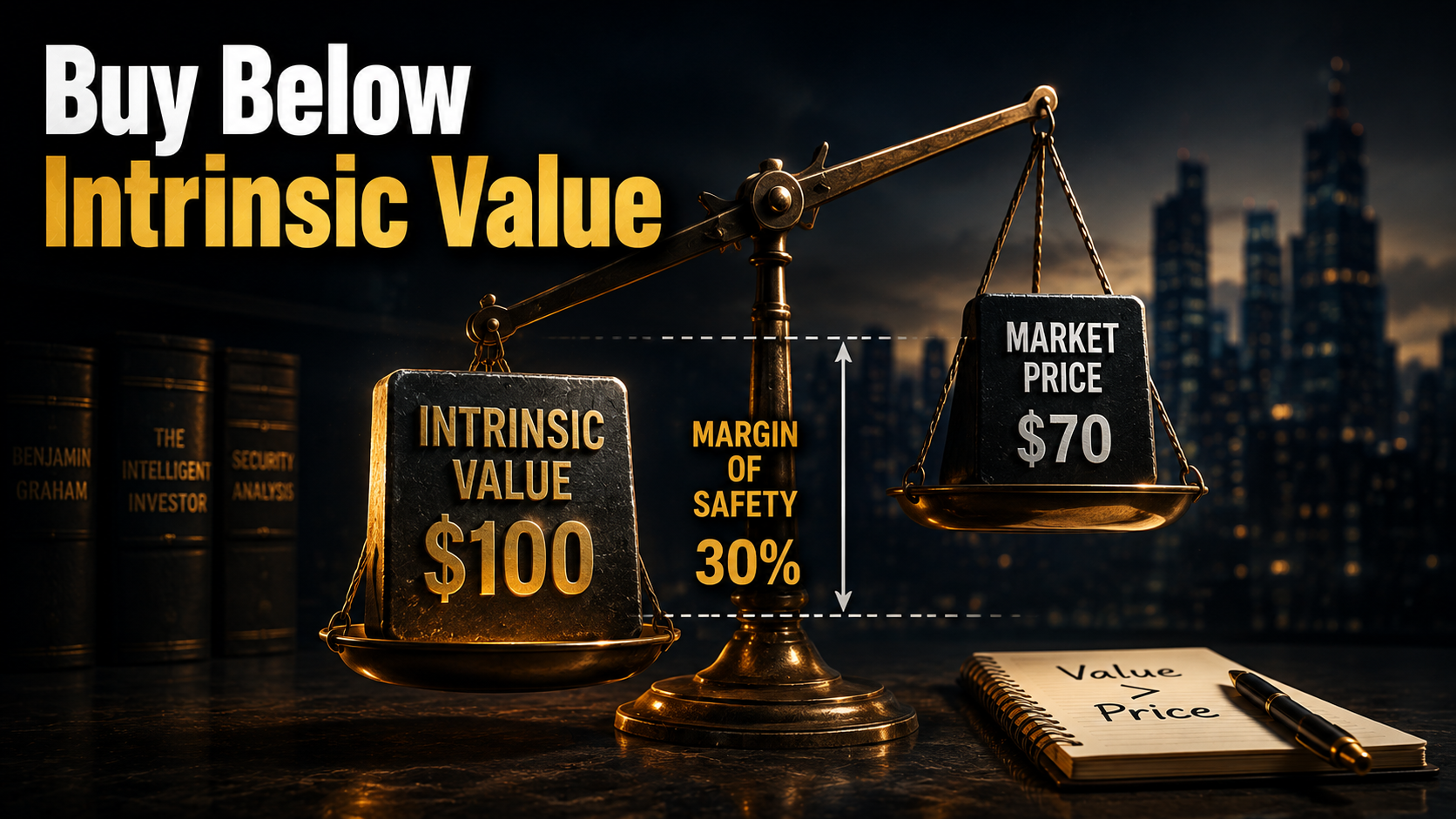
Imagine you estimate that a company's intrinsic value is $100 per share, but temporary market pessimism pushes the stock down to $70.
That $30 difference provides a cushion against uncertainty.
Even if your valuation turns out to be slightly optimistic, you may still have purchased the company at a reasonable price.
How Do You Calculate Margin of Safety?
Investors often calculate the Margin of Safety using the following formula
Margin of Safety (%) = (Intrinsic Value − Current Market Price) ÷ Intrinsic Value × 100
For example
- Estimated intrinsic value: $100
- Current market price: $70
Margin of Safety
($100 − $70) ÷ $100 = 30%
In this example, the investor has a 30% Margin of Safety.
There is no universal rule regarding the "perfect" percentage.
However, many value investors look for a Margin of Safety of 20% to 40%, depending on the quality of the business, industry risks, and the confidence level of their valuation.
The greater the uncertainty, the larger the Margin of Safety investors generally require.
Margin of Safety vs. Intrinsic Value
These two concepts are closely related, but they are not the same.
| Concept | Meaning |
| Intrinsic Value | What a business is actually worth |
| Market Price | What investors are currently willing to pay |
| Margin of Safety | The discount between intrinsic value and market price |
Think about buying a house.
Suppose careful analysis suggests a home's fair value is $1 million.
If you have the opportunity to purchase it for $700,000, the $300,000 discount represents your Margin of Safety.
The home's value hasn't changed.
Only the purchase price has.
The same principle applies to stocks.
Intrinsic value is the destination.
The Margin of Safety determines how much room for error exists before your investment becomes risky.
How Does Margin of Safety Work?
The Margin of Safety is built on one fundamental assumption
Your analysis will never be perfect.
Every valuation depends on assumptions about
- Future earnings
- Revenue growth
- Interest rates
- Profit margins
- Economic conditions
Some of those assumptions will inevitably prove wrong.
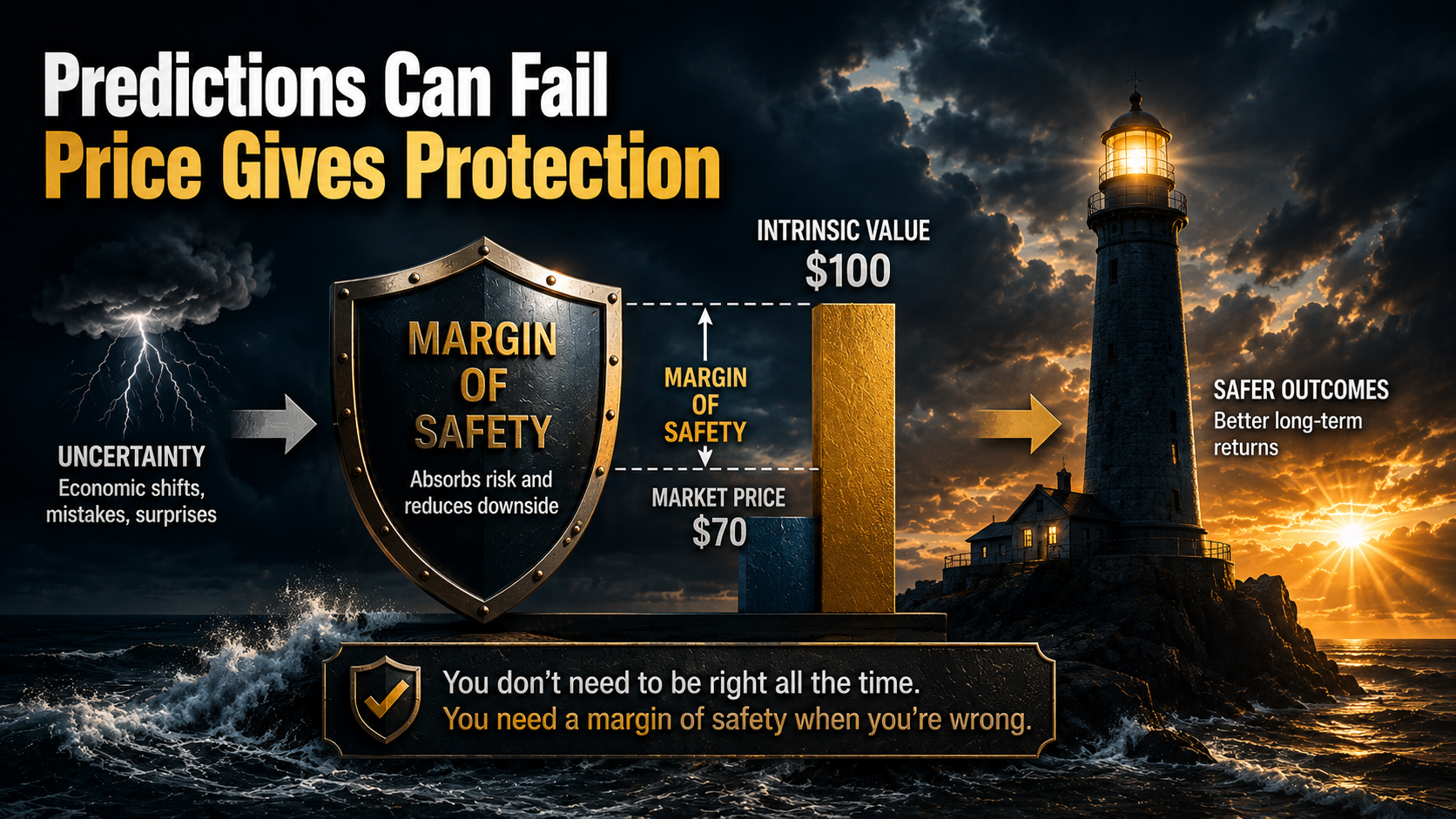
Rather than attempting to eliminate uncertainty, successful investors build uncertainty directly into their buying decisions.
1. It Reduces Downside Risk
Buying well below intrinsic value limits the impact of negative surprises.
When pessimism is already reflected in the share price, additional bad news often has less room to push prices dramatically lower.
Lower purchase prices generally provide better downside protection.
2. It Creates Asymmetrical Risk-Reward
One of the most attractive features of the Margin of Safety is its asymmetrical payoff.
If you purchase a quality company at a substantial discount
- Potential downside becomes more limited.
- Potential upside increases as price gradually converges toward intrinsic value.
This creates a more favorable balance between risk and expected return.
3. It Absorbs Valuation Errors
No discounted cash flow model, earnings forecast, or valuation multiple is perfectly accurate.
Economic recessions, technological disruption, regulatory changes, or unexpected competition can all affect a company's future value.
A Margin of Safety provides a cushion against those inevitable forecasting mistakes.
Instead of requiring perfect analysis, it allows room for imperfect assumptions.
4. It Keeps Investors Focused on Business Value
Bull markets often encourage investors to chase momentum.
Bear markets tempt them to panic and sell.
The Margin of Safety shifts attention away from market emotion and back toward business fundamentals.
Rather than asking,
"Will this stock go up next month?"
Value investors ask,
"Is the current price significantly below what this business is truly worth?"
That change in perspective often leads to more rational investment decisions.
How Much Margin of Safety Is Enough?
This is one of the most common questions among value investors.
The honest answer is
There is no universal number.
The appropriate Margin of Safety depends on several factors, including
- Business quality
- Industry stability
- Financial strength
- Competitive advantages
- Confidence in the valuation
That said, many long-term investors generally use these guidelines
- Around 20% for highly predictable, financially strong businesses
- 30% or more for typical value investing opportunities
- 40% to 50% or higher for cyclical industries or companies with greater uncertainty
The key point is not reaching a specific percentage.
The goal is to leave yourself enough room for mistakes.
The best investors are not those who predict the future with perfect accuracy.
They are the ones who prepare for the possibility of being wrong.
Why Does Margin of Safety Matter?
The most dangerous investment is not necessarily the one with the highest volatility.
It is the one that leaves no room for error.
When an asset is priced for perfection, even a small disappointment can trigger a sharp decline. Revenue growth may slow, interest rates may remain higher than expected, or profit margins may weaken. If the market price already assumes an ideal future, there is little protection when reality falls short.
A Margin of Safety matters because it recognizes a basic truth
Investing is not about eliminating uncertainty. It is about surviving it.
1. Survival Matters More Than Prediction
Many investors focus on identifying the next market winner.
But long-term wealth is often built by avoiding permanent losses rather than by making perfect forecasts.
A 50% loss requires a 100% gain just to return to the original starting point.
| Portfolio Loss | Gain Required to Recover |
| 10% | 11.1% |
| 20% | 25% |
| 30% | 42.9% |
| 40% | 66.7% |
| 50% | 100% |
This mathematical imbalance is why downside protection matters so much.
The deeper the loss, the harder recovery becomes. A large drawdown can also force investors to sell at the worst possible moment, especially if leverage, margin debt, or short-term cash needs are involved.
A Margin of Safety cannot prevent every decline. However, it can reduce the risk that a temporary setback turns into permanent capital impairment.
In investing, the first objective is not to be right every time.
It is to remain financially capable of participating when the next opportunity appears.
2. It Protects the Power of Compounding
Compounding works best when capital remains intact for long periods.
A portfolio that compounds steadily does not need spectacular annual returns to create substantial wealth. But a single severe loss can interrupt that process and erase years of progress.
For example, a business may continue generating cash through a recession even if its stock price temporarily declines. If an investor purchased that company with a sufficient Margin of Safety, the underlying cash flow may provide the patience needed to hold through volatility.
This is why long-term investors often care more about
- Balance sheet strength
- Free cash flow
- Debt maturity schedules
- Durable competitive advantages
- Management discipline
These factors determine whether a company can continue operating, investing, and creating value during difficult periods.
A true Margin of Safety is not only a discount in the stock price.
It is also the financial resilience of the business itself.
3. It Reduces Emotional Decision-Making
Market volatility affects more than portfolio values.
It affects investor psychology.
When prices rise rapidly, investors often become more confident and lower their standards. When prices fall sharply, they may abandon businesses they once believed in.
A clear valuation framework can reduce this emotional instability.
If an investor understands
- What the business is worth
- Why the stock is undervalued
- What risks could invalidate the thesis
- How much financial strength the company has
then short-term price movements become easier to interpret.
The investor is no longer reacting only to price.
The investor is comparing price with value.
That distinction is critical because market prices can change much faster than business fundamentals.
4. It Turns Market Fear Into a Source of Opportunity
Some of the largest discounts between price and value appear during periods of market stress.
Examples may include
- Recessions
- Credit crises
- Industry downturns
- Earnings disappointments
- Regulatory fears
- Forced selling
- Broad risk-off environments
During these periods, investors often sell assets indiscriminately.
Strong companies may decline alongside weak ones because funds need liquidity, institutions reduce risk, or traders respond to short-term uncertainty.
This is where disciplined investors look for mispricing.
They do not assume every falling stock is a bargain. Instead, they ask whether the price decline is larger than the deterioration in the underlying business.
Market fear creates opportunity only when the asset retains its economic value.
A collapsing price by itself is not a Margin of Safety.
Margin of Safety Across Different Asset Classes
The concept is most commonly associated with stocks, but the underlying principle can also be applied to bonds, cash, gold, and other assets.
The method changes depending on the asset.
Margin of Safety in Stocks
For stocks, the Margin of Safety is usually based on the gap between estimated intrinsic value and market price.
Investors may estimate intrinsic value using
- Discounted cash flow analysis
- Earnings power
- Free cash flow yield
- Asset value
- Comparable valuation multiples
- Historical profitability
A stock may offer a meaningful Margin of Safety when
- The market underestimates normalized earnings
- Temporary problems overshadow long-term business quality
- The company has strong cash flow and low financial risk
- The valuation reflects excessive pessimism
However, a low price-to-earnings ratio does not automatically indicate safety.
A company may appear cheap because its earnings are about to decline, its balance sheet is deteriorating, or its industry is facing structural disruption.
Price is only one part of the analysis.
Margin of Safety in Bonds
For bonds, the Margin of Safety comes from the relationship between yield, credit quality, maturity risk, and the investor’s purchase price.
A bond may offer greater protection when
- The issuer has strong interest coverage
- Default risk is low
- The yield adequately compensates for inflation and credit risk
- The maturity is appropriate for the interest-rate environment
- The bond is purchased below par value
For example, a higher yield may look attractive, but it may simply reflect a high probability of default.
The relevant question is not whether the yield is high.
It is whether the yield is sufficient relative to the risk being accepted.
Margin of Safety in Cash and U.S. Treasuries
Cash does not usually produce high long-term returns, but it can provide strategic flexibility.
During periods of extreme market stress, cash and short-term U.S. Treasuries may allow investors to
- Avoid forced selling
- Meet near-term obligations
- Preserve purchasing power better than risk assets during sharp declines
- Purchase high-quality assets when valuations become attractive
Holding cash has an opportunity cost, especially during strong bull markets.
But investors with no liquidity may be unable to take advantage of major selloffs.
From this perspective, cash is not merely an idle asset.
It is a reserve of future purchasing power.
Margin of Safety in Gold
Gold does not produce cash flow, making intrinsic value more difficult to estimate than it is for a business or bond.
Its investment case often depends on
- Real interest rates
- Currency confidence
- Inflation expectations
- Central-bank demand
- Geopolitical risk
- Portfolio diversification needs
For gold, a Margin of Safety may come from position sizing, portfolio role, and entry price rather than from a traditional cash-flow valuation.
Gold can act as a hedge under certain conditions, but it can also experience long periods of weak returns.
It should not be treated as risk-free.
Margin of Safety in Bitcoin
Bitcoin presents an even greater valuation challenge because it does not generate earnings, dividends, or contractual cash flows.
Its price is influenced by
- Adoption
- Network activity
- Liquidity
- Regulation
- Institutional demand
- Market sentiment
- Scarcity expectations
Because intrinsic value is difficult to estimate, applying a precise Margin of Safety is challenging.
For highly volatile assets such as Bitcoin, risk management may depend more heavily on
- Position size
- Time horizon
- Liquidity needs
- Entry discipline
- Portfolio diversification
- The investor’s tolerance for drawdowns
The absence of a traditional valuation model does not eliminate risk.
It increases the importance of conservative assumptions.

What Investors Need to Understand
A Cheap Stock Is Not Always a Safe Investment
One of the most common mistakes in value investing is confusing a falling price with improving value.
A stock can decline because it was previously overpriced.
But it can also decline because the business is becoming less valuable.
A falling stock may be a value opportunity when
- The problem is temporary
- The balance sheet remains strong
- Long-term demand is intact
- Cash flow can recover
- Competitive advantages remain durable
It may be a value trap when
- Debt is becoming unmanageable
- Revenue is structurally declining
- The company is losing market share
- Technology is making the business obsolete
- Management repeatedly destroys shareholder value
The key question is not
“How far has the stock fallen?”
The better question is
“Has the price fallen more than the underlying value?”
A Great Company Can Still Be a Poor Investment
High-quality businesses often deserve premium valuations.
But no company is worth an unlimited price.
Even a dominant company can produce disappointing investment returns if investors pay too much for expected growth.
When a stock price already assumes
- Rapid revenue growth
- Expanding margins
- Continued market dominance
- Low interest rates
- No major competitive disruption
there may be little room for disappointment.
The business can perform well while the stock performs poorly because the original purchase price was too high.
Investment returns depend on both business quality and valuation.
A great business purchased at an excessive price may offer less protection than an average business purchased at a deeply discounted price.
Intrinsic Value Is a Range, Not a Precise Number
Investors often treat intrinsic value as if it were an exact figure.
In reality, it is an estimate based on uncertain assumptions.
A small change in the discount rate, terminal growth rate, or future profit margin can significantly alter a valuation.
For this reason, it is often more useful to estimate a range.
For example
- Conservative value: $80
- Base-case value: $100
- Optimistic value: $120
If the stock trades at $95, it may look inexpensive under the optimistic case but expensive under the conservative case.
If it trades at $60, the investment may still appear attractive across several reasonable scenarios.
The Margin of Safety should be measured against conservative assumptions, not only the most favorable outcome.
Financial Strength Is Part of the Margin of Safety
A discounted stock price means little if the company cannot survive long enough for its value to recover.
Investors should examine
- Net debt
- Interest expense
- Debt maturities
- Free cash flow
- Liquidity
- Share dilution
- Pension obligations
- Capital expenditure needs
Two companies may trade at the same valuation multiple, but the company with less debt and stronger cash generation usually has greater financial flexibility.
During an economic downturn, that flexibility can determine which company survives and which company is forced to restructure, issue shares, or sell assets.
Patience Is an Investment Advantage
A Margin of Safety is not always available.
During periods of abundant liquidity and extreme optimism, high-quality assets may trade at expensive valuations for extended periods.
Investors may feel pressure to lower their standards because prices continue rising.
But the absence of an attractive opportunity does not create an obligation to buy.
Waiting can be a rational decision.
Patience allows investors to preserve capital until
- Valuations improve
- Business uncertainty declines
- Interest rates change
- Market expectations become more realistic
- Forced selling creates mispricing
The discipline to do nothing is often one of the most underappreciated skills in investing.
What Do Wealthy Investors Look for in This Environment?
Wealthy investors and long-term capital allocators often look beyond short-term price targets.
They focus on where money is moving, which assets can generate durable cash flow, and which businesses can survive unfavorable economic conditions.
1. The Direction of Capital Flows
Markets are shaped by the movement of capital.
When liquidity is abundant, money often moves toward higher-growth and more speculative assets.
When financial conditions tighten, capital may return to
- Profitable businesses
- Strong balance sheets
- Short-term Treasuries
- Cash-generating assets
- Defensive sectors
The important issue is not simply whether money is entering or leaving the stock market.
It is where that money is going and why.
A shift toward quality often signals that investors are becoming more sensitive to valuation and financial strength.
2. Durable Free Cash Flow
Revenue growth can attract attention, but free cash flow ultimately determines whether a business can
- Pay down debt
- Repurchase shares
- Pay dividends
- Fund expansion
- Survive recessions
- Invest without relying constantly on outside capital
Long-term investors prefer companies that can finance their own future.
A business dependent on continuous borrowing or equity issuance may appear successful during easy financial conditions but become vulnerable when capital becomes expensive.
Sustainable free cash flow is one of the strongest forms of Margin of Safety.
3. The Ability to Survive a Downturn
A company’s true strength often becomes visible during difficult periods.
Investors should ask
- Can the company remain profitable during a recession?
- Does it have enough liquidity to meet obligations?
- Can it continue investing while competitors cut back?
- Is customer demand cyclical or durable?
- Can management allocate capital rationally under pressure?
The strongest businesses may emerge from downturns with greater market share because weaker competitors are forced to retreat.
That is why survival is not merely defensive.
It can become a source of long-term competitive advantage.
4. Long-Term Purchasing Power
Wealthy investors often evaluate returns in real terms.
A nominal gain is less meaningful if inflation reduces purchasing power.
They therefore consider whether an asset can
- Grow cash flow faster than inflation
- Reprice products and services
- Preserve real income
- Maintain competitive relevance
- Compound capital over long periods
The goal is not simply to own assets that rise in price.
It is to own assets capable of preserving and increasing future purchasing power.
Questions Investors Should Ask Themselves
Before buying an asset, consider the following questions
- What is the conservative estimate of intrinsic value?
- Which assumptions have the greatest impact on that estimate?
- What could permanently reduce the asset’s value?
- Does the current price already reflect a favorable scenario?
- How strong is the company’s balance sheet?
- Can the business survive one or two difficult years?
- Does the company generate real free cash flow?
- Am I buying because of value or because the price is rising?
- How much could I lose if my thesis is wrong?
- Is the position size small enough to survive a negative outcome?
These questions do not guarantee success.
They create a more disciplined decision-making process.

Final Thoughts
Margin of Safety is often described as the foundation of value investing.
But its importance extends far beyond buying undervalued stocks.
It is a broader philosophy of risk management.
It means accepting that forecasts will be imperfect, markets will remain volatile, and unexpected events will occur.
Rather than demanding certainty, investors create protection through
- Conservative valuations
- Strong balance sheets
- Durable cash flow
- Reasonable purchase prices
- Adequate liquidity
- Disciplined position sizing
The market continually moves between optimism and fear.
During periods of optimism, investors often assume that favorable conditions will continue indefinitely. During periods of fear, they may ignore the long-term value of productive assets.
A disciplined investor does neither.
The investor waits for a meaningful gap between price and value.
The most important lesson is simple
Finding a great business is not enough. The price you pay plays a major role in determining both your future return and your risk of permanent loss.
Successful investing is not about predicting every market move.
It is about building a portfolio that can survive when predictions fail.
That is the real purpose of a Margin of Safety.
This was MasterMind.
'[Global] Success Blueprints' 카테고리의 다른 글