What Is Intrinsic Value? How Investors Determine a Company's True Worth


Hello, this is MasterMind.
Every day, stock prices rise and fall, sometimes dramatically. But does a company's true value really change as quickly as its share price?
Why do some companies with strong earnings see their stock prices decline, while others with little or no profit continue climbing to new highs?
The answer lies in understanding one of the most important concepts in investing: Intrinsic Value.
Legendary investors like Warren Buffett and Benjamin Graham have built their investment philosophy around a simple idea: price and value are not the same thing.
If you can estimate what a business is truly worth, short-term market volatility becomes less intimidating and long-term investment decisions become far more rational.
In this article, we'll explore what intrinsic value is, how investors estimate it, why it matters, and how professional investors use it to separate market noise from long-term opportunity.

Key Takeaway
Intrinsic Value is a company's true economic worth based on its future cash flows, competitive advantages, and long-term earning power—not the price investors happen to pay for it today.
What Is Intrinsic Value?
Intrinsic Value is an estimate of what a business is actually worth based on its ability to generate cash over time.
Rather than focusing on today's stock price, intrinsic value asks a much more important question
"How much cash can this company generate for its owners over its lifetime?"
Professional investors analyze factors such as
- Future Free Cash Flow (FCF)
- Revenue growth potential
- Profitability
- Competitive advantages
- Capital allocation
- Long-term industry outlook
Together, these factors help estimate the economic value of a business independent of short-term market sentiment.
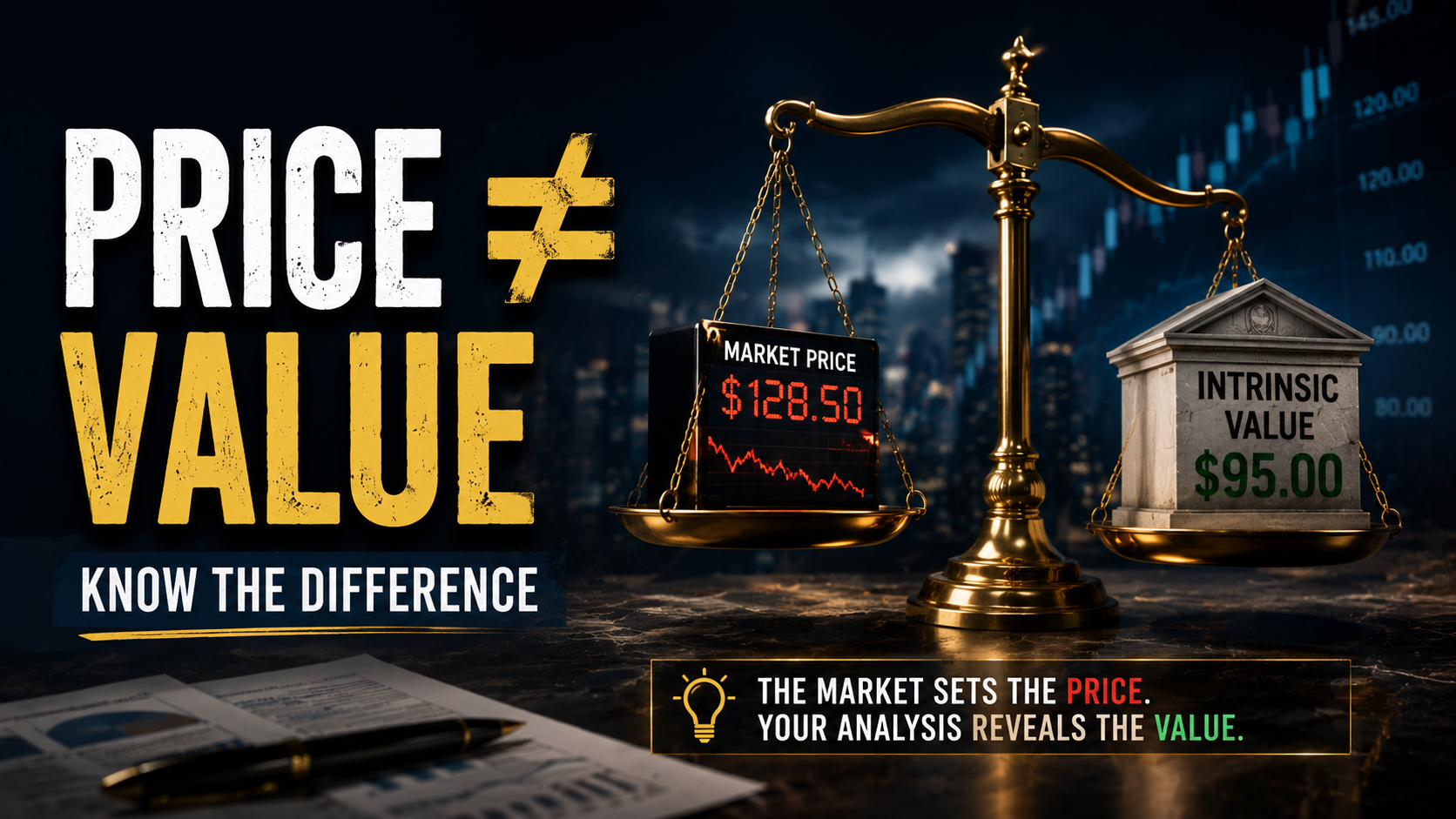
Market Price vs. Intrinsic Value
Many new investors assume that a stock's current market price reflects its true value.
In reality, these are two very different concepts.
| Market Price | Intrinsic Value |
| Determined by buyers and sellers | Determined by business fundamentals |
| Changes every second | Changes gradually over time |
| Influenced by fear, greed, and headlines | Influenced by earnings and cash flow |
| Reflects current market sentiment | Reflects long-term business value |
One of the most important lessons in investing is this
Prices move every day. Intrinsic value usually doesn't.
A company's factories, software, patents, customer relationships, and competitive position don't suddenly double or disappear overnight simply because investors become optimistic or fearful.
That gap between price and value is where investment opportunities are created.
Benjamin Graham's "Mr. Market"
Benjamin Graham, often called the father of value investing, described the stock market as an emotional business partner named Mr. Market.
Every day, Mr. Market offers to buy or sell shares at a different price.
Some days he's wildly optimistic and willing to pay almost any price.
Other days he's overwhelmed by fear and wants to sell great businesses at bargain prices.
Successful investors don't allow Mr. Market to tell them what a business is worth.
Instead, they calculate intrinsic value first and then decide whether the market price offers an attractive opportunity.
How Is Intrinsic Value Calculated?
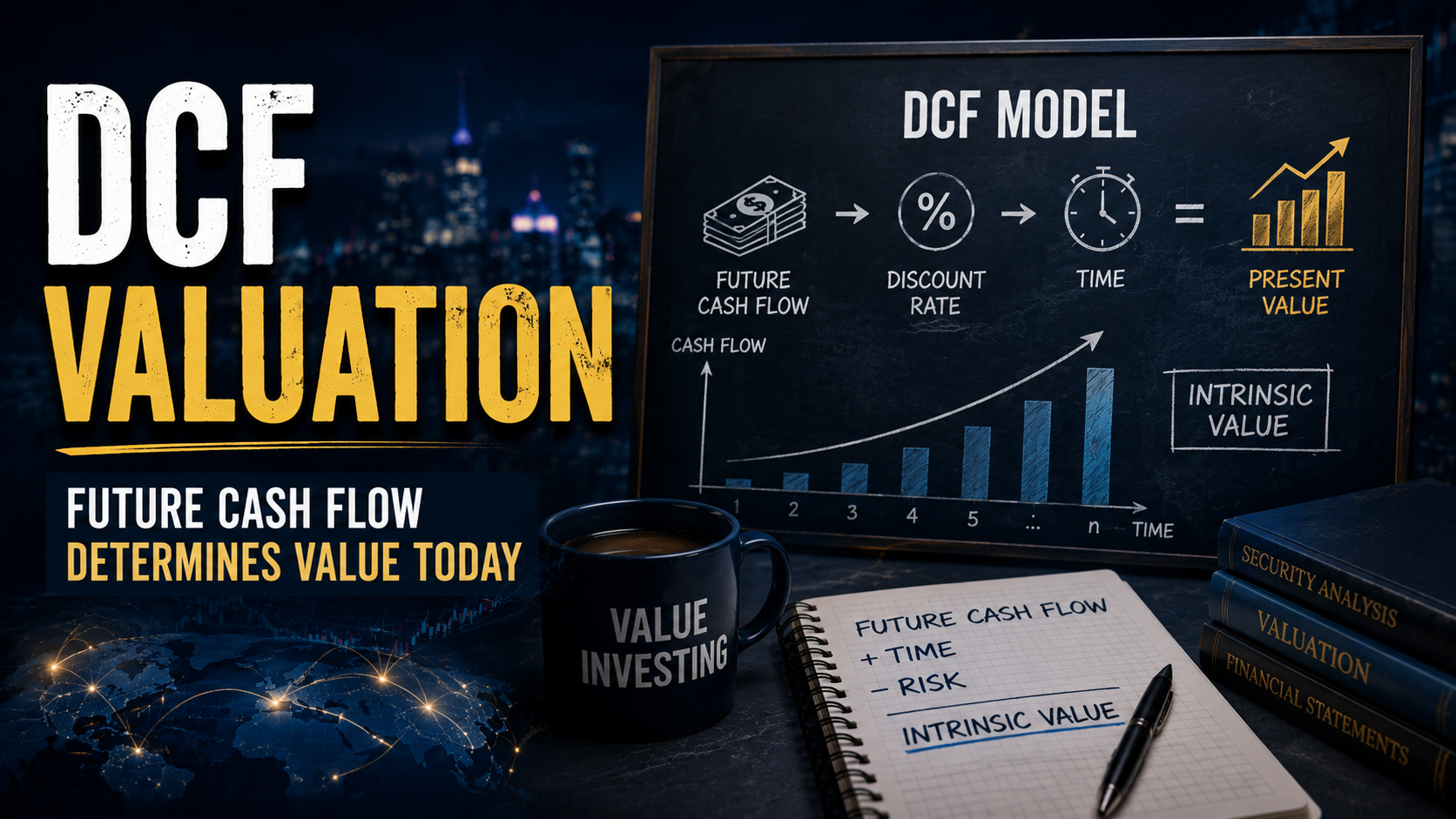
There are several valuation methods, but the most widely used approach on Wall Street is the Discounted Cash Flow (DCF) model.
The basic idea is straightforward
A company's value equals the present value of all the cash it is expected to generate in the future.
The process typically involves three steps.
1. Estimate Future Free Cash Flow
Analysts forecast how much cash the company will generate after operating expenses and capital investments.
Free Cash Flow is important because it represents the money that can ultimately be returned to shareholders or reinvested to create future growth.
2. Apply a Discount Rate
A dollar received ten years from now isn't worth the same as a dollar received today.
Future cash must be discounted to account for
- Time value of money
- Inflation
- Interest rates
- Investment risk
- Opportunity cost
This is why interest rates play such an important role in stock valuation.
3. Calculate Present Value
Each future cash flow is discounted back to today's dollars.
Those present values are then added together to estimate the company's intrinsic value.
In simple terms,
Intrinsic Value is the total value of all future cash a business can realistically generate, expressed in today's dollars.
Why Interest Rates Matter
One of the biggest drivers of intrinsic value is the discount rate.
When Treasury yields or Federal Reserve interest rates rise, investors demand higher returns.
That increases the discount rate used in valuation models.
As a result, future cash flows become less valuable today.
This explains why high-growth technology companies often experience larger valuation declines during periods of rising interest rates.
Companies expected to generate most of their profits many years into the future are naturally more sensitive to changes in discount rates.
Why Intrinsic Value Matters
1. It Helps Investors Separate Price From Value
Markets are emotional.
Business value is fundamentally economic.
Stock prices may fluctuate dramatically because of
- Earnings headlines
- Economic data
- Interest rate expectations
- Geopolitical events
- Investor sentiment
Intrinsic value provides a rational benchmark that helps investors determine whether the market is overreacting or underreacting.
2. It Creates a Margin of Safety
One of Benjamin Graham's most influential ideas is the Margin of Safety.
Imagine a company's intrinsic value is estimated at $100 per share.
If the market offers the stock at $70, investors may have a cushion against uncertainty if their assumptions are reasonably accurate.
Conversely, paying $180 for a business worth around $100 leaves very little room for error.
Of course, intrinsic value is always an estimate—not an exact number.
But even an estimate provides a much stronger foundation than relying solely on price momentum or market sentiment.

3. It Reduces Emotional Decision-Making
Markets generate an endless stream of headlines.
Most influence short-term prices.
Very few permanently change the underlying value of a quality business.
Investors who focus on intrinsic value spend less time reacting to daily volatility and more time evaluating what truly matters
- Cash flow
- Competitive advantage
- Capital allocation
- Long-term earnings power
As Warren Buffett famously said
"Price is what you pay. Value is what you get."
Ultimately, markets determine prices.
Businesses create value.
How Intrinsic Value Affects Different Asset Classes
Intrinsic value is most useful when an asset produces measurable cash flows. However, the concept applies differently across stocks, bonds, real estate, currencies, gold, and Bitcoin.
| Asset Class | Primary Valuation Basis | Key Market Sensitivity |
| Stocks | Future free cash flow, earnings power, competitive advantage | Interest rates, growth expectations, margins |
| Bonds | Contractual interest and principal payments | Treasury yields, credit risk, inflation |
| Real Estate | Rental income, operating cash flow, resale value | Mortgage rates, occupancy, local demand |
| U.S. Dollar | Relative interest rates, purchasing power, economic strength | Federal Reserve policy, capital flows |
| Gold | Scarcity, monetary demand, safe-haven appeal | Real interest rates, inflation expectations |
| Bitcoin | Scarcity, adoption, network strength, liquidity | Risk appetite, regulation, market demand |
For cash-flow-producing assets such as stocks, bonds, and real estate, investors can estimate value by discounting future income.
Gold and Bitcoin are different because they do not generate cash flow on their own. Traditional DCF analysis therefore does not work well for them.
Their value depends more heavily on scarcity, adoption, liquidity, monetary credibility, and what future buyers are willing to pay.
This distinction matters because not every asset should be analyzed with the same valuation tool.
What Changes a Company's Intrinsic Value?
Intrinsic value is not a permanent number.
It changes when the long-term economics of the business change.
Revenue Growth
If a company can increase sales without destroying profitability, its future cash-flow potential may rise.
However, revenue growth alone is not enough.
A company that grows rapidly while losing money on every sale may create less value than investors expect.
Profit Margins
Higher operating margins allow a company to convert more revenue into profit and cash flow.
Businesses with strong pricing power can often protect margins during inflationary periods by passing higher costs on to customers.
That ability can help preserve intrinsic value.
Free Cash Flow
Free cash flow is one of the most important inputs in valuation.
A company can report accounting profits while producing weak cash flow because of heavy capital spending, rising inventory, or delayed customer payments.
Long-term investors therefore look beyond earnings per share and ask
How much cash is the business actually producing after maintaining and expanding its operations?
Interest Rates
Higher interest rates generally reduce estimated intrinsic values because future cash flows are discounted more aggressively.
Lower interest rates can support higher valuations, especially for growth companies whose profits are expected far into the future.
This is one reason the Federal Reserve has such a large influence on U.S. equity valuations.
The Fed does not directly determine what a company is worth, but it influences the discount rate investors use to value future cash flows.
Competitive Advantage
A company with durable competitive advantages may sustain high returns for longer than its competitors.
Examples of an economic moat may include
- Strong brand loyalty
- Network effects
- High switching costs
- Cost advantages
- Intellectual property
- Regulatory barriers
- Distribution scale
A business that cannot defend its profits may appear attractive today but produce weaker cash flows in the future.
Intrinsic value therefore depends not only on how much money a company earns now, but also on how long it can protect those earnings.
Capital Allocation
Management decisions can either increase or destroy intrinsic value.
Cash generated by a business can be used for
- Reinvestment
- Acquisitions
- Debt repayment
- Dividends
- Share repurchases
The key question is whether management can deploy capital at attractive rates of return.
A company may generate substantial cash but still destroy shareholder value through expensive acquisitions, excessive debt, or poorly timed buybacks.
The Most Important Risks in Intrinsic Value Analysis
Intrinsic value sounds precise, but every valuation model depends on assumptions.
Small changes in those assumptions can produce very different results.
Intrinsic Value Is a Range, Not a Single Number
No investor can predict future revenue, margins, interest rates, or competition with perfect accuracy.
For that reason, it is usually more realistic to estimate a valuation range.
For example
- Conservative value: $75 per share
- Base-case value: $95 per share
- Optimistic value: $120 per share
This approach makes uncertainty visible instead of hiding it behind one overly precise target price.
Professional investors often use multiple scenarios rather than relying on one forecast.
Beware of Overly Optimistic Growth Assumptions
A small increase in the assumed long-term growth rate can significantly raise a DCF valuation.
That creates a common problem: investors may adjust assumptions until the model produces the answer they want.
A disciplined valuation should begin with realistic business economics, not a preferred stock price.
The most dangerous spreadsheet is often the one that appears mathematically precise while being built on unrealistic assumptions.
The Discount Rate Can Change the Entire Result
A lower discount rate makes future cash flows appear more valuable.
A higher discount rate reduces their present value.
Because discount rates reflect interest rates and risk, two analysts can reach very different conclusions about the same company.
Investors should therefore examine not only the final valuation but also the assumptions behind it.
Terminal Value Can Dominate a DCF Model
A large portion of a company's estimated value often comes from the terminal value, which represents cash flows beyond the explicit forecast period.
This makes the model highly sensitive to long-term assumptions.
If the terminal growth rate is too aggressive or the discount rate is too low, intrinsic value can be significantly overstated.
A good model should remain reasonable even under more conservative assumptions.
The Value Trap: When a Cheap Stock Is Not Truly Undervalued
One of the biggest mistakes in value investing is assuming that a low valuation multiple automatically means a stock is cheap.
A company may trade at a low price-to-earnings or price-to-book ratio because its business is weakening.
This is known as a value trap.
A stock may look inexpensive because
- Revenue is permanently declining
- Technology is making its products obsolete
- Competitors are taking market share
- Debt is becoming unmanageable
- Margins are structurally deteriorating
- Management is destroying capital
- Customer demand is shifting elsewhere
In these situations, the market price may not be falling below intrinsic value.
Instead, intrinsic value itself may be falling.
This is why investors must distinguish between a temporary price decline and permanent business deterioration.
A declining stock is not automatically a bargain.
Sometimes the market is recognizing damage that has not yet appeared clearly in reported earnings.
How to Use Intrinsic Value in Real-World Investing
Intrinsic value should not be treated as a mechanical buy-or-sell signal.
It is better used as a framework for disciplined thinking.
Start With the Business, Not the Stock Chart
Before building a valuation model, investors should understand
- How the company makes money
- Why customers choose its products
- Whether demand is durable
- What could weaken its competitive position
- How much capital is required to grow
- Whether management allocates capital well
A valuation is only as reliable as the business understanding behind it.
Use Conservative Assumptions
Investors should avoid assuming that recent high growth will continue forever.
Growth normally slows as companies become larger.
Competition also tends to increase when an industry is highly profitable.
Conservative assumptions may produce fewer apparent bargains, but they can also reduce the risk of overpaying.
Compare Price With a Valuation Range
Suppose an investor estimates that a company's intrinsic value falls between $90 and $110 per share.
The investment decision may look very different at different market prices.
| Market Price | Possible Interpretation |
| $65 | Potentially meaningful margin of safety |
| $95 | Near the lower end of estimated fair value |
| $110 | Near the upper end of estimated fair value |
| $150 | Requires stronger growth than the base case assumes |
This does not mean the stock must rise or fall immediately.
It means the investor can evaluate how much optimism or pessimism is already embedded in the price.
Recalculate When the Business Changes
An investor should not defend an outdated valuation simply because the stock price has fallen.
Intrinsic value should be reassessed when there are meaningful changes in
- Long-term growth
- Profitability
- Debt
- Competitive position
- Regulation
- Management quality
- Capital requirements
- Industry structure
The goal is not to remain loyal to an old estimate.
The goal is to remain loyal to reality.
The Market's Deeper Structure
The stock market shows investors a price every second.
It does not show them value.
In the short run, prices are heavily influenced by expectations, positioning, liquidity, fear, greed, and the need to buy or sell quickly.
In the long run, returns are more closely tied to the cash a business generates and how effectively that cash is reinvested or returned to shareholders.
This leads to one of the most important principles in investing
Short-term prices are driven by changes in expectations. Long-term value is driven by changes in cash flow.
A great company can still be a poor investment if the market price assumes unrealistic perfection.
A struggling company can appear statistically cheap while its ability to produce cash continues to deteriorate.
The investor's job is not simply to identify good businesses.
It is to evaluate the relationship between the quality of the business, its future cash-flow potential, and the price being asked today.
What Do Wealthy Investors Look For?

Wealthy investors and institutional managers generally focus less on short-term price movement and more on the process through which value is created and preserved.
The Movement of Capital
Experienced investors watch where capital is flowing and why.
They do not automatically chase the asset class that has recently performed best.
Instead, they consider whether changing interest rates, risk premiums, and business conditions are making one type of cash flow more attractive than another.
When Treasury yields rise, capital may move away from expensive long-duration growth stocks toward shorter-duration or more cash-generative assets.
When rates fall, investors may become more willing to pay for distant future growth.
The important issue is not simply where money is moving today, but what change in expected returns caused that movement.
The Quality of Cash Flow
Not all earnings are equally valuable.
Investors prefer cash flows that are
- Recurring
- Predictable
- Capital efficient
- Resistant to competition
- Supported by strong balance sheets
A business that requires constant borrowing or heavy capital spending to maintain growth may be less valuable than its reported earnings suggest.
By contrast, a company that produces strong free cash flow with limited additional capital may compound value more efficiently.
Asset Survivability
Long-term investors ask whether a business can survive
- Recessions
- Inflation
- Higher borrowing costs
- Technological disruption
- Competitive pressure
- Temporary demand shocks
A company with high debt, unstable margins, and weak pricing power may not survive long enough for its estimated value to be realized.
This is why investing is not only about maximizing returns.
It is also about avoiding permanent loss.
Prediction is useful, but survival is essential.
Long-Term Compounding
Intrinsic value can grow even when the stock price remains stagnant.
If a company continues increasing free cash flow, strengthening its competitive position, and reinvesting at attractive returns, its underlying value may compound over time.
Eventually, the market may recognize that progress.
But the timing is uncertain.
Wealthy investors often have an advantage because they can use patient capital and avoid being forced to sell during temporary volatility.
Time becomes valuable only when the underlying asset continues creating value.
Waiting alone is not a strategy.
Waiting while intrinsic value compounds can be.
Questions Every Investor Should Ask
Before investing, consider asking
- Does this business generate real and sustainable free cash flow?
- What assumptions are already reflected in the current stock price?
- Could the company's competitive advantage weaken over time?
- How sensitive is the valuation to higher interest rates?
- Does the company have enough financial strength to survive a recession?
- Is the stock genuinely undervalued, or is it becoming a value trap?
- Would I still be comfortable owning this business if the stock market closed for three years?
These questions do not eliminate uncertainty.
They help investors focus on the risks that matter most.
Final Thoughts
Intrinsic value is more than a valuation formula. It is a framework for understanding what a business is truly worth beyond its daily stock price.
In the short term, markets are driven by headlines, sentiment, and changing expectations. Over the long term, however, a company's ability to generate sustainable cash flow and compound shareholder value becomes the primary driver of returns.
No valuation model can predict the future with complete accuracy. Intrinsic value should therefore be viewed as a well-reasoned estimate rather than an exact number. The objective is not to find perfect precision, but to make better investment decisions based on business fundamentals instead of market emotion.
The most important idea to remember is simple
The market determines the price, but the business creates the value.
Successful investing is not about predicting every market movement. It is about identifying high-quality businesses, buying them at reasonable valuations, and allowing time for their intrinsic value to grow.
Because in the end, prices fluctuate—but long-term value is created by the business itself.
'[Global] Success Blueprints' 카테고리의 다른 글