What Is a Dark Pool? Why Institutional Investors Use It and How It Affects the Stock Market


Hello, this is MasterMind.
When a pension fund, hedge fund, or mutual fund needs to buy or sell millions of shares, how can it execute such a massive trade without sending the market into panic?
Behind the familiar trading screens of the NYSE and Nasdaq lies another marketplace that most retail investors never see: the Dark Pool.
Dark Pools are not mysterious or illegal exchanges. They are an essential part of today's U.S. financial system, allowing institutional investors to move enormous amounts of capital while minimizing market disruption.
Understanding how Dark Pools work provides more than just another investing term—it offers insight into how capital flows through the market before price movements become obvious.

Key Takeaway
A Dark Pool is a private trading venue that allows institutional investors to execute large stock transactions anonymously, reducing market impact while quietly moving significant amounts of capital.
What Is a Dark Pool?
A Dark Pool is a private electronic trading venue where buy and sell orders remain hidden until after a trade has been completed.
Unlike public exchanges such as the New York Stock Exchange (NYSE) or Nasdaq, where every bid and ask is visible through the order book, Dark Pools keep trading intentions confidential.
Most Dark Pools operate as Alternative Trading Systems (ATS) under SEC regulation.
Despite the name, there is nothing illegal about them. They simply serve a different purpose than traditional exchanges.
Public Exchanges vs. Dark Pools
| Feature | Public Exchange | Dark Pool |
| Order Visibility | Public before execution | Hidden until execution |
| Order Book | Fully visible | Not visible |
| Main Users | All investors | Primarily institutions |
| Primary Purpose | Price discovery | Reduce market impact |
| Transparency | High | Limited before execution |
Why Were Dark Pools Created?
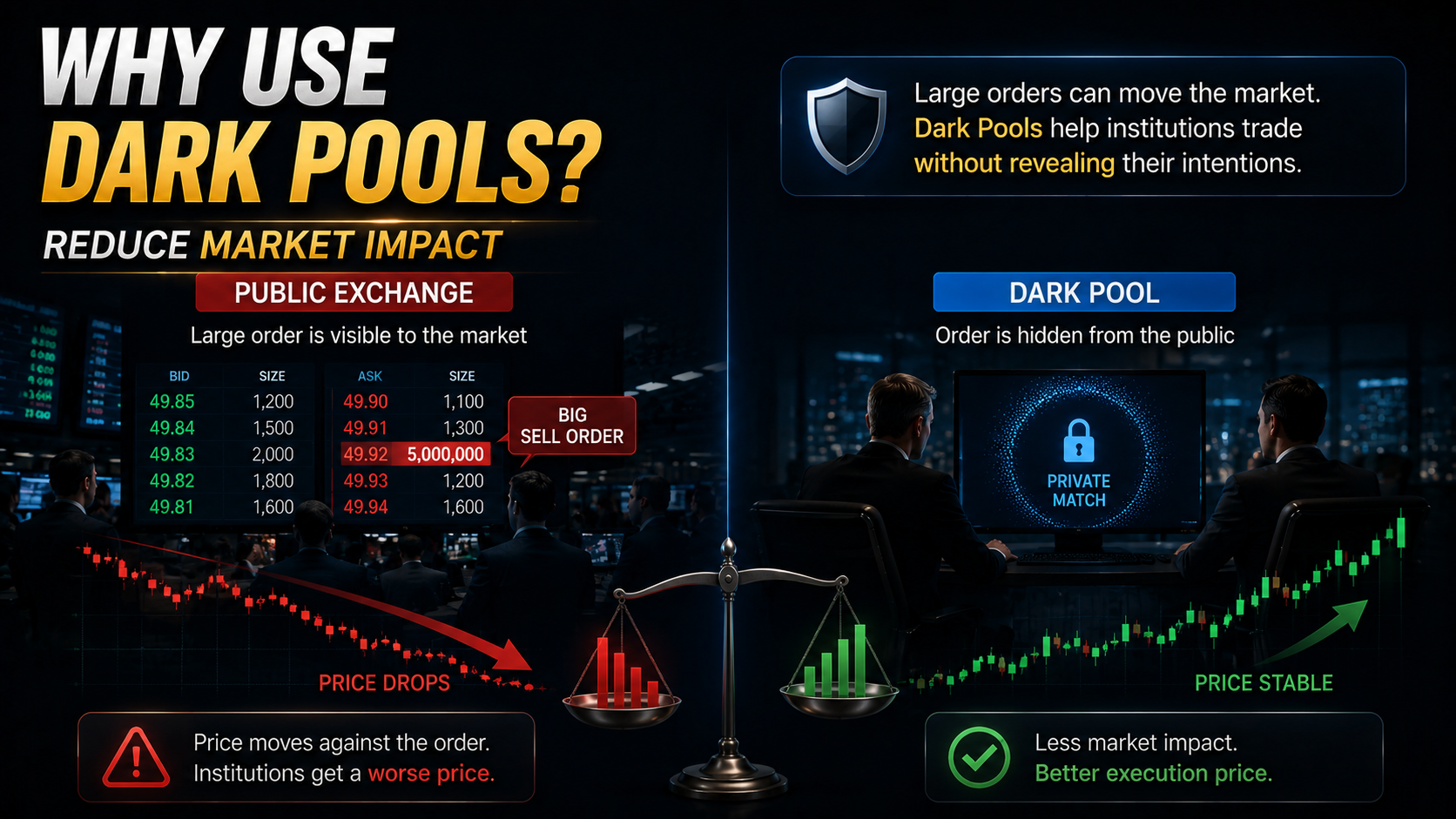
The primary purpose of a Dark Pool is to reduce market impact.
Imagine that a large pension fund wants to sell five million shares of a company.
If that order appears on the public market, traders immediately notice the massive sell order.
Many investors begin selling before the institution finishes its trade.
The stock price falls rapidly.
Ironically, the institution ends up receiving a much lower selling price precisely because everyone saw its order.
The same principle applies to large buy orders.
Once the market recognizes strong institutional demand, other traders rush in, pushing prices higher before the institution can complete its purchases.
For large investors, executing a trade quietly is often just as important as choosing the right investment.
How Does a Dark Pool Work?
Dark Pools follow a relatively straightforward process.
1. Hidden Orders
Institutional investors submit buy or sell orders without displaying them to the public market.
2. Anonymous Matching
The Dark Pool matches compatible buyers and sellers internally without revealing their identities.
3. Price Determination
Most Dark Pools do not create their own prices.
Instead, they reference the National Best Bid and Offer (NBBO), which represents the best available bid and ask prices across U.S. exchanges.
Many transactions execute at the midpoint between those prices.
4. Post-Trade Reporting
After execution, the completed trade is reported to regulators and eventually becomes part of the public record.
The market sees the completed transaction—but only after it has already occurred.

Why Are Dark Pools Important?
Dark Pools have grown into a significant part of the U.S. equity market.
For long-term investors, their importance goes far beyond institutional trading.
They Can Influence Price Discovery
Financial markets rely on price discovery, where buyers and sellers openly compete to establish fair market value.
When a meaningful share of trading occurs away from public exchanges, the visible order book may no longer represent all market activity.
This does not necessarily make prices inaccurate, but it means that public quotes do not always tell the complete story.
They Highlight Information Asymmetry
Retail investors generally rely on publicly available quotes and trading volume.
Institutional investors have access to multiple execution venues, including Dark Pools.
Understanding this difference helps investors recognize that visible market activity represents only part of the overall trading landscape.
They Reveal the Importance of Liquidity
Markets often move because of liquidity, not simply because of headlines.
Large institutional investors constantly evaluate how capital can move efficiently without dramatically affecting prices.
Dark Pools exist because liquidity has real value.
The biggest market participants often think about execution first and prediction second.
Dark Pools vs. OTC Trading
Dark Pools and Over-the-Counter (OTC) markets are often confused, but they serve different purposes.
| Feature | Dark Pool | OTC Market |
| Trading Method | Anonymous electronic matching | Direct negotiation between counterparties |
| Pricing | Based on public market prices (NBBO) | Negotiated between participants |
| Primary Assets | Equities | Bonds, currencies, derivatives, and other assets |
| Main Objective | Minimize market impact | Customized large transactions |
While both operate outside traditional exchanges, Dark Pools remain closely tied to public market pricing.
How Dark Pools Affect Financial Markets
| Asset | Potential Impact |
| Stocks | Large institutional trades can be executed with less price disruption. |
| Treasuries & Bonds | Improve execution efficiency for institutional fixed-income transactions. |
| U.S. Dollar | Large portfolio reallocations may indirectly influence capital flows. |
| Gold | Limited direct impact, though broader risk sentiment can create indirect effects. |
| Bitcoin & Crypto | Institutional OTC desks and crypto Dark Pool-style services help reduce market impact for large transactions. |
What Investors Should Know
1. The Order Book Doesn't Show Everything
Visible bids and asks represent only a portion of total market activity.
Significant institutional trades may be taking place elsewhere.
2. Higher Dark Pool Volume Isn't Automatically Bullish
Many investors mistakenly assume rising Dark Pool activity means institutions are buying.
In reality, Dark Pools process both large purchases and large sales.
Volume alone does not reveal market direction.
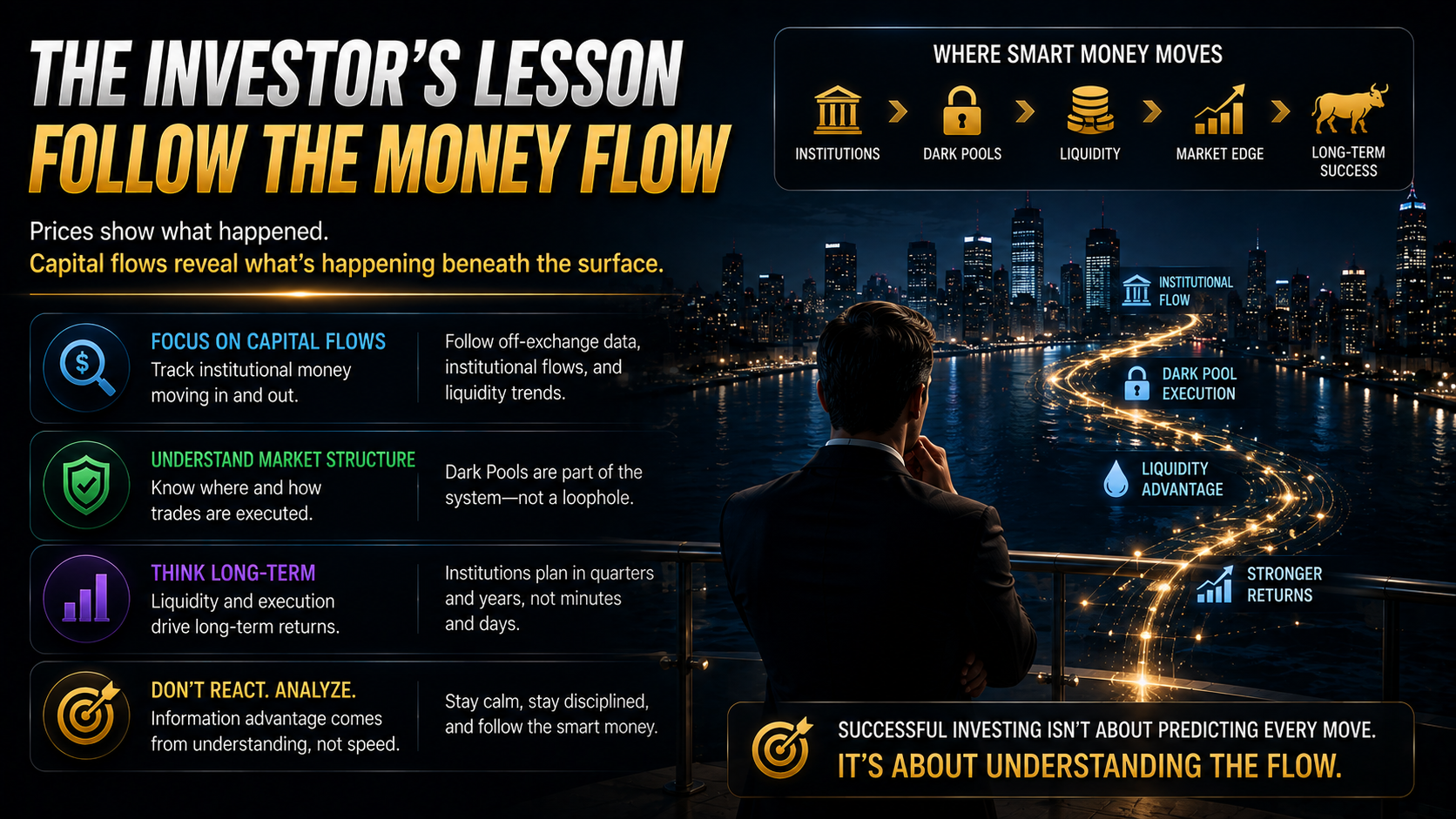
3. Follow Capital Flows, Not Just Trading Volume
Professional investors often monitor:
- Off-Exchange Volume
- FINRA Trade Reporting Facility (TRF) data
- Institutional flow statistics
- Liquidity conditions
These indicators provide broader context than exchange volume alone.
4. Regulation Continues to Evolve
The U.S. Securities and Exchange Commission (SEC) continues reviewing market structure and transparency rules.
Future regulatory changes could alter how institutional trading is executed and where liquidity is concentrated.
Where Can Investors Track Dark Pool Activity?
Retail investors can access several sources that provide information about off-exchange trading.
Common resources include:
- FINRA Trade Reporting Facility (TRF)
- Off-Exchange Volume statistics
- Cboe market data
- Nasdaq Data Link
- Professional market data platforms
These reports are primarily useful for understanding market structure, not predicting tomorrow's stock price.
What Do Wealthy Investors Focus On?

Experienced investors rarely concentrate only on today's stock price.
Instead, they ask a different set of questions.
- Where is capital flowing?
- Which sectors are attracting institutional money?
- How is market liquidity changing?
- Are investors seeking growth, safety, or cash flow?
The market's most successful long-term investors understand that capital moves before headlines change.
Price is often the final result of a process that begins with liquidity.
Rather than trying to predict every short-term move, they focus on understanding how money flows through the financial system.
Ask yourself:
- Is the visible market showing the full picture?
- Where is institutional capital moving today?
- Am I following headlines, or am I following liquidity?
- Is my portfolio built to survive changing market conditions?
Markets reward investors who understand structure—not just those who react quickly.
Final Thoughts
Dark Pools are far more than hidden trading venues.
They are an essential part of modern financial markets, allowing institutional investors to move billions of dollars efficiently while reducing unnecessary market disruption.
For retail investors, the lesson isn't to chase Dark Pool activity or treat it as a buy or sell signal.
Instead, the real value comes from understanding how institutional capital moves and why market liquidity matters.
Remember this:
Stock prices tell you what has happened. Liquidity often tells you what is happening beneath the surface. Investors who understand capital flows gain a broader perspective on how markets truly work.
MasterMind.
'[Global] Success Blueprints' 카테고리의 다른 글