What Is a Gamma Squeeze? How It Works and Why It Matters to Investors


Hello, this is MasterMind.
Why do some stocks suddenly surge 20%, 50%, or even several hundred percent in just a few trading sessions?
Many investors assume these explosive rallies are driven by strong earnings, major news, or an influx of buyers. While those factors can certainly move prices, they don't always explain the full story.
Sometimes, the real driver isn't the company itself—it's the options market.
One of the clearest examples is a Gamma Squeeze, a phenomenon where options market mechanics force institutional market makers to buy shares, creating a self-reinforcing cycle of rising prices.
The GameStop and AMC rallies introduced millions of investors to the term, but Gamma Squeezes are not rare, one-time events. As options trading has grown rapidly—particularly with the rise of weekly and 0DTE (Zero Days to Expiration) options—Gamma Squeezes have become an increasingly important part of modern U.S. equity markets.
Understanding this mechanism helps investors distinguish between a rally driven by improving business fundamentals and one driven primarily by market structure.
Key Takeaway
A Gamma Squeeze occurs when market makers continuously buy shares to hedge call options they have sold, creating a feedback loop in which rising stock prices trigger even more buying.
What Is a Gamma Squeeze?
A Gamma Squeeze is a market event in which options hedging activity creates additional demand for the underlying stock, pushing prices even higher.
Unlike traditional rallies driven by corporate earnings or economic news, a Gamma Squeeze is primarily caused by the structure of the options market.
To understand why this happens, it's helpful to know the roles of the two primary participants.
Call Option
A call option gives its owner the right—but not the obligation—to buy a stock at a predetermined strike price before expiration.
Investors typically purchase call options when they expect a stock to rise.
Market Maker
A market maker is a financial institution responsible for providing liquidity in the options market.
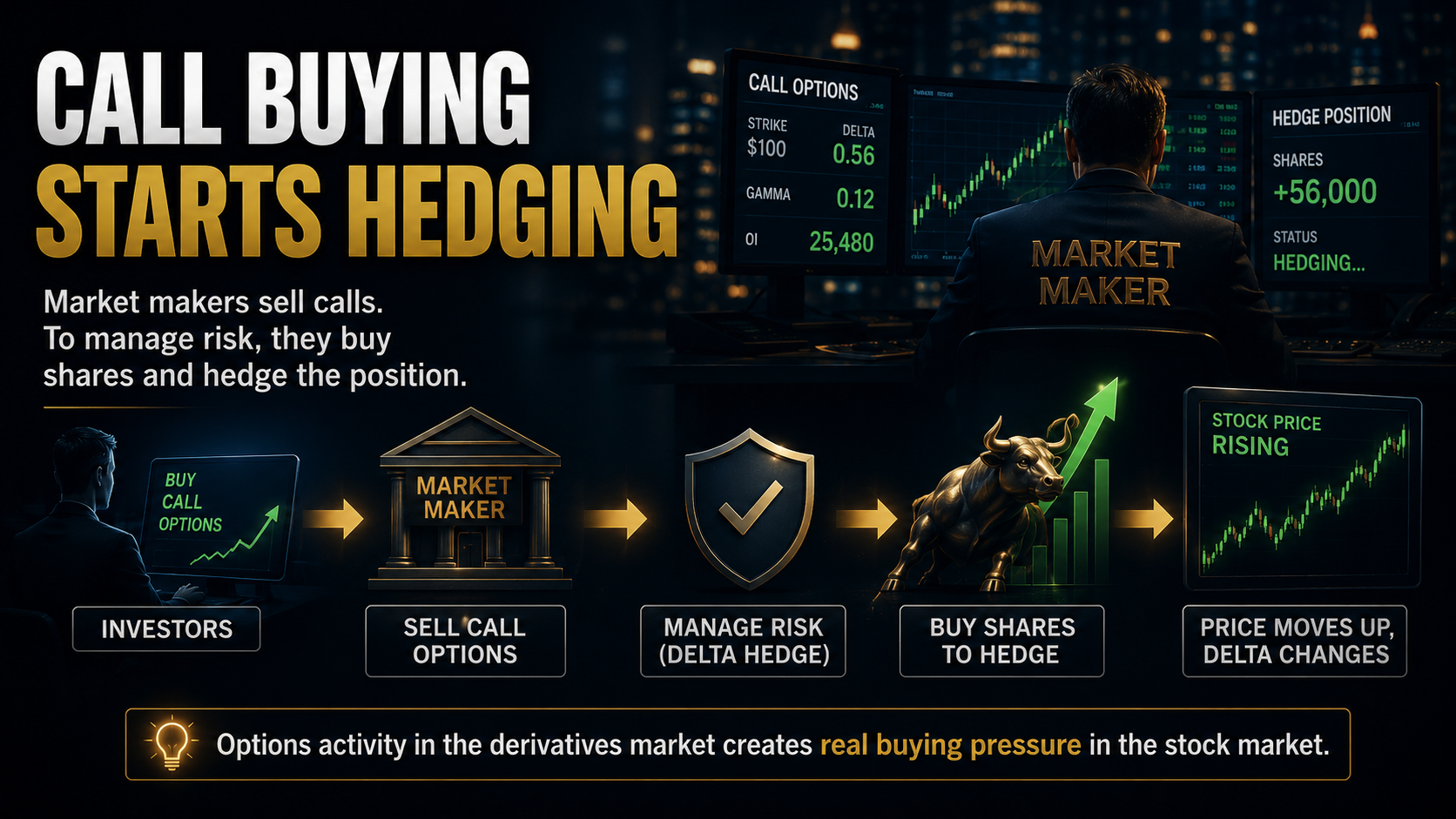
When retail or institutional investors buy call options, market makers are often the counterparties selling those contracts.
By selling calls, however, market makers expose themselves to potentially significant losses if the stock price rises sharply.
To reduce that risk, they purchase shares of the underlying stock.
This risk-management process is known as Delta Hedging.
In other words,
Activity in the options market creates real buying pressure in the stock market.
That is the foundation of a Gamma Squeeze.
How Does a Gamma Squeeze Work?
The entire process revolves around two important option Greeks
- Delta
- Gamma
The sequence typically looks like this
Heavy Call Buying

↓

Market Makers Sell Calls

↓

Delta Hedging Begins

↓

Market Makers Buy Shares

↓

Stock Price Rises

↓

Gamma Increases

↓

Delta Increases

↓

Additional Hedging

↓

More Share Buying

↓

Further Price Appreciation
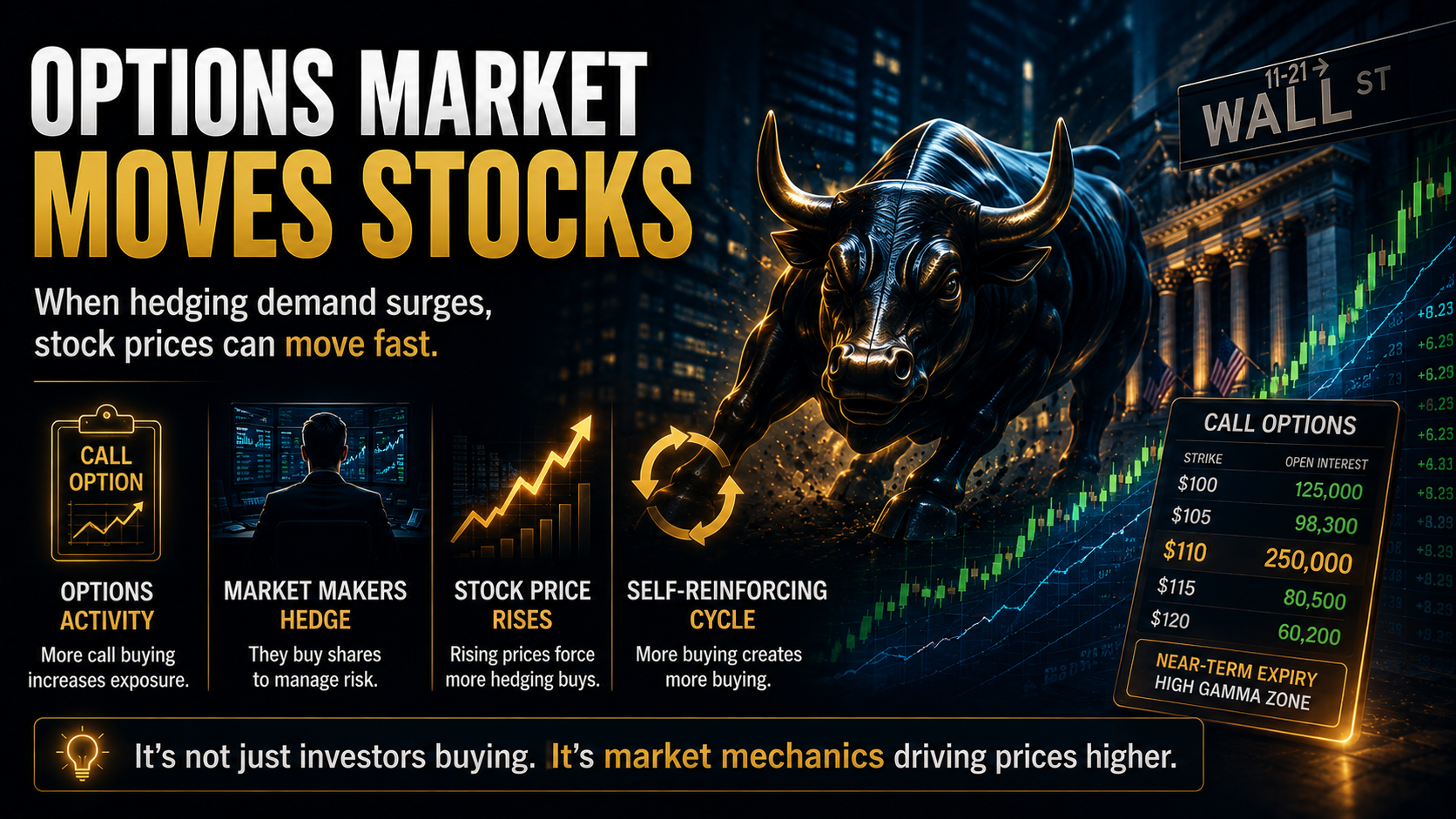
As the stock continues rising, market makers must repeatedly increase their hedge positions.
This creates a self-reinforcing feedback loop where higher prices generate additional buying pressure.

Understanding Delta
Delta measures how much an option's price is expected to change for every $1 move in the underlying stock.
For example,
If a call option has a Delta of 0.50, a $1 increase in the stock price should increase the option's value by approximately $0.50.
Suppose a market maker sells one call option contract covering 100 shares.
With a Delta of 0.50, the market maker may purchase roughly 50 shares to hedge that position.
This is known as Delta Hedging.
At this stage, the hedge remains relatively manageable.
Understanding Gamma
Gamma measures how quickly Delta changes as the stock price moves.
This is where things become interesting.
As a stock approaches the option's strike price, Gamma often increases significantly.
That causes Delta to change rapidly.
For example,
Delta: 0.40 → 0.58 → 0.74 → 0.90 → 1.00
As Delta increases, market makers must purchase additional shares to maintain a neutral risk position.
The cycle becomes
Stock Price Rises
↓
Delta Increases
↓
Additional Hedging Required
↓
More Shares Purchased
↓
Stock Price Rises Again
This positive feedback mechanism is the defining characteristic of a Gamma Squeeze.
Rather than investors chasing higher prices, higher prices themselves create additional institutional buying.
Why Does Gamma Increase Near Expiration?
Gamma is typically highest when options are approaching expiration and the stock price is trading close to the strike price.
This is one reason why options expiration weeks often experience unusually high volatility.
Small price movements can force market makers to make significant adjustments to their hedge positions.
The growth of 0DTE options in the U.S. market has made this dynamic even more important.
With contracts expiring on the same day they are traded, Delta can change extremely quickly, requiring market makers to rebalance their positions almost continuously.
As a result, even relatively small price moves can generate disproportionately large hedging flows.
Why Does Gamma Squeeze Matter?
Most investors believe stock prices rise because buyers enter the market.
During a Gamma Squeeze, however, the opposite can happen.
Rising prices create new buyers.
Every increase in the stock price forces market makers to buy additional shares, and those purchases push prices even higher.
In other words,
Price itself becomes the catalyst for additional demand.
This is one of the clearest examples of what market professionals sometimes call "the tail wagging the dog."
Instead of the stock market determining options prices, the options market temporarily influences the direction of the stock itself.
This is why some stocks can experience dramatic short-term rallies without any meaningful improvement in their underlying business.
For long-term investors, recognizing the difference between fundamental buying and structural hedging demand is essential.
Understanding that distinction helps investors avoid confusing temporary market mechanics with lasting improvements in a company's intrinsic value.
Gamma Squeeze vs. Short Squeeze
Gamma Squeezes and Short Squeezes can both cause dramatic stock-price rallies, but they are driven by different mechanisms.
| Category | Gamma Squeeze | Short Squeeze |
| Primary Cause | Options hedging | Short sellers closing positions |
| Main Buyers | Market makers | Short sellers |
| Core Mechanism | Delta hedging | Short covering |
| Market Origin | Options market | Stock market |
| Key Trigger | Rapid changes in Delta and Gamma | Rising losses on short positions |
| Can They Occur Together? | Yes | Yes |
A Short Squeeze occurs when investors who have sold a stock short are forced to buy shares back as the price rises.
A Gamma Squeeze, by contrast, occurs when market makers buy shares to hedge call options they have sold.
In real markets, the two can happen simultaneously.
Market-maker hedging may push the stock higher, increasing losses for short sellers. Those short sellers may then close their positions by purchasing shares, adding another layer of demand.
The combined process can look like this
Heavy Call Buying

↓

Market-Maker Hedging

↓

Stock Price Rises

↓

Short Sellers Face Larger Losses

↓

Short Covering Begins

↓

Additional Buying Pressure

↓

Faster Price Appreciation
This interaction helps explain why heavily shorted stocks with active options markets can experience exceptionally sharp price moves.
However, investors should not assume that every heavily shorted stock is about to experience a squeeze. A large short interest or high call-option volume may create the conditions for a squeeze, but it does not guarantee that one will occur.
What Market Conditions Can Increase Gamma Squeeze Risk?
A Gamma Squeeze generally requires more than simply high options volume.
Several conditions often appear together.
1. Heavy Call-Option Buying
A sudden increase in call-option demand can leave market makers with larger short-call exposure.
The more call options they sell, the more shares they may need to buy as a hedge.
This effect can be particularly strong when traders concentrate their activity in near-term contracts.
2. Call Open Interest Near the Current Stock Price
Open Interest measures the number of outstanding option contracts that remain open.
When large amounts of call open interest are concentrated around strike prices near the current stock price, relatively small price movements may create significant changes in Delta.
This can increase the need for market makers to adjust their hedges.
3. Short-Dated Options
Short-dated contracts usually have greater Gamma sensitivity near expiration.
This is especially relevant for weekly and 0DTE options.
Because there is little time remaining before expiration, the probability that an option will finish in or out of the money can change rapidly. Market makers may therefore need to rebalance their hedges more aggressively.
4. Limited Share Liquidity
Gamma-driven buying can have a larger effect on stocks with relatively low trading liquidity or limited public float.
When fewer shares are readily available, a surge in hedging demand may move the price more dramatically than it would in a highly liquid mega-cap stock.
5. High Short Interest
High short interest is not required for a Gamma Squeeze, but it can amplify the move.
As the stock rises, short sellers may face margin pressure or risk limits that force them to buy shares back.
That additional demand can transform an options-driven rally into a combined Gamma and Short Squeeze.
How a Gamma Squeeze Affects Financial Markets
The most direct impact appears in the underlying stock and its options.
However, the broader effects can spread through liquidity, volatility and investor behavior.
| Market Area | Typical Reaction | Why It Happens |
| Underlying Stock | Rapid short-term rally | Market makers buy shares to hedge |
| Implied Volatility | May increase sharply | Demand for options rises |
| Call-Option Premiums | Can become expensive | Higher volatility and stronger demand |
| Short Positions | Greater loss and covering pressure | Rising prices increase short losses |
| Trading Volume | Often increases | Speculation and hedging activity accelerate |
| Market Liquidity | Can become unstable | Orders concentrate in one stock or strike |
| Bonds and the Dollar | Usually limited direct effect | Gamma Squeezes are often stock-specific |
| Bitcoin and Crypto | Similar mechanisms are possible | Crypto derivatives also require hedging |
A Gamma Squeeze in a single stock does not normally have a major direct effect on Treasury yields, the U.S. dollar or gold.
The broader market impact depends on the size of the company, the amount of capital involved and whether similar positioning exists across an index.
For example, options activity in a heavily weighted S&P 500 or Nasdaq stock may influence the broader index more than a squeeze in a small-cap company.
Why Implied Volatility Matters
During a potential Gamma Squeeze, investors often focus only on the stock price.
However, Implied Volatility, or IV, is equally important.
Implied Volatility reflects the market's expectation of future price movement. When demand for options rises, IV often increases, making option premiums more expensive.
This creates an important risk for late buyers.
Even if the stock continues rising, a call option may fail to produce the expected return if the investor paid an extremely high volatility premium.
When the excitement fades, IV can fall rapidly. This is known as an IV crush.
As a result, an investor can correctly predict the direction of the stock and still lose money on the option because the decline in volatility offsets the benefit of the price move.
The lesson is simple
Buying a call option is not only a bet on direction. It is also a bet on timing, volatility and the speed of the move.
What Happens When a Gamma Squeeze Ends?
A Gamma Squeeze cannot continue indefinitely.
The buying pressure depends on the need for market makers to maintain their hedge positions.
That need can weaken for several reasons.
Option Expiration
Once the options expire, the positions that created the hedge may disappear.
Market makers may no longer need to hold the same number of shares.
Delta Stops Increasing
If the stock stops rising, Delta may stabilize.
Without further changes in Delta, the need for additional share purchases declines.
Traders Close Their Calls
When investors sell or close their call-option positions, market makers may reduce the hedges associated with those contracts.
This can create de-hedging pressure.
Implied Volatility Falls
A decline in volatility can reduce option demand and weaken the speculative momentum that supported the rally.
Hedge Unwinding Begins
The same mechanism that forced market makers to buy shares on the way up can cause them to sell shares on the way down.
The reversal may look like this
Stock Price Stops Rising

↓

Call Demand Weakens

↓

Delta Declines

↓

Market Makers Reduce Hedges

↓

Shares Are Sold

↓

Stock Price Falls

↓

Further De-Hedging
This is why Gamma Squeeze rallies can reverse with extraordinary speed.
The buying was not necessarily based on a long-term belief in the company. It was partly the result of risk-management rules.
Once those rules require less hedging, the temporary source of demand can disappear.
What Investors Should Watch
Gamma Squeezes are difficult to predict with certainty, but several indicators can help investors understand whether unusual options positioning may be influencing a stock.
Call Volume
A sharp increase in call-option volume may signal growing speculative demand.
However, volume alone does not reveal whether traders are opening or closing positions.
Call Open Interest
Open Interest can show where outstanding contracts are concentrated.
Large call positions near the current stock price may create stronger hedging sensitivity.
Strike-Price Concentration
Investors should examine whether large amounts of activity are clustered around a few nearby strike prices.
These levels can become important because Delta may change rapidly as the stock approaches them.
Time to Expiration
Short-dated options usually have greater Gamma exposure near the strike price.
The closer the expiration date, the more quickly hedging requirements can change.
Implied Volatility
Rapidly rising IV may indicate that the options market is pricing in unusually large movements.
It can also mean that options have already become expensive.
Short Interest and Days to Cover
High short interest may increase the possibility that a Gamma-driven rally triggers short covering.
Days to Cover estimates how long it could take short sellers to close their positions based on average trading volume.
Still, neither high short interest nor high Days to Cover guarantees a Short Squeeze.
Trading Liquidity and Public Float
A stock with a limited float may react more strongly to concentrated buying.
Investors should distinguish between total shares outstanding and the number of shares that are actually available for public trading.
Key Risks Investors Should Understand
1. The Rally May Not Reflect Business Improvement
A Gamma Squeeze can push a stock far above the level suggested by its earnings, cash flow or long-term growth prospects.
The price may be real, but the underlying reason for that price may be temporary.
2. Late Buyers Face Asymmetric Risk
The most visible stage of a squeeze often occurs after much of the hedging demand has already entered the market.
Investors who buy after a dramatic rally may be entering when the remaining upside is smaller and the reversal risk is larger.
3. Options Can Lose Value Extremely Quickly
Short-dated calls are exposed to time decay, changes in implied volatility and rapid price reversals.
A stock does not need to collapse for an option buyer to suffer a significant loss.
4. Open Interest Is Not a Directional Signal by Itself
Large call open interest does not automatically mean that investors are bullish.
Every option contract has both a buyer and a seller, and some positions may be part of spreads, hedges or complex institutional strategies.
Open Interest should therefore be interpreted alongside volume, price action, volatility and expiration dates.
5. Market Makers Are Not Always Positioned the Same Way
Simplified explanations often assume that market makers are always short Gamma and must buy as prices rise.
In reality, dealer positioning can vary.
Depending on the overall structure of the options market, dealers may be long Gamma, short Gamma or close to neutral.
When dealers are long Gamma, their hedging can dampen volatility rather than amplify it.
Therefore, identifying heavy call activity is not enough to prove that a Gamma Squeeze is underway.
What Do Wealthy Investors Look for in This Situation?
Experienced investors do not focus only on which stock is rising the fastest.
They look beneath the price movement and ask what type of capital is driving it.
The Movement of Money
Is new capital entering because investors believe the company's future cash flow has improved?
Or is the buying mainly coming from hedging, short covering and short-term speculation?
The distinction matters because different sources of demand have different levels of durability.
Cash Flow
A temporary options imbalance can move a stock price, but it does not improve revenue, profit margins or free cash flow.
Long-term wealth is generally built through ownership of assets that can continue producing cash after speculative attention disappears.
Asset Survivability
Experienced investors ask whether their portfolio can withstand the reversal if market structure changes.
A position that looks manageable during rising volatility may become dangerous when liquidity disappears.
Risk management is not designed to eliminate every loss. It is designed to prevent one event from damaging the investor's ability to participate in the future.
Long-Term Value
A Gamma Squeeze may create a temporary price that is disconnected from the company's underlying economics.
Long-term investors try to separate the market price from the value of the business.
They may ask
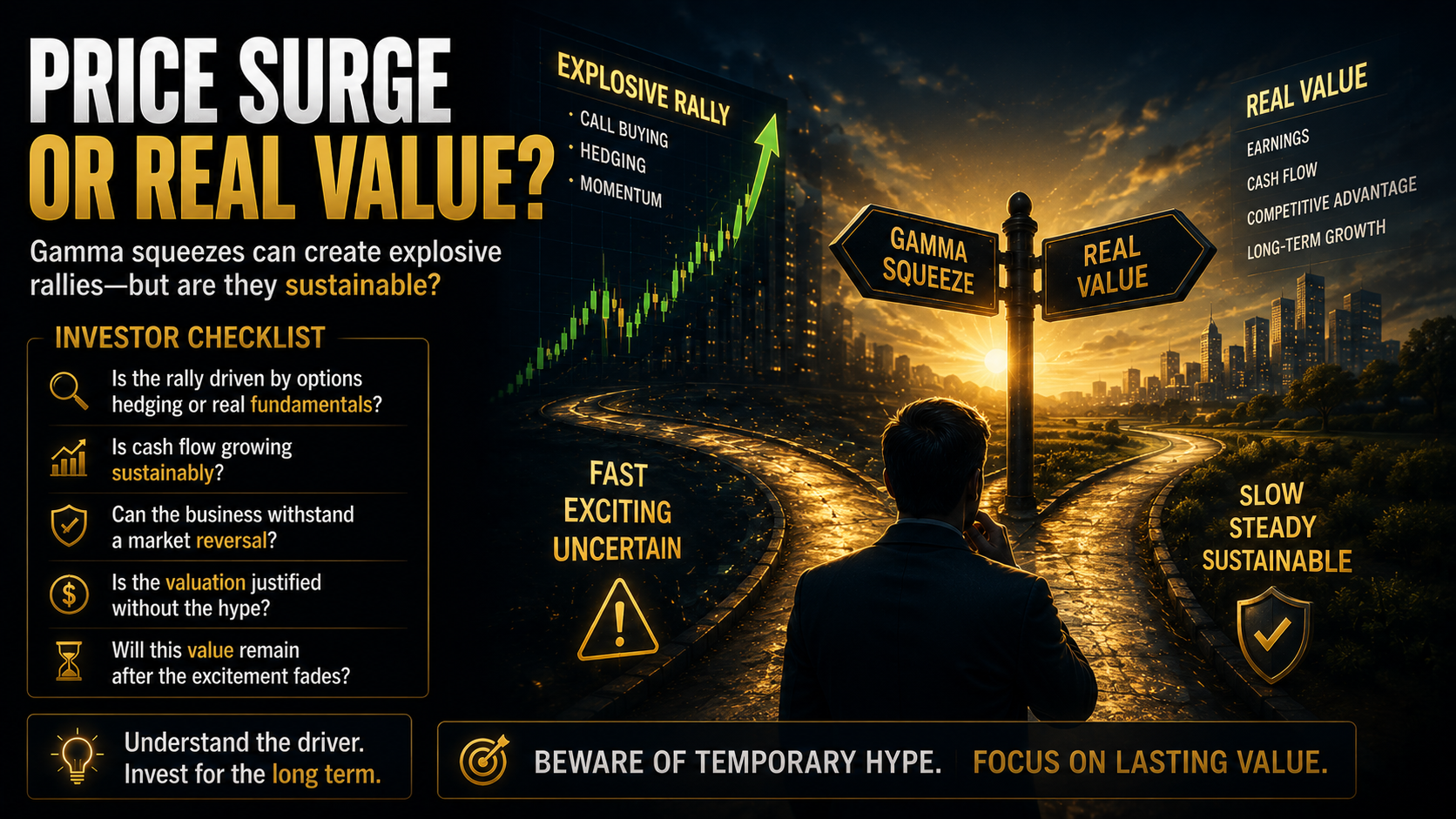
- Has the company's earning power actually improved?
- Is free cash flow growing?
- Is the balance sheet strong enough to survive a downturn?
- Will demand for the company's products remain after the speculation ends?
- Is the current valuation supported by realistic assumptions?
- Would I still want to own this company if options trading disappeared tomorrow?
These questions help separate durable investment value from temporary market momentum.
Final Thoughts
A Gamma Squeeze is one of the clearest examples of how derivatives can influence the underlying stock market.
Heavy call buying can force market makers to purchase shares, rising prices can increase Delta, and higher Delta can create additional hedging demand.
When short covering joins the process, the rally can become even more powerful.
But the same mechanism can work in reverse.
Once call demand weakens, options expire or Delta declines, market makers may unwind their hedges. The buying pressure that supported the rally can disappear and be replaced by selling pressure.
For investors, the most important lesson is not how to predict the next squeeze.
It is learning to identify whether a price movement is being driven by lasting improvements in a business or by temporary market structure.
Markets can move far away from fundamental value in the short term. Over longer periods, however, earnings, cash flow, balance-sheet strength and competitive advantages remain the foundation of sustainable value.
The goal is not to chase every explosive move. The goal is to understand the flow of money, manage risk and remain financially capable of investing when the next opportunity arrives.
This has been MasterMind.
'[Global] Success Blueprints' 카테고리의 다른 글