What Is Max Pain? Why Options Expiration Can Influence Stock Prices


Hello, this is MasterMind.
Have you ever noticed that a stock seems to gravitate toward a specific price as options expiration approaches?
Sometimes the move appears almost intentional. A stock that had been trending strongly suddenly stalls, volatility fades, or the price repeatedly returns to the same level despite seemingly bullish or bearish news.
Many retail investors assume this is market manipulation. In reality, the explanation is usually much more structural.
One of the most discussed concepts behind this phenomenon is Max Pain—a theory that attempts to explain why prices sometimes drift toward certain strike prices as options expire.
While Max Pain is not a rule that predicts future prices, it provides valuable insight into how options positioning, hedging activity, and market liquidity interact.
Understanding this concept can help investors better interpret short-term price action without losing sight of the bigger picture.

Key Takeaway
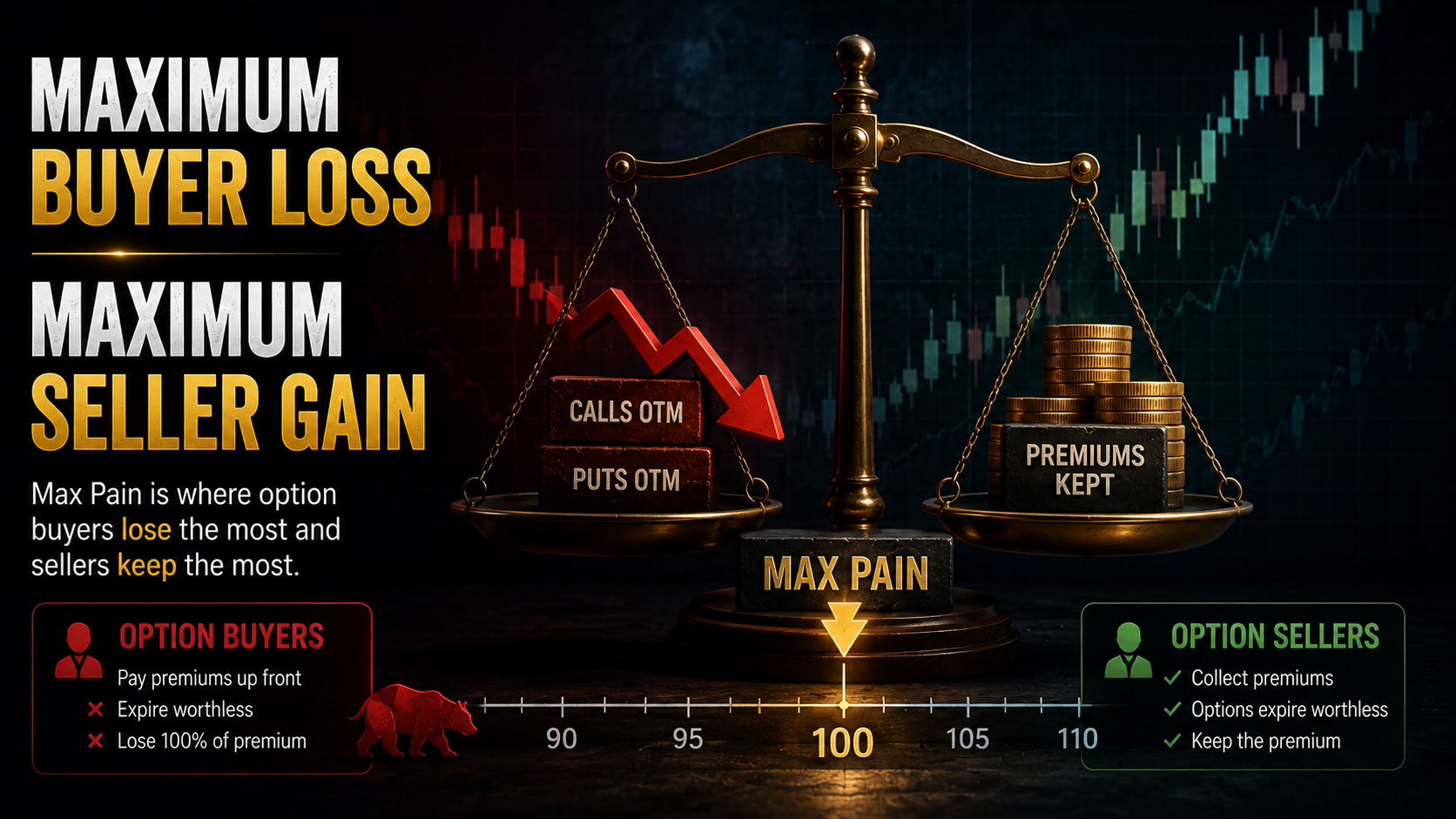
Max Pain is the price at which option buyers experience the greatest financial loss and option sellers retain the largest portion of collected premiums at expiration. Rather than predicting prices, it serves as a useful framework for understanding options market structure and hedging flows.
What Is Max Pain?
Max Pain refers to the stock price or index level where the combined value of outstanding call and put options expires with the lowest payout to option holders.
From another perspective, it is the price that benefits option sellers the most because the greatest number of contracts expire worthless.
Since option buyers pay an upfront premium for the right to buy or sell an asset, every option that expires out of the money represents a complete loss of that premium.
Option sellers, on the other hand, keep the premium when the contract expires without intrinsic value.
This is why the concept is called "Max Pain."
It represents the point where option buyers collectively experience the greatest financial pain.
Option Buyers vs. Option Sellers
Understanding Max Pain begins with recognizing the different incentives of market participants.
| Participant | Primary Objective |
| Option Buyer | Pays a premium for the right to buy or sell an asset |
| Option Seller | Collects the premium while assuming contractual obligations |
Because options lose time value every day through theta decay, sellers generally benefit when prices remain relatively stable into expiration.
This structural advantage is one reason institutional traders frequently incorporate option-selling strategies into broader portfolio management.
How Is Max Pain Calculated?
The calculation itself is conceptually straightforward.
For every available strike price
- Calculate the value of all outstanding call options.
- Calculate the value of all outstanding put options.
- Sum the potential payouts.
- Identify the strike price where the total payout is the smallest.
That strike becomes the Max Pain price.
Financial websites and options analytics platforms typically update this figure automatically using current open interest data.
Because new contracts are opened and existing positions are closed every trading day, the Max Pain level is not fixed—it can change as expiration approaches.
A Simple Example
Imagine a stock with the following option positioning
| Strike Price | Open Interest |
| $95 | 4,200 |
| $100 | 17,800 |
| $105 | 6,100 |
If the largest concentration of open interest sits around $100, many analysts will monitor that level as the potential Max Pain price.
This does not mean the stock must finish at $100.
Instead, it highlights an area where hedging activity and market positioning may become increasingly influential as expiration nears.
Why Does Max Pain Happen?
This is where many investors misunderstand the concept.
A common belief is that large institutions deliberately push stock prices toward the Max Pain level.
While intentional price manipulation occasionally makes headlines in financial markets, Max Pain is generally better explained by hedging mechanics than by coordinated market control.
The primary driver is often delta hedging performed by market makers.
The Role of Delta Hedging
Market makers are typically not trying to speculate on whether a stock will rise or fall.
Instead, their objective is to remain as close to market-neutral as possible.
When they sell large quantities of options, they assume directional risk.
To offset that exposure, they continuously buy or sell shares of the underlying stock.
As prices move throughout the trading day, those hedge positions must be adjusted.
This continuous process of buying and selling creates additional supply and demand that can influence short-term price behavior.
As expiration approaches and option gamma becomes increasingly significant, these hedging adjustments may become more frequent.
In some situations, that feedback loop can make prices appear to gravitate toward heavily populated strike prices.

Open Interest Matters More Than Most Investors Realize
Max Pain becomes much more meaningful when analyzed alongside Open Interest (OI).
Open Interest measures the total number of outstanding option contracts that remain open.
Large concentrations of contracts at specific strike prices often indicate where hedging activity could become more intense.
For this reason, professional traders rarely analyze Max Pain in isolation.
Instead, they combine it with several other options market indicators, including
- Open Interest (OI)
- Put/Call Ratio
- Gamma Exposure (GEX)
- Implied Volatility (IV)
- Dealer positioning
Taken together, these metrics provide a much clearer picture of market positioning than any single indicator alone.
Why Does Max Pain Matter to Investors?
Max Pain matters because it offers a framework for understanding why price action can behave differently near options expiration.
A stock may appear fundamentally unchanged, yet its price can become unusually stable, repeatedly reverse around the same level, or experience a sudden burst of volatility.
These moves are not always driven by earnings, economic data, or changes in business value.
Sometimes they reflect the temporary influence of options positioning, dealer hedging, and liquidity conditions.
For investors, the value of Max Pain is not that it reveals exactly where a stock will close. Its real value lies in helping separate short-term market structure from long-term fundamental change.
Understanding Expiration-Week Price Behavior
As expiration approaches, options with strike prices near the current market price become especially sensitive to small price movements.
This can increase the need for market makers to adjust their hedges.
When dealer positioning is stabilizing, those hedge adjustments may counteract price movements and keep the underlying asset near a major strike. This is often described as price pinning.
In other conditions, dealer hedging may reinforce the direction of the market rather than suppress it. This can accelerate a rally or decline and produce a sharper move than investors expected.
The key point is that options positioning does not always reduce volatility.
Depending on dealer exposure and market conditions, it can either
- absorb price movements and keep the market range-bound, or
- amplify price movements and increase volatility.
This is why investors should not assume that every expiration will pull prices smoothly toward the Max Pain level.
Can Max Pain Act as Support or Resistance?
During expiration week, major option strikes can sometimes behave like temporary support or resistance levels.
Suppose a large amount of call open interest is concentrated above the current stock price. Traders may view that strike as a possible resistance area.
Likewise, a large concentration of put open interest below the market may appear to provide support.
However, open interest alone does not reveal whether participants bought or sold those contracts, nor does it fully disclose how dealers are hedged.
For that reason, a heavily populated strike should not automatically be interpreted as a guaranteed price barrier.
It is better understood as a zone where
- trading activity may increase,
- hedging flows may become more important,
- volatility may change,
- price reactions may become more pronounced.
Max Pain can therefore support technical analysis, but it should not replace a broader assessment of price trends, liquidity, fundamentals, and macroeconomic conditions.
How Max Pain Can Affect Different Asset Classes
Max Pain is most commonly discussed in equity options, but similar expiration-related dynamics can appear across several financial markets.
| Asset Class | Potential Max Pain and Expiration Effects |
| Individual stocks | Large option positions may contribute to price pinning or volatility near major strikes, especially in heavily traded names such as Apple, Nvidia, Tesla, and Microsoft. |
| Index ETFs | SPY, QQQ, and other highly liquid ETFs can experience meaningful hedging flows because of their enormous options markets. |
| Stock indexes | S&P 500 and Nasdaq-100 options can influence broader market liquidity and intraday volatility around major expiration dates. |
| Bitcoin and crypto assets | Large option expirations may affect short-term sentiment and volatility, although spot liquidity and leverage conditions remain equally important. |
| Foreign exchange | Large option expiries can occasionally influence major currency pairs near widely watched strike levels. |
| Gold and crude oil | Futures and options positioning may affect short-term price behavior, but supply, demand, inventories, interest rates, and geopolitical developments often remain more powerful drivers. |
The influence of Max Pain tends to be more visible when the options market is large relative to the underlying asset’s normal trading volume.
It may be less meaningful in securities with limited option activity or fragmented liquidity.

Why Max Pain Is Not a Guaranteed Forecast
One of the most dangerous mistakes is treating Max Pain as if it were a fixed destination.
A stock does not have to close at the Max Pain price.
Powerful fundamental and macroeconomic forces can easily overwhelm expiration-related flows.
Examples include
- earnings announcements,
- Federal Reserve decisions,
- inflation reports,
- employment data,
- mergers and acquisitions,
- regulatory developments,
- geopolitical shocks,
- unexpected changes in liquidity.
If a major catalyst changes the market’s expectations, traders may rapidly open new positions, close old contracts, or move into different strike prices.
The Max Pain level itself can therefore change before expiration.
In addition, the calculation usually relies on open interest data, which may not fully reveal the direction, timing, or purpose of each position.
Some options may be speculative.
Others may be part of hedged portfolios, spreads, covered calls, protective puts, or institutional risk-management strategies.
The same open interest number can therefore represent very different market intentions.
Max Pain is a probabilistic reference point, not a law of market behavior.
Max Pain, Open Interest, and Gamma Exposure
Max Pain becomes more useful when combined with related options indicators.
Open Interest
Open Interest shows where outstanding contracts are concentrated.
It helps investors identify which strike prices may attract the most attention as expiration approaches.
However, it does not show whether traders are net bullish or bearish by itself.
Put/Call Ratio
The Put/Call Ratio compares put activity with call activity.
It can provide insight into market sentiment, but it should be interpreted in context because puts are frequently used for portfolio hedging rather than outright bearish speculation.
Gamma Exposure
Gamma Exposure, commonly called GEX, estimates how dealer hedging may respond to price changes.
Positive dealer gamma can sometimes create stabilizing flows, while negative dealer gamma may contribute to trend acceleration and greater volatility.
Implied Volatility
Implied Volatility reflects the market’s expectations for future price movement.
A high implied volatility environment may weaken the usefulness of a simple Max Pain level because the market is already pricing in a wide range of possible outcomes.
Together, these indicators provide a more complete view of market structure.
| Indicator | Main Question |
| Max Pain | At which expiration price is the total option-holder payout lowest? |
| Open Interest | Where are outstanding contracts concentrated? |
| Put/Call Ratio | How is option activity divided between puts and calls? |
| Gamma Exposure | Could dealer hedging stabilize or amplify price movements? |
| Implied Volatility | How much future movement is the options market pricing in? |
What Happens After Options Expiration?
Expiration can remove a large amount of short-term positioning from the market.
When options expire or are closed, market makers may no longer need the same hedge positions.
This can lead to hedge unwinding, where previously purchased or shorted shares are reduced.
As a result, a price level that appeared unusually strong before expiration may lose its influence immediately afterward.
A stock that was pinned near a major strike may begin moving more freely once the related options disappear.
However, investors should avoid assuming that expiration automatically causes a reversal or squeeze.
Post-expiration price action still depends on
- the direction of hedge unwinding,
- remaining weekly or monthly option positions,
- broader market liquidity,
- investor sentiment,
- new fundamental information.
Expiration removes one source of pressure, but it does not determine what replaces it.
Key Points Investors Should Know
1. Use Max Pain as Context, Not a Price Target
Max Pain can help explain unusual market behavior, but it should not be used as a precise entry or exit price.
The market may move toward it, remain far away from it, or pass through it without a meaningful reaction.
2. Focus on Liquid Options Markets
The concept is generally more relevant for assets with significant options volume and open interest.
Large-cap U.S. stocks, major indexes, and liquid ETFs tend to provide more meaningful data than thinly traded securities.
3. Watch Changes, Not Just the Current Number
A single Max Pain reading provides limited information.
More useful questions include
- Is the Max Pain level moving?
- Is open interest increasing or declining?
- Are large positions shifting to different strikes?
- Is implied volatility rising?
- Is the current price moving closer to or farther from the level?
The direction of change often matters more than the absolute number.
4. Consider the Expiration Schedule
Weekly, monthly, quarterly, and long-dated options can create different layers of positioning.
Monthly and quarterly expirations may receive more attention because they can involve larger institutional positions, but weekly options have also become increasingly important in highly liquid U.S. markets.
5. Do Not Ignore Fundamental Catalysts
An earnings report or Federal Reserve announcement can outweigh the entire options structure.
Max Pain should always be viewed alongside the economic calendar, corporate events, interest rates, and broader market conditions.
6. Prioritize Risk Management
Options-related signals can change quickly.
Investors who build oversized positions around a single expiration level may face significant losses when the market reacts to an unexpected catalyst.
The goal is not to predict every short-term movement. It is to understand the risks influencing the market and remain positioned to survive when the expected pattern fails.
What Do Wealthy Investors Look for in This Flow?
Sophisticated investors do not view Max Pain merely as a number on an options dashboard.
They use it to study how capital, liquidity, and risk are distributed across the market.
The Movement of Money
Large investors ask where capital is committed and what transactions may be required to manage those positions.
A major concentration of options can create temporary buying or selling flows, but those flows eventually expire, roll forward, or unwind.
Understanding that cycle helps distinguish lasting demand from temporary market pressure.
Cash Flow
Options markets are built around premium payments.
Buyers pay premiums for asymmetric exposure or protection, while sellers receive premiums in exchange for assuming risk.
Professional investors focus not only on the potential payoff but also on the quality and sustainability of the cash flow behind a strategy.
Receiving premium is not free income. It is compensation for taking on obligations that can become extremely costly during large market moves.
Asset Resilience
A durable asset should not depend on favorable expiration mechanics to preserve its value.
Long-term investors evaluate whether a company can continue generating revenue, free cash flow, and competitive returns after temporary options pressure disappears.
If a high-quality asset experiences a short-lived price distortion around expiration, the movement may create an opportunity to reassess valuation.
But the decision should still depend on business quality, balance-sheet strength, and long-term cash-generation capacity.
Long-Term Perspective
Options flows may dominate a trading session, but they do not determine the long-term value of a company.
Over time, stock prices are more likely to reflect earnings power, capital allocation, financial resilience, competitive advantages, and investor expectations.
The most useful question is therefore not
“Will the stock close at Max Pain?”
A better question is
“Is the current price movement caused by a lasting change in value, or by a temporary imbalance in positioning and liquidity?”
Investors can also ask themselves
- Is this move driven by fundamentals or expiration-related flows?
- Where is open interest concentrated?
- Is dealer hedging likely to suppress or amplify volatility?
- Will this pressure remain after expiration?
- Does the asset still generate durable cash flow?
- Am I reacting to short-term noise or evaluating long-term value?
- Can my portfolio survive if the expected Max Pain pattern fails?
These questions shift the focus away from prediction and toward market understanding.

Final Thoughts
Max Pain is one of the most widely discussed concepts around options expiration, but it is also one of the most frequently misunderstood.
It does not prove that institutions are controlling prices, and it does not guarantee that a stock or index will finish at a specific level.
Instead, Max Pain provides a window into the structure of the options market.
It shows where contracts are concentrated, where option-holder payouts may be minimized, and where hedging activity could affect short-term price behavior.
For U.S. investors, it can be especially useful when analyzing highly liquid stocks, major indexes, and ETFs with active weekly and monthly options markets.
Still, the indicator works best when combined with Open Interest, Gamma Exposure, the Put/Call Ratio, Implied Volatility, and upcoming market catalysts.
The central lesson is simple
Max Pain is not a formula for predicting the future. It is a tool for understanding how positioning, liquidity, and risk management can influence prices near expiration.
Long-term investing is not about correctly forecasting every expiration-day move. It is about recognizing temporary market distortions while remaining focused on cash flow, asset quality, and portfolio survival.
This was MasterMind.
'[Global] Success Blueprints' 카테고리의 다른 글