Why Investors Think “It’s Due to Go Up” (The Gambler’s Fallacy)


Hello, this is MasterMind.
Have you ever looked at a stock that has fallen for five straight trading sessions and thought,
"It has to bounce tomorrow."
Or watched the S&P 500 rally for weeks and assumed,
"A correction is overdue."
These thoughts feel logical because the human brain naturally searches for balance and patterns. Yet financial markets don't reward intuition—they respond to new information.
One of the most common psychological traps investors fall into is the Gambler's Fallacy, the mistaken belief that a series of past outcomes changes the probability of what happens next.
Understanding this bias can help investors make more rational decisions and avoid costly mistakes driven by emotion rather than evidence.

Key Takeaway
The Gambler's Fallacy is the false belief that independent events influence future probabilities. In investing, assuming that a stock is "due for a rebound" simply because it has fallen repeatedly can lead to poor decisions and unnecessary losses.
What Is the Gambler's Fallacy?
The Gambler's Fallacy is a cognitive bias in which people believe that independent events become more or less likely because of previous outcomes.
The classic example is a roulette wheel.
If red appears ten times in a row, many people assume black has a higher chance of appearing next.
In reality, if the wheel is fair, every spin remains an independent event. The probability has not changed.
Investors often make the same mistake.
- "This stock has dropped enough. It's bound to recover."
- "Bitcoin has been falling all week. Tomorrow has to be green."
- "The market has gone up too much. A crash is inevitable."
These conclusions are based on recent patterns, not on new information that actually changes the value of an asset.

Why Does Our Brain Make This Mistake?
Humans evolved to recognize patterns because pattern recognition helped us survive.
The problem is that our brains often create patterns where none actually exist.
When we observe repeated outcomes, we instinctively expect balance to return.
Behavioral economists often associate this with the Representativeness Heuristic, where people incorrectly assume that small samples should resemble long-term averages.
Our brains dislike randomness.
Financial markets, however, are filled with randomness.
Misunderstanding the Law of Large Numbers
A major reason behind the Gambler's Fallacy is misunderstanding the Law of Large Numbers.
The law states that as the number of observations becomes very large, outcomes tend to approach their expected probabilities.
Many investors incorrectly interpret this as meaning that balance must occur immediately.
For example, if you flip a coin 10,000 times, heads and tails will likely approach a 50/50 split.
But over just ten flips, getting heads eight or even ten times in a row is entirely possible.
Markets work the same way.
Just because a stock has declined for several consecutive sessions does not mean tomorrow must be positive.
Markets owe investors nothing.
Gambler's Fallacy vs. Mean Reversion
Many investors confuse the Gambler's Fallacy with mean reversion, but they are fundamentally different concepts.
| Concept | Gambler's Fallacy | Mean Reversion |
| Nature | Psychological bias | Statistical and economic tendency |
| Based on | Human expectation | Fundamentals and valuation |
| Typical belief | "It's due to rebound." | "The asset may gradually return toward its long-term average." |
Mean reversion can occur because of changes in earnings, valuation, interest rates, or economic cycles.
The Gambler's Fallacy, by contrast, assumes a reversal without any fundamental reason.

Why Does It Matter to Investors?
Financial markets are driven by information, liquidity, expectations, and human psychology.
The Gambler's Fallacy becomes dangerous because it weakens risk management.
Averaging Down Without Evidence
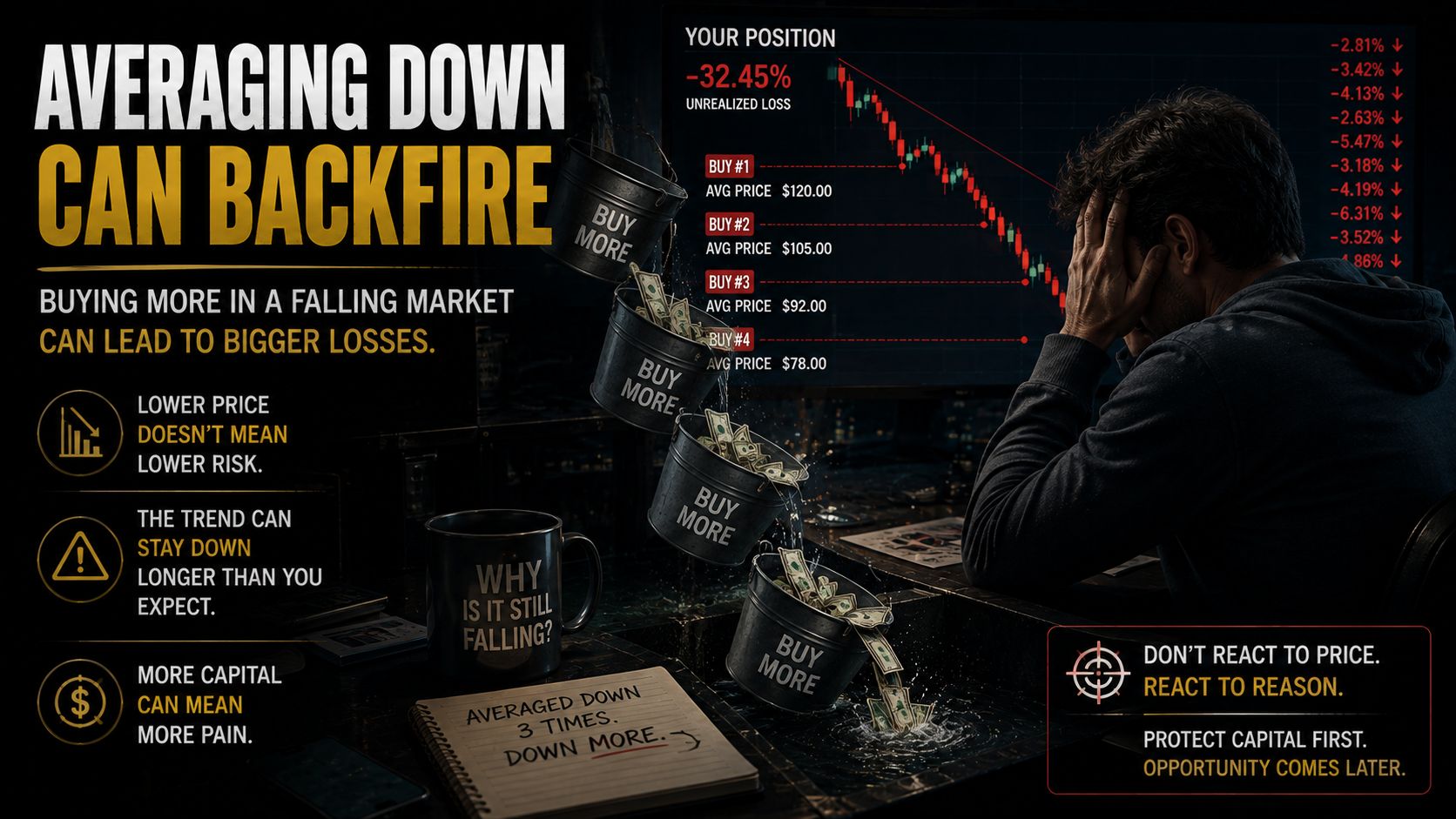
Many investors continue buying a falling stock simply because they believe it cannot keep falling.
If the business fundamentals continue to deteriorate, losses can quickly compound.
Selling Winners Too Early
Others assume that a stock that has risen significantly is "due" for a correction.
As a result, they exit strong long-term trends prematurely.
Ignoring Structural Changes
Markets sometimes experience genuine structural shifts.
Artificial intelligence, cloud computing, demographic changes, or Federal Reserve policy can create trends that last much longer than expected.
Investors trapped by the Gambler's Fallacy often mistake these structural trends for temporary extremes.
The Real Nature of Markets
Markets do not reward past price movements—they price new information.
Stock prices change because expectations change.
Corporate earnings, interest rates, liquidity, innovation, consumer demand, and macroeconomic conditions matter far more than how many consecutive green or red candles appear on a chart.
Markets have no concept of "turns."
They only reflect changing probabilities.
How It Affects Different Asset Classes
| Asset | Common Gambler's Fallacy | Potential Consequence |
| Stocks | Buying simply because prices have fallen | Larger losses if fundamentals continue to weaken |
| Bonds | Assuming interest rates must reverse soon | Additional price declines if yields keep rising |
| U.S. Dollar | Betting against prolonged dollar strength | Losses if macro conditions continue favoring the dollar |
| Gold | Expecting an automatic rebound after a correction | Missing the broader macro picture |
| Bitcoin | Assuming every sharp decline creates a buying opportunity | Increased exposure during periods of extreme volatility |
Across every asset class, the important question is not how long prices have moved, but why they are moving.
Key Lessons for Investors
- A falling price does not automatically mean an asset is undervalued.
- A rising price does not automatically mean it is overvalued.
- Analyze the cause of price movement before reacting.
- Focus on fundamentals rather than streaks.
- Replace "It's due to rebound" with "What has actually changed?"
- Always prepare for the possibility that your investment thesis is wrong.
The most dangerous question in investing is
"Isn't it finally time for this stock to go up?"
A much better question is
"What new information could realistically drive future returns?"
What Do Experienced Investors Look For?
Professional investors spend far less time counting consecutive gains or losses than individual investors.
Instead, they focus on
Capital Flows
Where is institutional money moving?
Which sectors are attracting capital?
Where is liquidity leaving?
Cash Flow and Business Quality
Is the company generating sustainable free cash flow?
Are earnings improving?
Does management allocate capital effectively?
Long-Term Survival
Successful investors understand that survival matters more than being right.
Rather than making aggressive bets because they believe a reversal is overdue, they build portfolios that can withstand uncertainty.
They know markets can stay irrational—or simply trend much longer—than expected.
Questions Worth Asking Yourself
- Am I buying only because the price has fallen?
- Has anything fundamental actually improved?
- Could this trend continue longer than I expect?
- Can my portfolio survive if my assumption is wrong?

Final Thoughts
The Gambler's Fallacy is not just a casino mistake.
It appears in stock markets, bond markets, foreign exchange, commodities, and cryptocurrencies.
Whenever investors assume that prices must reverse simply because they have moved in one direction for too long, they risk replacing analysis with emotion.
The market does not care how many consecutive down days a stock has experienced.
It responds to changing expectations, new information, and capital flows.
Remember one simple principle
Markets are not driven by what is "due." They are driven by what changes.
The investors who succeed over decades are rarely those who predict every turning point. They are the ones who recognize their own psychological biases, manage risk carefully, and remain disciplined through changing market conditions.
This was MasterMind.
'[Global] Success Blueprints' 카테고리의 다른 글