Why Investors Can't Sell Losing Stocks (The Sunk Cost Fallacy)


Hello, this is MasterMind.
Have you ever looked at a stock that's down 50% and thought,
"I can't sell now. If I do, the loss becomes real."
If so, you're far from alone.
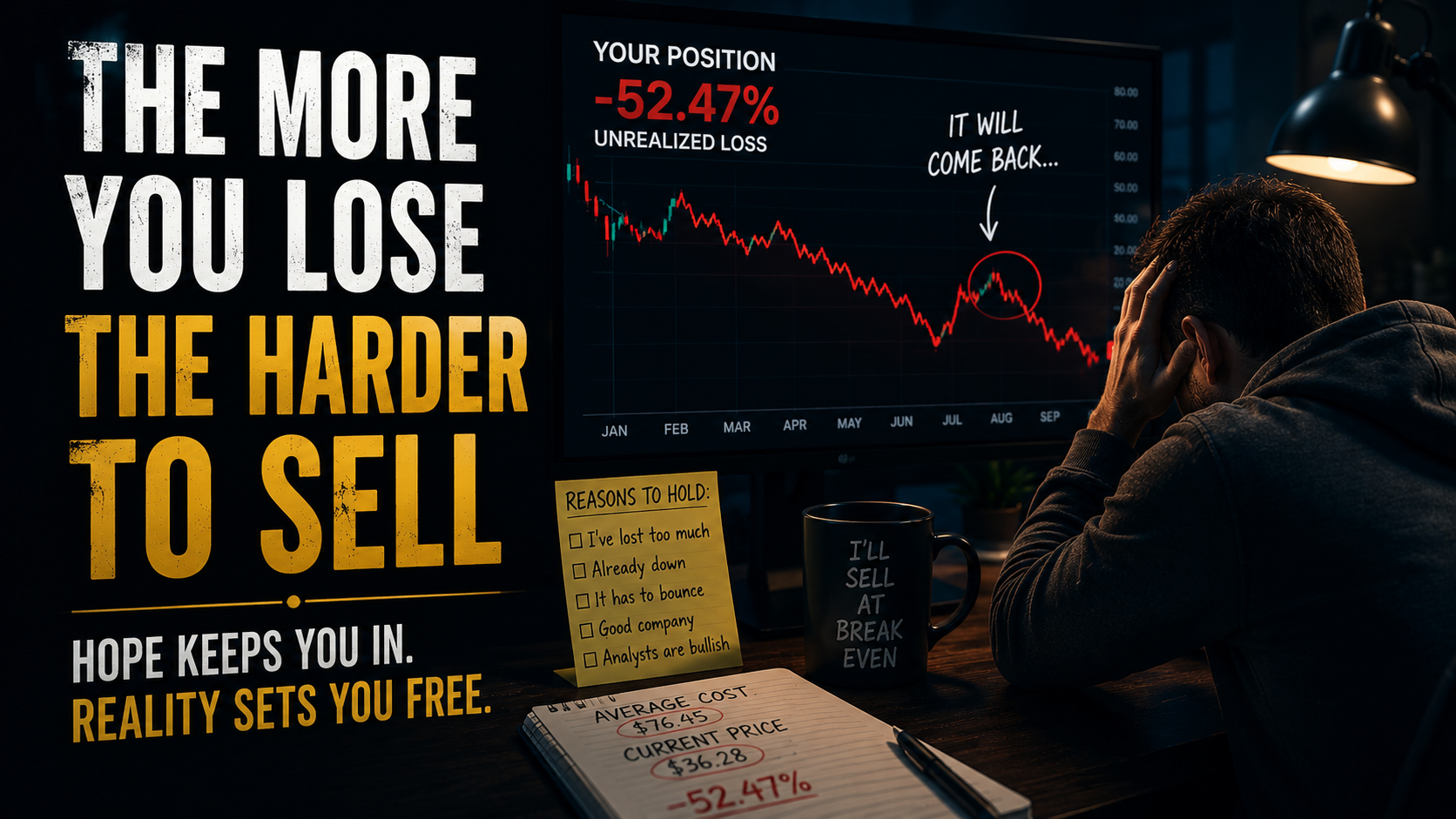
Many investors continue holding losing positions not because the investment still makes sense, but because walking away feels emotionally impossible. The more money they lose, the harder it becomes to hit the sell button.
This behavior isn't a lack of discipline or intelligence. It's one of the most powerful psychological biases in behavioral economics—the Sunk Cost Fallacy.
In investing, long-term success isn't determined solely by your ability to analyze companies. It also depends on your ability to recognize when your own emotions have taken control of your decisions.

Key Takeaway
The Sunk Cost Fallacy occurs when past losses influence future decisions, causing investors to protect their emotions instead of their capital.
What Is the Sunk Cost Fallacy?
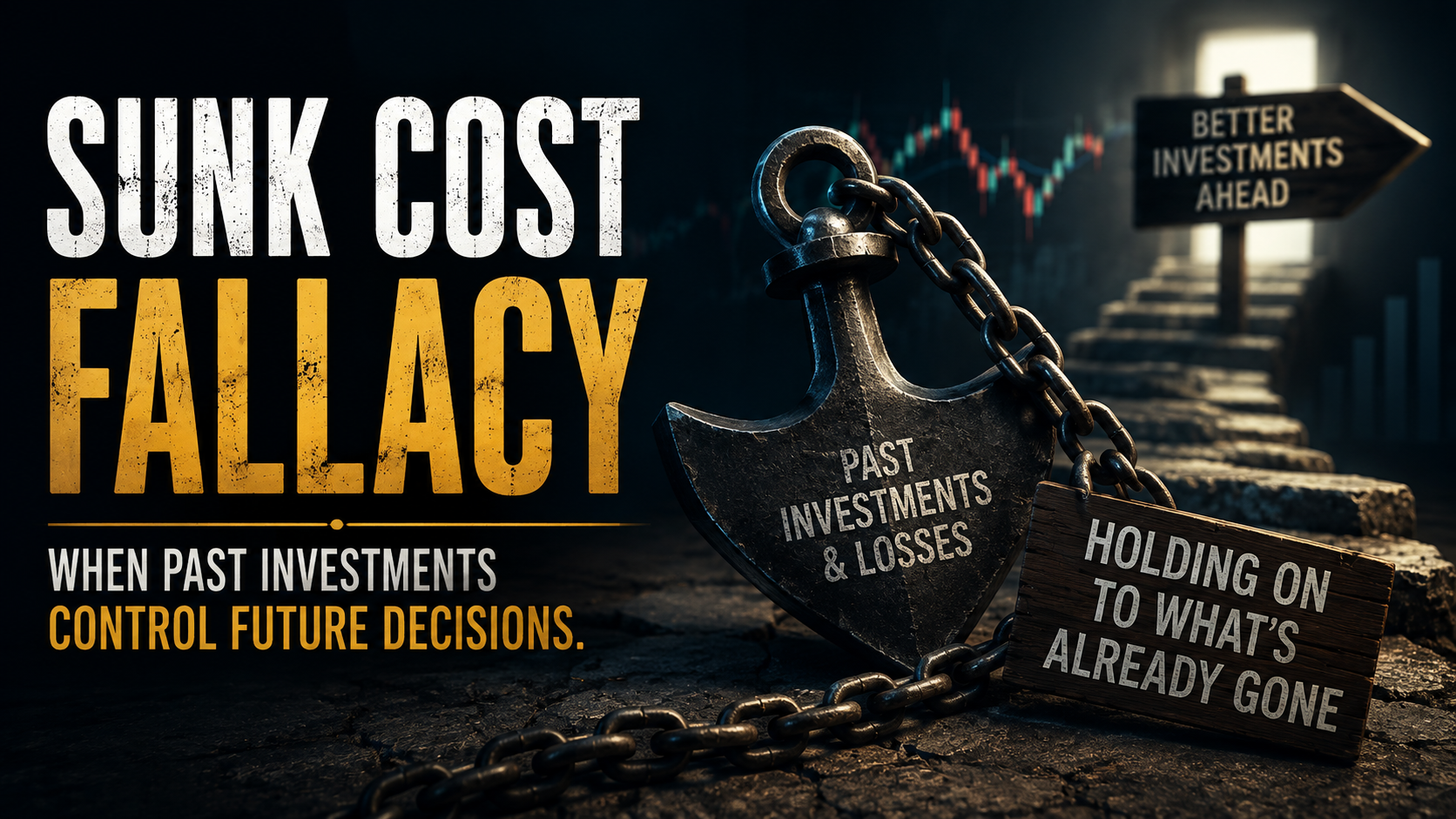
A sunk cost is any cost that has already been paid and cannot be recovered, regardless of what you decide next.
Most people immediately think of money, but sunk costs include much more than cash.
They can include
- Money you've invested
- Time spent researching
- Emotional attachment to an investment
- Opportunities you gave up by choosing one investment over another
From an economic perspective, none of these should influence your next decision.
Rational investing is forward-looking. The only question that matters is
"What is the best decision from this point forward?"
However, human psychology rarely works that way.
Instead of evaluating future potential, investors often focus on recovering what they've already lost. That emotional attachment to past decisions is what behavioral economists call the Sunk Cost Fallacy.
How the Sunk Cost Fallacy Works
The sunk cost fallacy doesn't happen because investors lack knowledge.
It happens because two powerful psychological forces quietly influence almost every financial decision.
1. Loss Aversion
According to behavioral economics, people experience the pain of losing money much more intensely than the satisfaction of making the same amount.
Selling a losing investment forces you to accept that the loss is real.
Holding it, however, allows you to believe there is still a chance everything will recover.
That hope often feels emotionally safer than accepting reality—even when the numbers suggest otherwise.
2. Confirmation Bias and Self-Justification
Admitting that an investment thesis was wrong can be surprisingly difficult.
Instead of objectively reviewing new information, investors begin searching for evidence that supports their original decision.
Common behaviors include
- Reading only bullish articles
- Ignoring negative earnings reports
- Focusing on optimistic analyst opinions
- Buying more shares simply to lower the average cost
At this point, the investment decision is no longer driven by analysis.
It's driven by emotion.
Why the Sunk Cost Fallacy Is So Dangerous
The biggest cost isn't always the money you've already lost.
It's the opportunity cost.
Capital trapped in a weak investment cannot be deployed into stronger opportunities.
Imagine a stock that falls 50%.
To break even, it must gain 100% from its current price.
While you're waiting for that recovery, other companies with improving fundamentals may continue compounding wealth year after year.
More importantly, the market doesn't know—or care—what price you paid.
Your average purchase price has absolutely no influence on future returns.
The market values businesses based on future earnings, future cash flows, and future expectations.
Investors, however, often evaluate stocks based on their past purchase price.
That's where the disconnect begins.
The market looks forward. Investors trapped by the sunk cost fallacy keep looking backward.
And in investing, looking backward can become one of the most expensive mistakes you ever make.

How the Sunk Cost Fallacy Affects Financial Markets
The sunk cost fallacy is not limited to individual brokerage accounts.
When many investors react to losses in the same way, those decisions can influence trading behavior, liquidity, and price formation across entire markets.
| Asset Class | Common Sunk Cost Behavior | Possible Market Effect |
| Stocks | Investors refuse to sell until the stock returns to their purchase price | Heavy overhead supply during rebounds and delayed capitulation |
| Bonds | Investors hold outdated positions despite changes in inflation or interest rates | Poor capital allocation and unnecessary duration or credit risk |
| Real Estate | Owners anchor to the original purchase price and renovation costs | Wider bid-ask gaps, lower transaction volume, and reduced liquidity |
| Gold | Investors hold solely because they expect past losses to reverse | Capital remains tied to an asset that may no longer fit the portfolio’s purpose |
| Bitcoin and Crypto | Investors average down after the original thesis has failed | Greater concentration risk and exposure to extreme volatility |
One of the clearest examples appears in stocks that have suffered long declines.
Many shareholders begin telling themselves
"I'll sell as soon as it gets back to my break-even price."
As a result, large amounts of potential selling pressure can build above the current market price. When the stock finally rebounds, those investors may rush to exit at the same time.
This helps explain why some damaged stocks struggle to sustain recoveries even after positive news.
Market prices are shaped not only by earnings, interest rates, and liquidity, but also by the collective psychology of investors who are trying to escape previous mistakes.
Sunk Cost Fallacy vs. Long-Term Investing
It is important not to confuse the sunk cost fallacy with disciplined long-term investing.
Holding a stock through volatility is not automatically irrational.
A patient investor may continue holding because
- The company’s competitive advantage remains intact
- Revenue and free cash flow are still growing
- The balance sheet remains strong
- The original investment thesis is still valid
- The market decline appears temporary rather than structural
The sunk cost fallacy begins when the main reason for holding becomes
"I have already lost too much to sell."
That is not an investment thesis.
It is an emotional reaction to the past.
The key distinction is simple
Long-term investing is based on future value. The sunk cost fallacy is based on past pain.
How Investors Can Avoid the Sunk Cost Fallacy
1. Stop Treating Your Purchase Price as Fair Value
Your purchase price is part of your personal history.
It is not a measure of what the business is worth today.
A stock you bought at $100 is not automatically cheap at $60. It may be undervalued, fairly valued, or still expensive depending on the company’s earnings power, cash flow, debt, and competitive position.
The market does not owe investors a return to their original entry price.
A more useful question is
"What is this business worth based on the information available today?"
2. Revisit the Original Investment Thesis
Before buying an asset, write down why you are buying it.
That thesis might include
- Expected revenue growth
- Margin expansion
- Industry leadership
- Product demand
- Balance-sheet strength
- Valuation assumptions
- A specific catalyst
Then review those assumptions when conditions change.
If the stock price falls but the business continues to improve, holding or adding may still be rational.
If the price falls because the underlying business is deteriorating, refusing to sell may simply turn a manageable loss into a permanent impairment of capital.
3. Separate Price Declines From Thesis Failure
A falling stock price does not always mean the investment was wrong.
Likewise, a rising stock price does not always mean the investment was right.
Investors should distinguish between
- Market volatility: The price changes while the long-term thesis remains intact
- Fundamental deterioration: Earnings power, cash flow, demand, or competitive strength declines
- Thesis failure: The original reason for owning the investment is no longer valid
This distinction is more useful than reacting to an arbitrary percentage loss alone.
4. Define Exit Rules Before Emotions Take Over
Investment decisions are usually clearest before money is at risk.
That is why exit criteria should be established before or shortly after entering a position.
An exit rule could be triggered by
- A broken investment thesis
- Deteriorating balance-sheet quality
- A loss of competitive advantage
- Persistent negative free cash flow
- Management credibility problems
- A valuation that no longer offers an acceptable risk-reward balance
- Excessive concentration in one position
A percentage-based stop-loss may be useful for some trading strategies, but long-term investors should avoid treating one fixed percentage as universally appropriate.
The more important question is whether the original assumptions remain valid.
5. Ask the Fresh-Capital Question
Imagine that you own no shares of the investment today.
Now imagine that the entire current position has been converted into cash.
Would you use that cash to buy the same asset at today’s price?
If the answer is no, continuing to hold may be difficult to justify.
This question removes the emotional attachment to the original purchase and forces the investor to compare the asset with every other opportunity available today.
Averaging Down: Rational Strategy or Emotional Trap?
Buying more after a decline is not automatically a mistake.
Averaging down can be rational when
- The company’s fundamentals remain strong
- The decline is caused by temporary sentiment
- The valuation has become more attractive
- The position remains appropriately sized
- The investor has a clear understanding of the risks
It becomes dangerous when the only objective is to reduce the displayed average cost.
A lower average purchase price does not repair a broken business.
It only increases the amount of capital exposed to the same thesis.
Before adding to a losing position, investors should ask
- What new evidence makes the investment more attractive?
- Has intrinsic value increased, decreased, or remained unchanged?
- Would I buy this asset today without an existing position?
- Am I improving expected returns or merely trying to avoid admitting a mistake?
- How much of my portfolio would be at risk after adding?
Averaging down should result from stronger expected value, not stronger emotional discomfort.
What Do Wealthy and Institutional Investors Look For?
Experienced investors tend to view losses differently from inexperienced market participants.
They are not emotionally immune, but their decision-making systems are usually designed to reduce the influence of sunk costs.
The Movement of Capital
Sophisticated investors focus less on where money was lost and more on where the remaining capital can work most efficiently.
They compare the expected return of the current position with the expected return of alternative investments.
The relevant question is not
"How do I recover my loss in this stock?"
It is
"Where does this capital have the best risk-adjusted opportunity from today?"
Cash Flow
High-quality assets eventually need to produce or support cash flow.
This may come from business earnings, dividends, interest income, rental income, or a credible path toward future free cash flow.
When an asset’s cash-flow outlook weakens, experienced investors do not assume that patience alone will restore its value.
They reassess whether the capital should remain invested.
Asset Survivability
In long-term investing, survival matters more than preserving pride.
A controlled loss leaves capital available for future opportunities.
A catastrophic loss can remove an investor from the market entirely.
This is why professional investors often treat risk management as a cost of staying in the game rather than as evidence of failure.
Investing is not a competition to avoid every loss. It is a process of avoiding losses large enough to destroy future compounding.
The Long-Term Perspective
Strong long-term results do not require every decision to be correct.
They require a structure in which
- Mistakes remain manageable
- Strong investments are allowed time to compound
- Portfolio concentration stays within tolerable limits
- Capital can move when facts change
- Emotional attachment does not override evidence
The objective is not to defend every past decision.
It is to preserve the ability to make better decisions in the future.
Questions Investors Should Ask Themselves
Before continuing to hold a deeply losing investment, consider the following
- Would I buy this asset today with fresh cash?
- Is my investment thesis still supported by current evidence?
- Am I holding because of future potential or because of my past purchase price?
- Has the company’s cash-flow outlook improved or deteriorated?
- Is this position preventing me from pursuing better opportunities?
- Am I adding because the expected return improved, or because the loss feels uncomfortable?
- Could this position become large enough to threaten the survival of my portfolio?
These questions cannot eliminate uncertainty.
They can, however, make it more difficult for past losses to quietly control future decisions.

Final Thoughts
The sunk cost fallacy begins with a natural human desire to avoid regret.
Once money, time, and confidence have been invested, walking away can feel like admitting that all three were wasted.
But financial markets do not reward investors for emotional loyalty to past decisions.
They reward capital that remains flexible, disciplined, and focused on future value.
Your average purchase price is not a promise from the market.
A previous loss does not make an asset more likely to recover.
And holding longer does not automatically transform a weak investment into a strong one.
Past losses cannot be changed. The allocation of your remaining capital can.
The most important lesson is this
Do not ask what an investment must do to return your money. Ask what your money should do from this point forward.
In investing, prediction matters less than survival. Only investors who preserve capital and remain in the market can benefit from the long-term power of compounding.
This was MasterMind.
'[Global] Success Blueprints' 카테고리의 다른 글