What Is HBM4? How Next-Generation AI Memory Could Reshape the Semiconductor Industry


Hello, this is MasterMind.
When NVIDIA unveils a new AI GPU, why do investors pay almost as much attention to its HBM supplier as they do to the GPU itself?
The answer lies in a simple reality: today's AI chips are no longer limited by computing power alone. As AI models grow larger and more complex, moving massive amounts of data quickly has become just as important as processing it.
This is why High Bandwidth Memory (HBM) has become one of the most valuable technologies in the semiconductor industry. And now, the industry is preparing for its next major leap with HBM4.
Unlike previous generations, HBM4 is not simply a faster memory chip. It represents a structural shift in semiconductor design by bringing advanced logic manufacturing into memory architecture. That change could reshape the competitive landscape for AI hardware over the next decade.
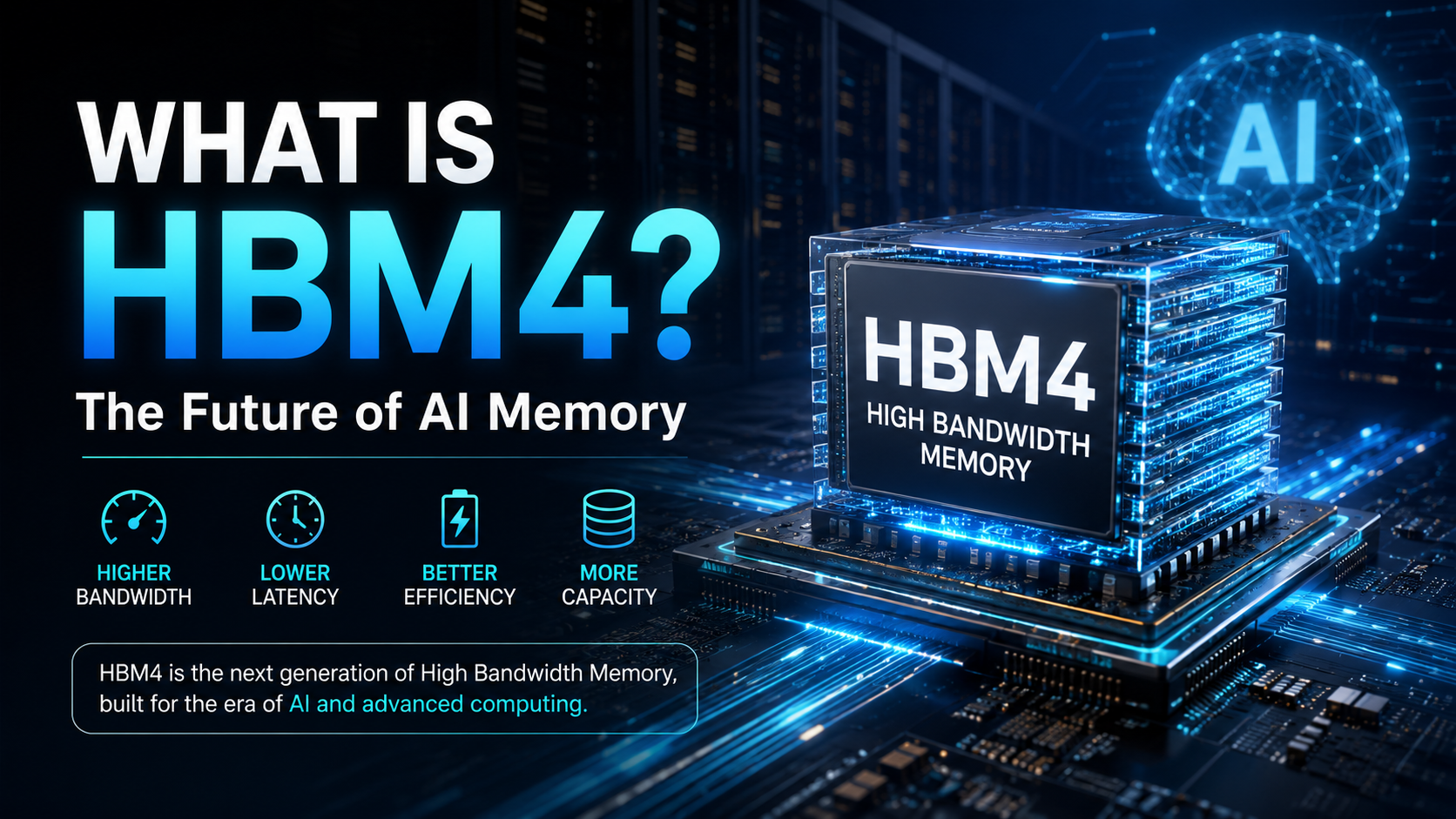
Key Takeaway
HBM4 is more than the sixth generation of High Bandwidth Memory—it marks a new era where memory and advanced logic manufacturing converge to eliminate AI data bottlenecks and redefine the semiconductor value chain.
What Is HBM4?
HBM4 (High Bandwidth Memory 4) is the sixth generation of High Bandwidth Memory designed for artificial intelligence, high-performance computing (HPC), and hyperscale data centers.
Unlike conventional DDR memory modules that sit separately on a motherboard, HBM stacks multiple DRAM chips vertically and places them next to the AI processor inside the same advanced package.
These stacked memory layers communicate through Through-Silicon Vias (TSVs)—microscopic vertical connections that dramatically shorten the distance data must travel.
The result is
- Much higher memory bandwidth
- Lower latency
- Better power efficiency
- Higher memory density
- Greater AI processing performance
As large language models continue to expand into the trillions of parameters, these advantages become increasingly important.
The Biggest Innovation in HBM4: The Base Die Revolution
Many investors assume HBM4 is simply another memory speed upgrade.
In reality, the biggest breakthrough is happening underneath the memory stacks.
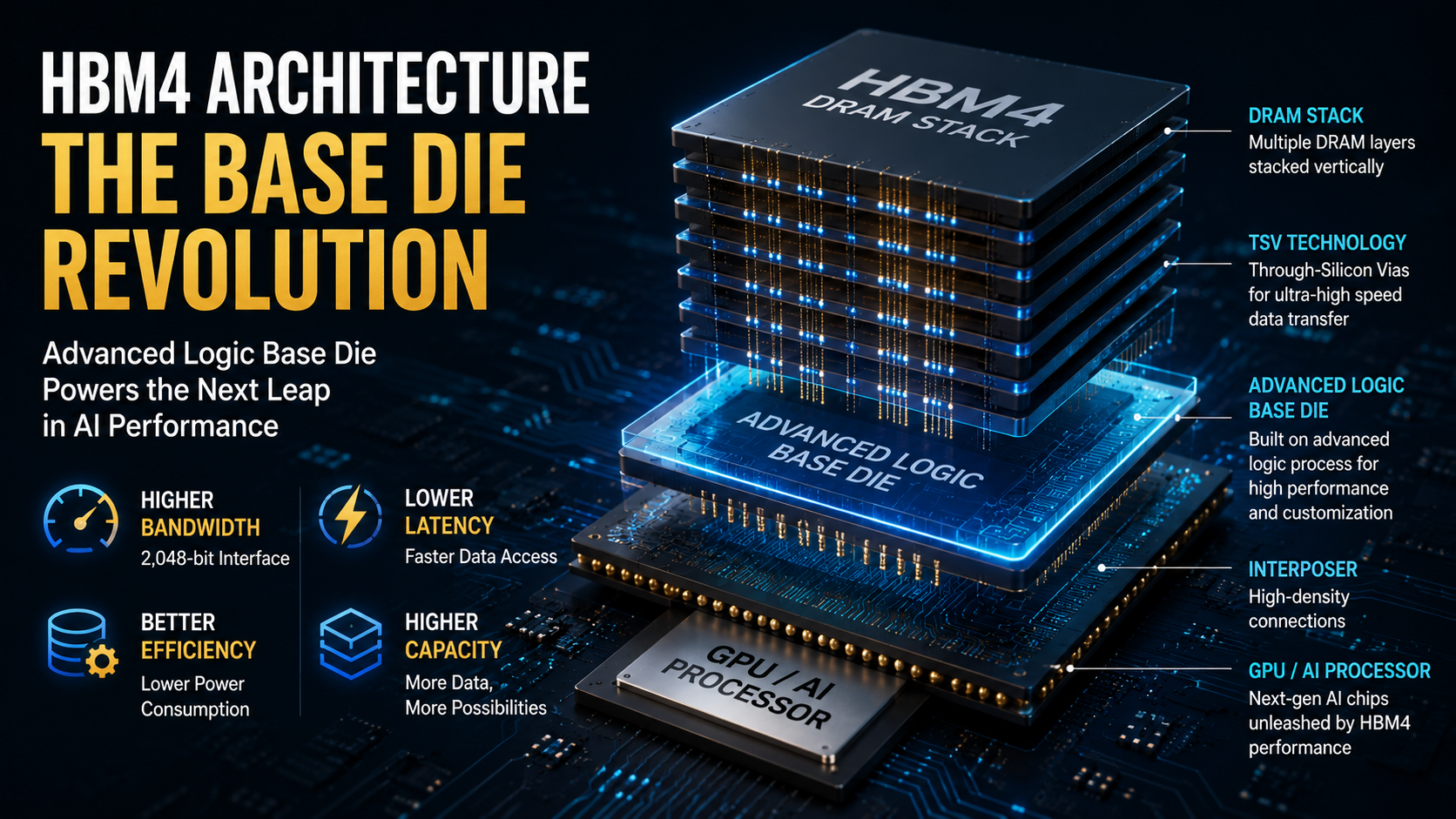
At the bottom of every HBM package sits the Base Die—a control layer responsible for managing data movement between the memory stacks and the AI processor.
Previous Generations (HBM3E and Earlier)
The base die was manufactured using traditional DRAM processes.
This approach worked well because memory interfaces were relatively simple.
HBM4 Changes Everything
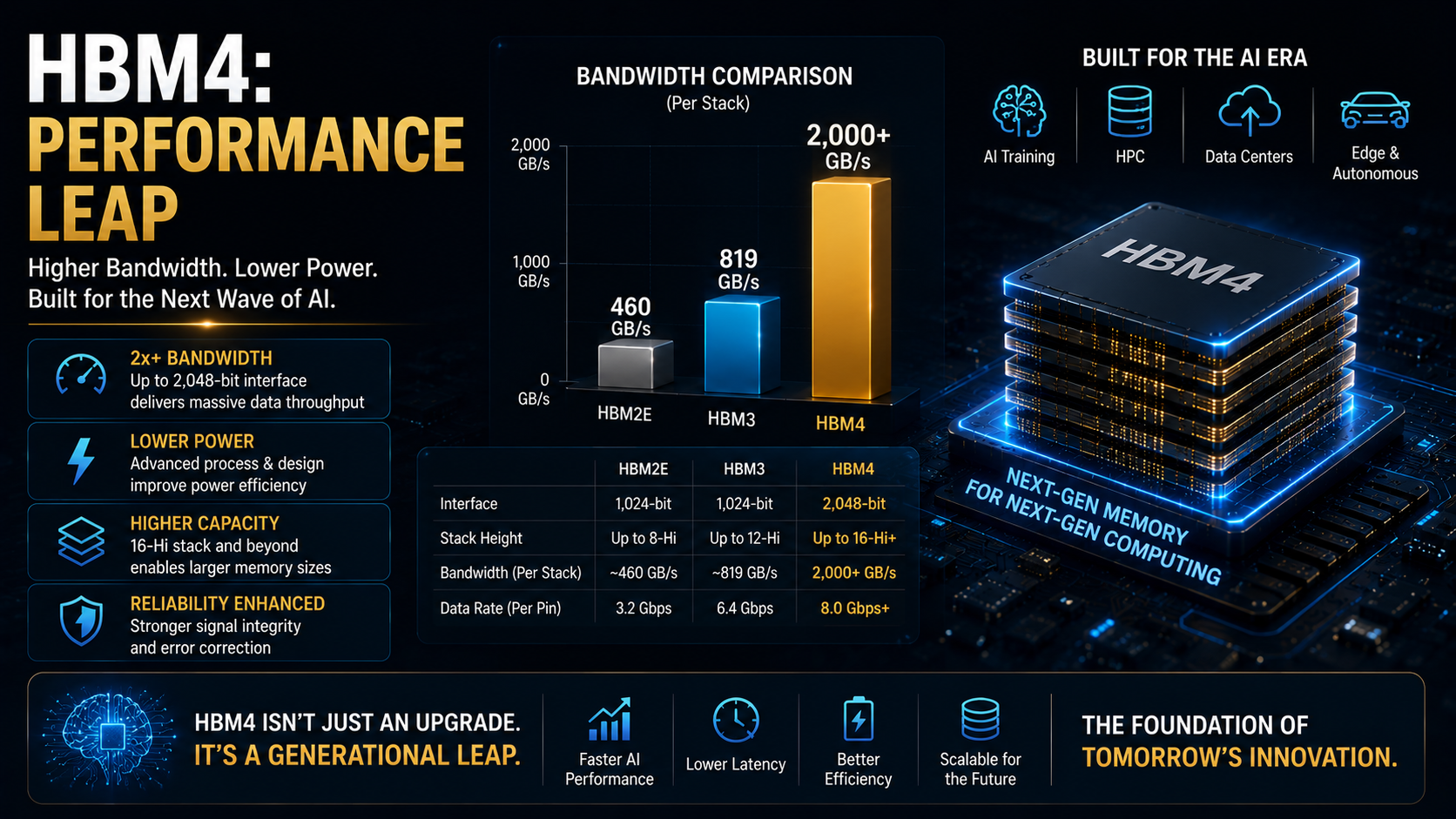
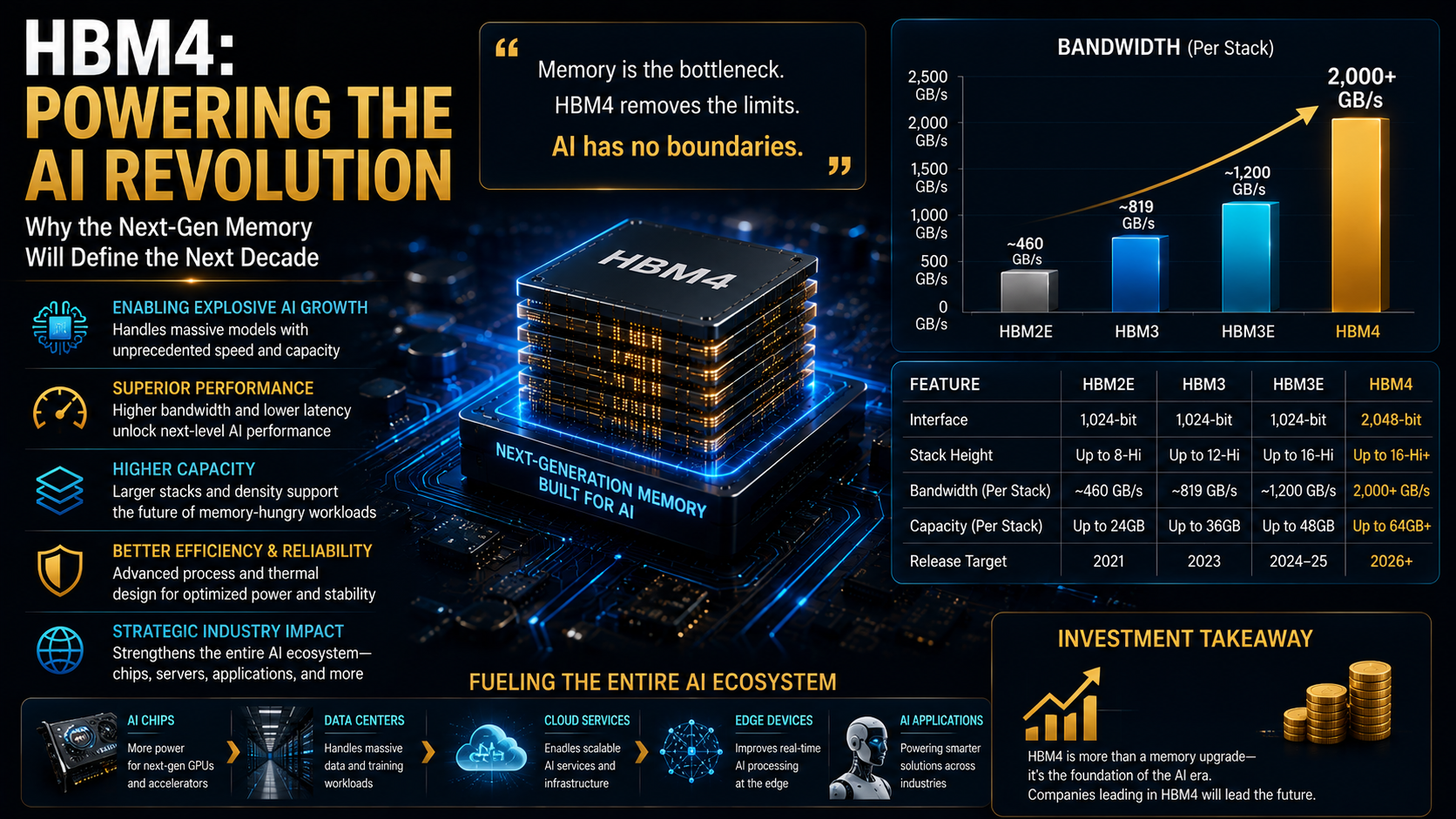
HBM4 doubles the memory interface from approximately 1,024 bits to 2,048 bits.
That dramatic increase requires much finer circuitry than conventional DRAM manufacturing can efficiently provide.
Instead of relying solely on memory fabrication technology, HBM4 introduces advanced logic manufacturing processes for the base die.
This is why partnerships between memory manufacturers and leading foundries—such as SK hynix and TSMC—have become strategically important.
In other words, HBM4 blurs the traditional boundary between memory manufacturing and logic semiconductor production.
It is no longer just a memory product—it is a hybrid semiconductor platform.
How HBM4 Solves the AI Memory Wall
One of the biggest challenges in AI computing today is known as the Memory Wall.
Modern GPUs can execute trillions of calculations every second.
However, if memory cannot deliver data fast enough, those computing units sit idle while waiting for information to arrive.
Think of it like a Formula 1 race car trapped behind city traffic.
The engine is incredibly powerful, but without an open road, its full performance can never be realized.
HBM4 is designed specifically to remove that bottleneck by providing
- Approximately twice the memory interface width
- Significantly higher bandwidth
- Improved energy efficiency
- Greater memory capacity
- Support for customized base-die architectures
Rather than making GPUs faster, HBM4 allows GPUs to operate closer to their maximum potential.
That distinction is critical.
As AI infrastructure scales, memory bandwidth may become just as valuable as compute performance itself.
HBM3E vs. HBM4

| Feature | HBM3E | HBM4 |
| Generation | Fifth | Sixth |
| Base Die | DRAM-based | Advanced logic process |
| Memory Interface | 1,024-bit | 2,048-bit |
| Customization | Limited | Custom base-die support |
| AI Optimization | High | Significantly enhanced |
| Industry Impact | Memory performance improvement | Memory and logic convergence |
The transition from HBM3E to HBM4 is not simply another performance upgrade.
It represents a new semiconductor architecture where memory, packaging, foundries, and AI chip design become increasingly interconnected.
That shift is likely to influence not only technology development but also competitive positioning across the semiconductor industry.
Why HBM4 Matters to Investors
HBM4 matters because it changes where value is created across the AI semiconductor supply chain.
During the first phase of the AI boom, investors focused primarily on GPU designers. But as AI infrastructure becomes more complex, performance increasingly depends on the entire system surrounding the processor.
That system includes
- High Bandwidth Memory
- Advanced foundry processes
- Semiconductor packaging
- Interposers and substrates
- Networking equipment
- Power infrastructure
- Cooling systems
- Data-center construction
HBM4 sits near the center of this ecosystem because it determines how efficiently an AI accelerator can access and process data.
A powerful GPU without sufficient memory bandwidth is like a factory filled with advanced machines but starved of raw materials. The equipment may be capable of producing more, but output remains constrained by the speed of supply.
This is why HBM4 could become one of the most important bottlenecks—and profit pools—within the next generation of AI infrastructure.
How HBM4 Could Reshape the AI Semiconductor Supply Chain
HBM4 is expected to deepen the connection among memory companies, foundries, AI chip designers, and advanced-packaging providers.
In previous memory cycles, companies competed largely through manufacturing scale, cost efficiency, and DRAM pricing.
HBM4 introduces a different competitive structure.
Memory suppliers must now combine several capabilities
- High-quality DRAM production
- Advanced logic base-die design
- Reliable foundry partnerships
- Complex stacking technology
- Packaging integration
- Customer-specific customization
- Stable high-volume manufacturing
This makes HBM4 more difficult to produce than conventional commodity memory.
It also means that success may depend less on total memory capacity and more on whether a company can deliver a complete, qualified solution to a major AI customer.
The deeper lesson is that semiconductor value is moving away from isolated components and toward tightly integrated systems.
The Rise of Custom HBM
One of the most important changes in the HBM4 era is the potential expansion of custom HBM.
Major AI chip designers may want memory products optimized for their specific accelerators, networking architecture, power limits, and data-center workloads.
A custom logic base die could allow memory suppliers to integrate functions tailored to a customer's chip design.
This could improve
- Data movement
- Power management
- Signal efficiency
- System-level performance
- Compatibility with specialized AI accelerators
For companies such as NVIDIA, AMD, Broadcom, Google, Amazon, and other custom-silicon developers, this creates an opportunity to optimize memory and compute as one coordinated platform.
For memory manufacturers, however, it creates both an opportunity and a challenge.
The opportunity is stronger customer integration and potentially higher margins.
The challenge is that each customized product may require additional design work, qualification, capital spending, and production complexity.
HBM4 and Customer Lock-In
Custom HBM could create stronger customer lock-in than traditional memory products.
Commodity DRAM can often be replaced by another supplier if specifications and pricing are similar.
HBM4 may be different.
Once a memory solution is jointly designed, tested, packaged, and qualified for a specific AI accelerator, replacing it may require
- Redesigning the base die
- Revalidating the package
- Repeating reliability tests
- Adjusting software and firmware
- Reworking production schedules
- Managing additional supply-chain risk
This raises switching costs.
As a result, a qualified HBM4 supplier may gain a more durable relationship with the customer than was possible in traditional memory markets.
However, lock-in works both ways. A memory supplier that becomes heavily dependent on one major customer may also face pricing pressure, concentration risk, and changing product road maps.
Investors should therefore examine not only whether a supplier has secured a customer, but also the economics and durability of that relationship.
The Importance of Yield
HBM4 is technologically advanced, but complexity does not automatically translate into profit.
The most important manufacturing variable may be yield.
Yield refers to the percentage of chips that meet performance and quality requirements after production.
HBM packages contain multiple stacked DRAM layers, TSV connections, a base die, and advanced packaging components. If one critical part fails, the value of the entire package can be affected.
This means that small differences in manufacturing yield can create large differences in
- Production cost
- Gross margin
- Delivery capacity
- Customer confidence
- Capital efficiency
A company may announce an advanced HBM product, but the real competitive advantage comes from producing it consistently, at scale, and at acceptable cost.
In advanced semiconductors, the winner is not always the company that develops the technology first. It is often the company that manufactures it reliably.
Capital Expenditure and Cash Flow
The HBM4 transition requires significant capital expenditure.
Memory manufacturers may need to invest in
- Advanced DRAM production
- TSV capacity
- Wafer-level processing
- Logic base-die development
- Testing equipment
- Advanced packaging lines
- Clean-room expansion
- Research and development
Foundries and packaging companies may also need to expand capacity to support increasingly complex AI products.
This creates an important distinction for investors.
High capital expenditure can indicate strong future demand, but it can also reduce free cash flow if revenue growth, pricing power, or utilization rates fail to meet expectations.
The key question is not simply whether a company is spending more.
It is whether that spending creates a durable economic return.
Investors should watch
- HBM revenue growth
- Operating margin trends
- Free cash flow
- Capital expenditure intensity
- Customer prepayments
- Capacity utilization
- Inventory levels
- Return on invested capital
A strong AI narrative does not eliminate the need for financial discipline.
HBM4's Impact on Major Asset Classes
HBM4 is primarily a semiconductor technology, but its effects can extend across financial markets.
| Asset Class | Potential HBM4 Impact |
| Semiconductor Stocks | Greater valuation gaps between companies with advanced HBM capabilities and those dependent on commodity memory |
| Foundry Companies | Increased demand for advanced logic base dies and tighter integration with memory suppliers |
| Packaging and Equipment Stocks | Higher demand for TSV, bonding, testing, substrates, and advanced packaging capacity |
| Corporate Bonds | More debt issuance may occur as semiconductor companies finance large capital-spending programs |
| Currencies | Semiconductor exports can influence trade balances and currency expectations in major manufacturing economies |
| Power and Infrastructure Assets | AI data-center expansion may increase demand for electricity, cooling, grid equipment, and construction |
| Broad Technology Stocks | AI infrastructure costs may affect margins and capital-allocation decisions across hyperscale cloud companies |
The market impact will not be uniform.
Some companies may benefit from higher selling prices and structural demand, while others may face rising capital intensity, customer concentration, or technology risk.
What U.S. Investors Should Watch
For U.S. investors, HBM4 should be viewed as part of the broader AI infrastructure cycle rather than as an isolated memory product.
1. AI Accelerator Demand
HBM demand ultimately depends on the production and deployment of AI accelerators.
Investors should monitor whether spending by hyperscale cloud providers continues to support strong demand for GPUs and custom AI chips.
2. Memory Content per Chip
The amount of HBM used in each accelerator matters as much as the number of accelerators sold.
Higher memory capacity and more advanced stacks can increase the economic value of each AI system.
3. Foundry and Packaging Capacity
Even when end demand is strong, supply can remain constrained by shortages in advanced packaging, logic base dies, substrates, or testing capacity.
4. Pricing Power
The central investment question is whether HBM remains a structurally differentiated product or gradually becomes more commoditized as supply expands.
5. Customer Concentration
A small number of large AI customers may account for a significant share of industry demand. This can strengthen long-term partnerships but also increase bargaining power on the customer side.
6. Technology Transitions
The shift from one HBM generation to the next can create temporary winners and losers. Product qualification, yield, heat management, and delivery timing can influence market share.
Key Investment Risks
HBM4 may offer attractive structural growth, but investors should not ignore the risks.
Supply Expansion
If too many manufacturers expand capacity at the same time, shortages can eventually turn into oversupply.
High Capital Intensity
Large investments can weaken free cash flow if demand growth slows.
Customer Bargaining Power
Major AI chip designers and hyperscalers may pressure suppliers on price, specifications, and delivery terms.
Manufacturing Complexity
Problems with yield, packaging, heat, or reliability can delay shipments and reduce profitability.
Technology Substitution
Future changes in AI architecture, memory systems, networking, or chip design could alter the amount and type of HBM required.
Valuation Risk
Even companies positioned in a strong industry can deliver weak investment returns if expectations are already too high.
This is why investors should separate technological importance from investment attractiveness.
A critical technology does not automatically make every company associated with it a good investment at every price.
What Are Institutional Investors Watching?
Large investors are unlikely to focus only on the HBM4 label.
They will examine how the technology changes capital flows, pricing power, and long-term cash generation.
Capital Flow
Is investment moving toward companies that control scarce AI infrastructure, or toward businesses that are merely associated with the theme?
The strongest capital flows tend to concentrate around bottlenecks—areas where supply is difficult to expand and customers have few alternatives.
Cash Flow
Can HBM4 revenue produce sustainable free cash flow after accounting for capital expenditure?
Revenue growth is important, but long-term value depends on how much cash remains after maintaining and expanding production.
Asset Durability
Does the company own technology, intellectual property, manufacturing know-how, customer relationships, or infrastructure that competitors cannot easily replicate?
In a rapidly changing industry, durable assets matter more than temporary headlines.
Long-Term Positioning
Is the company an essential part of the AI system, or is it benefiting only because the entire sector is receiving a higher valuation?
This distinction becomes increasingly important when market expectations are elevated.
Questions Investors Should Ask
Before making a judgment about an HBM4-related company, investors may want to ask
- Does the company occupy a critical position in the AI supply chain?
- Can it manufacture advanced products at high yield?
- Does it have a credible foundry and packaging ecosystem?
- Is customer demand supported by long-term contracts or only short-term shortages?
- Will capital spending improve future cash flow?
- Can the company maintain pricing power as competitors expand capacity?
- Is the current valuation already assuming flawless execution?
- Would the business remain financially strong if the AI investment cycle slowed?
These questions do not predict the next quarter.
They help investors evaluate whether a company can survive and compound value through an entire semiconductor cycle.
What Wealthy Investors See in the HBM4 Transition
Sophisticated investors often look beyond product announcements and focus on the structure of the market.
The Movement of Money
Capital is moving away from generic semiconductor exposure and toward companies that control essential AI infrastructure.
The most valuable position may belong to the business that owns the bottleneck rather than the company that sells the most visible final product.
Cash-Flow Quality
Investors will distinguish between companies generating temporary revenue from shortages and companies building recurring, high-quality cash flows through technology leadership and customer integration.
Asset Survivability
Technology transitions can rapidly weaken companies that fail to qualify for a new standard.
Businesses with proprietary processes, manufacturing expertise, customer trust, and scarce infrastructure may have greater long-term resilience.
The Long-Term Question
Does the company merely participate in the AI boom, or does it own an indispensable position within the HBM4 ecosystem?
That is the question long-term investors should keep asking.

Conclusion
HBM4 is not merely the next version of High Bandwidth Memory.
It represents a structural shift in which memory, logic manufacturing, advanced packaging, and AI processor design become increasingly integrated.
This transition could create new opportunities across memory manufacturing, foundries, semiconductor equipment, packaging, networking, power, and data-center infrastructure.
But the investment outcome will depend on more than technological leadership.
Investors must evaluate yield, capital intensity, pricing power, customer concentration, free cash flow, and valuation.
The most important lesson is this
HBM4 may redefine where economic value is captured in the AI semiconductor industry, but long-term returns will belong to companies that can convert technological importance into durable cash flow and structural competitive advantage.
In investing, survival matters more than prediction.
This was MasterMind.
'[Global] Success Blueprints' 카테고리의 다른 글