What Is Free Float? How It Affects Stock Liquidity, Volatility, and ETF Flows


Hello, this is MasterMind.
Why can two companies with nearly identical market capitalizations behave so differently in the stock market? Why does one stock barely move despite strong earnings, while another surges or crashes on relatively small trading volume?
Many investors focus on revenue growth, earnings, and valuation metrics such as the P/E ratio. However, one of the most overlooked drivers of stock price behavior is Free Float.
In today's market—where index funds and ETFs control trillions of dollars—understanding Free Float is no longer optional. It helps explain why institutional money flows into certain companies, why some stocks experience extreme volatility, and why market capitalization alone often fails to tell the full story.
Key Takeaway
Free Float represents the shares that are actually available for trading. It influences stock liquidity, price volatility, index weightings, and the flow of passive investment capital far more than many investors realize.
What Is Free Float?
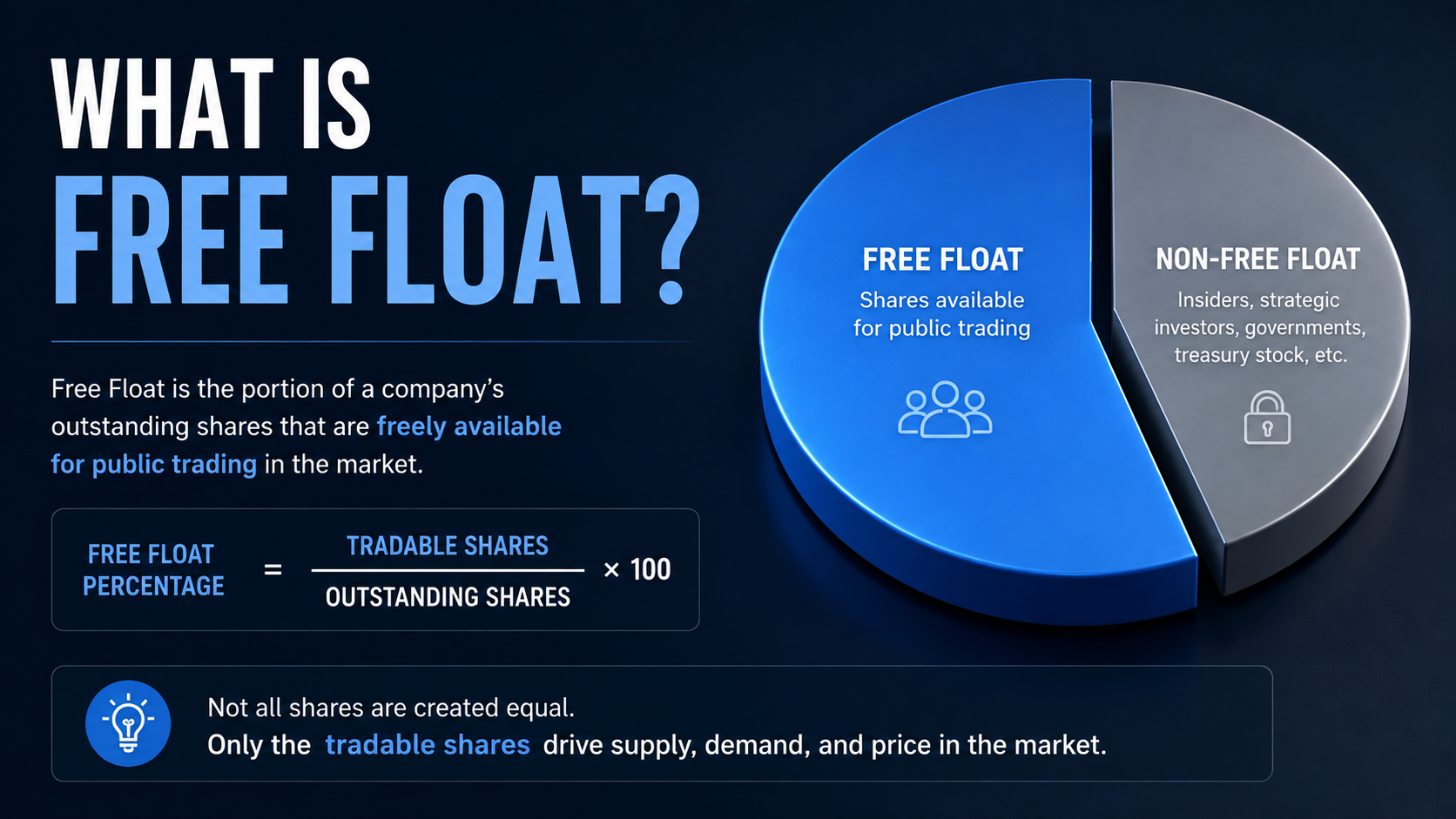
Free Float refers to the percentage of a company's outstanding shares that are freely available for public trading.
Not every share issued by a company is actively circulating in the market.
Large portions are often held by
- Founders and executives
- Company insiders
- Strategic corporate investors
- Governments
- Long-term controlling shareholders
- Treasury stock held by the company itself
These shares rarely enter the market under normal conditions and therefore are generally excluded from the company's Free Float.
In other words, Free Float measures the stock supply that investors can realistically buy and sell every day.
Free Float Formula
Free Float = Outstanding Shares − Restricted or Closely Held Shares
or
Free Float Percentage = Tradable Shares ÷ Outstanding Shares × 100
For example
- Outstanding shares: 1 billion
- Founder ownership: 450 million
- Treasury shares: 150 million
- Strategic investors: 100 million
The remaining 300 million shares are actively tradable.
That means the company's Free Float is 30%.
Although the company has one billion shares outstanding, only a fraction of them actually determines daily market pricing.
Free Float vs. Outstanding Shares
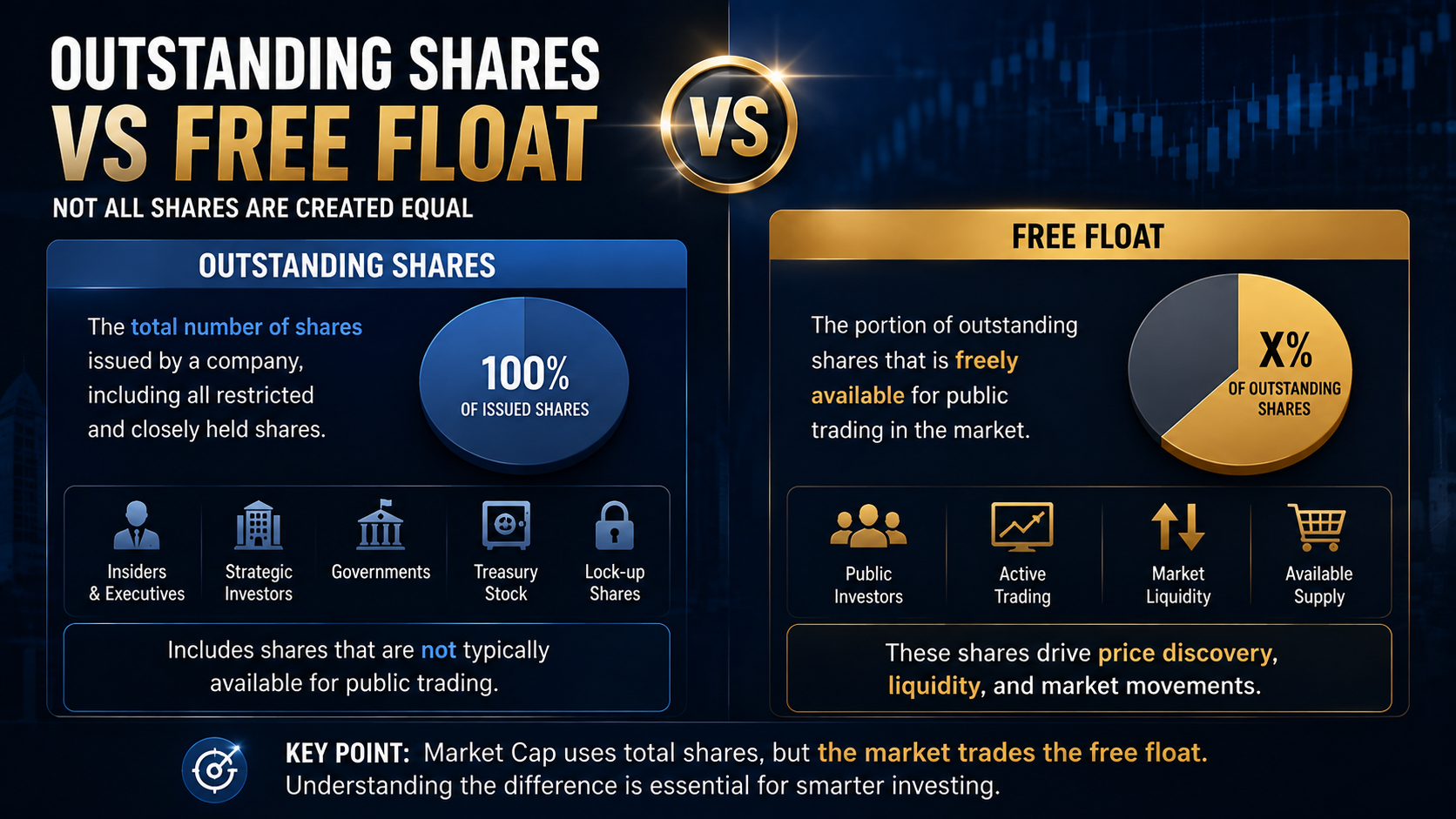
Many beginning investors confuse these two concepts.
| Metric | Outstanding Shares | Free Float |
| Definition | Total shares issued by the company | Shares available for public trading |
| Includes insider ownership | Yes | No |
| Includes treasury stock | Yes | No |
| Used for market capitalization | Yes | Indirectly |
| Used by major stock indexes | No | Yes |
This distinction has become increasingly important because most modern equity indexes use free-float-adjusted market capitalization rather than total market capitalization.
That means a company with a massive valuation may receive a much smaller index weighting if only a limited number of its shares are available for trading.
How Free Float Affects Stock Prices
Free Float influences the market through two powerful mechanisms.
1. Supply and Demand
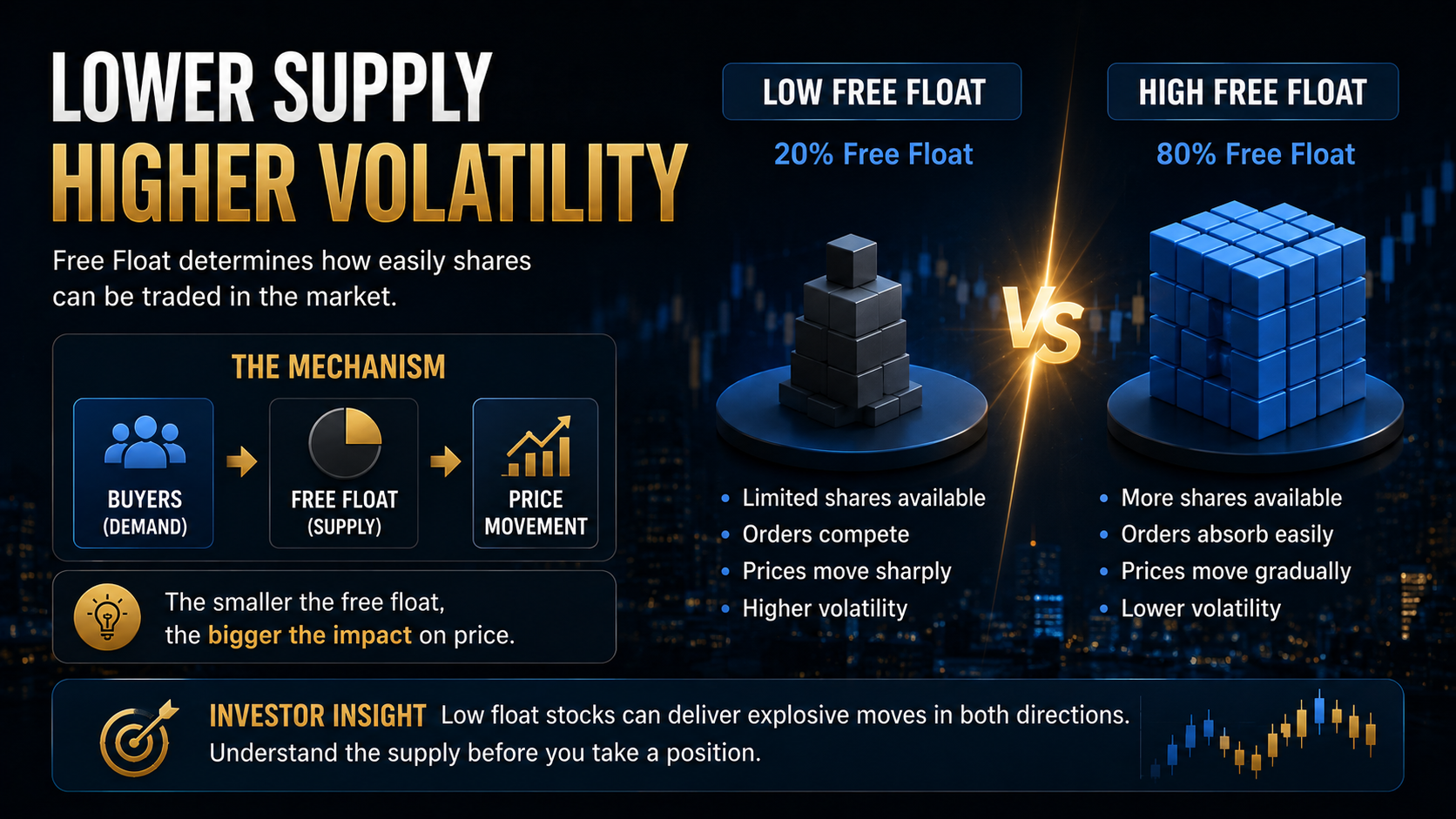
Every financial market ultimately operates according to supply and demand.
Free Float represents the effective supply of shares.
Imagine two companies with identical market capitalizations.
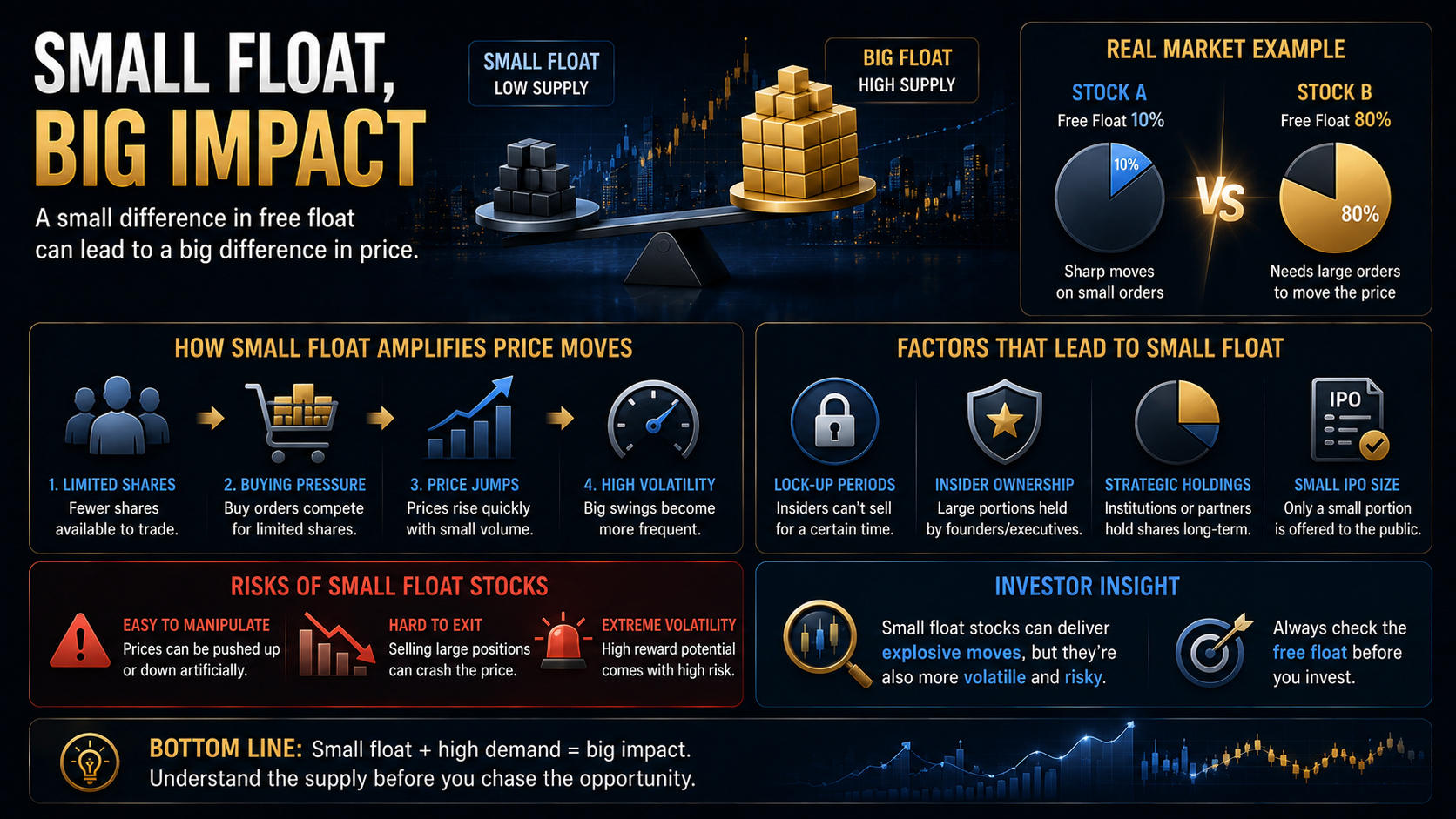
Company A has a Free Float of 20%, while Company B has a Free Float of 80%.
If institutional investors suddenly decide to invest $5 billion in both companies, Company A has far fewer shares available for purchase.
Competition among buyers becomes more intense, pushing prices higher.
Company B, on the other hand, has a much deeper pool of tradable shares, making it easier to absorb large orders without dramatic price swings.
This explains why stocks with lower Free Float often experience
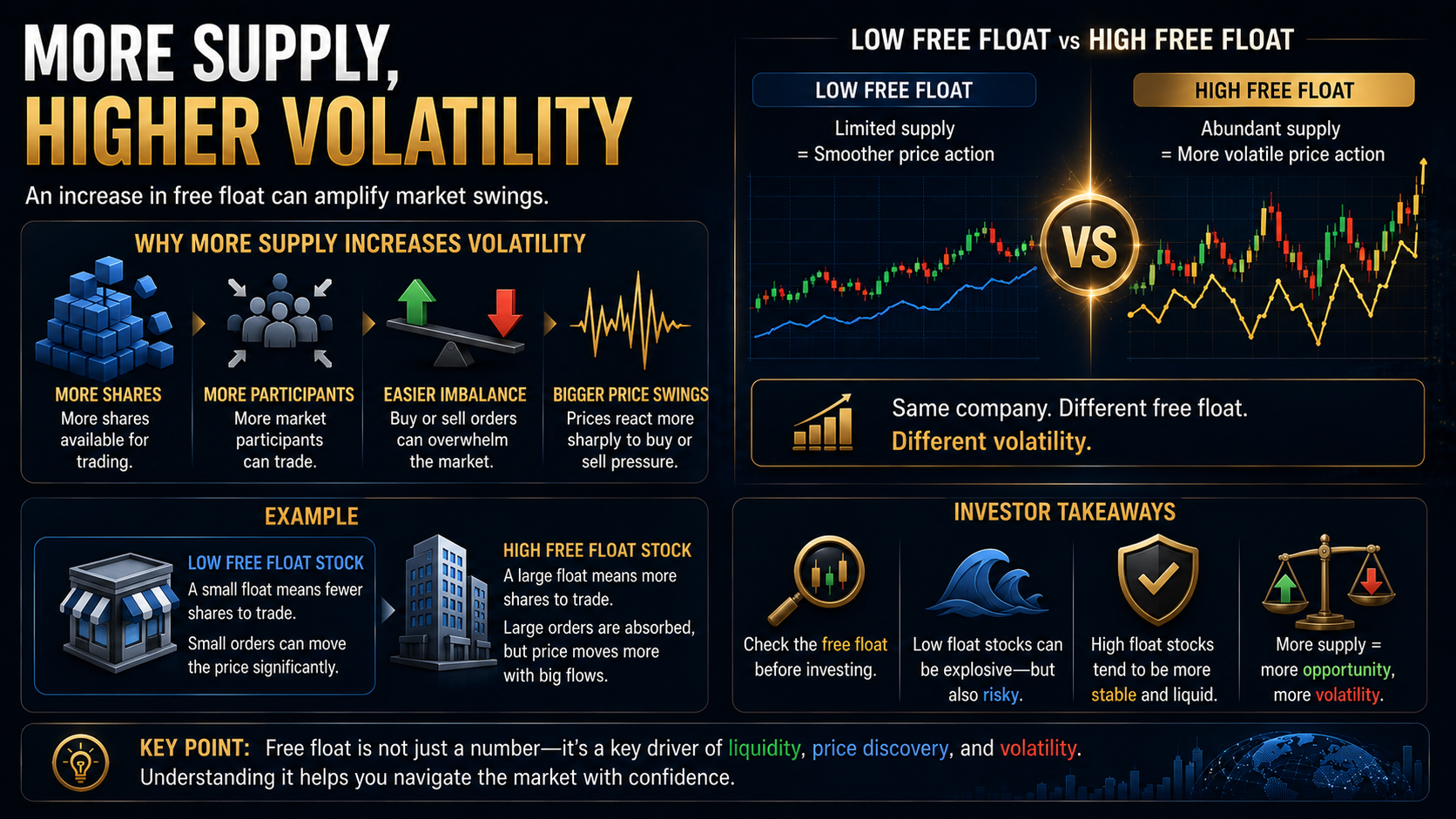
- Higher volatility
- Faster rallies
- Sharper corrections
- Larger bid-ask spreads
Professional traders often describe these stocks as having a thin order book, meaning relatively small trades can move prices significantly.
2. Index Construction and ETF Flows

Perhaps the most important role of Free Float today is its impact on index investing.
Major index providers—including
- S&P Dow Jones Indices
- MSCI
- FTSE Russell
- Nasdaq
adjust company weightings using free-float-adjusted market capitalization rather than total market capitalization.
Why?
Because index funds must be able to purchase the shares they track.
If most shares are locked up by insiders, the company may appear enormous on paper but offer limited investment capacity for institutional portfolios.
As a result, a higher Free Float can increase a company's weighting within major indexes, attracting larger inflows from ETFs and passive investment funds.
In today's investment landscape, capital often follows index construction as much as corporate fundamentals.
That is why changes in Free Float can influence stock prices even when the company's earnings remain unchanged.
Why Free Float Matters to Investors
The importance of Free Float goes far beyond short-term trading activity. It helps investors understand how much capital a stock can absorb, how vulnerable it may be to sudden selling pressure, and whether large institutional investors can enter or exit without significantly disrupting the price.
Measuring Real Market Liquidity
Headline market capitalization can create an illusion of depth.
A company may be valued at $100 billion, but if only 25% of its shares are freely tradable, its effective investable market capitalization is closer to $25 billion.
This distinction matters because large investors do not evaluate a stock only by its total valuation. They also ask
- How many shares are actually available?
- How much daily volume can the market absorb?
- Can a large position be sold without causing a sharp decline?
- Is the bid-ask spread wide or narrow?
- Are ownership and trading activity concentrated among a small number of investors?
A stock can look large on paper while remaining surprisingly illiquid in practice.
Free Float and Passive Capital
Index funds and ETFs do not select stocks based solely on whether a company has a good business model. They follow index rules.
When a company's Free Float increases, its free-float-adjusted market capitalization may also increase. That can raise its weighting in a major benchmark and force passive funds to buy more shares.
The opposite can also happen.
If insiders, founders, or strategic investors increase their ownership, the publicly tradable share count may fall. Index providers may reduce the company's weighting, which can trigger mechanical selling by funds that track the benchmark.
These flows are important because they are often unrelated to a company's latest earnings report.
A business can remain fundamentally unchanged while its stock experiences significant buying or selling due to an index rebalancing.
This reveals one of the market's most important structural truths
Stock prices are shaped not only by expectations about future profits, but also by the rules that determine where capital is allowed or required to flow.
Free Float and Stock Volatility
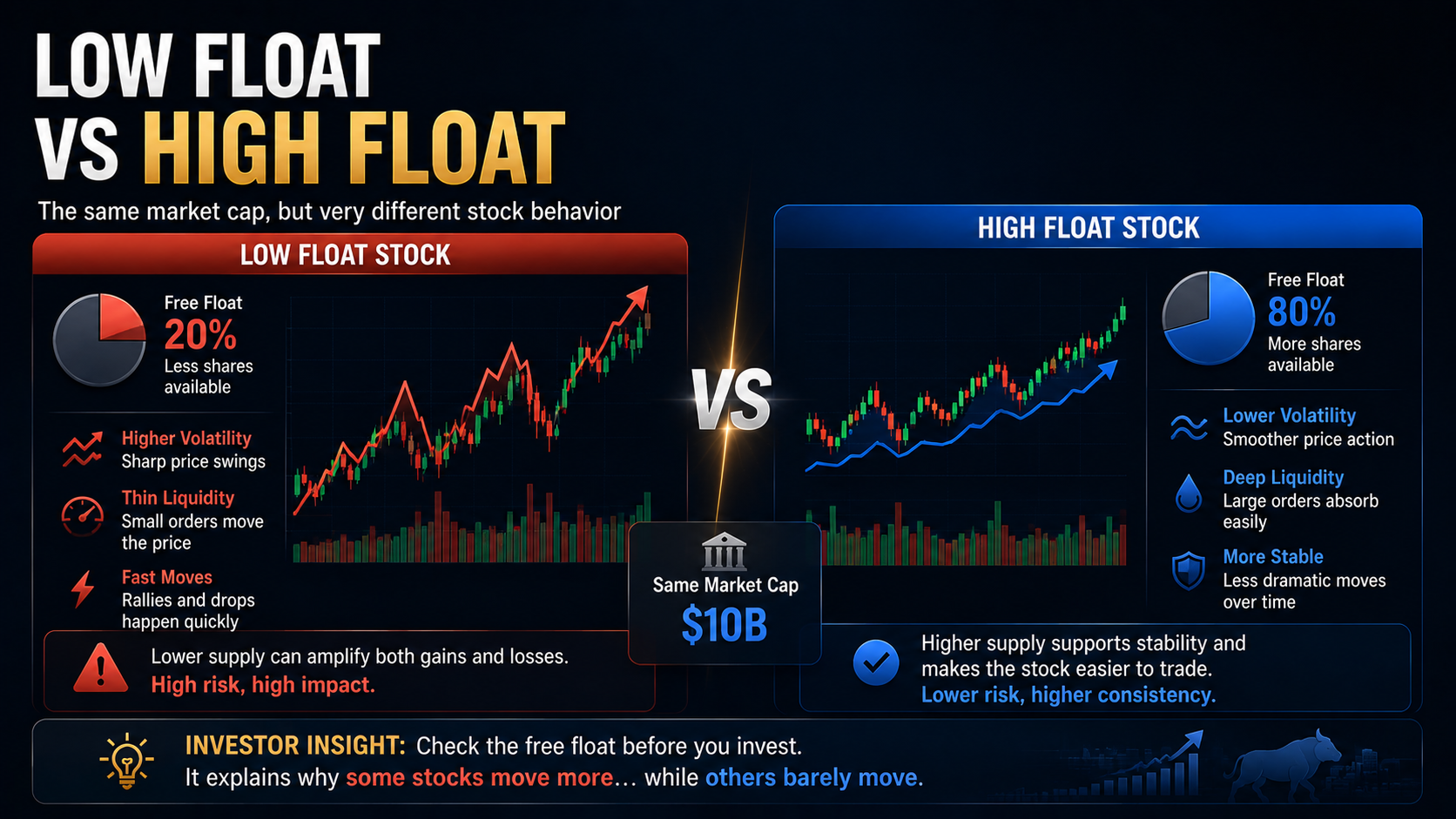
A low Free Float can create powerful upside momentum, but it can also increase downside risk.
When only a small number of shares are available, buyers may have to compete aggressively for limited supply. This can create rapid price appreciation during periods of strong demand.
However, the same structure becomes dangerous when sentiment reverses.
If investors rush to sell and the order book lacks sufficient buyers, the price may fall sharply before new demand appears.
Low-Float stocks are therefore more likely to experience
- Sudden price gaps
- Short squeezes
- Momentum-driven rallies
- Rapid reversals
- Wider bid-ask spreads
- Temporary disconnection from fundamental value
This does not mean that every low-Float stock is speculative. It means that its market structure may amplify both optimism and fear.
A stock with limited supply can rise faster than its fundamentals justify, but it can also decline more violently when liquidity disappears.
Is a High Free Float Always Better?
Not necessarily.
A high Free Float usually supports deeper liquidity and more stable price discovery. It can make the stock easier for institutional investors to trade and may improve its eligibility for major indexes.
However, a very high Free Float can also indicate that insider ownership is relatively low.
That may raise questions about
- Management's long-term alignment with shareholders
- The stability of corporate control
- Exposure to activist investors
- The risk of a hostile takeover
- Whether founders and executives still have meaningful financial commitment
A low Free Float can also have positive characteristics.
For example, strong founder ownership may signal confidence and a long-term operating mindset. It may protect management from short-term market pressure and allow the company to pursue strategies that take years to produce results.
The issue is not whether Free Float is high or low in isolation.
The more useful question is whether the ownership structure matches the company's stage of development, governance quality, liquidity needs, and investor base.
Free Float in IPOs
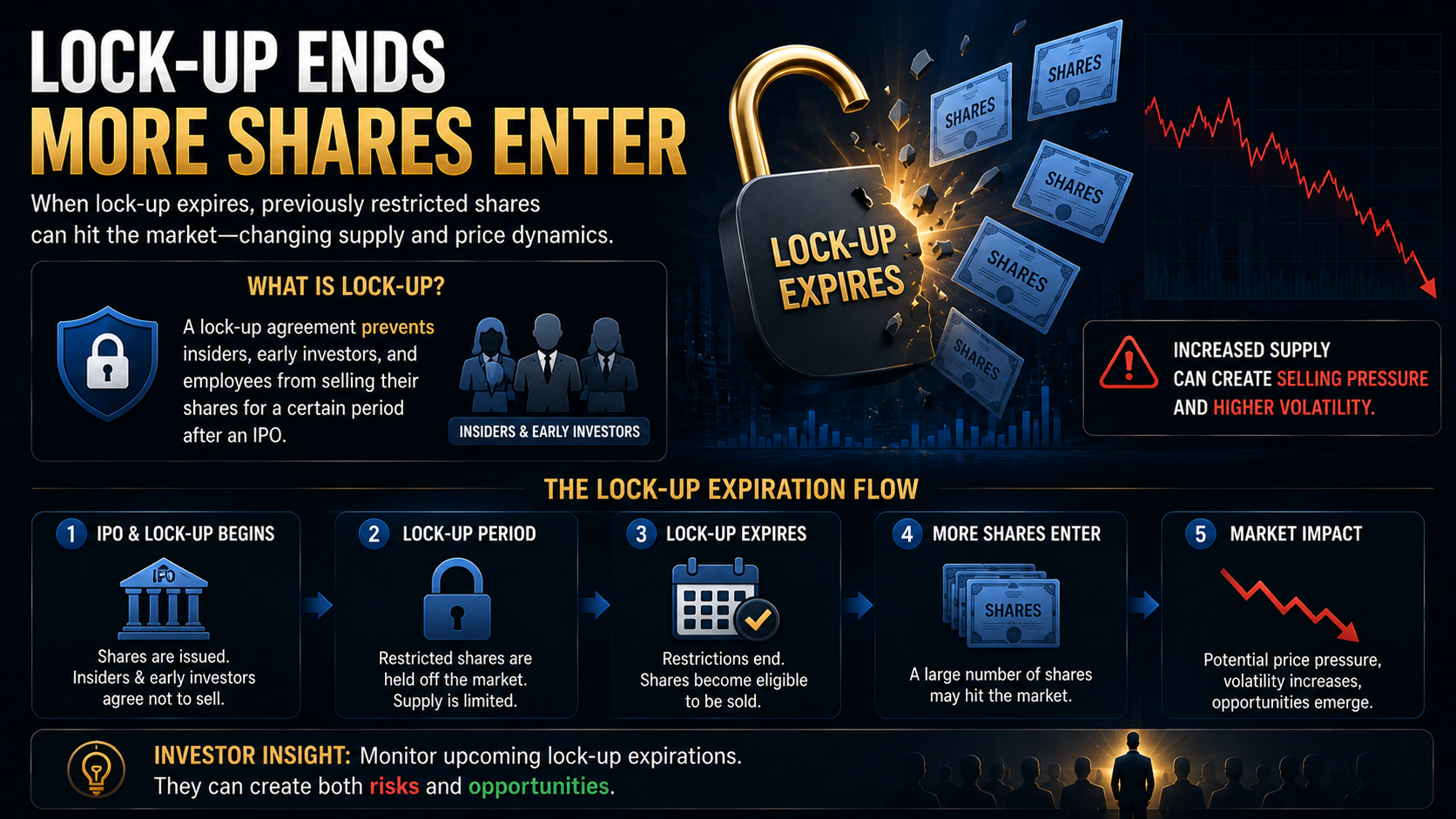
Free Float is especially important when evaluating newly listed companies.
At the time of an initial public offering, only a portion of the company's shares may be available to the public. Founders, venture capital firms, private equity sponsors, employees, and early investors are often subject to lock-up agreements.
A lock-up prevents certain shareholders from selling immediately after the IPO.
These restrictions commonly expire several months after listing. Once they expire, previously restricted shares may become eligible for sale.
This can create an overhang, meaning the market anticipates a future increase in available supply.
Investors should pay attention to
- The percentage of shares sold in the IPO
- Insider ownership after the offering
- Lock-up expiration dates
- Shares held by venture capital or private equity funds
- Employee equity compensation
- Convertible securities and warrants
- Secondary offerings
A company can report strong revenue growth and still face downward pressure if a large amount of new supply is about to enter the market.
For IPO investors, the question is not only whether the business is growing.
It is also
How many shares can become available, and who may be motivated to sell them?
Share Buybacks, Issuance, and Changes in Free Float
Free Float is not permanent. It changes as companies and shareholders make capital allocation decisions.
Share Buybacks
When a company repurchases stock, the effect depends on what happens to those shares.
If the shares are retired, the total share count falls. This can increase earnings per share and reduce the supply of equity.
If the shares are held as treasury stock, they are generally removed from the publicly tradable Float until they are reissued.
Buybacks can therefore tighten market supply, although investors should still evaluate whether the company is repurchasing stock at a reasonable valuation.
Secondary Offerings
A secondary offering can increase the number of shares available to public investors.
This may occur when
- The company issues new stock to raise capital
- Founders sell part of their holdings
- Private equity investors reduce their positions
- Strategic shareholders exit
- Employees exercise stock options
An increase in Free Float can improve liquidity and attract institutional participation. At the same time, it can create short-term selling pressure because the market must absorb additional supply.
Insider Selling
Insider selling does not always signal a negative outlook.
Executives and founders may sell shares for diversification, taxes, estate planning, or personal liquidity.
However, large or repeated insider sales can materially change the Free Float and alter the balance between supply and demand.
The meaning depends on the size, timing, and context of the transaction.
How Free Float Affects Different Parts of the Market
| Market Area | Potential Effect of Free Float |
| Large-cap stocks | Influences index weightings, ETF demand, and institutional capacity |
| Small-cap stocks | Lower Float can amplify volatility and liquidity risk |
| IPOs | Initial public Float and lock-up expirations can shape post-listing performance |
| Index rebalancing | Changes in Float can trigger forced buying or selling |
| Share buybacks | May reduce tradable supply and support per-share value |
| Secondary offerings | Can improve liquidity but create short-term supply pressure |
| Options markets | Low-Float stocks may experience sharper moves and more unstable implied volatility |
| Short selling | Limited share availability can raise borrowing costs and increase squeeze risk |
Free Float has little direct effect on Treasury bonds, gold, the U.S. dollar, or Bitcoin. However, it can influence how capital moves between equities and other asset classes.
When equity liquidity deteriorates or volatility rises sharply, investors may reduce exposure to low-liquidity stocks and move capital toward
- U.S. Treasury securities
- Cash and money market funds
- Gold
- Large-cap defensive stocks
- Highly liquid index ETFs
The connection is indirect but important. Capital often leaves fragile market structures before it leaves the broader investment system.
Key Points Investors Should Check
Free Float should never be used as a stand-alone buy or sell signal. It is most useful when combined with fundamental analysis, ownership data, trading volume, and upcoming corporate events.
1. Free Float Percentage
Check how much of the total share count is actually available for public trading.
A low percentage may indicate greater volatility and more limited institutional capacity.
2. Free-Float-Adjusted Market Capitalization
This figure provides a more realistic estimate of the company's investable size.
It is especially useful when comparing index weightings and potential ETF demand.
3. Average Daily Trading Volume
A company may have a reasonable Free Float but still trade infrequently.
Volume reveals how actively that Float circulates.
4. Insider and Strategic Ownership
High insider ownership may reflect strong alignment, but it can also reduce liquidity.
The quality of governance matters as much as the percentage.
5. Lock-Up Expirations
For recent IPOs, these dates can materially increase supply.
They should be viewed as potential liquidity events rather than guaranteed sell-offs.
6. Index Review Dates
MSCI, S&P, Russell, and Nasdaq periodically review index membership and constituent weights.
Changes in Free Float can affect those decisions.
7. Buybacks and Share Issuance
Investors should distinguish between a company reducing the share count and one repeatedly issuing stock-based compensation or raising capital through new equity.
What Do Wealthy Investors Look for in This Trend?
Sophisticated investors do not evaluate an asset only by asking how much it might rise.
They also ask how easily capital can enter, remain productive, and exit when conditions change.
The Movement of Money
Large pools of capital require deep markets.
A stock may have an attractive story, but if the available Float is too small, a large investor may be unable to build a position without pushing up the price.
Exiting can be even more difficult.
This is why professional investors often prefer businesses with sufficient liquidity, broad ownership, and stable trading volume.
Cash Flow
Free Float does not replace cash-flow analysis.
A liquid stock backed by a weak business is still a weak long-term asset.
The strongest structure usually combines
- Durable operating cash flow
- A healthy balance sheet
- Reasonable valuation
- Adequate trading liquidity
- Stable and credible ownership
- Access to institutional capital
Liquidity helps a stock survive market stress, but cash flow helps the business survive economic stress.
Asset Survivability
During a crisis, markets stop treating every stock equally.
Companies with weak liquidity, concentrated ownership, poor cash flow, and excessive leverage may face multiple pressures at the same time.
Their stock prices can fall rapidly, financing becomes more expensive, and investors may struggle to exit.
By contrast, companies with strong cash generation and deep liquidity are more likely to retain access to capital.
The goal is not to eliminate volatility. That is impossible.
The goal is to avoid structures that can turn temporary market stress into permanent capital loss.
Long-Term Investing
Long-term investors should track changes in Free Float because those changes can reveal shifts in
- Insider confidence
- Corporate governance
- Capital allocation
- Institutional participation
- Index eligibility
- Potential future selling pressure
A falling Free Float caused by disciplined share retirement can be constructive.
A falling Free Float caused by increasing control from a conflicted shareholder may deserve more caution.
A rising Free Float caused by broader institutional ownership can improve liquidity.
A rising Free Float caused by aggressive insider selling may carry a different message.
The number itself matters, but the reason behind the change matters more.
Questions Investors Should Ask
- What percentage of this company's shares is freely tradable?
- Is daily trading volume sufficient for the size of my position?
- Could a lock-up expiration or secondary offering increase supply?
- Are insiders selling, buying, or maintaining their ownership?
- Could changes in Free Float affect index eligibility or weighting?
- Is the recent price move driven by improving cash flow or temporary scarcity?
- Would this stock remain liquid during a market downturn?
- Am I analyzing the business, or simply reacting to a supply-driven rally?
Investing is not about predicting every market move.
It is about building a portfolio capable of surviving the moves that cannot be predicted.
Final Thoughts
Free Float is one of the clearest ways to understand the difference between a company's total value and the portion of that value the market can actually trade.
It affects liquidity, volatility, institutional participation, index weightings, IPO behavior, and passive fund flows.
Corporate fundamentals determine whether a business can create value over time. Free Float helps determine how that value is priced and traded in the market.
The key message is simple
A stock's price is not driven by total market capitalization alone. It is driven by the interaction between investable supply, investor demand, and the flow of capital.
This has been MasterMind.
'[Global] Success Blueprints' 카테고리의 다른 글