What Drives the U.S. Stock Market? The Three Forces Every Investor Should Understand


Welcome to MasterMind.
Why does the U.S. stock market rally after some earnings reports but sell off after others? Why can strong economic data push stocks lower, while weaker data sometimes sparks a market rally?
To many investors, the market appears chaotic. Every day brings new headlines about inflation, Federal Reserve policy, corporate earnings, AI spending, and geopolitical events.
But beneath that constant stream of news, the U.S. stock market is driven by three fundamental forces
- Corporate Earnings
- Interest Rates
- Growth Investment (CAPEX)
Almost every major market event ultimately affects one or more of these three variables.
Understanding this framework can help investors focus on long-term market trends instead of reacting to every headline.

Key Takeaway
Over the long run, the U.S. stock market is driven by the interaction between corporate earnings, interest rates, and growth investment. Investors who understand these three forces are better equipped to navigate market cycles.
What Are the Three Key Drivers of the U.S. Stock Market?
Stock prices are not simply reflections of today's business performance.
Instead, investors constantly ask three questions
- How much profit will companies generate in the future?
- What is the appropriate value of those future cash flows today?
- Which companies are investing enough to remain tomorrow's market leaders?
Those questions translate into three market drivers
Corporate Earnings
A company's earnings represent its ability to generate profits for shareholders. Sustainable earnings growth has historically been one of the strongest long-term drivers of stock performance.
Interest Rates
Interest rates determine the cost of capital throughout the economy. They also serve as the discount rate used to value future corporate cash flows.
Growth Investment
Growth investment includes capital expenditures (CAPEX), research and development (R&D), artificial intelligence infrastructure, cloud computing, semiconductor manufacturing, and other investments that create future earnings power.
The market doesn't price today's economy—it prices tomorrow's expectations.
Corporate Earnings: The Foundation of Stock Prices
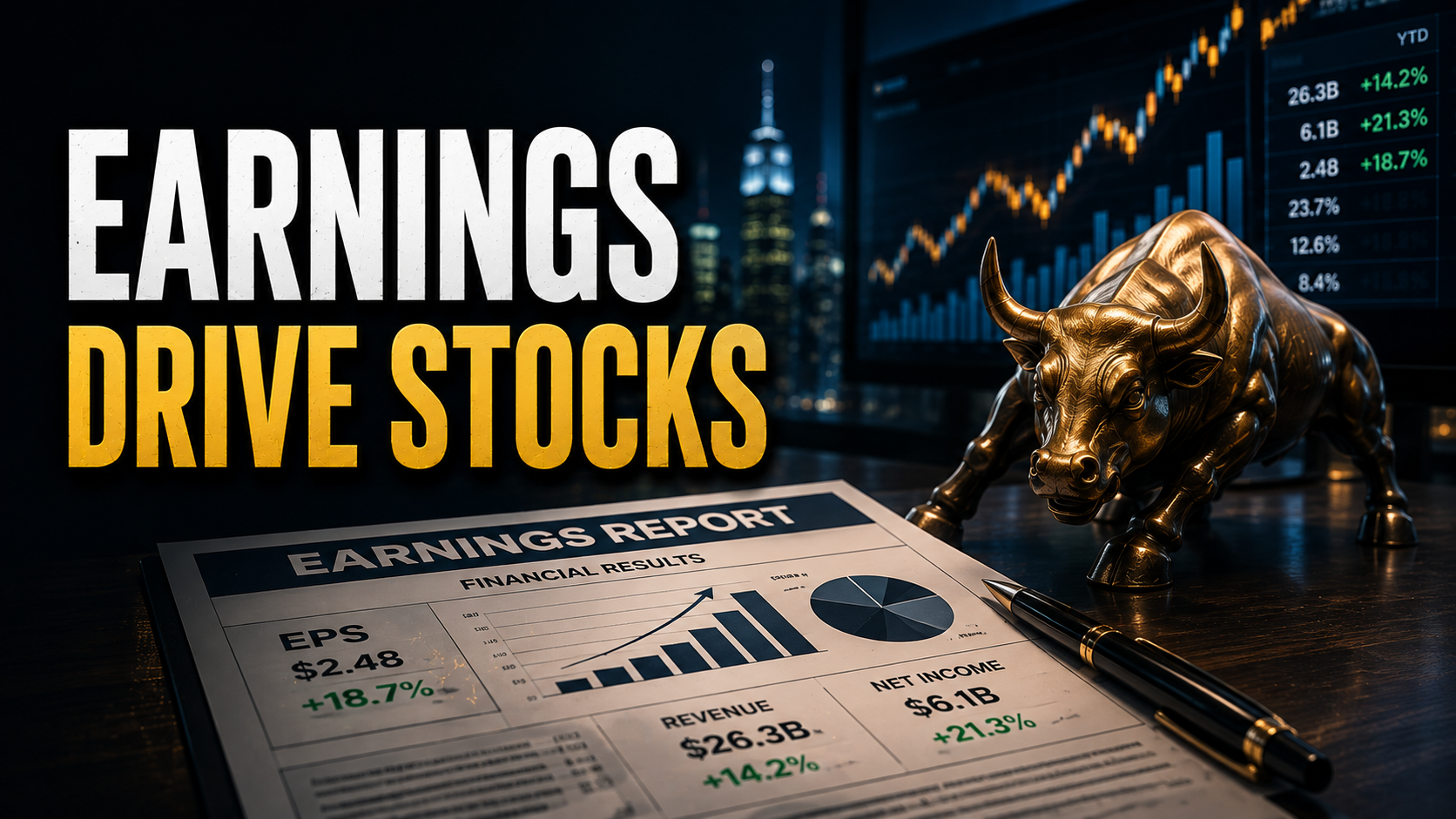
Corporate earnings are the starting point of every long-term valuation.
When investors buy a stock, they are ultimately purchasing a claim on a company's future profits.
Stronger earnings generally lead to
- Higher valuations
- Improved investor confidence
- Upward revisions in future profit expectations
However, experienced investors know that quarterly earnings alone rarely determine stock prices.
Markets pay even closer attention to
- Forward guidance
- Revenue growth
- Operating margins
- Free cash flow (FCF)
- Management commentary
This explains why a company can report record profits yet see its stock decline if future expectations disappoint.
Conversely, companies with modest current earnings can rally sharply when investors believe future growth is accelerating.
Wall Street rewards future earnings more than past performance.
Interest Rates: The Price of Money
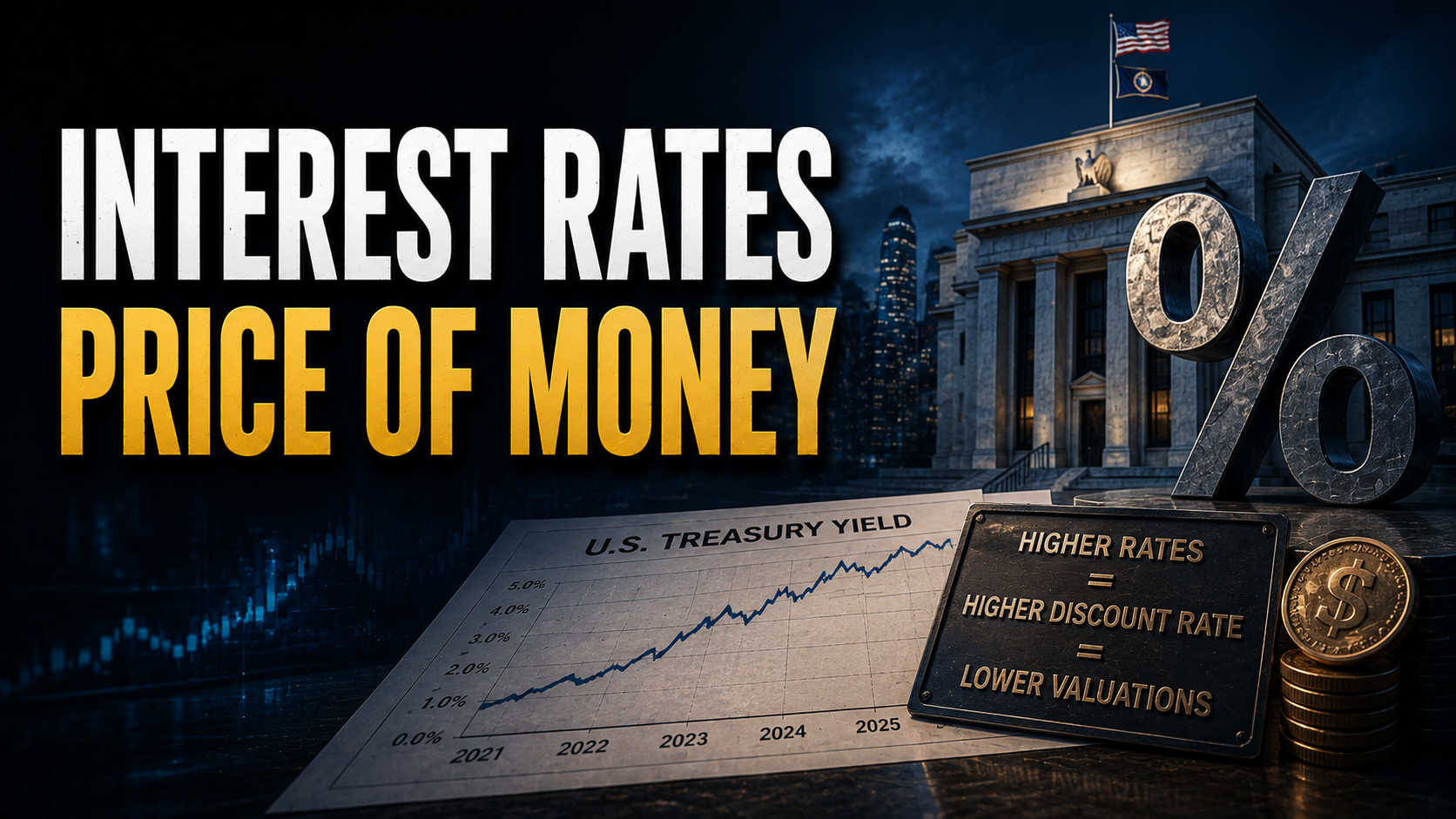
If earnings determine how much companies are worth, interest rates determine how much investors are willing to pay for those earnings.
Interest rates influence markets in two major ways.
First, they affect borrowing costs.
Higher interest rates increase financing expenses for businesses and consumers, often slowing economic activity.
Second, they change how future cash flows are valued.
Growth companies typically generate a larger share of their profits years into the future.
When Treasury yields rise, those future earnings are discounted more heavily, reducing today's valuation.
This is one reason technology stocks often react more sharply to rising interest rates than mature value companies.
The U.S. 10-year Treasury yield is particularly important because it serves as one of the benchmark discount rates used across global financial markets.
Interest rates act like gravity in financial markets. The higher the rate, the stronger the pull on future valuations.
Growth Investment: Building Tomorrow's Cash Flows
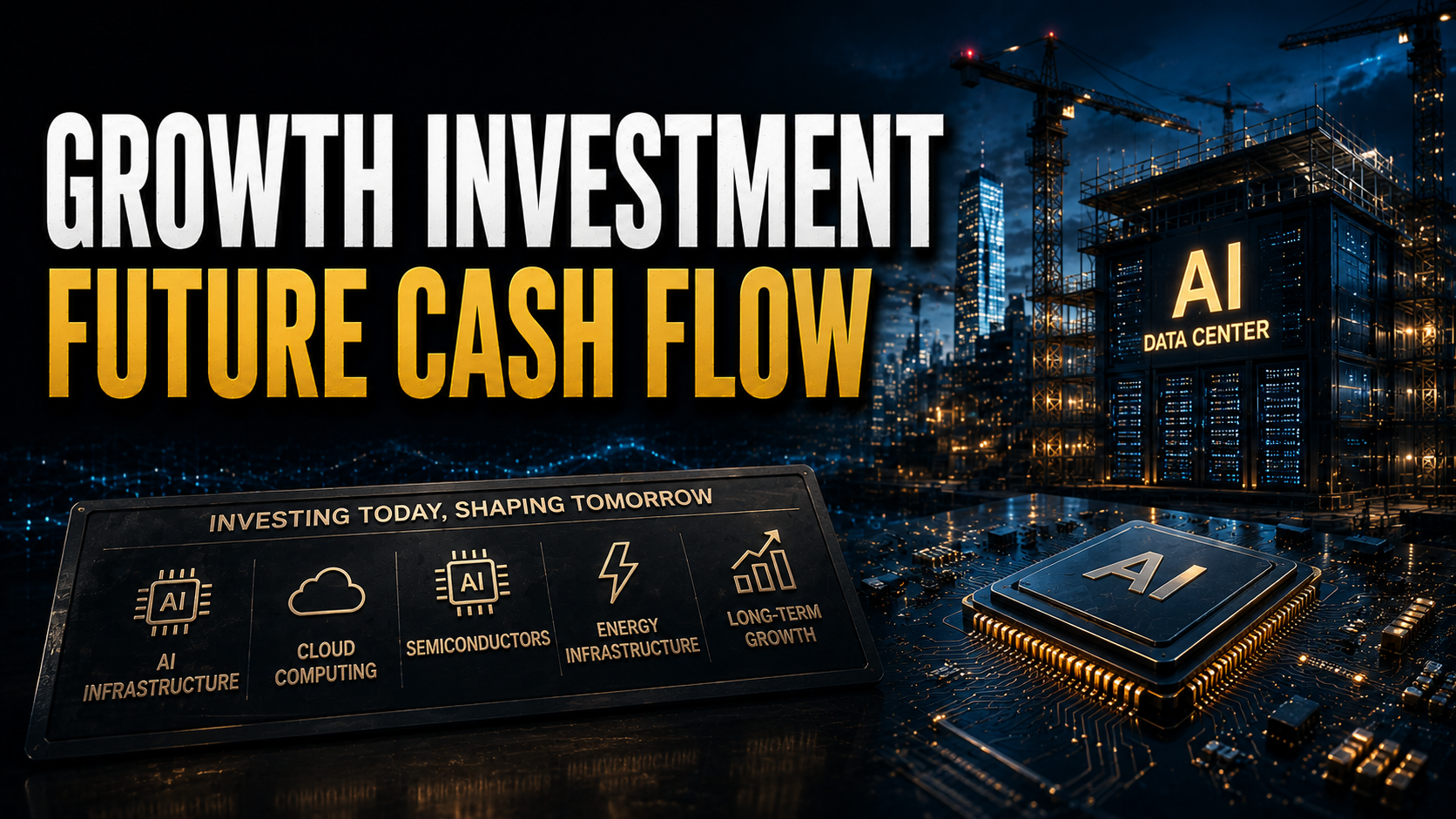
One of the defining characteristics of today's market is the enormous wave of investment flowing into artificial intelligence.
Companies such as NVIDIA, Microsoft, Alphabet, Amazon, and Meta are spending billions of dollars on
- AI data centers
- Advanced semiconductors
- Cloud infrastructure
- High-performance networking
- Energy infrastructure to support AI computing
These investments often reduce short-term profits because capital spending increases operating costs.
However, investors are willing to accept lower current earnings if they believe those investments will generate significantly larger cash flows in the future.
This is why markets frequently reward companies that continue investing aggressively during technological transitions.
Growth investment is not simply an expense.
It is the process of creating future competitive advantages.
For long-term investors, the key question is not how much a company spends, but whether today's investment is likely to become tomorrow's earnings.
Why These Three Forces Work Together
These variables do not operate independently.
Instead, they constantly reinforce—or offset—one another.
Consider today's AI investment cycle.
Companies increase capital spending on AI infrastructure.
↓
Productivity improves over time.
↓
Future earnings expectations rise.
↓
Investors assign higher valuations.
However, if interest rates climb rapidly during the same period, higher discount rates can partially offset those valuation gains.
This is why markets often experience periods when excellent corporate fundamentals are temporarily overshadowed by monetary policy.
Understanding this relationship helps explain why stock prices rarely move based on a single headline.
The market is constantly balancing earnings, interest rates, and future growth at the same time.
Why Does the Market Sometimes React More to Earnings Than Economic Data?
Economic indicators such as the Consumer Price Index, payroll growth, retail sales, and GDP are important because they help investors understand the broader economy.
However, the stock market does not trade on economic data alone.
It trades on how that data changes expectations for
- Corporate earnings
- Federal Reserve policy
- Interest rates
- Business investment
- Future cash flows
For example, stronger-than-expected inflation data may push Treasury yields higher because investors expect the Federal Reserve to keep interest rates elevated for longer.
That change can reduce the valuation investors are willing to assign to growth stocks, even when the economy itself remains strong.
Likewise, weaker economic data can sometimes lift the market if it increases expectations for lower interest rates without creating serious concerns about corporate profits.
This is why “good news” for the economy is not always good news for stocks, and “bad news” is not always bearish.
The market is constantly asking a more important question
How will this information change earnings, discount rates, and future investment?
Corporate earnings reports can have an especially large impact because they provide direct evidence of all three forces at once.
A major technology company’s quarterly report may reveal
- Current profit growth
- Demand from customers
- Pricing power
- Operating margins
- AI capital expenditure plans
- Management’s expectations for future revenue
That is why earnings from the largest companies in the S&P 500 and Nasdaq can influence the direction of the entire market.
How Earnings, Interest Rates, and Growth Investment Affect Major Assets
The same three variables that move U.S. stocks also influence bonds, the dollar, gold, and Bitcoin.
Their effects are not always identical, but several broad patterns are useful to understand.
| Change in Market Conditions | U.S. Stocks | Treasury Bonds | U.S. Dollar | Gold and Bitcoin |
| Earnings expectations rise | Generally positive, especially for market leaders | Often neutral or slightly negative if growth expectations push yields higher | Can strengthen if U.S. growth outperforms | Mixed, depending on liquidity and risk appetite |
| Interest rates rise | Often negative for high-valuation growth stocks | Bond prices generally fall | Often strengthens | Can face pressure as real yields rise |
| Interest rates fall | Often supportive, especially for growth stocks | Bond prices generally rise | Can weaken | May benefit from lower real rates and improved liquidity |
| Growth investment expands | Positive for technology, semiconductors, infrastructure, and suppliers | Can create upward yield pressure if investment demand is strong | May strengthen if capital flows toward the U.S. | Can benefit if broader liquidity also improves |
| Earnings weaken while rates remain high | One of the most difficult combinations for equities | Higher-quality bonds may become more attractive | Often remains firm | Performance depends on recession and liquidity expectations |
These relationships should not be treated as fixed rules.
Markets react to the difference between expectations and reality.
A rate cut may support stocks if inflation is easing, but it may fail to do so if the cut reflects a severe deterioration in economic growth.
Similarly, large capital expenditures can be bullish when they create future revenue, but bearish when spending rises without a credible path to monetization.
The Difference Between an Earnings-Driven Market and a Liquidity-Driven Market
Not every market rally has the same foundation.
Some rallies are driven by rising corporate profits.
Others are driven primarily by lower interest rates and easier financial conditions.
Understanding the difference matters.
Earnings-Driven Market
An earnings-driven rally occurs when companies are producing stronger revenue, higher margins, and increasing free cash flow.
This type of market is generally supported by improving business fundamentals.
Key signs include
- Rising earnings estimates
- Strong forward guidance
- Expanding profit margins
- Healthy free cash flow
- Broad participation across sectors
Liquidity-Driven Market
A liquidity-driven rally occurs when lower interest rates, easier monetary policy, or abundant capital push asset valuations higher.
Key signs include
- Falling Treasury yields
- Expanding valuation multiples
- Strong speculative activity
- Rising stock prices without equivalent earnings growth
- Increased demand for long-duration assets
Liquidity-driven rallies can last for extended periods, but they are often more sensitive to changes in inflation or Federal Reserve expectations.
When earnings rise, the market builds a stronger foundation. When only valuations rise, the market becomes more dependent on liquidity.
Three Things U.S. Investors Should Watch Regularly
Investors do not need to follow every headline.
A more practical approach is to monitor a small number of indicators connected to the three core market drivers.
| What to Watch | Why It Matters |
| S&P 500 earnings estimates | Shows whether expected corporate profits are rising or falling |
| The U.S. 10-year Treasury yield | Reflects changes in discount rates, inflation expectations, and capital costs |
| Big Tech capital expenditure plans | Reveals the strength and durability of investment in AI, cloud computing, and digital infrastructure |
These indicators provide a clearer view of the market’s underlying structure than daily price movements alone.
Investors should also pay attention to revisions.
A single earnings number matters less than the direction of future estimates.
A single Treasury yield move matters less than whether real interest rates are trending higher or lower.
A single quarter of capital spending matters less than whether investment is producing revenue growth, productivity gains, and sustainable cash flow.
Key Points Investors Should Understand
Earnings Expectations Matter More Than Past Results
Markets are forward-looking.
A company may report strong historical results and still decline if management lowers future guidance.
The opposite can also happen when current earnings are weak but the outlook improves.
Real Interest Rates Matter
The nominal interest rate does not tell the entire story.
Investors should also monitor real interest rates, commonly understood as nominal yields adjusted for expected inflation.
Higher real rates increase the opportunity cost of owning assets that do not generate immediate cash flow and can place pressure on expensive growth stocks.
Capital Spending Must Eventually Produce Returns
Large investment programs can support long-term growth, but spending alone does not guarantee value creation.
Investors should ask whether capital expenditures are leading to
- Higher revenue
- Better productivity
- Stronger pricing power
- Competitive advantages
- Growing free cash flow
If monetization takes too long, market excitement can turn into disappointment.
Balance Sheet Strength Becomes More Important When Rates Stay High
Companies with heavy debt burdens become more vulnerable when borrowing costs rise.
By contrast, businesses with strong cash positions and durable free cash flow can continue investing even during difficult financial conditions.
That flexibility can become a major competitive advantage.

What Do Wealthy Investors Look for in This Cycle?
Experienced investors do not focus only on whether the S&P 500 rises or falls on a particular day.
They study where capital is moving and which assets are likely to survive different market environments.
Capital Allocation
The first question is where money is flowing.
Is capital moving from short-term Treasury bills into equities?
Are investors leaving expensive technology stocks for financials, industrials, or defensive sectors?
Is money concentrating in a narrow group of companies, or is the rally becoming broader?
Capital flows reveal which risks the market is willing to accept.
Cash Flow Quality
Sophisticated investors often place more weight on free cash flow than on accounting earnings alone.
Free cash flow shows how much cash remains after a company pays for the investments required to maintain and expand its business.
A company that can fund research, infrastructure, acquisitions, and shareholder returns from internal cash generation has greater financial independence.
Asset Resilience
A strong asset is not simply one that rises during favorable conditions.
It is one that can endure higher interest rates, slower economic growth, and temporary declines in demand.
Companies with low leverage, recurring revenue, strong margins, and strategic importance often have greater resilience than businesses dependent on continuous external financing.
Secular Growth
Long-term investors also look beyond the current economic cycle.
They search for structural trends that may continue for years, including
- Artificial intelligence
- Semiconductor demand
- Data center construction
- Power generation and grid investment
- Automation
- Cloud infrastructure
- Cybersecurity
The goal is not to chase every company associated with a major trend.
It is to identify which businesses can convert that trend into sustainable revenue and cash flow.
Investors can ask themselves
- Is this company growing because of durable demand or temporary excitement?
- Can it finance future investment without excessive debt?
- Will today’s capital spending produce measurable returns?
- Can the business survive if interest rates remain higher than expected?
- Am I buying sustainable cash flow or simply paying for market enthusiasm?
The most important investment skill is not predicting every market move. It is owning assets that can survive when the prediction is wrong.
Final Thoughts
The U.S. stock market appears to be influenced by countless variables, but most major developments eventually connect to three fundamental forces
- Earnings determine the underlying profit potential of businesses.
- Interest rates determine how those future profits are valued.
- Growth investment determines whether companies can create larger cash flows in the years ahead.
When earnings improve, rates remain manageable, and productive investment expands, the market has a strong foundation for long-term growth.
When earnings weaken, discount rates rise, and capital spending fails to generate returns, market risk increases.
News changes every day, but the structure behind the market changes much more slowly.
Investors who understand earnings, interest rates, and growth investment can look beyond daily volatility and better evaluate where capital is moving, which companies are building durable advantages, and which assets are positioned to survive the next market cycle.
The key message to remember is simple
The U.S. stock market is ultimately driven by the interaction between profits, the price of money, and investment in future growth.
This was MasterMind.
'[Global] Success Blueprints' 카테고리의 다른 글