What Is EV/Sales? How to Calculate It and Compare It With the P/S Ratio


Hello, this is MasterMind.
How do you value a company that is growing revenue by 30% every year but still reports losses?
If you've ever looked at companies like Snowflake, Palantir, Cloudflare, or many AI startups, you've probably noticed that traditional valuation metrics such as the Price-to-Earnings (P/E) ratio often become useless. Without positive earnings, there's simply no meaningful P/E ratio to analyze.
So how do institutional investors, venture capital firms, and Wall Street analysts determine whether these companies are expensive or reasonably valued?
One of the most widely used answers is EV/Sales (Enterprise Value to Sales).
Unlike many traditional valuation metrics, EV/Sales measures a company's total enterprise value—not just its stock market capitalization—and compares it to annual revenue. This makes it especially valuable for evaluating high-growth businesses that prioritize expansion over short-term profitability.
In this guide, you'll learn what EV/Sales is, how it works, why professional investors rely on it, and how to interpret it alongside other valuation metrics.

Key Takeaway
EV/Sales compares a company's total enterprise value to its annual revenue, making it one of the most useful valuation multiples for analyzing growth companies, SaaS businesses, AI firms, and other companies that have not yet reached consistent profitability.
What Is EV/Sales?
EV/Sales stands for Enterprise Value-to-Sales.
It measures how much investors are willing to pay for every dollar of a company's annual revenue.
The formula is straightforward
EV/Sales = Enterprise Value ÷ Annual Revenue
Unlike the Price-to-Sales (P/S) ratio, EV/Sales looks beyond the stock price alone.
Instead, it measures the value of the entire business.
Enterprise Value (EV) is calculated as
Enterprise Value = Market Capitalization + Net Debt
where
Net Debt = Total Debt − Cash and Cash Equivalents
This distinction is important because if you were buying an entire company, you wouldn't simply pay its stock market value.
You would also assume its outstanding debt while benefiting from the cash already on its balance sheet.
That makes Enterprise Value a much more realistic estimate of what the business is actually worth.
As a result, EV/Sales answers a simple but powerful question
How much is the market willing to pay for each dollar of revenue generated by this company?
For example, if a company has an EV/Sales multiple of 8x, investors are valuing every $1 of annual revenue at approximately $8 of enterprise value.
Why Do Investors Use EV/Sales?
Many investors begin their valuation process with the P/E ratio.
The problem is that earnings often disappear long before revenue does.
High-growth companies intentionally sacrifice short-term profits to invest heavily in
- Artificial intelligence
- Cloud infrastructure
- Software development
- Customer acquisition
- Research and development
- International expansion
These investments can significantly reduce earnings while revenue continues growing rapidly.
Consider many software-as-a-service (SaaS) companies.
A business may increase revenue by 35% annually while remaining unprofitable because management chooses to reinvest aggressively rather than maximize current earnings.
Using only the P/E ratio would make such a company impossible to evaluate.
Revenue, however, continues to provide a stable benchmark.
That is why EV/Sales has become one of the preferred valuation multiples for analyzing growth businesses.
How EV/Sales Works
To understand EV/Sales properly, it's helpful to understand what Enterprise Value actually represents.
Think of a company as having two primary financial stakeholders.
- Shareholders own the equity.
- Lenders own claims through debt.
Market capitalization measures only the shareholders' portion.
Enterprise Value measures both.
This distinction becomes particularly important when comparing companies with very different balance sheets.
Imagine two businesses generating exactly the same annual revenue.
Company A has virtually no debt.
Company B carries billions of dollars in borrowings.
If both companies have identical market capitalizations, they may appear equally valuable at first glance.
In reality, Company B would cost significantly more to acquire because a buyer must also assume its debt obligations.
Enterprise Value captures this difference.
That's why many investment bankers, private equity firms, and institutional investors rely on EV rather than market capitalization when evaluating acquisition targets.
Ultimately, EV/Sales is not simply measuring today's revenue.
It reflects what investors believe that revenue could become in the future.
A high EV/Sales multiple often suggests the market expects
- Strong long-term revenue growth
- Expanding profit margins
- Durable competitive advantages
- Significant future free cash flow
- Increasing market share
Conversely, a lower EV/Sales multiple may indicate slower expected growth, greater competitive pressure, or concerns about future profitability.
Markets rarely value companies based solely on current financial statements.
They price expectations.
EV/Sales is one of the clearest ways to measure those expectations.
EV/Sales vs. Price-to-Sales (P/S): What's the Difference?
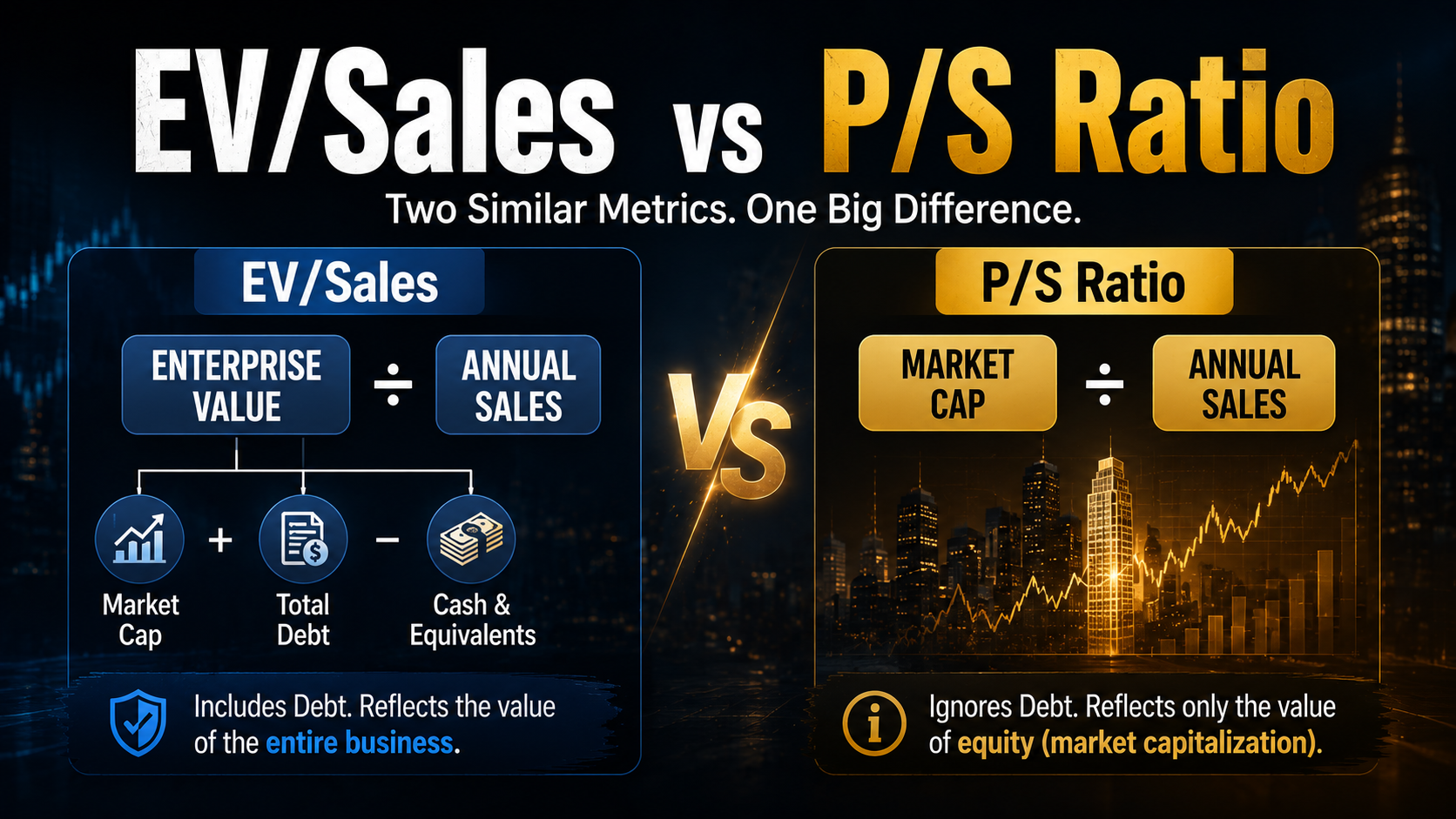
Many investors mistakenly assume EV/Sales and the Price-to-Sales (P/S) ratio are interchangeable.
They are not.
Although both metrics compare company value to revenue, they measure different things.
MetricEV/SalesPrice-to-Sales (P/S)
| Numerator | Enterprise Value | Market Capitalization |
| Includes Debt | Yes | No |
| Reflects Entire Business | Yes | No |
| Best For | Comparing businesses with different capital structures | Simple equity valuation |
Consider two companies with identical revenue and identical market capitalizations.
If one company carries substantial debt while the other has almost none, the P/S ratio treats them as equally valued.
EV/Sales does not.
Because Enterprise Value incorporates debt and cash, it provides a more complete picture of what investors are actually paying for the business.
This is one reason why mergers and acquisitions professionals almost always rely on Enterprise Value rather than market capitalization.
From an acquirer's perspective, outstanding debt is part of the purchase price.
Ignoring it can produce misleading valuation comparisons.
How Should Investors Interpret EV/Sales?

A common misconception is that a high EV/Sales multiple automatically means a stock is overvalued.
Likewise, a low multiple doesn't necessarily mean a bargain.
Context matters.
Different industries naturally trade at different valuation multiples.
For example
EV/Sales MultipleGeneral Interpretation
| Under 2x | Mature or slower-growth businesses |
| 2x–5x | Stable growth companies |
| 5x–10x | High-growth businesses |
| Above 10x | Premium valuation reflecting exceptional growth expectations |
Software companies often command much higher EV/Sales multiples than retailers because software businesses typically enjoy higher gross margins, recurring revenue, and stronger long-term scalability.
Retailers, manufacturers, and commodity businesses usually operate with thinner margins, leading to lower valuation multiples.
For this reason, EV/Sales should almost always be compared within the same industry rather than across completely different sectors.
Comparing Microsoft's EV/Sales multiple to Costco's, for example, provides very little insight because the economics of their businesses are fundamentally different.
Why EV/Sales Matters for Growth Investors

EV/Sales becomes especially important when a company is still building scale rather than maximizing current profits.
Many fast-growing businesses spend heavily on customer acquisition, product development, cloud infrastructure, data centers, or artificial intelligence. Those investments can depress earnings for years, even when the underlying business is expanding rapidly.
In these cases, revenue often provides a clearer starting point than net income.
However, revenue alone does not create value.
A company must eventually convert that revenue into operating profit and free cash flow. This is the key limitation every investor should remember.
A high-growth company can report impressive sales while destroying shareholder value if the cost of generating those sales remains permanently too high.
That is why EV/Sales should be viewed as the beginning of the analysis, not the conclusion.
Why Revenue Is Useful—but Not Perfect
Revenue is generally more stable than earnings.
Net income can swing dramatically because of
- Stock-based compensation
- Depreciation and amortization
- Restructuring charges
- Tax benefits
- Interest expense
- One-time accounting items
- Acquisition-related costs
Revenue is less affected by many of these factors, which makes it useful when comparing companies that are still in different stages of profitability.
But revenue can also be misleading.
Two companies may each generate $1 billion in annual sales, yet the economic value of those sales can be completely different.
One company may earn an 80% gross margin with recurring subscriptions and low customer churn.
Another may operate at a 10% gross margin in a highly competitive market with little pricing power.
The revenue figures are identical, but their future cash-flow potential is not.
This is why professional investors rarely examine EV/Sales without also analyzing
- Gross margin
- Revenue growth
- Operating margin
- Free cash flow
- Customer retention
- Capital intensity
- Competitive advantages
The market does not ultimately reward revenue for its own sake.
It rewards revenue that can become durable cash flow.
How Interest Rates Affect EV/Sales Multiples
EV/Sales multiples are highly sensitive to interest rates and financial liquidity.
This is particularly true for technology and growth stocks because a large portion of their expected value lies far in the future.
When interest rates decline, the present value of future cash flows generally rises. Investors may become more willing to pay high multiples for companies expected to generate substantial profits several years from now.
When interest rates rise, the opposite can occur.
Future cash flows are discounted more heavily, and investors tend to demand stronger current profitability. High-multiple growth companies often experience the greatest valuation compression during these periods.
| Market Environment | Typical EV/Sales Effect | Likely Market Response |
| Falling interest rates | Multiple expansion becomes more likely | Growth and technology stocks may outperform |
| Rising interest rates | Multiple compression becomes more likely | High-valuation stocks face greater pressure |
| Expanding liquidity | Investors accept more future uncertainty | Premium growth companies attract capital |
| Tightening liquidity | Investors favor current cash flow | Capital shifts toward profitable and defensive businesses |
This does not mean every high-EV/Sales company will rise when rates fall or decline when rates increase.
Business performance still matters.
But the broader valuation environment can significantly affect how much investors are willing to pay for each dollar of revenue.
The market's deepest mechanism is not simply the movement of prices.
It is the movement of capital between present certainty and future possibility.
How EV/Sales Affects Different Asset Classes
EV/Sales is a company-level valuation metric, but the forces that move it are connected to broader financial markets.
Growth and Technology Stocks
Growth stocks are the most directly affected.
When revenue growth is accelerating and liquidity is abundant, investors may accept very high EV/Sales multiples.
However, if growth slows even slightly, the valuation can decline sharply because much of the stock price was based on future expectations.
This is why a company can report higher revenue and still see its stock fall.
The result may be good in absolute terms but disappointing relative to what the market had already priced in.
Value and Mature Companies
Mature companies usually trade at lower EV/Sales multiples because their growth rates are slower and their business models are more established.
For these companies, investors often place more weight on
- Earnings
- Dividends
- Free cash flow
- Return on invested capital
- Balance-sheet strength
A low EV/Sales multiple may be attractive, but it can also reflect weak margins, structural decline, or limited pricing power.
Corporate Bonds
Bond investors focus less on valuation upside and more on repayment capacity.
A company with a high EV/Sales multiple but weak cash flow may still pose significant credit risk if it carries substantial debt.
For bondholders, rapid sales growth matters only if it eventually improves interest coverage and strengthens the balance sheet.
The U.S. Dollar
The dollar does not move directly because of EV/Sales, but the same monetary forces influence both.
Higher U.S. interest rates can support the dollar while pressuring high-multiple growth stocks.
Lower rates can weaken the dollar and improve the valuation environment for long-duration assets, depending on the broader economic outlook.
Gold and Bitcoin
Gold and Bitcoin are not valued through EV/Sales, but liquidity conditions that expand growth-stock multiples can also influence demand for alternative assets.
Falling real yields, easier monetary conditions, and greater risk appetite may support all three, although their underlying investment cases are different.
The Three Most Important Ways to Use EV/Sales

1. Compare Companies Within the Same Industry
An EV/Sales multiple has little meaning in isolation.
A software company, semiconductor manufacturer, retailer, and airline operate under completely different economic structures.
Their gross margins, capital requirements, and revenue quality vary substantially.
A 10x EV/Sales multiple may be reasonable for a rapidly growing subscription software company but extremely difficult to justify for a low-margin retailer.
The most useful comparison is therefore
- Company versus direct competitors
- Company versus its historical average
- Current multiple versus expected growth and margin improvement
Cross-industry comparisons should be approached carefully.
2. Compare the Multiple With Revenue Growth
A premium multiple requires premium performance.
If a company trades at 15x EV/Sales while growing revenue by 50% annually, investors may believe the valuation is justified by future scale.
If revenue growth falls to 15% while the multiple remains elevated, the risk of valuation compression increases.
This relationship is sometimes described as the balance between growth and valuation.
The key question is not simply whether EV/Sales is high.
It is whether future growth can support the price investors are already paying.
3. Examine the Path to Profitability
High revenue growth does not guarantee future profits.
Investors should examine whether scale is improving the company's economics.
Important indicators include
- Gross margin stability
- Operating-loss reduction
- Sales and marketing efficiency
- Free-cash-flow improvement
- Customer acquisition cost
- Customer retention
- Stock-based compensation
- Capital expenditure requirements
A business with rising sales and improving margins may deserve a premium valuation.
A company with rising sales but permanently negative cash flow may not.
What Can Cause an EV/Sales Multiple to Rise?

An EV/Sales multiple can increase for several reasons.
Faster Revenue Growth
If the market expects sales to grow more rapidly, investors may be willing to pay more for each current dollar of revenue.
Improving Profit Margins
A company that demonstrates operating leverage can receive a higher valuation even if revenue growth remains unchanged.
Stronger Competitive Position
Market leadership, network effects, intellectual property, switching costs, or a trusted brand can increase confidence in future cash flow.
Lower Interest Rates
A lower discount rate can increase the present value of earnings expected far in the future.
Stronger Risk Appetite
When liquidity is abundant, investors may become more willing to own companies with uncertain short-term profits but large long-term opportunities.
However, a rising multiple does not always reflect improving fundamentals.
Sometimes it reflects speculation.
The investor's task is to distinguish between a better business and a more expensive story.
What Can Cause EV/Sales to Fall?
EV/Sales can decline even when revenue continues to rise.
Common reasons include
- Revenue growth slowing below expectations
- Guidance being reduced
- Gross margins weakening
- Competition increasing
- Interest rates rising
- Share dilution accelerating
- Debt levels becoming more concerning
- Investors rotating toward profitable companies
- The broader market reducing risk exposure
This is known as multiple compression.
For example, suppose a company's enterprise value is $20 billion and annual revenue is $2 billion.
Its EV/Sales multiple is 10x.
If revenue rises to $2.5 billion but enterprise value falls to $15 billion, EV/Sales declines to 6x.
The company increased sales, but the market reduced the premium attached to those sales.
This explains why growth investing is often driven by two separate forces
- Fundamental growth
- Changes in the valuation multiple
A strong company can still produce a weak stock return if investors paid too much at the beginning.
EV/Sales and the Rule of 40
For SaaS companies, EV/Sales is often considered alongside the Rule of 40.
The Rule of 40 combines a company's revenue growth rate and profit margin.
Revenue Growth Rate + Profit Margin = Rule of 40 Score
For example
- Revenue growth: 30%
- Free-cash-flow margin: 12%
- Rule of 40 score: 42%
A company above 40% is often viewed as balancing growth and profitability effectively.
The measure is not perfect, and investors use different margin definitions, but it helps explain why two software companies with similar revenue may trade at very different EV/Sales multiples.
A company growing 40% with improving free cash flow may deserve a higher multiple than a company growing 20% while generating large losses.
The EV/Sales multiple tells investors what the market is paying.
The Rule of 40 helps assess whether the business performance may justify it.
EV/Sales Limitations Investors Should Understand

EV/Sales is useful, but it has several major limitations.
It Ignores Profitability
The metric treats all revenue equally even though some revenue is far more profitable than others.
It Can Reward Growth at Any Cost
A company can increase revenue through excessive spending, acquisitions, discounting, or inefficient customer acquisition.
Enterprise Value Can Change Quickly
Stock prices, debt issuance, share dilution, and cash balances can cause EV to move significantly.
It Is Less Useful for Financial Companies
Banks and insurers have capital structures that differ from those of industrial and technology companies. Debt often functions as part of their core operations, making conventional EV calculations less meaningful.
Industry Differences Are Enormous
Comparing unrelated sectors can lead to poor conclusions.
It Does Not Measure Shareholder Dilution
A company may achieve strong revenue growth while issuing large amounts of stock compensation. EV/Sales alone may not reveal how much existing shareholders are being diluted.
For these reasons, EV/Sales should be combined with other measures rather than used as a standalone decision rule.
EV/Sales vs. Other Valuation Metrics
| Metric | Best Used For | Main Limitation |
| EV/Sales | Unprofitable and high-growth companies | Ignores margins and profitability |
| Price-to-Sales | Simple equity-based revenue comparison | Ignores debt and cash |
| P/E Ratio | Profitable companies with stable earnings | Useless or misleading for loss-making firms |
| EV/EBITDA | Comparing operating profitability | Can understate capital expenditure needs |
| Price-to-Free-Cash-Flow | Businesses producing real cash | Less useful when cash flow is temporarily negative |
| PEG Ratio | Relating earnings valuation to growth | Depends heavily on earnings estimates |
No single metric can capture the entire economic reality of a business.
The strongest analysis uses several measures to understand different parts of the same company.
What Do Wealthy and Institutional Investors Look For?

Experienced investors rarely buy a company simply because its EV/Sales multiple appears low.
They ask why it is low.
A discounted valuation can represent an opportunity, but it can also signal
- Structural decline
- Weak pricing power
- Excessive debt
- Poor management
- High capital requirements
- Permanent margin pressure
Likewise, a high multiple is not automatically irrational.
It may reflect a business with
- Recurring revenue
- Strong customer retention
- High gross margins
- Network effects
- Low marginal costs
- Dominant market share
- Long-term free-cash-flow potential
Institutional investors often focus on four deeper questions.
Where Is Capital Moving?
Capital usually moves toward companies that can convert growth into durable cash flow.
When liquidity tightens, money often leaves speculative businesses first and moves toward firms with stronger balance sheets and proven profitability.
Is the Revenue High Quality?
Recurring subscription revenue is generally more predictable than one-time product sales.
Investors also examine customer concentration, churn, pricing power, and contract duration.
Can the Company Survive?
A promising business may still fail if it runs out of cash before reaching profitability.
Cash burn, debt maturities, dilution risk, and access to capital are critical.
Can the Business Compound Over Time?
Long-term wealth is generally created by companies that reinvest capital at attractive returns while strengthening their competitive position.
The best business is not always the one growing fastest today.
It is often the one capable of surviving, adapting, and compounding for many years.
Questions Investors Should Ask
Before using EV/Sales to judge a company, consider the following questions
- Is revenue growth structural or temporary?
- How does the multiple compare with direct competitors?
- Are gross margins stable or improving?
- Is revenue becoming more or less expensive to generate?
- Can the company produce positive free cash flow without sacrificing growth?
- Does the balance sheet provide enough financial flexibility?
- Is stock-based compensation causing significant dilution?
- How sensitive is the valuation to interest rates?
- What growth rate is already priced into the stock?
- Could the company survive a prolonged market downturn?
These questions shift the analysis away from a single number and toward the quality and durability of the business.
Final Thoughts
EV/Sales is one of the most useful valuation tools for analyzing high-growth companies that do not yet produce consistent earnings.
Because it uses Enterprise Value rather than market capitalization, it accounts for debt and cash while comparing the value of the entire business with annual revenue.
This makes it more comprehensive than the Price-to-Sales ratio and more practical than the P/E ratio when earnings are negative.
However, EV/Sales should never be interpreted in isolation.
A high multiple may be justified by rapid growth, recurring revenue, expanding margins, and strong competitive advantages. It may also represent excessive optimism.
A low multiple may indicate undervaluation. It may also reflect a weak business with limited prospects.
The central lesson is simple
EV/Sales shows how much investors are paying for revenue, but it does not reveal whether that revenue will ever become sustainable free cash flow.
Ultimately, markets reward businesses that can turn sales into cash, maintain financial strength, and survive changing economic conditions.
Investing is not only about predicting which company will grow fastest.
It is about identifying which companies can continue creating value long after current expectations have changed.
This was MasterMind.
'[Global] Success Blueprints' 카테고리의 다른 글