Enterprise Value (EV) Explained: How It Differs From Market Cap and Reveals a Company's True Value


Hello, this is MasterMind.
When investors compare two companies, the first number they usually look at is market capitalization. But does market cap really tell you what a business is worth?
Imagine two companies with the exact same $50 billion market cap. One has almost no debt and billions of dollars in cash. The other is carrying massive debt and struggling to generate free cash flow.
Would you really pay the same price for both?
Professional investors, private equity firms, and corporate acquirers certainly wouldn't. Instead of relying solely on market capitalization, they evaluate a company's Enterprise Value (EV)—a metric designed to measure what it would actually cost to acquire the entire business.
Understanding Enterprise Value is one of the biggest steps investors can take toward evaluating companies based on fundamentals rather than stock prices.

Key Takeaway
Enterprise Value (EV) represents the true economic value of a business by combining its market capitalization with its debt while subtracting its available cash. In simple terms, EV estimates the real cost of buying the entire company.
What Is Enterprise Value (EV)?
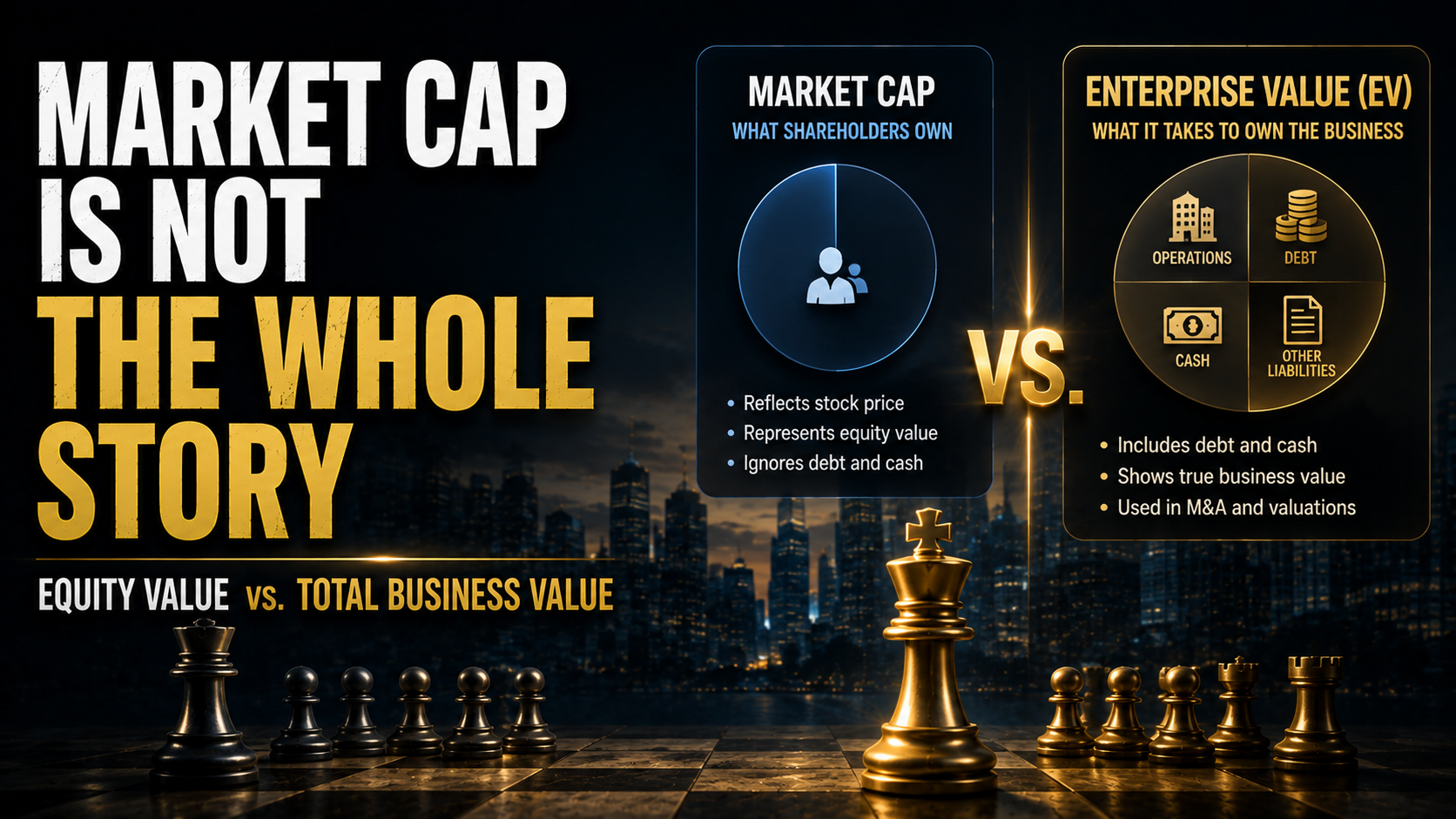
Enterprise Value, commonly abbreviated as EV, measures the total value of a company's operating business.
Unlike market capitalization, which only reflects the value of shareholders' equity, Enterprise Value considers everyone with a financial claim on the company—including lenders.
Think of it this way
- Market Capitalization = The price of the company's stock.
- Enterprise Value = The price to own the entire business.
That distinction makes EV one of the most widely used valuation metrics in mergers and acquisitions, institutional investing, and equity research.
How Is Enterprise Value Calculated?
The formula is surprisingly straightforward.
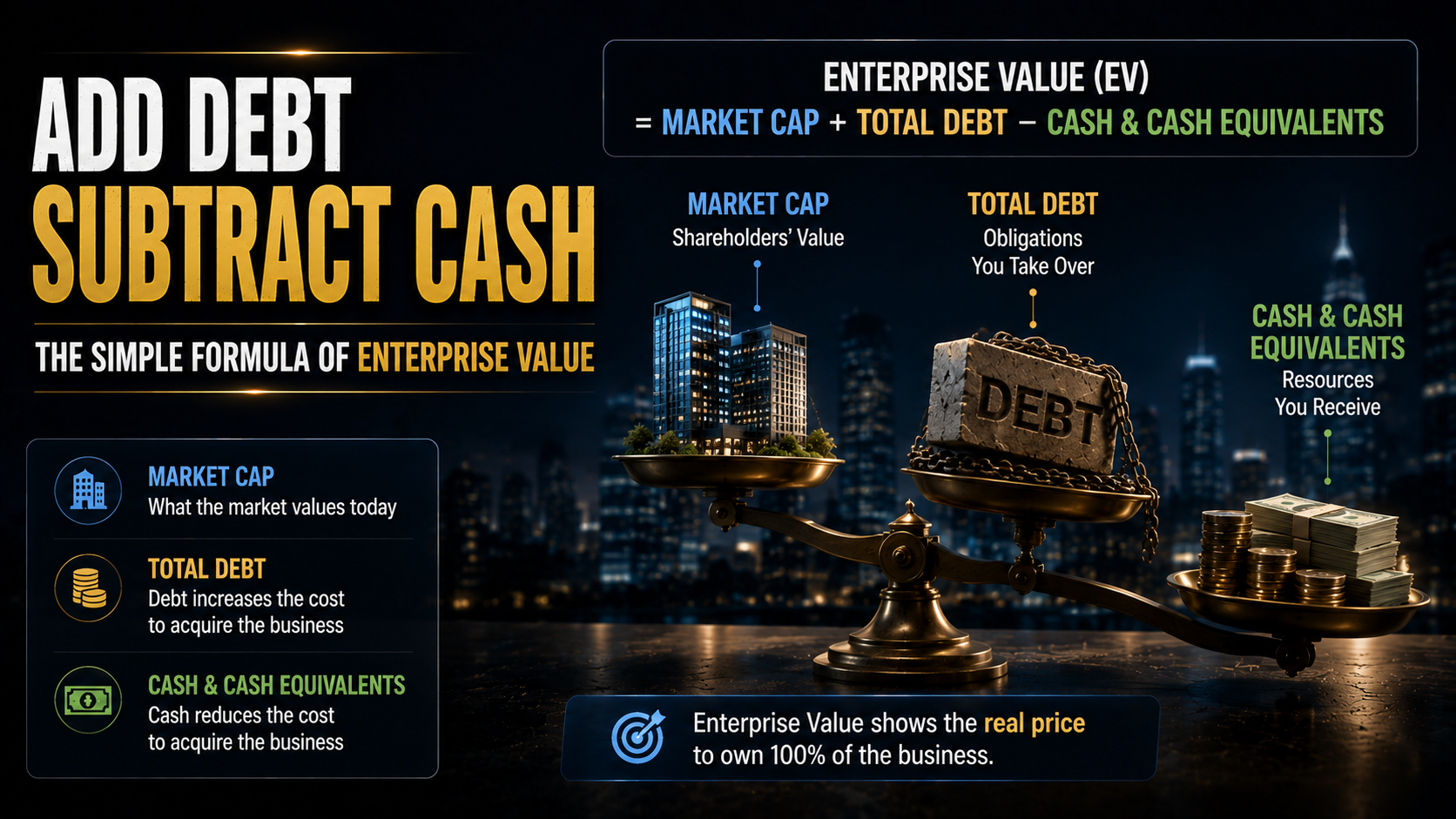
Enterprise Value = Market Capitalization + Total Debt − Cash & Cash Equivalents
Or more simply,
EV = Market Cap + Net Debt
where
Net Debt = Total Debt − Cash
The logic behind the formula is equally simple.
- If you buy a company, you inherit its debt.
- At the same time, you gain access to the cash sitting on its balance sheet.
Debt increases the effective purchase price, while cash reduces it.
That's why Enterprise Value provides a much more realistic picture of what a company is actually worth.
Understanding EV Through a Real Estate Example
Suppose you're buying an apartment building listed for $10 million.
Scenario A: Outstanding Mortgage
The property still has a $4 million mortgage attached to it.
Although the purchase price is $10 million, you also assume responsibility for the remaining debt.
The property's economic value is still $10 million.
Scenario B: Cash Inside the Business
Now imagine the same building comes with $2 million sitting in its operating account.
After acquiring the property, that cash immediately becomes yours.
Your effective purchase cost falls to $8 million.
Businesses work exactly the same way.
When acquiring a company, investors aren't simply purchasing shares—they're acquiring assets, liabilities, and cash together.
That's precisely what Enterprise Value captures.
Market Capitalization vs. Enterprise Value
Many investors mistakenly assume these numbers measure the same thing.
They don't.
| Metric | Market Capitalization | Enterprise Value |
| Represents | Equity Value | Total Business Value |
| Includes Debt | No | Yes |
| Includes Cash | No | Yes |
| Used for Acquisitions | Limited | Yes |
| Best for Company Comparison | Sometimes | Yes |
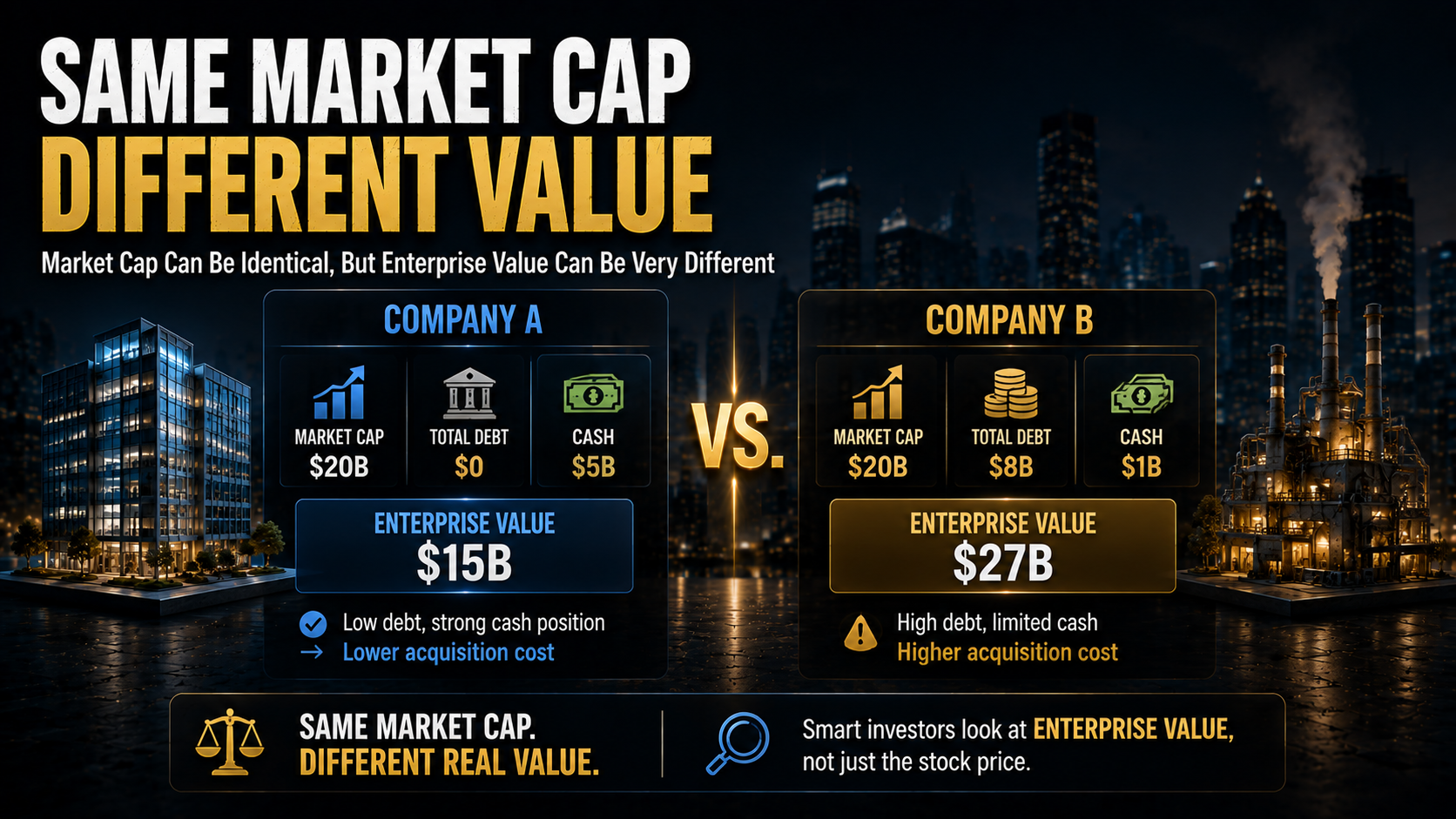
Consider two companies
Company A
- Market Cap: $20 billion
- Debt: $0
- Cash: $5 billion
Enterprise Value = $15 billion
Company B
- Market Cap: $20 billion
- Debt: $8 billion
- Cash: $1 billion
Enterprise Value = $27 billion
Although both companies have identical market capitalizations, acquiring Company B would require far more capital.
This is why experienced investors rarely stop at market cap.
Why Enterprise Value Matters
1. It Reveals the Company's Real Price
A business is more than its stock price.
When investors buy an entire company, they also acquire
- Debt
- Cash
- Factories
- Intellectual property
- Customer relationships
- Operating assets
Enterprise Value captures the complete economic picture.
2. It Eliminates Capital Structure Distortions
Two companies can generate identical operating profits while having dramatically different debt levels.
Market capitalization ignores this difference.
Enterprise Value does not.
That makes EV especially useful when comparing companies across industries and countries.
3. EV/EBITDA Creates Better Valuation Comparisons
One of Wall Street's favorite valuation metrics is
EV/EBITDA
Unlike the Price-to-Earnings (P/E) ratio, EV/EBITDA minimizes the impact of financing decisions and tax differences.
As a result, analysts can compare companies with different capital structures on a more consistent basis.
This is why investment banks, private equity firms, and institutional investors rely heavily on EV/EBITDA.
How Enterprise Value Responds to Interest Rates
Interest rates don't affect every company equally.
A firm's Enterprise Value can become more or less attractive depending on its balance sheet.
| Environment | Highly Leveraged Companies | Cash-Rich Companies |
| Rising Rates | Higher financing costs and greater financial risk | Stronger balance sheets often provide downside protection |
| Falling Rates | Lower borrowing costs may improve valuation | Cash becomes relatively less valuable unless invested productively |
For investors, the key lesson is simple
A strong balance sheet becomes increasingly valuable during periods of tighter financial conditions.
Enterprise Value Across Asset Classes
Although EV is primarily an equity valuation metric, its implications extend further.
| Asset | Potential Impact |
| Stocks | Companies with healthier balance sheets often outperform during economic stress. |
| Corporate Bonds | Higher debt levels generally increase credit risk. |
| U.S. Dollar | Large cross-border acquisitions can influence capital flows. |
| Gold | Limited direct relationship. |
| Bitcoin | Minimal direct impact, though overall risk appetite can matter. |
One important principle is worth remembering
Markets don't simply price stocks—they price balance sheets. The movement of capital often follows companies with stronger cash generation, healthier finances, and greater resilience.
What Investors Should Watch
Don't Judge Companies by Market Cap Alone
Two companies with identical market values can have dramatically different Enterprise Values.
Always examine debt and cash before deciding whether a stock looks cheap.
Be Careful With Negative EV
Occasionally, a company's cash exceeds both its debt and market capitalization, producing a negative Enterprise Value.
While this may appear to be an incredible bargain, investors should ask
- Is the business burning cash?
- Is management willing to return excess cash to shareholders?
- Is this a genuine opportunity—or a value trap?
Evaluate Cash Quality
Not all cash on the balance sheet is equally available.
Restricted cash or overseas cash may not be immediately accessible for operations or shareholder returns.
Don't Rely Solely on EV/EBITDA
Capital-intensive industries such as semiconductors, utilities, telecommunications, and airlines require substantial ongoing capital expenditures.
In these sectors, Free Cash Flow (FCF) is often just as important as EBITDA.
What Do Wealthy Investors Look For?
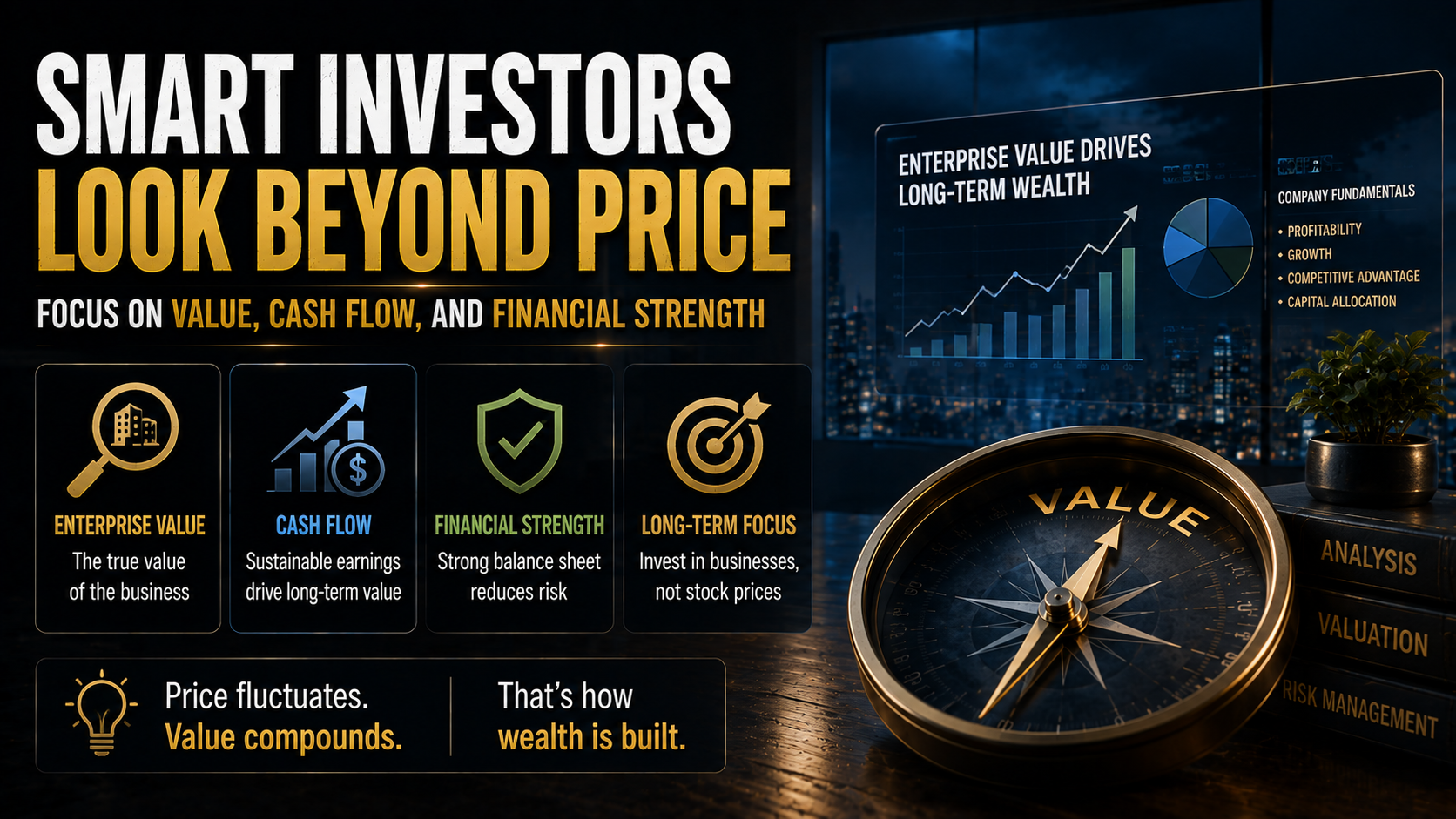
Professional investors rarely begin with stock prices.
Instead, they study
- Cash flow generation
- Debt repayment capacity
- Balance sheet strength
- Capital allocation discipline
- Long-term competitive advantages
During market downturns, capital tends to migrate away from businesses burdened by excessive leverage and toward companies with durable cash flows and financial flexibility.
Rather than asking,
"Has this stock fallen enough?"
experienced investors ask,
"If I were buying this entire business today, would the underlying economics justify the price?"
That shift in perspective separates business owners from stock traders.
Final Thoughts
Enterprise Value is far more than another financial formula.
It reflects the true economic cost of owning a business, incorporating not only equity but also debt and cash.
While market capitalization measures what investors currently think a company's shares are worth, Enterprise Value provides a more complete picture of the company's underlying business value.
Markets will always fluctuate based on sentiment.
Businesses, however, ultimately create value through sustainable cash flows, disciplined capital allocation, and resilient balance sheets.
For long-term investors, understanding Enterprise Value isn't simply about mastering another valuation metric—it's about learning to evaluate companies the way professional acquirers and institutional investors do.
In the end, successful investing is less about predicting tomorrow's stock price and more about understanding what a business is truly worth.
This was MasterMind.
'[Global] Success Blueprints' 카테고리의 다른 글