What Is the Potential Growth Rate? Why It Matters to Investors


Hello, this is MasterMind.
The U.S. economy continues to produce world-leading technology companies, attract global capital, and drive innovation. Yet economists often warn that America's potential growth rate is changing over time.
Why does this matter?
Can an economy continue growing forever simply because companies innovate? If GDP grows rapidly for a few quarters, does that automatically mean the country's long-term outlook has improved?
These questions lead us to one of the most important concepts in macroeconomics: Potential Growth Rate.
Understanding this metric helps investors look beyond quarterly headlines and evaluate the long-term earning power of an economy, its companies, and ultimately their own investment portfolios.
Key Takeaway
Potential growth rate represents the fastest pace an economy can sustain without creating excessive inflation. It is one of the strongest indicators of long-term economic strength, corporate earnings potential, and future capital allocation.
What Is the Potential Growth Rate?
Potential Growth Rate is the maximum sustainable rate at which an economy can expand over the long run without generating excessive inflation.
Unlike quarterly GDP figures, which fluctuate with business cycles, potential growth reflects the economy's underlying productive capacity.
Think of it like a high-performance engine.
A sports car can briefly accelerate to its maximum speed, but it cannot operate there indefinitely without overheating. Likewise, governments can stimulate economic activity through fiscal spending or easier monetary policy, but if production capacity does not improve, inflation eventually becomes the limiting factor.
Potential growth is therefore not about how fast an economy can grow for a short period.
It is about how fast it can grow year after year while remaining fundamentally healthy.
What Determines Potential Growth?
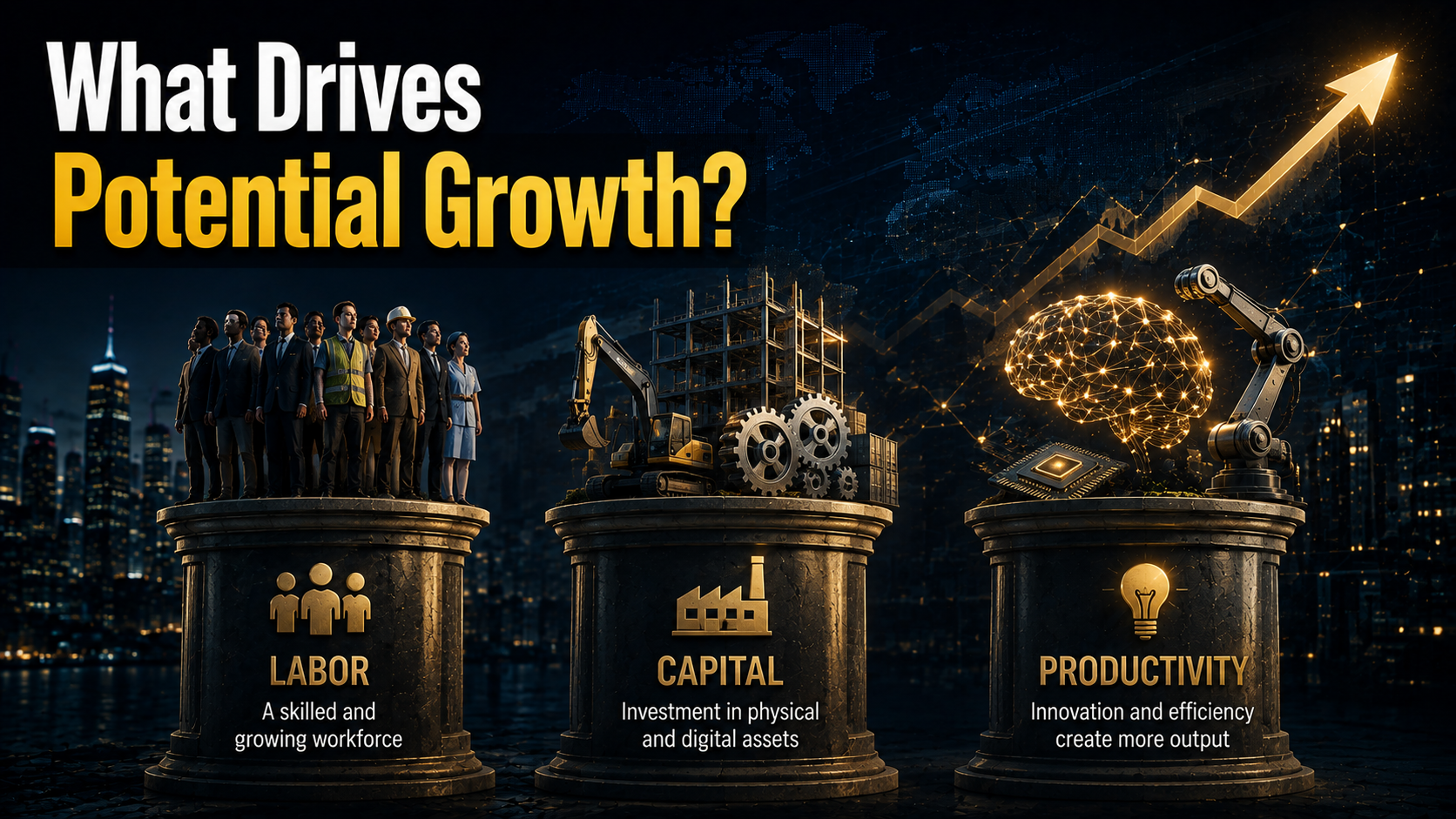
Economists generally view potential growth as the result of three major drivers.
1. Labor
A growing workforce expands an economy's productive capacity.
Population growth, labor-force participation, immigration, education, and workforce quality all influence long-term growth potential.
In the United States, demographic trends have become increasingly important as the labor market ages, making productivity gains even more valuable.
2. Capital Investment
Businesses increase productive capacity by investing in factories, data centers, semiconductor manufacturing, transportation infrastructure, and advanced equipment.
Today's massive investments in AI infrastructure, cloud computing, and energy systems are not simply expenditures—they are attempts to raise tomorrow's productive capacity.
Higher capital investment generally supports higher long-term economic growth.
3. Productivity
Productivity is often the single most important driver of potential growth.
If workers and businesses can produce more output using the same amount of labor and capital, the economy becomes more efficient.
Artificial intelligence, automation, robotics, software, biotechnology, and semiconductor innovation all have the potential to improve productivity.
This is one reason why investors closely watch AI-related capital expenditures from companies such as Nvidia, Microsoft, Amazon, Alphabet, and Meta. Markets are evaluating whether these investments will permanently increase productivity across the broader economy.
Potential Growth vs. Actual GDP Growth
Many investors confuse actual GDP growth with potential growth.
| Metric | Meaning |
| Actual GDP Growth | How much the economy grew during a specific period |
| Potential Growth Rate | The economy's sustainable long-term growth capacity |
Actual GDP changes every quarter.
Potential growth changes much more slowly because it depends on structural factors such as demographics, investment, education, innovation, and productivity.
This makes potential growth a better measure of an economy's long-term health.
Why Does Potential Growth Matter?

Potential growth influences far more than economic forecasts.
It shapes long-term expectations for
- Corporate earnings
- Interest rates
- Productivity
- Wage growth
- Government finances
- Asset valuations
When an economy consistently raises its productive capacity, businesses have more opportunities to expand revenue and profits.
Conversely, when potential growth slows, future earnings expectations often become more restrained, even if short-term GDP remains strong.
For central banks like the Federal Reserve, potential growth also provides an important benchmark.
If actual economic growth rises well above potential growth, inflationary pressures may increase.
If growth remains below potential for an extended period, unemployment may rise and economic resources may remain underutilized.
How Does Potential Growth Affect Financial Markets?
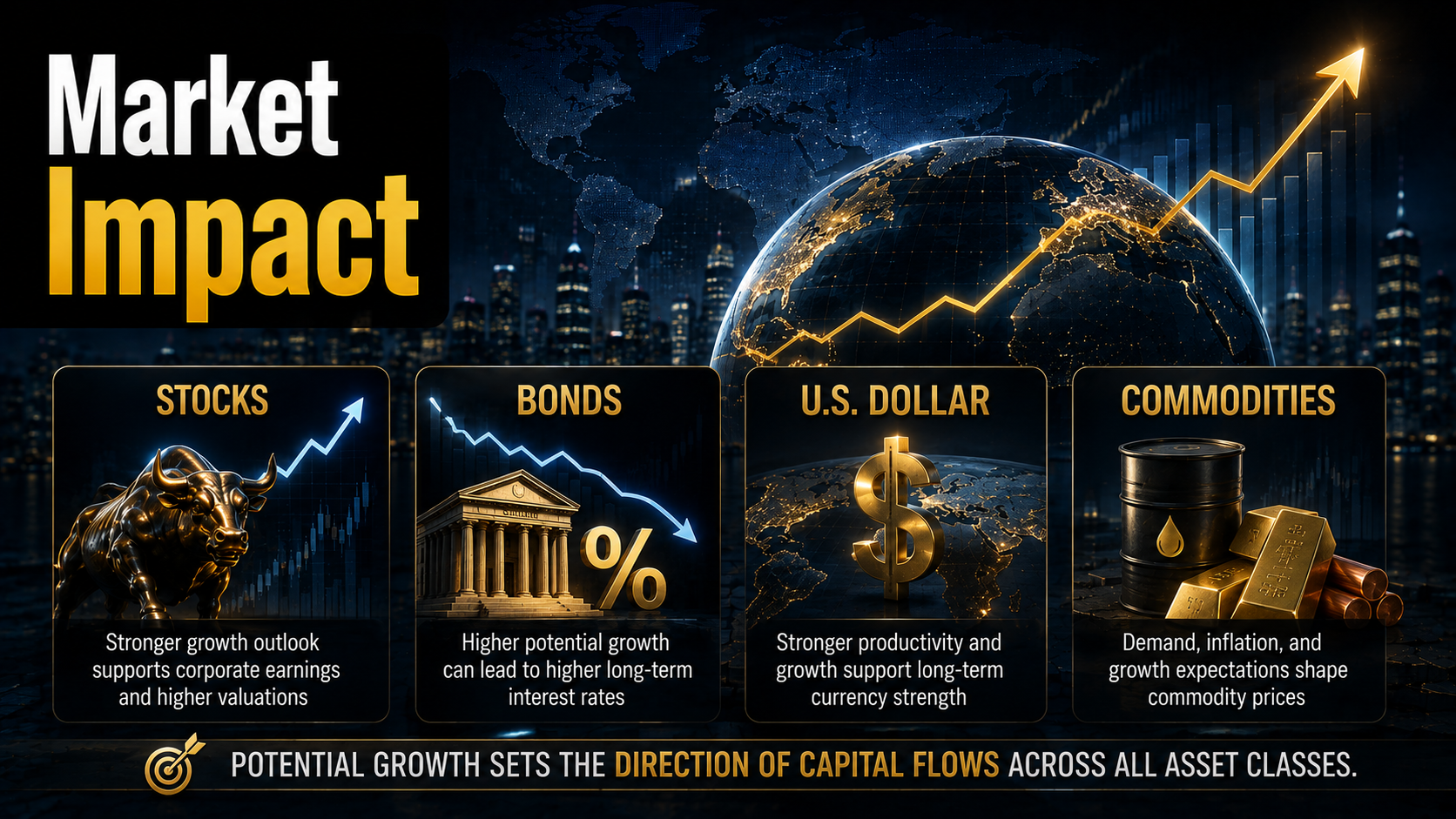
Potential growth influences long-term capital flows across nearly every asset class.
| Asset | Higher Potential Growth | Lower Potential Growth |
| Stocks | Stronger earnings growth and broader market expansion | Slower earnings growth and greater focus on high-quality companies |
| Treasury Bonds | Higher long-term interest-rate expectations | Lower neutral rates and stronger bond demand |
| U.S. Dollar | Often supported by stronger productivity and economic leadership | Relative weakness if growth consistently underperforms peers |
| Gold | May face headwinds as investors favor productive assets | Can benefit when investors seek stability during slower growth |
| Bitcoin | Often benefits from improving risk appetite and technological optimism, although liquidity conditions remain an important driver | Performance depends more heavily on monetary conditions and investor sentiment |
Markets rarely respond to one indicator alone.
However, potential growth often determines the long-term direction in which capital prefers to flow.
As investors, we should remember one important principle
Capital naturally moves toward economies capable of generating higher future productivity and stronger long-term cash flows.
What Should Long-Term Investors Watch?
Rather than focusing exclusively on quarterly GDP releases, investors should monitor whether an economy is improving its productive capacity.
Key questions include
- Is productivity accelerating?
- Are businesses increasing long-term capital investment?
- Is innovation creating sustainable competitive advantages?
- Is the labor force expanding or becoming more efficient?
- Are technological advances translating into higher economic output?
These structural trends matter far more than temporary fluctuations in quarterly economic data.
What Do Professional Investors Look For?
Experienced investors rarely build portfolios based solely on next quarter's GDP estimate.
Instead, they ask a more important question
Which economies are becoming more productive over the next decade?
That perspective changes how capital is allocated.
Money tends to flow toward businesses capable of producing durable cash flows, maintaining pricing power, and benefiting from structural productivity improvements.
This explains why companies leading AI infrastructure, cloud computing, advanced semiconductors, automation, and digital transformation often command premium valuations.
Professional investors understand that sustainable wealth creation depends less on predicting tomorrow's headlines and more on identifying where long-term productivity is increasing.
Ask yourself
- Is my portfolio concentrated in industries with declining long-term growth potential?
- Are the companies I own investing to improve productivity?
- Do they possess durable competitive advantages?
- Is capital flowing toward or away from the sectors where I am invested?
Ultimately, investing is not about predicting every economic cycle.
It is about owning assets capable of generating growing cash flows across many economic cycles.

Final Thoughts
Potential Growth Rate is one of the most important measures of an economy's long-term strength.
Unlike short-term GDP reports, it reflects structural improvements in labor, investment, and productivity that can support sustainable economic expansion for years.
For investors, understanding potential growth provides a broader perspective on where future earnings, capital, and innovation are likely to concentrate.
Economic headlines may change every day.
Potential growth changes much more slowly—but its impact on long-term investment returns can be far greater.
Remember this
Markets fluctuate with sentiment in the short run, but over the long run, productivity and sustainable growth determine where wealth is ultimately created.
MasterMind.
'[Global] Success Blueprints' 카테고리의 다른 글