What Is the Effective Interest Rate? How It Affects Stocks, Bonds, and the Economy


Hello, this is MasterMind.
The Federal Reserve announces an interest rate decision, yet mortgage rates barely move. Treasury yields surge even though the Fed keeps rates unchanged. Stocks rally before an official rate cut, while bonds begin pricing in a slowdown months in advance.
Why does Wall Street often react differently from the Federal Reserve?
The answer lies in the Effective Interest Rate.
Many investors focus on the Federal Funds Rate because it dominates financial headlines. However, professional investors pay closer attention to the rates that borrowers, lenders, banks, and institutions actually face in the marketplace. Those real-world borrowing costs influence corporate investment, consumer spending, asset valuations, and ultimately the direction of financial markets.
Understanding the Effective Interest Rate helps investors move beyond headlines and see how money truly flows through the economy.
Key Takeaway
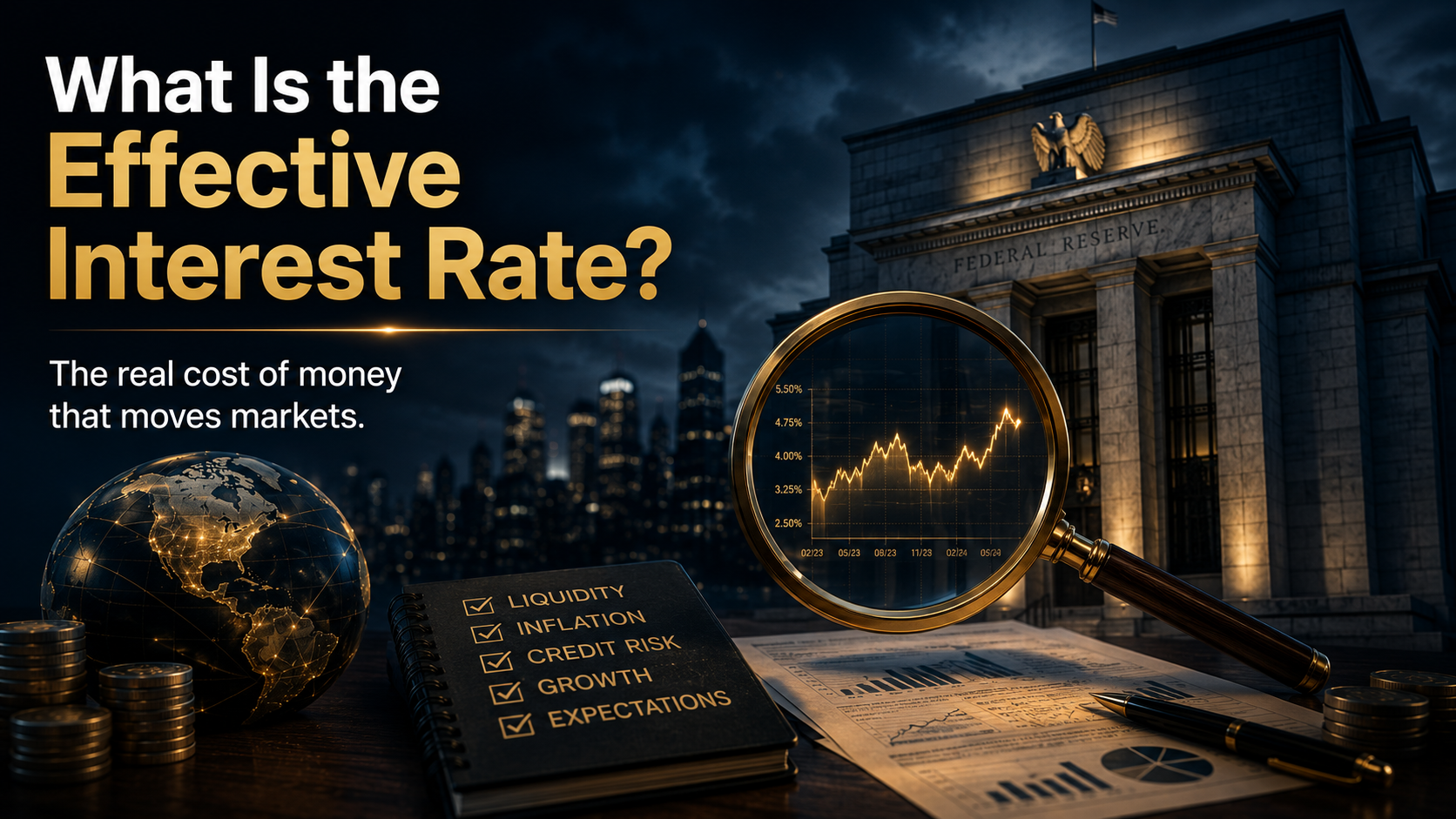
The Effective Interest Rate represents the actual cost of money in financial markets, making it one of the most important indicators of liquidity, credit conditions, and asset pricing.
What Is the Effective Interest Rate?
The Effective Interest Rate (EIR) refers to the actual interest rate applied in real financial transactions after accounting for market conditions, funding costs, pricing mechanisms, and other relevant factors.
Unlike a headline policy rate announced by a central bank, the Effective Interest Rate reflects the price participants truly pay—or receive—when money changes hands.
Think of it this way
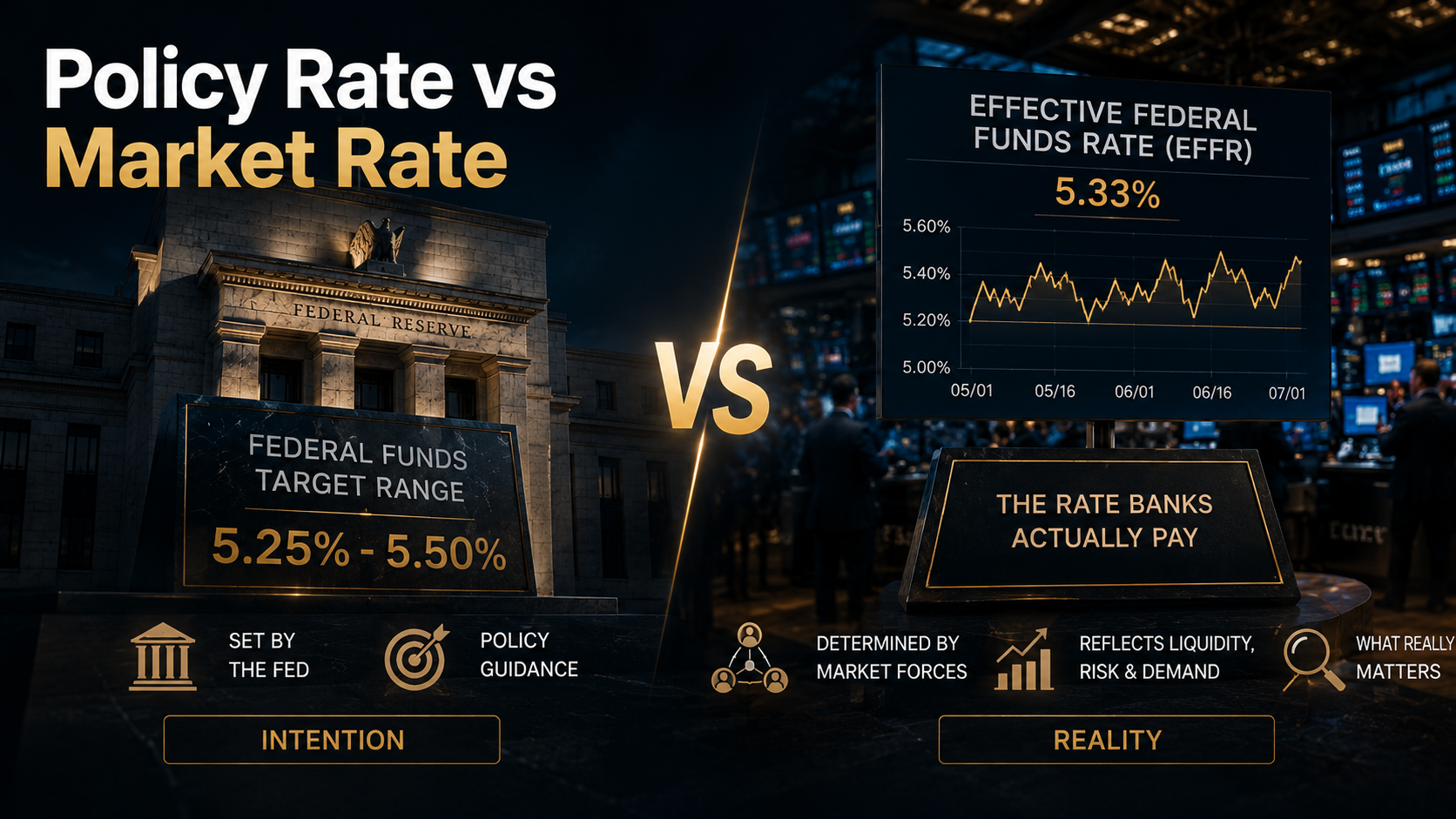
- The Federal Funds Rate is the Fed's policy signal.
- The Effective Interest Rate is the market's response.
This distinction explains why financial markets sometimes tighten even when the Federal Reserve has not raised interest rates, or why borrowing conditions improve before the first official rate cut.
In other words, policy sets the direction, but markets determine the final price.
Two Meanings Investors Should Know
Although "Effective Interest Rate" is used in several financial contexts, investors most commonly encounter it in two ways.
1. Effective Federal Funds Rate (EFFR)
For U.S. investors, the most important example is the Effective Federal Funds Rate (EFFR).
The Federal Reserve establishes a target range for overnight borrowing between banks. However, banks do not necessarily lend to one another at exactly the midpoint of that range.
Instead, thousands of overnight transactions occur every day, and the weighted average of those transactions becomes the Effective Federal Funds Rate.
The EFFR shows how monetary policy is functioning in the real world rather than simply reflecting what policymakers intend.
Because of this, economists and institutional investors closely monitor the EFFR to determine whether liquidity conditions are becoming tighter or looser.
2. The Real Borrowing or Investment Rate
The Effective Interest Rate also describes the actual borrowing cost faced by consumers and businesses.
For example, a mortgage advertised at 6.0% may include lender fees, discount points, or compounding structures that change the true financing cost.
Similarly, bond investors rarely focus only on a bond's coupon rate.
A Treasury or corporate bond purchased above or below its face value produces a different effective return than its stated coupon.
This is why experienced investors care less about the advertised rate and more about the return—or cost—they actually experience.
How Does the Effective Interest Rate Work?
Many new investors assume that when the Federal Reserve changes interest rates, every other interest rate in the economy immediately follows.
Reality is much more complex.
The Federal Reserve influences the direction of interest rates, but financial markets determine where money ultimately trades.
The process typically looks like this
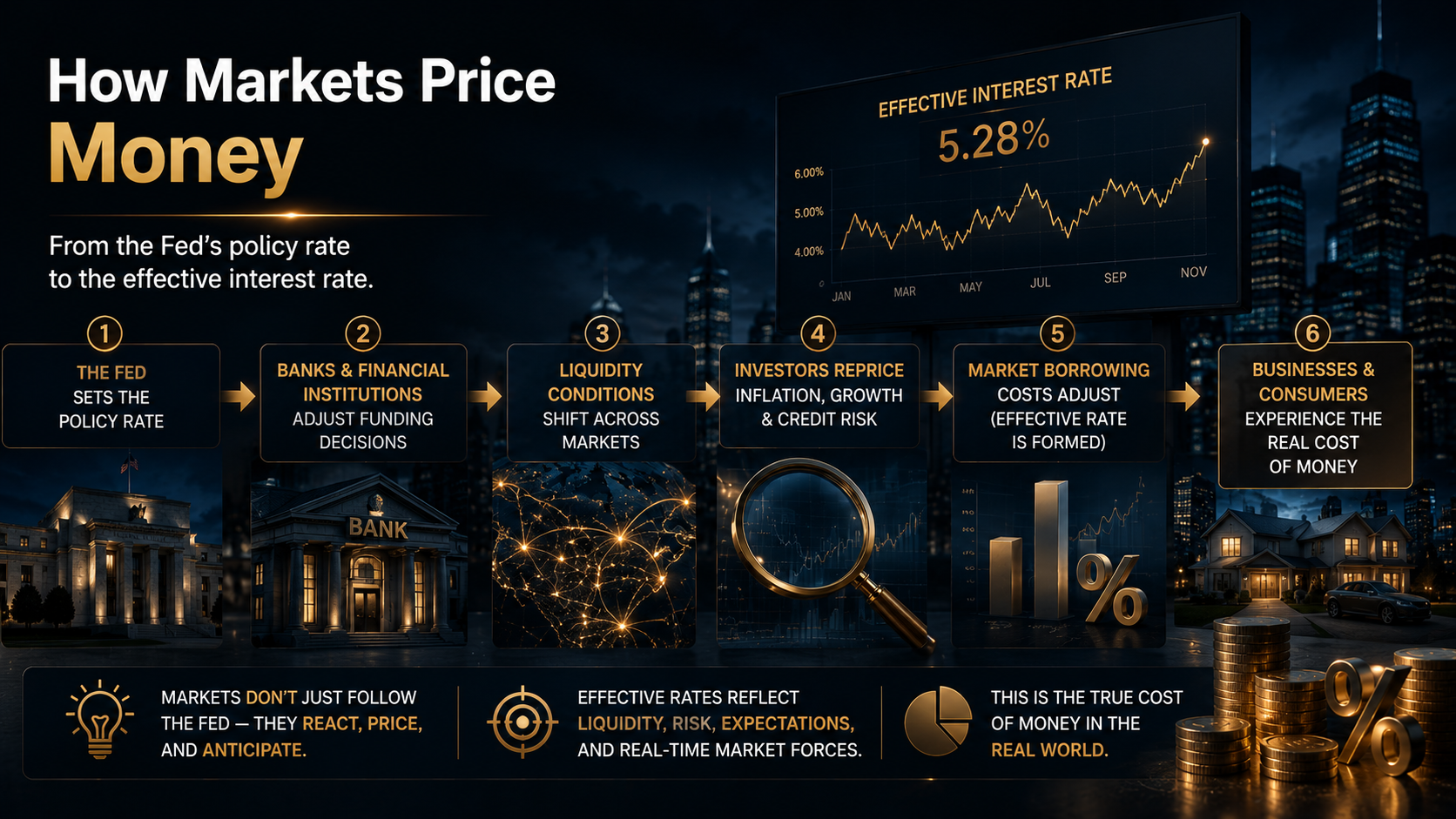
- The Federal Reserve announces monetary policy.
- Banks and financial institutions adjust funding decisions.
- Liquidity conditions shift across money markets.
- Investors reassess inflation expectations and credit risk.
- Market borrowing costs adjust.
- Businesses and consumers ultimately experience changes in financing costs.
This chain reaction explains why markets often move before economic data catches up.
What Determines the Effective Interest Rate?
Liquidity
Liquidity is one of the strongest drivers of effective rates.
When financial institutions have abundant cash, competition among lenders increases, often pushing borrowing costs lower.
When liquidity becomes scarce, even a stable policy rate may not prevent effective borrowing costs from rising.
This is why periods of financial stress often produce tighter credit conditions without an immediate change in Federal Reserve policy.
Credit Risk
Not every borrower represents the same level of risk.
When investors become concerned about corporate earnings, recession risks, or financial stability, lenders demand higher compensation for taking additional risk.
As a result, effective borrowing costs rise even if the policy rate remains unchanged.
This is clearly visible in widening credit spreads between U.S. Treasuries and corporate bonds.
Inflation Expectations
Markets always price the future—not the present.
If investors expect inflation to remain elevated, lenders generally demand higher returns to preserve purchasing power.
Conversely, if inflation is expected to cool significantly, market interest rates often decline before the Federal Reserve officially begins cutting rates.
This forward-looking behavior explains why Treasury yields frequently move months ahead of major policy decisions.
The MasterMind Perspective
One of the biggest mistakes investors make is confusing policy announcements with financial conditions.
Central banks communicate intentions.
Markets determine prices.
The Federal Funds Rate is like the destination entered into your GPS.
The Effective Interest Rate is the actual condition of the road you're driving on.
A smooth highway and an icy mountain pass may lead to the same destination—but the journey, the risks, and the outcome are completely different.
The same principle applies to investing.
Understanding where money actually flows is often far more valuable than simply following the latest Federal Reserve headline.
Why the Effective Interest Rate Matters to Investors
The Effective Interest Rate matters because it connects monetary policy to the real economy.
A change in the Federal Funds Rate does not affect asset prices in isolation. What matters is how that policy decision changes the actual cost of borrowing, the availability of credit, and the return investors can earn from safer assets.
When effective rates rise, capital becomes more expensive.
Businesses face higher financing costs. Consumers pay more for mortgages, auto loans, and credit cards. Investors demand higher returns before taking risk. Future corporate cash flows become less valuable when discounted at higher rates.
When effective rates fall, the opposite process can occur.
Borrowing becomes easier, financial conditions loosen, and investors become more willing to hold assets with longer-duration cash flows or greater risk.
This is why the Effective Interest Rate influences nearly every major asset class in the United States.
Effective Interest Rates and U.S. Stocks
Stocks are highly sensitive to changes in the cost of money.
A stock represents a claim on a company’s future earnings. To estimate what those future earnings are worth today, investors apply a discount rate.
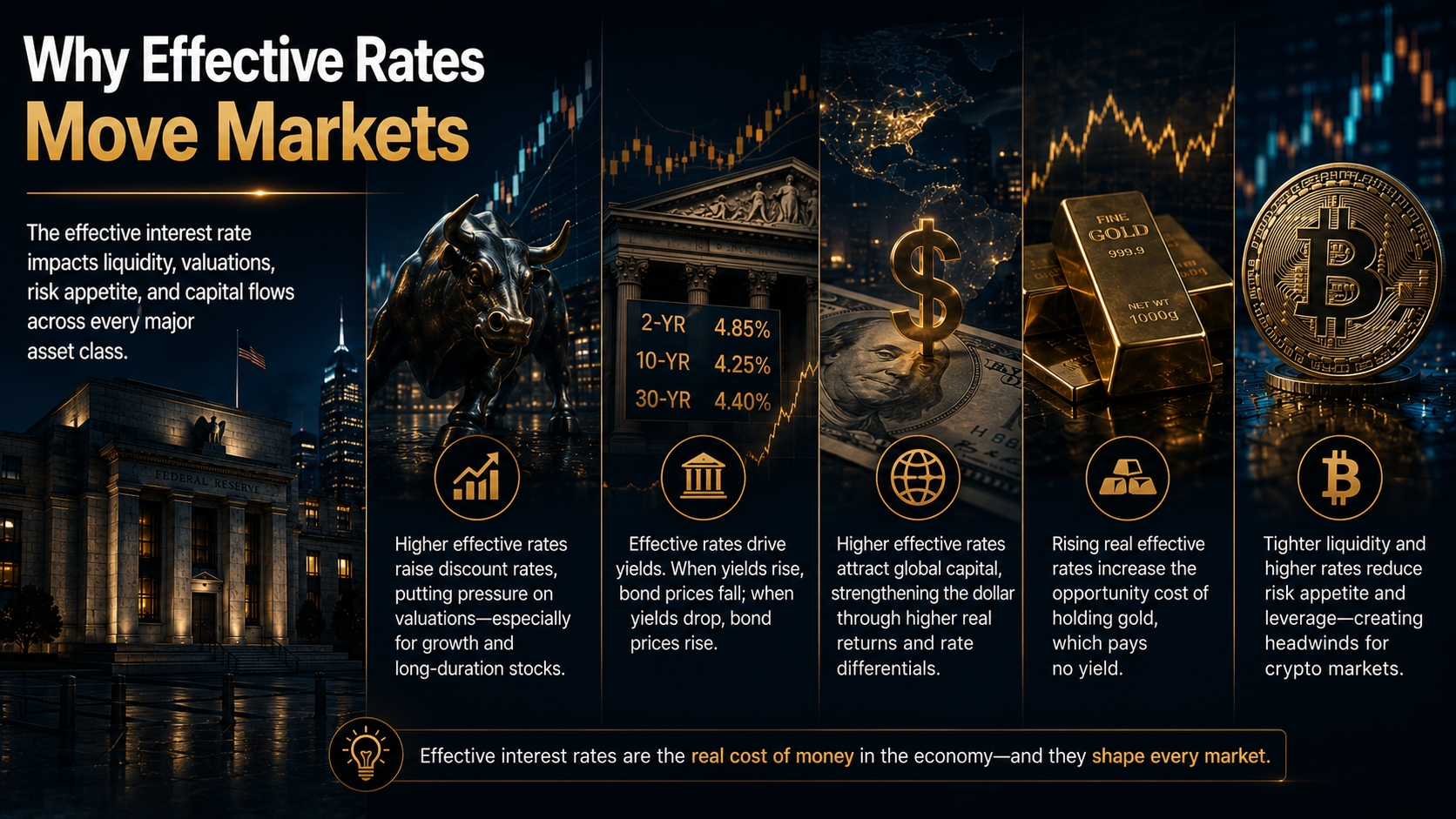
When effective interest rates rise, that discount rate usually rises as well.
As a result, the present value of future earnings falls.
This effect is especially important for growth companies whose valuations depend heavily on profits expected many years into the future. Technology stocks, early-stage companies, and other long-duration assets can therefore react sharply when market rates move higher.
However, interest rates do not affect every company in the same way.
Banks may benefit from wider lending margins under certain conditions. Insurance companies can earn more on newly invested premiums. Cash-rich businesses may receive higher interest income.
At the same time, heavily indebted companies may face higher refinancing costs and weaker profit margins.
The key question is not simply whether rates are rising or falling.
Investors should ask
Which companies can absorb a higher cost of capital, and which companies depend on cheap financing to survive?
Effective Interest Rates and U.S. Treasuries
The Treasury market is one of the clearest places to observe changing effective rates.
The Federal Reserve directly influences overnight rates, but Treasury yields reflect a much broader set of forces, including
- Expected future Fed policy
- Inflation expectations
- Economic growth forecasts
- Government borrowing needs
- Global demand for safe assets
- Term premiums
This is why the 10-year Treasury yield can rise even when the Fed leaves the Federal Funds Rate unchanged.
Bond prices and yields move in opposite directions.
When market yields rise, existing bonds with lower coupons become less attractive, causing their prices to fall. When yields decline, older bonds with relatively high coupons become more valuable.
Duration determines how sensitive a bond is to those changes.
Long-term Treasuries generally experience larger price movements than short-term Treasury bills when effective rates shift.
For bond investors, the headline policy rate is only the starting point. The yield curve provides a much richer picture of what markets expect from inflation, growth, and future monetary policy.
Effective Interest Rates and Corporate Bonds
Corporate borrowing costs depend on two major components
The risk-free interest rate plus a credit spread.
The risk-free component is usually linked to Treasury yields. The credit spread compensates investors for the possibility that a company may fail to repay its debt.
This means corporate effective rates can rise for two different reasons.
First, Treasury yields may increase because markets expect tighter monetary policy or persistent inflation.
Second, credit spreads may widen because investors become more concerned about recession risk, weaker earnings, or financial instability.
When both happen at the same time, corporate financing conditions can tighten dramatically.
This is often more important than the Federal Reserve’s official rate alone.
A company may hear that the Fed has stopped raising rates, yet still face higher borrowing costs because bond investors demand a larger risk premium.
For investors, widening credit spreads can serve as an early warning that financial stress is building beneath the surface of the stock market.
Effective Interest Rates and the U.S. Dollar
Higher effective interest rates can support the U.S. dollar because global investors are attracted to higher returns on dollar-denominated assets.
When U.S. Treasury yields rise relative to yields in other major economies, international capital may flow into the United States.
That demand can strengthen the dollar.
A stronger dollar has mixed consequences.
It can reduce the cost of imported goods and help ease inflationary pressure. However, it can also make U.S. exports more expensive and reduce the dollar value of overseas earnings generated by multinational companies.
For emerging markets, a stronger dollar can create additional stress because many governments and corporations borrow in U.S. dollars.
Therefore, investors should not view the dollar as an isolated currency trade.
It is often a reflection of global interest-rate differentials, capital flows, and demand for liquidity.
Effective Interest Rates and Gold
Gold does not produce interest, dividends, or cash flow.
Because of this, the opportunity cost of holding gold becomes more important when effective rates rise.
If investors can earn an attractive inflation-adjusted return from Treasury securities, holding a non-yielding asset such as gold may become less appealing.
This is why gold often faces pressure when real interest rates rise.
However, the relationship is not absolute.
Gold may still perform well during periods of geopolitical uncertainty, financial instability, currency concerns, or declining confidence in monetary policy.
The most useful variable is often not the nominal Federal Funds Rate but the real interest rate—the return investors receive after accounting for inflation expectations.
A high nominal rate does not necessarily create tight real conditions if inflation expectations are equally high.
Effective Interest Rates and Bitcoin
Bitcoin is frequently described as digital gold, but its market behavior has often resembled that of a high-volatility liquidity-sensitive asset.
When effective rates rise, investors can earn more from cash, Treasury bills, and other low-risk instruments.
The opportunity cost of holding speculative or non-yielding assets increases.
At the same time, tighter liquidity can reduce leverage and risk appetite across crypto markets.
When effective rates fall and financial conditions loosen, investors may become more willing to move into higher-risk assets.
However, Bitcoin is also influenced by factors beyond interest rates, including regulation, institutional adoption, market structure, supply dynamics, and investor sentiment.
The relationship is therefore indirect.
Effective rates do not mechanically determine Bitcoin’s price, but they strongly influence the liquidity environment in which Bitcoin trades.
Nominal Rates and Real Interest Rates
Investors should distinguish between nominal interest rates and real interest rates.
The nominal rate is the rate visible in the market.
The real rate adjusts that return for expected inflation.
A simplified relationship is
Real Interest Rate ≈ Nominal Interest Rate − Expected Inflation
Suppose a Treasury security yields 5%, while investors expect inflation of 3%.
The approximate real return is 2%.
If the nominal yield remains at 5% but inflation expectations rise to 4.5%, the real return falls to approximately 0.5%.
This distinction matters because real rates influence purchasing power, asset allocation, and the relative appeal of non-yielding assets.
Financial conditions may not be as tight as the nominal rate suggests when inflation expectations remain elevated.
Conversely, falling inflation can increase real rates even when nominal yields barely move.
The Yield Curve as a Market Signal
The U.S. Treasury yield curve compares interest rates across different maturities.
Under normal conditions, long-term yields are usually higher than short-term yields because investors demand compensation for time, inflation uncertainty, and duration risk.
However, the curve can flatten or invert when markets expect economic growth and inflation to weaken.
An inverted yield curve occurs when short-term yields rise above long-term yields.
This often reflects a combination of tight current monetary policy and expectations that the Federal Reserve may eventually need to cut rates.
Investors should avoid treating the yield curve as a precise market-timing tool.
Its value lies in showing how expectations are distributed across time.
Short-term rates reveal current monetary conditions.
Long-term rates reveal the market’s expectations for future growth, inflation, and policy.
What Should Investors Monitor?
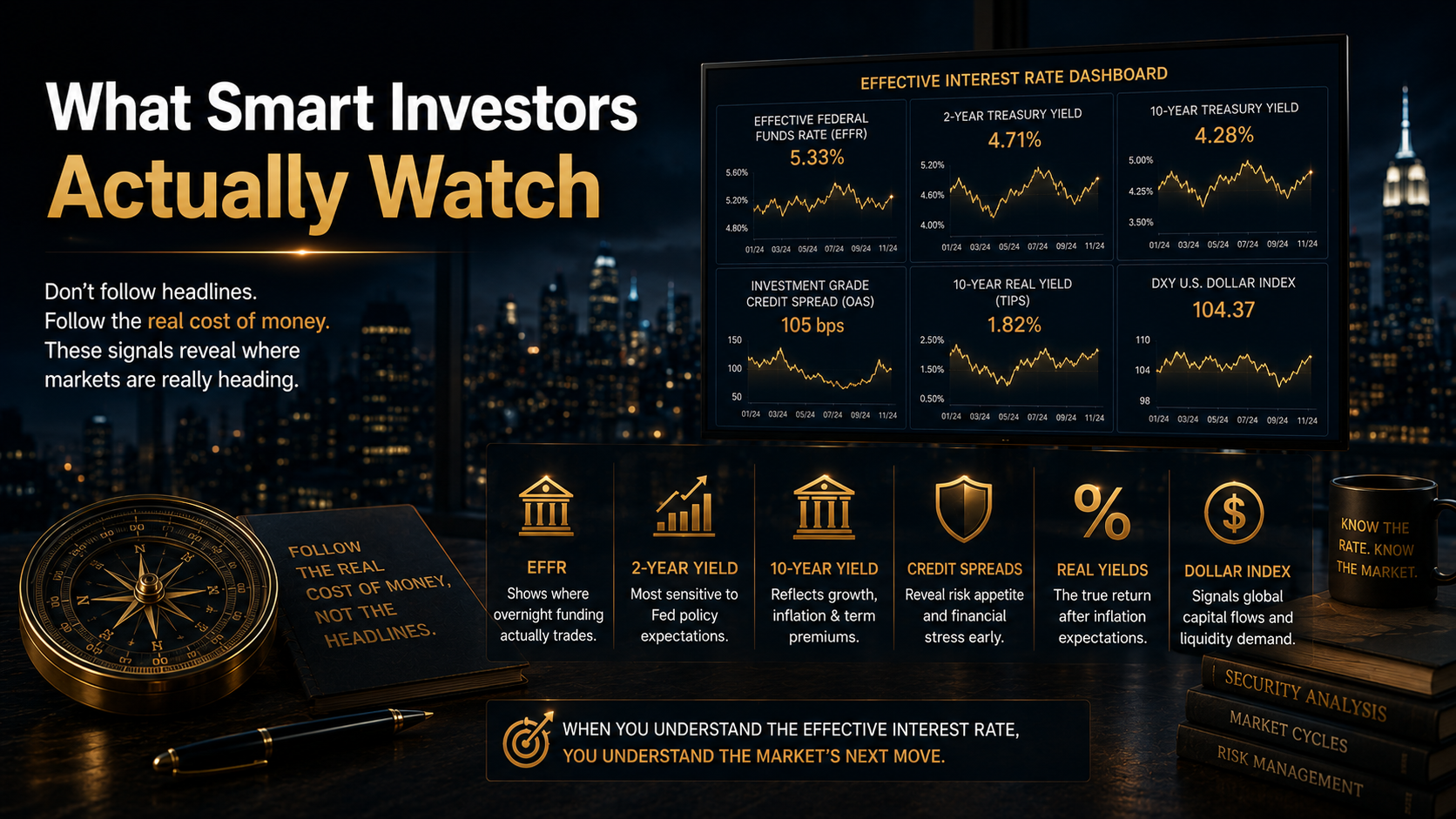
Investors do not need to track every interest-rate indicator each day.
A small group of variables provides a useful picture of U.S. financial conditions.
1. Effective Federal Funds Rate
The EFFR shows where overnight bank funding is actually trading.
It helps investors determine whether the Federal Reserve is maintaining control over short-term money markets and whether its policy is being transmitted as intended.
2. Two-Year Treasury Yield
The two-year yield is highly sensitive to expectations for Federal Reserve policy.
When it moves sharply, markets are often repricing the expected path of interest rates over the next several years.
3. Ten-Year Treasury Yield
The 10-year yield reflects a mix of growth expectations, inflation expectations, and term premium.
It plays an important role in mortgage rates, equity valuations, and broader financial conditions.
4. Credit Spreads
Credit spreads show how much additional yield corporate borrowers must pay compared with U.S. Treasuries.
Widening spreads suggest growing concern about default risk, weaker profits, or financial stress.
5. Real Yields
Real yields help investors evaluate the true inflation-adjusted return available from safe assets.
They are particularly relevant when analyzing gold, growth stocks, and other long-duration assets.
6. Lending Standards
Interest rates reveal the price of credit, but lending standards reveal whether credit is available at all.
Banks may tighten approval requirements even without raising advertised loan rates.
For households and smaller businesses, restricted access to credit can be just as important as the interest rate itself.
What Sophisticated Investors Understand
Sophisticated investors do not react only to the latest Federal Reserve decision.
They examine whether financial conditions are actually becoming tighter or looser.
A central bank can pause rate hikes while Treasury yields, mortgage rates, and corporate borrowing costs continue to rise.
It can also keep rates unchanged while falling bond yields and narrowing credit spreads make financing conditions easier.
This creates an important distinction
Monetary policy is what the Federal Reserve announces. Financial conditions are what markets and borrowers experience.
Professional investors therefore watch the interaction among policy rates, Treasury yields, credit spreads, liquidity, and the dollar.
No single indicator tells the entire story.
The goal is to identify whether the overall price and availability of money are supporting or restricting economic activity.
Common Misunderstandings About Effective Interest Rates
“The Fed Cut Rates, So All Borrowing Costs Must Fall”
Not necessarily.
Mortgage rates are influenced by longer-term Treasury yields, inflation expectations, mortgage-backed securities, and lender margins.
Corporate rates also depend on credit risk.
The Fed can cut short-term rates while some borrowing costs remain elevated.
“A High Interest Rate Is Always Bad for Stocks”
Higher rates create valuation pressure, but the broader context matters.
Rates may rise because economic growth is stronger than expected. In that environment, corporate earnings may offset some valuation pressure.
The most damaging combination is often rising effective rates together with falling growth expectations.
“Falling Rates Are Always Bullish”
Falling rates can support valuations, but they may also signal recession fears or financial stress.
Investors should ask why rates are falling rather than assuming that lower yields are automatically positive.
“The Policy Rate Controls Every Market Rate”
The Fed has significant influence over short-term rates, but longer-term yields and private borrowing costs are shaped by market expectations and risk premiums.
The monetary system is a network, not a single switch.
Practical Framework for Investors
When evaluating the interest-rate environment, investors can use a simple sequence.
First, identify the Federal Reserve’s current policy stance.
Second, examine whether short-term Treasury yields agree with that stance.
Third, review long-term yields to understand market expectations for growth and inflation.
Fourth, check credit spreads to determine whether private financing conditions are becoming more stressful.
Fifth, compare nominal yields with inflation expectations to estimate real rates.
Finally, observe how major asset classes are responding.
This framework helps separate policy headlines from actual market conditions.
It also reduces the risk of making investment decisions based on one rate or one Federal Reserve speech.
Final Thoughts
The most important interest rate is not always the one announced at a press conference.
What matters is the rate that households, businesses, banks, and investors actually experience.
The Effective Interest Rate reveals the real price of money after market expectations, liquidity, inflation, and credit risk have been incorporated.
When effective rates rise, capital becomes more expensive, valuation pressure increases, and weaker borrowers become more vulnerable.
When effective rates fall, liquidity can improve, financing becomes easier, and demand for risk assets may recover.
But the direction of rates alone is not enough.
Investors must understand why rates are changing, which part of the yield curve is moving, and whether credit conditions confirm the signal.
The Federal Reserve may set the framework, but markets determine how that framework reaches the economy.
Investors who understand this distinction can interpret monetary policy with greater clarity and recognize changes in financial conditions before they become obvious in corporate earnings or economic data.
This was MasterMind—designing success through deeper understanding.
'[Global] Success Blueprints' 카테고리의 다른 글