What Is Reverse Repo (RRP)? How the Fed Uses It to Control Liquidity and Interest Rates


Hello, this is MasterMind.
When the Federal Reserve changes interest rates, investors usually focus on the Fed Funds Rate, inflation data, or economic growth.
But behind these headline indicators is a less visible mechanism that plays a critical role in the U.S. financial system.
That mechanism is Reverse Repurchase Agreements, commonly known as Reverse Repo or RRP.
Most retail investors rarely hear about RRP, yet money market funds, banks, and institutional investors closely monitor it because it reveals where excess cash is sitting inside the financial system.
After the massive liquidity injections during the COVID-19 period, the Federal Reserve faced a new challenge
Where does all the excess cash go, and how does the Fed prevent short-term interest rates from falling too far?
Reverse repo became one of the key tools used to manage that liquidity.
Understanding RRP is not about predicting the stock market from one indicator.
It is about understanding a deeper question
Where is money flowing, and what does that mean for financial markets?
Key Takeaway
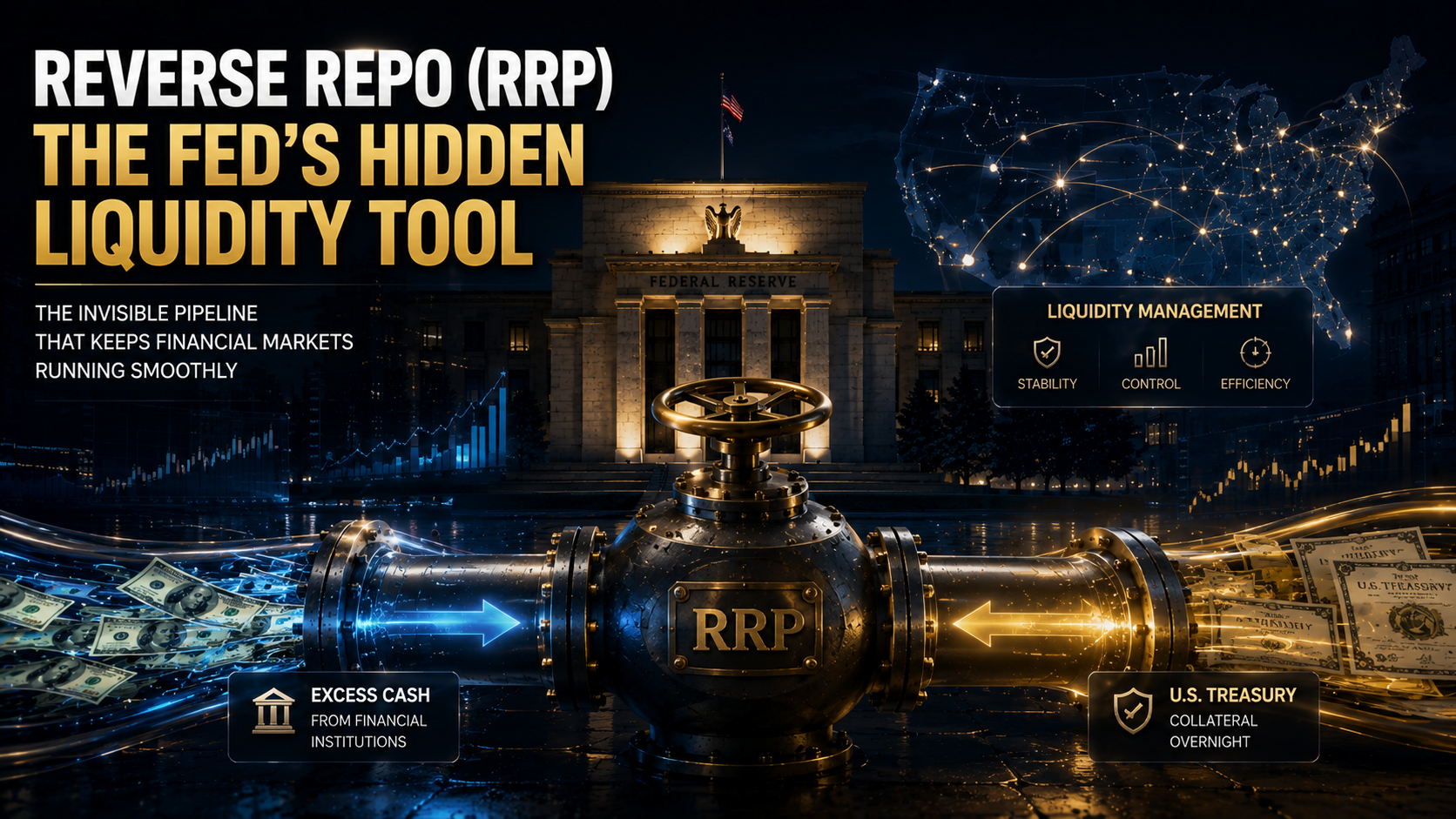
Reverse Repo (RRP) is a Federal Reserve liquidity management tool that absorbs excess cash from financial institutions while helping control short-term interest rates. Its balance provides insight into the location and movement of liquidity across markets.
What Is Reverse Repo (RRP)?
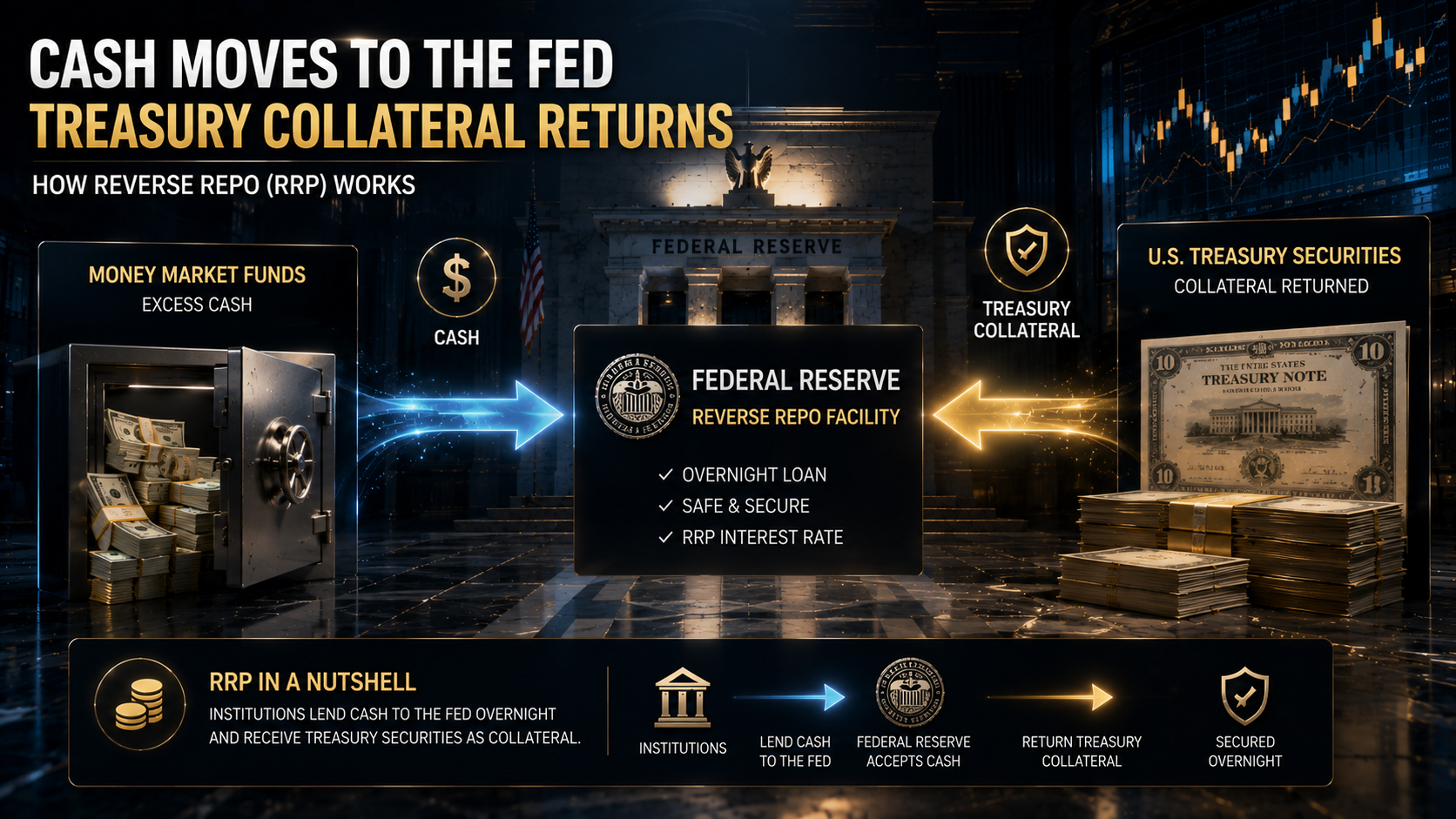
A Reverse Repurchase Agreement (RRP) is a transaction where financial institutions lend cash to the Federal Reserve overnight and receive U.S. Treasury securities as collateral.
Simply put
Money market funds and other institutions temporarily park excess cash at the Fed and earn interest.
The structure is similar to a short-term deposit, but instead of individuals depositing money at commercial banks, large financial institutions place funds directly with the Federal Reserve.
Reverse Repo Structure
Financial institutions
- Provide cash to the Federal Reserve
- Receive Treasury securities as collateral
- Earn the overnight reverse repo rate
The next day, the transaction is reversed.
The Fed returns the cash, and the institutions return the Treasury collateral.
Why Is It Called "Reverse" Repo?
A traditional repo transaction works in the opposite direction.
Repo
Financial institutions
- Provide Treasury securities
- Receive cash
Purpose
- Obtain short-term funding
Reverse Repo
Financial institutions
- Provide cash
- Receive Treasury collateral
Purpose
- Remove excess liquidity from the system
From the Fed's perspective, reverse repo is a way to temporarily take cash out of financial markets.
How Does Reverse Repo Work?
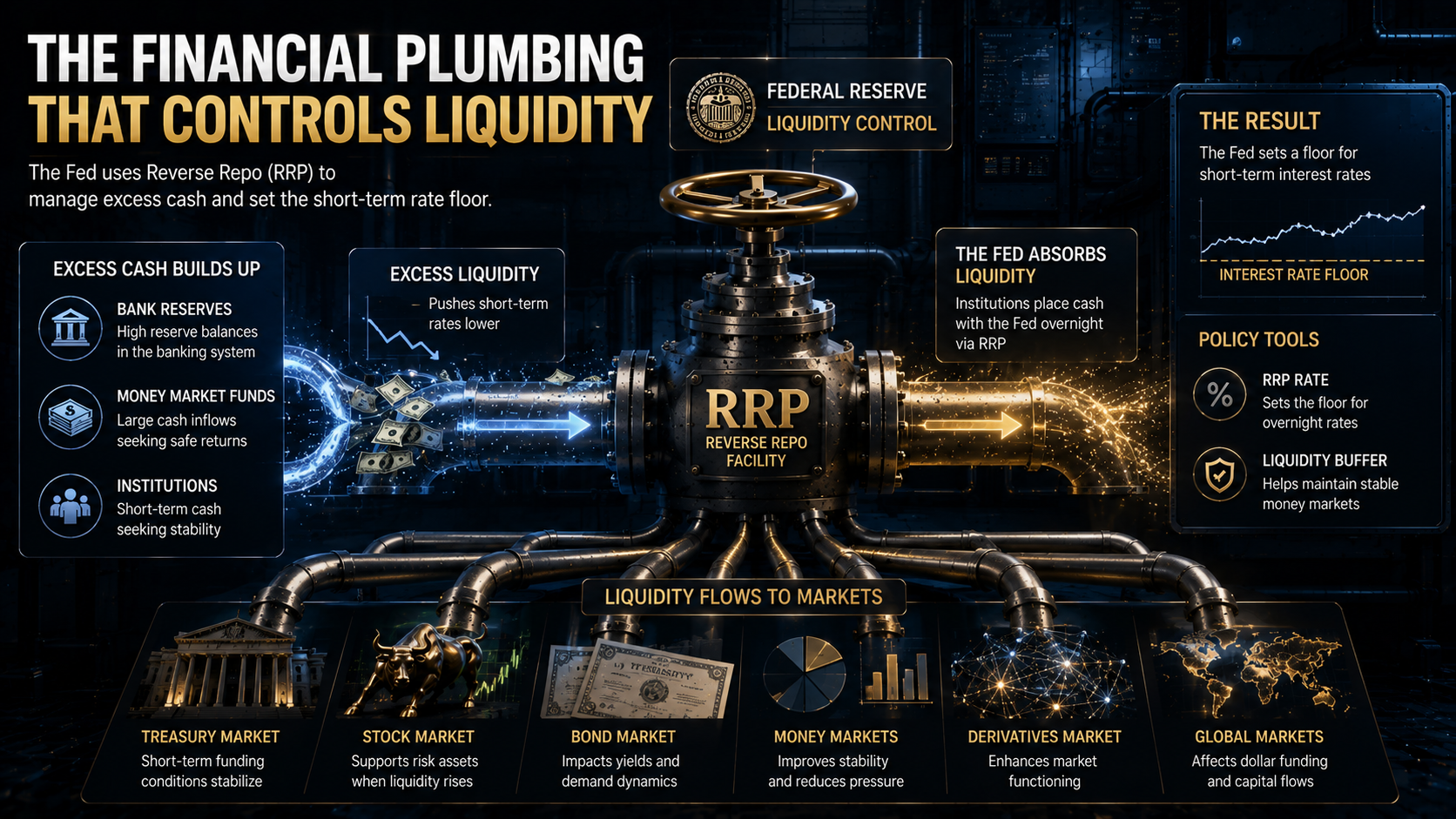
The U.S. financial system can be compared to a massive plumbing network.
Liquidity constantly moves through different channels
- Banks
- Money market funds
- Treasury markets
- Stock markets
- Bond markets
When too much cash accumulates in short-term markets, the Fed uses reverse repo operations to absorb some of that liquidity.
The process works like this
1. Excess Cash Builds Up
After periods of aggressive monetary easing
- Banks hold more reserves
- Money market funds receive large cash inflows
- Short-term interest rates face downward pressure
Too much cash chasing limited short-term investments can push rates lower.
2. The Fed Absorbs Liquidity Through RRP
The Federal Reserve offers an overnight reverse repo facility.
Financial institutions can choose
- Invest cash in the market
- Or place cash with the Fed at the RRP rate
Because the Fed provides a safe return, the RRP rate helps establish a floor for short-term interest rates.
Why Does Reverse Repo Matter?
1. RRP Shows Where Liquidity Is Located
Many investors focus on how much liquidity exists.
However, the more important question is
Where is that liquidity currently sitting?
The same amount of money can have very different effects depending on its location.
For example
- Cash parked at the Fed
- Cash inside the banking system
- Cash flowing into equities
can create completely different market outcomes.
Reverse Repo and Quantitative Tightening (QT)
One of the most important relationships is between RRP and the Federal Reserve's balance sheet reduction program.
During quantitative tightening (QT), the Fed reduces its holdings of Treasury securities and mortgage-backed securities.
The key question is
Which source of liquidity is being reduced first?
Initially
Fed balance sheet reduction
↓
Reverse repo balances decline
↓
Market impact is partially absorbed
The RRP facility acts as a liquidity buffer.
However, once excess liquidity from RRP is depleted, further tightening may begin affecting bank reserves more directly.
This is why investors watch RRP trends during QT cycles.
How Reverse Repo Impacts Financial Markets

Reverse repo does not directly determine asset prices.
Instead, it influences the broader liquidity environment.
| Asset | When RRP Declines | When RRP Increases |
| Stocks | Liquidity may move back into markets | Liquidity conditions may tighten |
| Bonds | Short-term funding conditions may stabilize | Money market volatility may rise |
| U.S. Dollar | Risk appetite may weaken dollar demand | Defensive demand may support dollar |
| Gold & Bitcoin | More liquidity may support risk assets | Liquidity tightening may pressure prices |
The important point
RRP is not a buy or sell signal. It is a window into financial system liquidity.
What Investors Should Watch
1. The Trend Matters More Than the Number
A single day's RRP balance is less important than the overall direction.
Investors should monitor
- Is RRP steadily declining?
- Is liquidity moving into markets?
- Is QT reducing excess liquidity?
- Are other funding markets showing stress?
2. RRP Decline Does Not Always Mean Bullish Liquidity
A falling RRP balance means cash is leaving the facility.
But that money does not automatically flow into stocks.
It may move into
- Treasury bills
- Other short-term investments
- Government funding markets
Understanding the destination of liquidity is more important than simply seeing the decline.
What Do Wealthy Investors Look At?

Professional investors do not watch RRP because they want to predict tomorrow's stock price.
They watch it because it reveals the movement of capital.
Money Flow
The key question
Is money sitting safely at the Federal Reserve, or is it moving into risk assets?
Capital rotates through different stages
Cash
→ Treasury securities
→ Corporate bonds
→ Equities
→ Higher-risk assets
Understanding this cycle helps investors recognize changing market conditions.
Cash Flow
Institutional investors also consider
- Corporate cash generation
- Debt sustainability
- Financing costs
- Interest rate sensitivity
Liquidity can lift markets, but long-term survival depends on financial strength.
Asset Survival
During periods of abundant liquidity, many assets can rise.
But when liquidity conditions tighten, differences become clearer.
Investors begin focusing on
- Strong balance sheets
- Sustainable earnings
- Competitive advantages
Long-Term Investment Perspective
Markets move through liquidity cycles.
The goal is not to predict every move from one indicator.
The goal is understanding the environment and owning assets that can survive different conditions.
Ask yourself
- Where is liquidity currently flowing?
- Is my investment dependent only on easy financial conditions?
- Can the asset survive when liquidity becomes tighter?
Final Thoughts
Reverse Repo (RRP) may seem like a complicated Federal Reserve tool, but its core concept is simple.
It shows where excess cash is stored inside the financial system and how the Fed manages short-term liquidity conditions.
Financial markets are ultimately driven by the movement of capital.
Prices are the result.
Liquidity flows are the cause.
Understanding RRP means understanding one of the hidden mechanisms behind modern financial markets.
The key message to remember
Reverse Repo does not tell investors where prices will go. It reveals where money is positioned and how liquidity is moving through the system.
MasterMind.
'[Global] Success Blueprints' 카테고리의 다른 글