What Is Par Value? How It Differs from Stock Price and Market Value


Hello, this is MasterMind.
If you've ever looked up a U.S. stock, you've probably noticed that companies can trade at hundreds of dollars per share—even though their par value may be just a few cents or even no par value at all.
So what exactly is par value, and why does it seem completely disconnected from the stock price?
Many new investors assume that par value reflects what a share is worth. In reality, it is mostly a legal and accounting concept, while the market price reflects what investors believe a business is worth today and in the future.
Understanding the difference between these two numbers is essential if you want to evaluate companies based on fundamentals instead of appearances.

Key Takeaway
Par value is a legal reference amount assigned to a share when it is issued, while a stock's market price reflects the company's earnings power, growth prospects, and investor expectations.
What Is Par Value?
Par value (also called face value) is the nominal value assigned to a share when a corporation issues stock.
Historically, par value represented the minimum legal price at which shares could be sold. Today, however, it has very little economic significance for investors.
In the United States, many corporations even issue no-par stock, meaning the shares have no stated face value at all.
This is one of the biggest differences between the U.S. market and many international markets, where par value is still more commonly referenced.
Simply put
- Par Value: A legal and accounting figure established by the company.
- Market Price: The price investors are willing to pay in the stock market.
These two numbers usually have little relationship to one another.
Par Value vs. Market Price

Suppose a company originally assigns a par value of $0.01 per share.
Years later, after decades of growing revenue, profits, and cash flow, the stock may trade at $300 per share.
Did the par value change?
No.
The business became more valuable, so investors were willing to pay more for ownership.
The market prices future earnings—not the historical accounting value printed on the stock certificate.
This is why focusing on par value when evaluating a stock can be misleading.
How Companies Build Value
Once a company begins operating, its value changes based on business performance.
If management consistently increases revenue, expands profit margins, and generates free cash flow, investors assign a higher valuation to the company.
As demand for the stock increases, the share price rises.
Par value, however, usually remains exactly the same.
Over time, the gap between par value and market price can become enormous.
Think about companies like Apple, Microsoft, or NVIDIA.
Their market value reflects decades of innovation, profitability, and investor confidence—not the tiny nominal value assigned to each share when they were issued.
Stock Splits: Why More Shares Don't Mean More Value

One concept often confused with par value is a stock split.
During a stock split
- The number of shares increases.
- The price per share decreases proportionally.
- The company's total market capitalization remains unchanged.
Imagine slicing the same pizza into eight pieces instead of four.
You now have more slices, but you don't have more pizza.
The same principle applies to stock splits.
A 10-for-1 split doesn't make shareholders richer overnight.
It simply changes how ownership is divided.
Companies often split their stock to make shares appear more affordable and improve trading liquidity, but the underlying business value does not change.
Why Investors Should Understand Par Value
Although par value has little influence on day-to-day investing, understanding it helps investors avoid several common mistakes.
1. Don't Judge a Company by Its Share Price
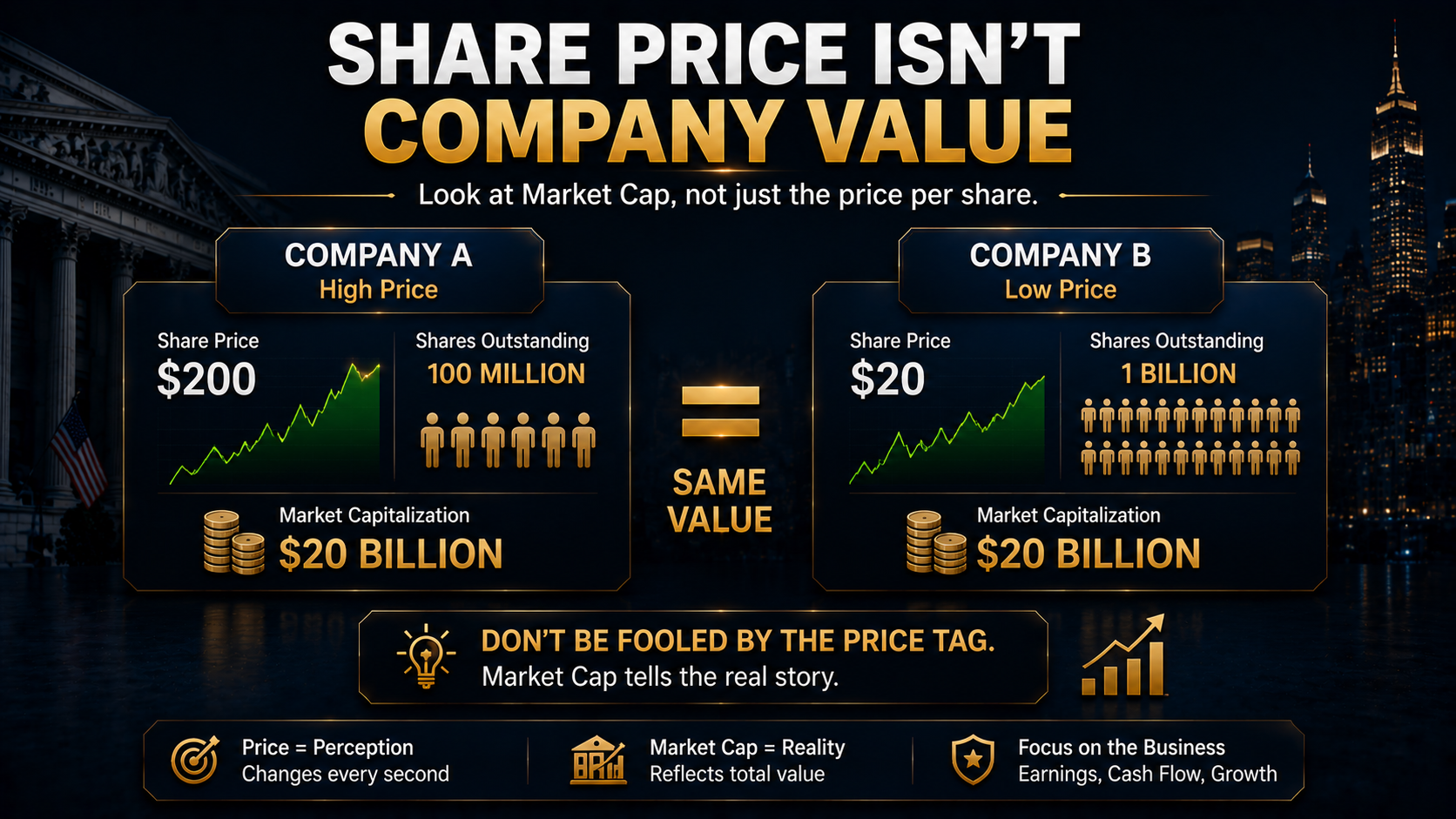
A $500 stock is not necessarily "more expensive" than a $20 stock.
Without knowing the number of shares outstanding, comparing stock prices alone is meaningless.
The better metric is market capitalization.
2. Market Capitalization Tells the Bigger Story
Market capitalization measures the total market value of a company.
Market Capitalization = Share Price × Shares Outstanding
For example
- Company A: $200 per share × 100 million shares = $20 billion
- Company B: $20 per share × 1 billion shares = $20 billion
Despite the huge difference in share price, both companies are worth exactly the same in the eyes of the market.
This is why experienced investors focus on enterprise value, market capitalization, earnings, and cash flow—not just the price of one share.
3. Understand No-Par Stock
Many U.S. corporations issue no-par stock.
In these cases, there is no stated face value because modern corporate finance no longer depends on par value to represent shareholder value.
For most investors, whether a company has par value or no-par stock makes little difference.
What matters is the quality of the underlying business.
How Par Value Affects Financial Markets
| Asset | Impact |
| Stocks | Minimal direct impact. Stock splits may improve liquidity and investor participation, but long-term returns depend on business performance. |
| Bonds | Much more important. Bond par value determines principal repayment at maturity and coupon interest calculations. |
| U.S. Dollar | No meaningful direct impact. |
| Gold | No direct relationship. |
| Bitcoin | No direct relationship. |
One important distinction is that par value plays a central role in bonds, where investors receive the bond's face value at maturity.
In stocks, however, par value is largely an administrative figure rather than an investment metric.
What Investors Should Remember
Before making an investment decision, keep these principles in mind
- Par value does not determine a stock's true worth.
- Share price alone does not measure company value.
- Market capitalization provides a much more accurate picture.
- Stock splits change the number of shares—not the intrinsic value of the business.
- Long-term returns are driven by earnings growth and cash flow, not accounting labels.
What Do Professional Investors Focus On?

Institutional investors and long-term wealth builders rarely spend time thinking about par value.
Instead, they ask questions such as
- Is the company generating consistent free cash flow?
- Does it have a durable competitive advantage?
- Can management continue increasing shareholder value over the next decade?
- Is capital flowing into this business because of improving fundamentals or temporary market excitement?
Markets are driven by capital allocation.
Money flows toward businesses capable of producing sustainable cash flow, strong returns on invested capital, and long-term growth.
Successful investing isn't about predicting tomorrow's price movement.
It's about owning businesses that can continue creating value through changing economic cycles.
Before buying any stock, ask yourself
Am I investing because the business is becoming more valuable—or simply because the stock price is moving higher?
That single question often separates investing from speculation.
Final Thoughts
Par value is an important legal concept, but it is rarely an important investment metric.
For modern investors, understanding how businesses create value is far more useful than memorizing the nominal value assigned to a share decades ago.
Instead of focusing on accounting labels, pay attention to revenue growth, profitability, competitive advantages, free cash flow, and capital allocation.
The market ultimately rewards businesses that create lasting economic value—not those with a particular par value.
Remember, successful investing is less about predicting the future and more about owning businesses that can survive, adapt, and compound over time.
This was MasterMind.
'[Global] Success Blueprints' 카테고리의 다른 글